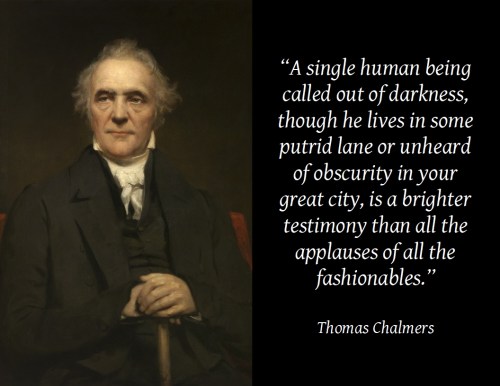
Image. Gordon, Sir John Watson. Thomas Chalmers, 1780 – 1847. Preacher and Social Reformer. About 1838. Scottish National Print Gallery, Edinburgh. Accessed December 19, 2019. [URL]
Image. Gordon, Sir John Watson. Thomas Chalmers, 1780 – 1847. Preacher and Social Reformer. About 1838. Scottish National Print Gallery, Edinburgh. Accessed December 19, 2019. [URL]
Posted in Benevolence & the Diaconate, Light of Eternity, Missiology, Thomas Chalmers, Vox Patrum | Leave a Comment »
Just finished a new addition to the Chalmers Audio Library, “The Right Ecclesiastical Economy of a Large Town.” (Original here.) While it is somewhat ponderous in its Victorian style and treats some antiquated matters, the core of this piece is a profoundly relevant contribution to historic, Reformed missiology. If only every Reformed and Presbyterian office-bearer would read it and process it!
Here is a little extract to give an idea of his parochial approach:
“If he go much among them through the week, the unfailing result in time will be, that they shall come much about him on the Sabbath. This is the ligament, and we know not a more important one in the whole mechanism of human society, by which to elevate a degenerate population, and again to place them on that higher moral platform from which they have descended. There is no romance, there is a sober and home-bred reality in all the steps of this operation. On the very first movements of the clergyman, he will meet with the smiles of encouragement and welcome from every quarter of his parish, with a thousand promises of attendance on his church, many of which in the first instance will not be realized; but, with every month of perseverance in the assiduities of his office, he will find a lessening reluctance on the part of his people, and that even the obstinacy of their practical heathenism is not unconquerable. It will at length give way under the power of his sustained and duteous attentions. Providence will open a door for him, even to the most ruthless of the families; and, implicating his presence with the sicknesses, and the deaths, and the funerals of every household, he will, on the sheer efficacy of his Christian worth, and with no other engine by which to make his way than Christian kindness, obtain an ascendant over the hearts of his people, only to be won by the omnipotence of charity” (Chalmers, Works 18:73-74).
For any who wants a simpler, more accessible introduction to Chalmers’ thought, you can listen to this lecture.
Posted in Missiology, Parish Theory & Practice, Parochial Strategy, Pastoral Theology, The Romance of Locality, Theology of Place, Thomas Chalmers | Leave a Comment »
[NOTE: The diagram below has since been expanded and reposted here on March 10, 2022.]
Here is something I designed for our catechism class to help young and old track with the main contours of Covenant Theology and its bearing on redemptive history. Comments below.
![S Cat 020 The Covenants [CCat]](https://westportexperiment.com/wp-content/uploads/2019/12/s-cat-020-the-covenants-ccat.jpg?w=500)
Much of this is self-explanatory for those with a working knowledge of Reformed doctrine. But a bit of clarification on my design. I added a dashed, horizontal line & arrow from Covenant of Works moving through the OT and NT dispensations to help reduce the impression that it is somehow a cipher after the Fall. I also configured the OT period to begin at Sinai (as technically it does), though canonically it usually embraces everything from Genesis to Malachi. Third, the dashed, vertical line above Sinai intersecting the horizontal lines of the Moral and Ceremonial law is intended to reflect the development and institutionalization of the latter and the explicit publication of the former. Last, the dashed and hard vertical lines at the cross represent the distinction between the definitive abolition of these laws at 33(-ish) A.D. and their actual, outward end with the destruction of the Temple and Jerusalem in 70 A.D.
I omitted the ‘biblical’ covenants (Noahic, Abrahamic, Davidic), leaving that for another day and another diagram.
And now you’ll need a chart to understand all that! Seriously, though, if you can help me perfect this further, I’m open. Just as long as you’re no Dispy, Hyper-Preterist, or any of the countless bunny trails from good old 1646 Federalism.
Posted in Articles, Biblical Interpretation, Catechesis, Covenant Theology, Theological Diagrams | 4 Comments »
 Yesterday I finished the last round through my parishes for the season. As the air gets chillier, my hands and ears get colder, so doorstep conversations turn less pleasant for all involved. For the winter, I turn to revisit folks who will likely have me in, reach out to other contacts outside the district, and resume and start up one-on-one Bible studies.
A few highlights from the last couple of outings. In my Warwick parish, I returned to a house where last year where I had a very interesting, long talk. But it wasn’t ‘John.’ Instead, ‘Jake’ answered the door with his 10 year old daughter, ‘Emily.’ I asked about John and found out that he had moved and was renting the place out to them. But clearly they were friends and had been cut out of the same cultural cloth. Jake was a skeptic, a self-styled pagan. Since I had recently finished a book that addressed the case for the resurrection, I made a brief case for it as well as the reliability of the NT. What a privilege it is to communicate the witness of those who witnessed glory. “We have not followed cunningly devised fables.” Emily was pretty precocious. Clearly, she had been religiously catechized. A rather outspoken atheist, Emily was a believer in ‘science.’ Heartbreaking. O Jesus, make them as Saul of Tarsus. Arrest them by your grace! Continue Reading »
Posted in Reformed Parish Mission (RPM) Posts, Uncategorized, WPE Editor | Leave a Comment »
* * * *
Music courtesy of Ernst Stolz, “Psalm 72 Genevan Psalter – setting by Claude Goudimel – viols & organ.” All images not my own are from the public domain (attributions here).
Posted in Ordinary Means Ministry, Parish in American Context, Parish Theory & Practice, Reformed Parish Mission (RPM) Posts | Leave a Comment »
 “The Bible rescues the cause [of benevolence] from the mischief to which a heedless or unthinking sensibility would expose it. It brings it under the cognizance of a higher faculty— a faculty of steadier operation than to be weary in well-doing, and of sturdier endurance than to give it up in disgust. It calls you to consider the poor. It makes the virtue of relieving them a matter of computation as well as of sentiment; and, in so doing, it puts you beyond the reach of the various delusions, by which you are at one time led to prefer the indulgence of pity to the substantial interest of its object; at another, are led to retire chagrined and disappointed from the scene of duty, because you have not met with the gratitude or the honesty that you laid your account with; at another, are led to expend all your anxieties upon the accommodation of time, and to overlook eternity It is the office of consideration to save you from all these fallacies.”
-Thomas Chalmers, Sermon on Psa. 41:1, “The Blessedness of Considering the Poor”
Posted in Benevolence & the Diaconate, Thomas Chalmers | Leave a Comment »
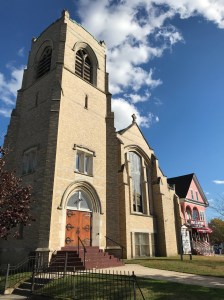 Last year we held our first evangelistic outreach meeting within walking distance of my S. Providence parish, right on Broad Street in Providence. Last Saturday evening we had our second. As before, we recruited Pr. Luis Morales to translate for me. We sang Psalm 1 in Spanish and English, and we read and preached from Matthew 21:1-11 on the Triumphal Entry.
In addition to many of our own folks, as well as the Morales family, several African contacts in the parish and the larger community came out. These are all professing Christians, but definitely not Reformed. While evangelism is my top concern, close behind is the pressing need to raise the profile of biblical, Reformational theology and worship within urban evangelicalism. Please pray that God may own these efforts as well.
Posted in Reformed Parish Mission (RPM) Posts, Uncategorized | Leave a Comment »
“The elements in the doctrine of God which above all others needed emphasis in Old Testament times were naturally His unity and His personality. The great thing to be taught the ancient people of God was that the God of all the earth is one person. Over against the varying idolatries about them, this was the truth of truths for which Israel was primarily to stand; and not until this great truth was ineffaceably stamped upon their souls could the personal distinctions in the Triune-God be safely made known to them. A premature revelation of the Spirit as a distinct hypostasis could have wrought nothing but harm to the people of God. We shall all no doubt agree with Kleinert that it is Continue Reading »
Posted in Theology Proper | Leave a Comment »
 Should robust, confessional, reformed Christianity be the preserve only of white, middle and upper class folk? Chalmers didn’t think so, much less that the Gospel should be left to the demands of the religious marketplace. Another appeal for establishments, and especially aggressive, territorial missions.
Another addition to the Chalmers Audio Library. Sermon on Isa. 26:9, “For when thy judgments are in the earth, the inhabitants of the world will learn righteousness.” In this message on the occasion of the death of Princess Charlotte of Wales, Chalmers argues that such national calamities are God’s instruments to call the nation to learn righteousness. He takes the opportunity to rebuke the fashionable upper classes for whom religion is a mere occasional, token exercise, and makes a general appeal to support the spread of righteousness among the nation’s poor and neglected by way of an endowed, territorial system, worked by godly ministers.
Posted in Chalmers Audio Library, Church of Scotland, Establishments, Gospel Proclamation, Locality & the Law of Residence, Missiology, Parish Theory & Practice, Patronage, The Gospel & the Poor, Thomas Chalmers | Leave a Comment »
Another addition to the ‘Chalmers Audio Library.’ A fascinating defense of religious establishments, arguing for them on the ground that they serve as a great, national Home Mission. In my opinion, he counters some of the standard objections well.
Posted in Chalmers Audio Library, Establishments, The Romance of Locality, The Sacred Ministry, Thomas Chalmers, Two Kingdoms Theology, Uncategorized | Leave a Comment »
 West Port Experiment