[NOTE: The diagram below has since been expanded and reposted here on March 10, 2022.]
Here is something I designed for our catechism class to help young and old track with the main contours of Covenant Theology and its bearing on redemptive history. Comments below.
![S Cat 020 The Covenants [CCat]](https://westportexperiment.com/wp-content/uploads/2019/12/s-cat-020-the-covenants-ccat.jpg?w=500)
Much of this is self-explanatory for those with a working knowledge of Reformed doctrine. But a bit of clarification on my design. I added a dashed, horizontal line & arrow from Covenant of Works moving through the OT and NT dispensations to help reduce the impression that it is somehow a cipher after the Fall. I also configured the OT period to begin at Sinai (as technically it does), though canonically it usually embraces everything from Genesis to Malachi. Third, the dashed, vertical line above Sinai intersecting the horizontal lines of the Moral and Ceremonial law is intended to reflect the development and institutionalization of the latter and the explicit publication of the former. Last, the dashed and hard vertical lines at the cross represent the distinction between the definitive abolition of these laws at 33(-ish) A.D. and their actual, outward end with the destruction of the Temple and Jerusalem in 70 A.D.
I omitted the ‘biblical’ covenants (Noahic, Abrahamic, Davidic), leaving that for another day and another diagram.
And now you’ll need a chart to understand all that! Seriously, though, if you can help me perfect this further, I’m open. Just as long as you’re no Dispy, Hyper-Preterist, or any of the countless bunny trails from good old 1646 Federalism.
 Yesterday I finished the last round through my parishes for the season. As the air gets chillier, my hands and ears get colder, so doorstep conversations turn less pleasant for all involved. For the winter, I turn to revisit folks who will likely have me in, reach out to other contacts outside the district, and resume and start up one-on-one Bible studies.
 “The Bible rescues the cause [of benevolence] from the mischief to which a heedless or unthinking sensibility would expose it. It brings it under the cognizance of a higher faculty— a faculty of steadier operation than to be weary in well-doing, and of sturdier endurance than to give it up in disgust. It calls you to consider the poor. It makes the virtue of relieving them a matter of computation as well as of sentiment; and, in so doing, it puts you beyond the reach of the various delusions, by which you are at one time led to prefer the indulgence of pity to the substantial interest of its object; at another, are led to retire chagrined and disappointed from the scene of duty, because you have not met with the gratitude or the honesty that you laid your account with; at another, are led to expend all your anxieties upon the accommodation of time, and to overlook eternity It is the office of consideration to save you from all these fallacies.”
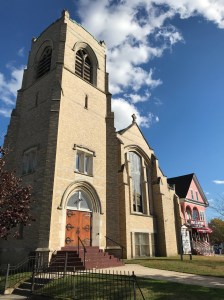 Last year we held our first evangelistic outreach meeting within walking distance of my S. Providence parish, right on Broad Street in Providence. Last Saturday evening we had our second. As before, we recruited Pr. Luis Morales to translate for me. We sang Psalm 1 in Spanish and English, and we read and preached from Matthew 21:1-11 on the Triumphal Entry.
 Should robust, confessional, reformed Christianity be the preserve only of white, middle and upper class folk? Chalmers didn’t think so, much less that the Gospel should be left to the demands of the religious marketplace. Another appeal for establishments, and especially aggressive, territorial missions.
 “A territorial division of the country in
 West Port Experiment