Feeds:
Posts
Comments

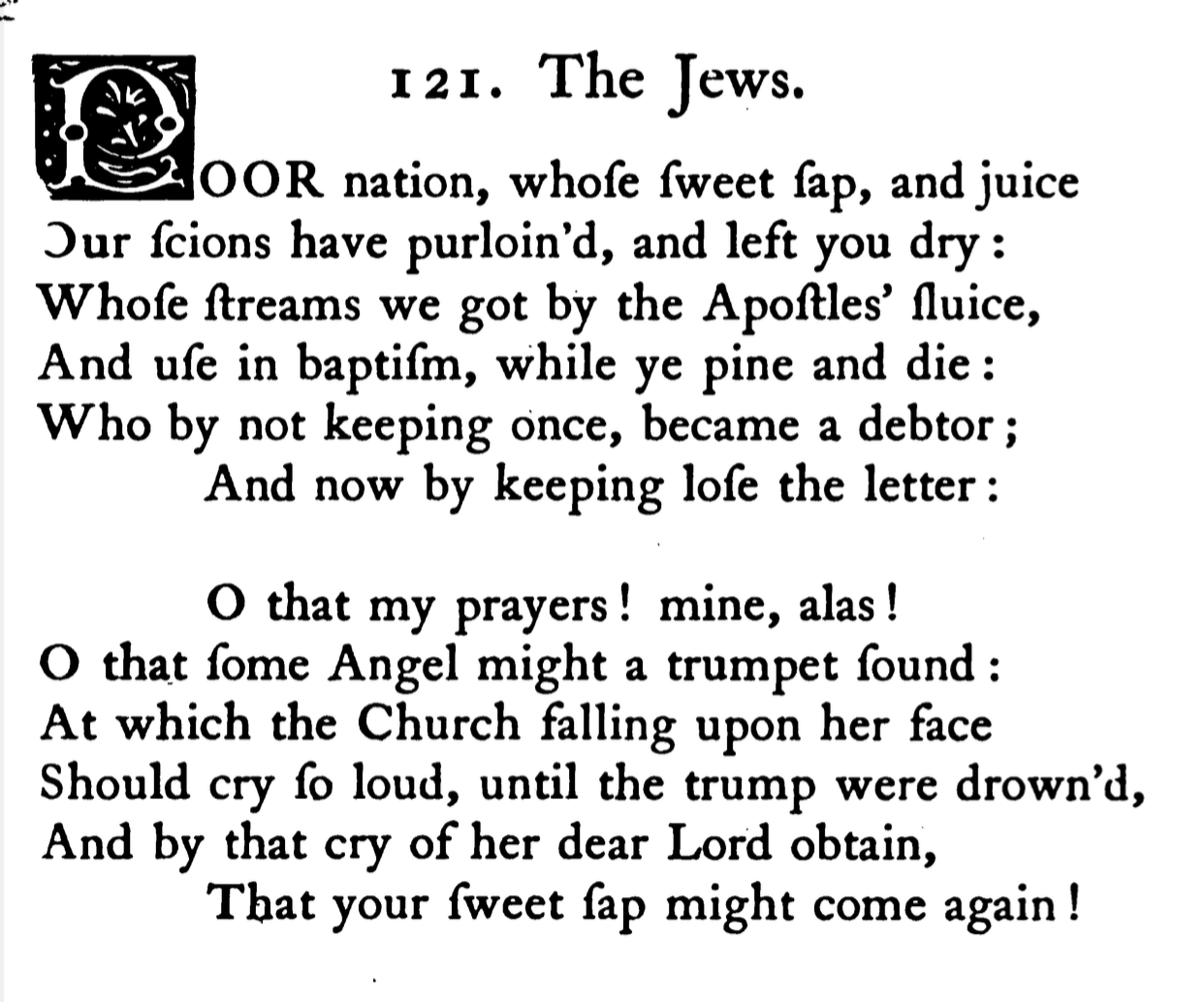
“For if thou wert cut out of the olive tree which is wild by nature, and wert graffed contrary to nature into a good olive tree: how much more shall these, which be the natural branches, be graffed into their own olive tree” (Romans 11:24). This poem of Herbert beautifully and tenderly expresses the right attitude of the believing Gentiles toward the disinherited Jews, with Pauline longings for their final restoration by repentance and faith in their own, rejected Messiah.

1. scion: a young shoot or twig of a plant, especially one cut for grafting or rooting. 2. purloin: to steal. 3. sluice: a sliding gate or other device for controlling the flow of water, especially one in a lock gate.

This was very, very good. Especially in light of a resurgent antisemitism in the West, and even in the Church. Remember, Satan’s grand conspiracy is multi-front. And the Jews, while “enemies for our sakes,” are yet “beloved for the fathers’ sakes.”

My role under presbytery is twofold. First is a conventional, pastoral one. I join my elders in pastoring our local congregation in S. Jersey, and I preach on average 1 out of every 2 of our Lord’s day services throughout the year. We are blessed with edifying pulpit supply for the balance of the pastoral ministry. The congregation is able to support me to a certain degree.

Second, I have what may be called a ‘home mission’ function. In 2023, presbytery formally approved my raising of funds for Reformed Parish Mission under the oversight and with accountability to our denominational missions committee. My presbytery also has committed to a measure of monetary support, but has limited means to do more. Together, those means are less than half of what my family and I require.

While not the ideal from a Presbyterian point of view (such missionaries would receive their full support from their own denomination), practical considerations lead me to raise funds for myself in a fashion similar to independent evangelicals. I am too convinced of the worthiness of the cause to allow it to wither for lack of funding; and so I have overcome my natural inhibitions and actively solicit funds for Reformed Parish Mission from friends, family, and churches within and beyond the Presbyterian Reformed Church.

Please pray for me. And if you could contribute—or even commit to monthly support—I would be in your debt. The Lord bless you and yours.

Recently as I was doing parish outreach visits, I came across a gentlemen with a rather interesting question. Rhetorical and somewhat cynical, to be sure; but a great opportunity to discuss the things of God with a lost sheep.

As this fellow, an African-American probably in his 50s, stood outside his house, I introduced myself. Very soon he raised this objection. “Alright. The Tower of Babel. Why should God even care? If He is so great and infinite, and human beings are just ants, how does their little building project matter?” Thus spake the ant.

So I, but another measly ant, took up the question. “David felt extremely small when he, in Psalm 8, looked up into the heavens and beheld the sun, the moon, the stars.” And so he exclaimed, “What is man, that thou art mindful of him, and the son of man, that thou visitest him?” Indeed, Father Abraham confessed that he was “but dust and ashes,” and Isaiah wondered at the nations as a mere “drop in a bucket and as the very small dust of the balances.”

I sense he was a bit flat-footed and struck that the Bible had actually considered these kinds of things. “But here’s the thing, Malcolm [pseudonym], the wonder is that God actually took such interest in His creation, and especially one speck of matter on which he impressed His very own image.” And when these image-bearing creatures rebel against Him, defy and dishonor Him, indeed, He cares! In fact, He is profoundly angry. And thus, Babel.

We talked for some time as the autumn sun set amid the changing colors. I got his number, parted from him, and thanked the Lord for another rebel ant who was open to talk. May God confound and confuse poor Malcolm, so that he may throw off the wisdom of this world for the “foolishness of God.”

For more information about RPM, click here. To receive quarterly updates, e-mail me at michael@reformedparish.com, or sign up for West Port Experiment on the right near the top.
Standard caveats, Rom. 12:9.

I’ve been meditating on these most mysterious and weighty words of our Lord in John 17:3, “As thou hast given him power over all flesh, that he should give eternal life to as many as thou hast given him.” Here is indication of the Father’s donation authority and right of Christ, as God-man, to dispense salvation to the elect out of the world over which He has been given all authority. Found this passage from Manton especially illuminating in light of it:

“There is no entrance into this kingdom but by coming into the kingdom of Christ. Besides the kingdom which belongeth to Father, Son, and Holy Ghost, one true and only God, there is the kingdom of Christ considered as mediator; a new right of empire and sovereignty over the creature, not destructive of the former,but accumulative, as superadded to it, that the government of God might be the more comfortable and beneficial to us in our lapsed estate.” Read the rest below.

[image source]

John Cotton gives an extremely helpful list of biblical considerations for the Christian who is trying to decide whether or not to move. This is taken from “God’s Promise to His Plantations” (1630). I’ve left the archaic formatting in place.

* * * * *

Quest. But how shall I know whether God hath appointed me such a place, if I be well where I am, what may warrant my removeall?

Answ. There be foure or five good things, for procurement of any of which I may remove. Secondly, there be some evill things, for avoiding of any of which wee may transplant our selves. Thirdly, if withall we find some speciall providence of God concurring in either of both concerning our selves, and applying general grounds of removall to our personall estate.

First, wee may remove for the gaining of knowledge. Our Saviour commends it in the Queene of the south, that she came from the utmost parts of the earth to heare the wisdom of Solomon: Matth. 12. 42. And surely with him she might have continued for the same end, if her personall calling had not recalled her home.

Secondly, some remove and travaile for merchandize and gaine-sake; Daily bread may be sought from farre, Prov. 31. 14. Yea our Saviour approveth travaile for Merchants, Matth. 13. 45, 46. when hee compareth a Christian to a Merchantman seeking pearles: For he never fetcheth a comparison from any unlawful thing to illustrate a thing lawfull. The comparison from the unjust Steward, and from the Theefe in the night, is not taken from the injustice of the one, or the theft of the other; but from the wisdome of the one, and the sodainnesse of the other; which in themselves are not unlawfull.

To read further, see below. To access the entire sermon and an audio recording, click here.

Chalmers’ parish mission theory made its way to the U.S. during his career and in the decades after his death in 1847. I had heard about such city missions inspired by the “territorial” method; and of course, I knew about his enthusiastic supporter of the West Port experiment, the New York philanthropist James Lenox. With a little free time, I did some poking around online and found one example: the Lebanon Chapel. Below is an 1878 report from that mission effort in the heart of New York City.

It bears all the marks of a convinced Chalmersian. We see the distinct and underscored prioritization of saving souls, above all efforts to ameliorate outward poverty. And there is also an absence of the individualistic-leaning and pietistic sort of American Christianity, but the old confessionally Reformed version that prizes the Visible (or as Kuyper eventually put it, the “Institutional”) Church with its outward and ordinary means of grace. Here’s a quote that could very easily have been written by the “Arch-Parson” himself:

Continue Reading »

Here is the latest quarterly update. If you missed the last one from February, you can read it here. Also, as a part of my home mission labors under my presbytery, I am free to take pulpit supply opportunities one Lord’s day per month on average. This enables me to supplement our support income with honoraria and, as opportunity allows, raise awareness of Reformed Parish Mission. If you have or know of any opportunities, feel free to drop me a note at michael@reformedparish.com. (Bio & online sermons here.)

Silence the critics . . . have them over for dinner! A good article by Carl Trueman:

Princeton professor Robert P. George recently drew my attention to a trivial but emblematic incident in which a flight attendant wished a passenger a “blessed” night. Unfortunately, the recipient of these kind words was a member of America’s progressive officer class who responded with predictable outrage. Clara Jeffery, editor of the progressive magazine Mother Jones, was so traumatized by this verbal assault, she took to X to express her splenetic indignation at the “creeping Christian nationalism” this unwanted benediction displayed.  

She has since deleted the post and been both derided and defended online. While Prof. George saw in the tantrum yet more evidence of progressive condescension and scorn for the working class, others have resorted to the incantatory clichés of critical theory that magically render superfluous the need for thoughtful engagement with anything outside of the acceptable progressive frame of reference. One simply cannot dialogue with such people because any attempt to do so is regarded as a manipulative (even if unwitting) attempt to reinforce the values of an intrinsically unjust system. “Shut up and listen!” is the progressive default response.

Read the rest here