Feeds:
Posts
Comments

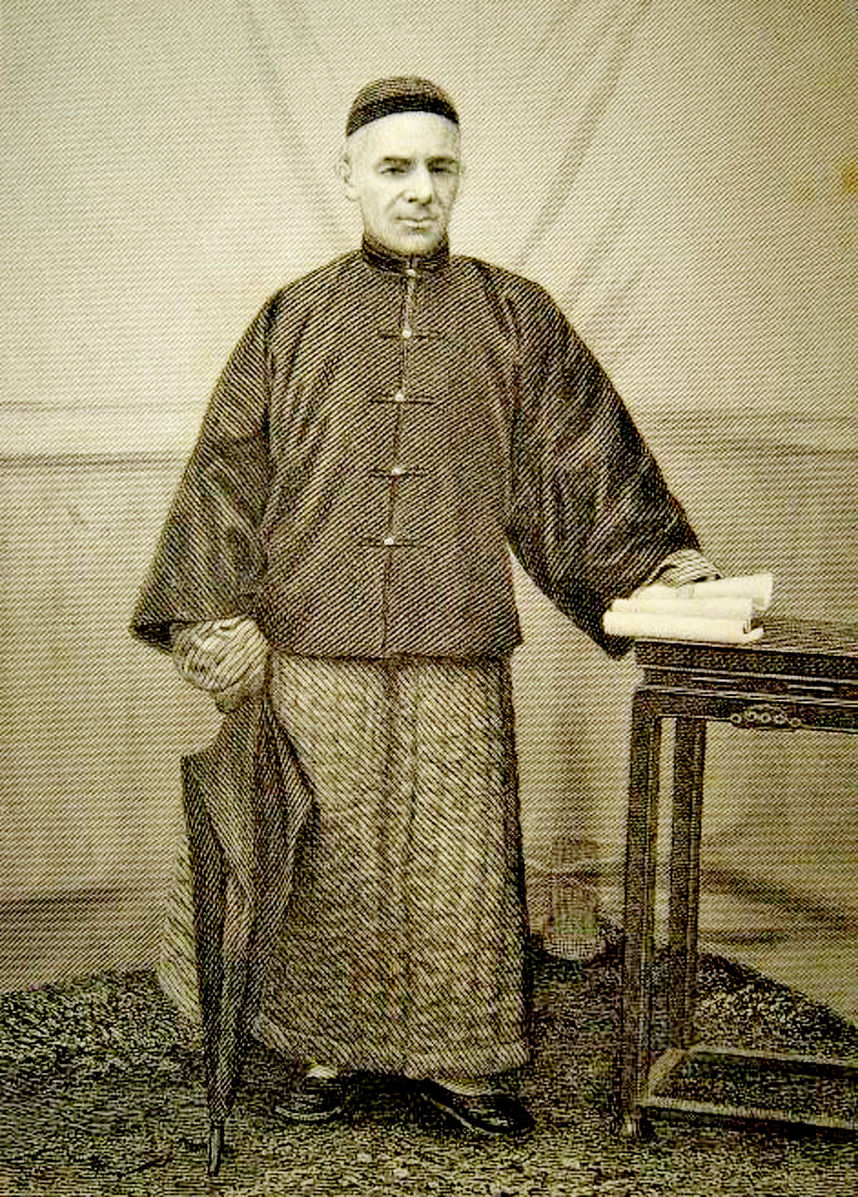
The following is a portion from William Chalmers Burns‘ sermon “I am Debtor,” from Romans 1:14. Burns was a good friend and ministerial colleague to Robert Murray M’Cheyne, and was a heroic Presbyterian missionary to China. Listen to the full audio recording here. And for more audio resources, click on the WPE Audio tab at the top.

* * * *

The apostle says something more than this, — “I am debtor both to the Greeks, and to the Barbarians; both to the wise, and the unwise.” The meaning of this seems to be, — if I were free to make a choice, I might choose the barbarian or I might choose the Greek, I might choose the wise or the unwise; but Paul says, I am debtor, and you know a debtor has no such thing as a choice to make to whom he will pay his debts. The debtor knows this, and the believer feels it just in the same way. “Whatever my calculations may be, or whatever I might myself desire, the question is not, what would I like, but what is my commission, — what are the objects of my embassy? It is not my choice that I have to do with, but God’s commission, — what instructions does it contain?”
We would fain impress this important, solemn truth upon God’s children. Believer, do you feel this? Do you know what it is to feel yourself a debtor to a lost world? Have you ever thought of what object Christ had in view when He brought you to Himself? what design He had in calling you? It was certainly, in the first instance, to save you from perdition, but that was not the only end. It is possible to think too much, or, at least, too exclusively, about your own case. In one sense you cannot do that; woe be to him who seeks to pull the mote out of a brother’s eye, when a beam is in his own. But yet a believer must remember that he is called to know Christ, not only to be safe himself, but also that he may be a witness for Christ in the world. Ah! think of this; don’t be selfish in the matter of salvation, and remember above all, that his is not a thing which you may or may not do, just as you like. Some people do much in this way, just because they have a liking to it, and because the employment suits their taste – and it is a happy thing to feel that; but there is a far more unchangeable foundation for a believer’s labour in the Lord’s vineyard than that. The man is no longer free to like, or not to like; he is a debtor now – a debtor to do it fully, and constantly, and unceasingly, and devotedly, whether he likes it or not. Think of it in this light, and then you will be going and hasting to tell your friends, and all whom you know, of these precious things of God. Oh, if this were fully felt, and felt universally , how many would be preaching whose mouths are dumb through sloth and idleness! There would be fewer preaching as a trade, and more preaching as debtors, forevery believer would then have a voice with which to sound the praises of the most high God.
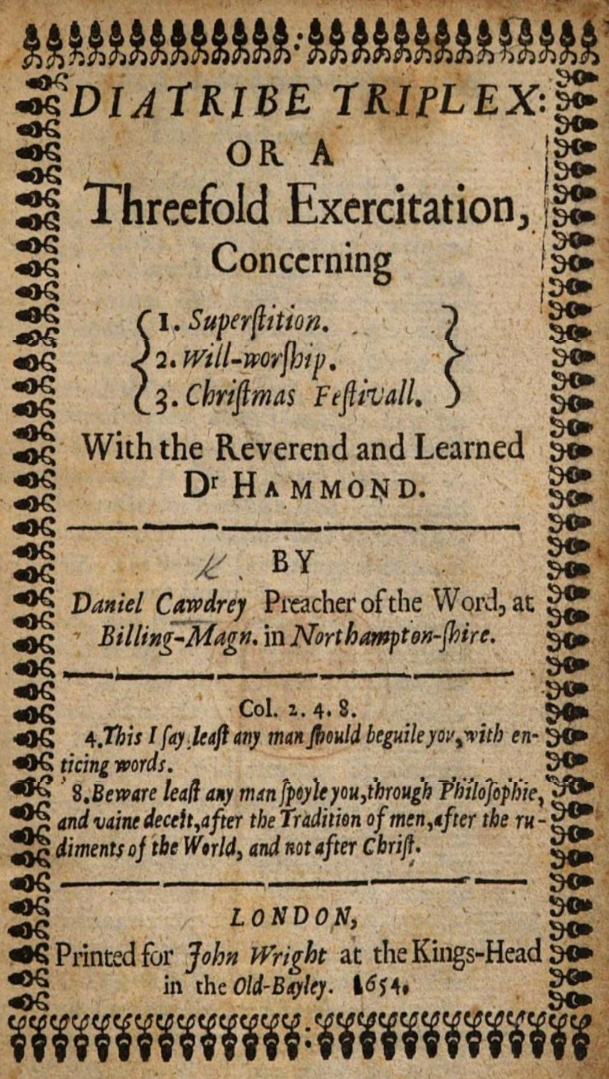
Just finished recording part 2 of 2 of Daniel Cawdrey’s “Of the Festivals of the Church, and Especially Christmas.” Listen to the audio here. This is the third part of a larger work, attached below. The University of Michigan has digitized the text here.

Visit the complete WPE Audio library.

Cawdrey (1588–1664) was a member of the Westminster Assembly, which produced the Westminster Confession of Faith, as well as the Larger and Shorter Catechisms. Like the rest of the Puritans of England and New England, as well as the Presbyterians of Scotland, these godly men rejected all holy days of men’s devising based on what has become called the ‘regulative principle of worship,’ which requires us to have clear and undoubted certainty about the divine, scriptural origin of any worship practice, and that any worship falling short of this standard must be set aside.

The Puritans were not kill-joys or men of bigoted, narrow minds. Anyone who reads their sermons and devotional writings will find them to be the warmest lovers of God, of Christ, and of their fellow men. They were also as a rule generous, catholic-minded men who embraced all those who called upon the Lord in sincerity, even among those who might disagree with them. And above all, they were men who passionately wanted to please God, even if that went against the flow of the opinions of men. I offer these recordings in that spirit.

The following is a sample from Cawdrey, in particular on his contention that the observation of Christmas is ultimately hostile to the proper, apostolic practice of Lord’s day observance:

“[It is said that] The Birth of Christ, is a mercy of such excellent quality, that it can never be overvalued, &c. This is granted; ​But to Institute a day as Holy, without command of Christ, for an Annual commemoration of this, is above the power of any Church, and a Superstitious presumption: and [altogether] needless; considering that the Lord’s day, (which includes the commemoration, not only of his Birth, but his Resurrection, and the whole works of our Redemption by him) was instituted by himself, or his Apostles, by him authorized and inspired, for this very end; & comes [around] once in every week. To limit it therefore to one day in a year, to remember that Mercy, is not an exaltation, but a derogation from it. If this were done, on his own design[ated] Day, wee need not fixe another day.”

Friend, let appeal to you not to brush off this position. You may in the end disagree with it; by all means, search the Scriptures, and be a Berean. But none of us “have attained,” and we should always be willing to bring any of our views or practices to the touchstone of Scripture. Embracing this position would naturally involve sacrifices, hurt feelings, and misunderstandings. But I can assure you from close to 30 years of experience after becoming convinced, and after raising four children in these principles, it is well worth it. “Them that honor me, I will honor.” And you don’t have to be a Grinch! I’m not—and I keep up many, many friendships with dear brothers who aren’t persuaded.

But of course, they’ll understand sooner or later (1 Cor. 13:12)!

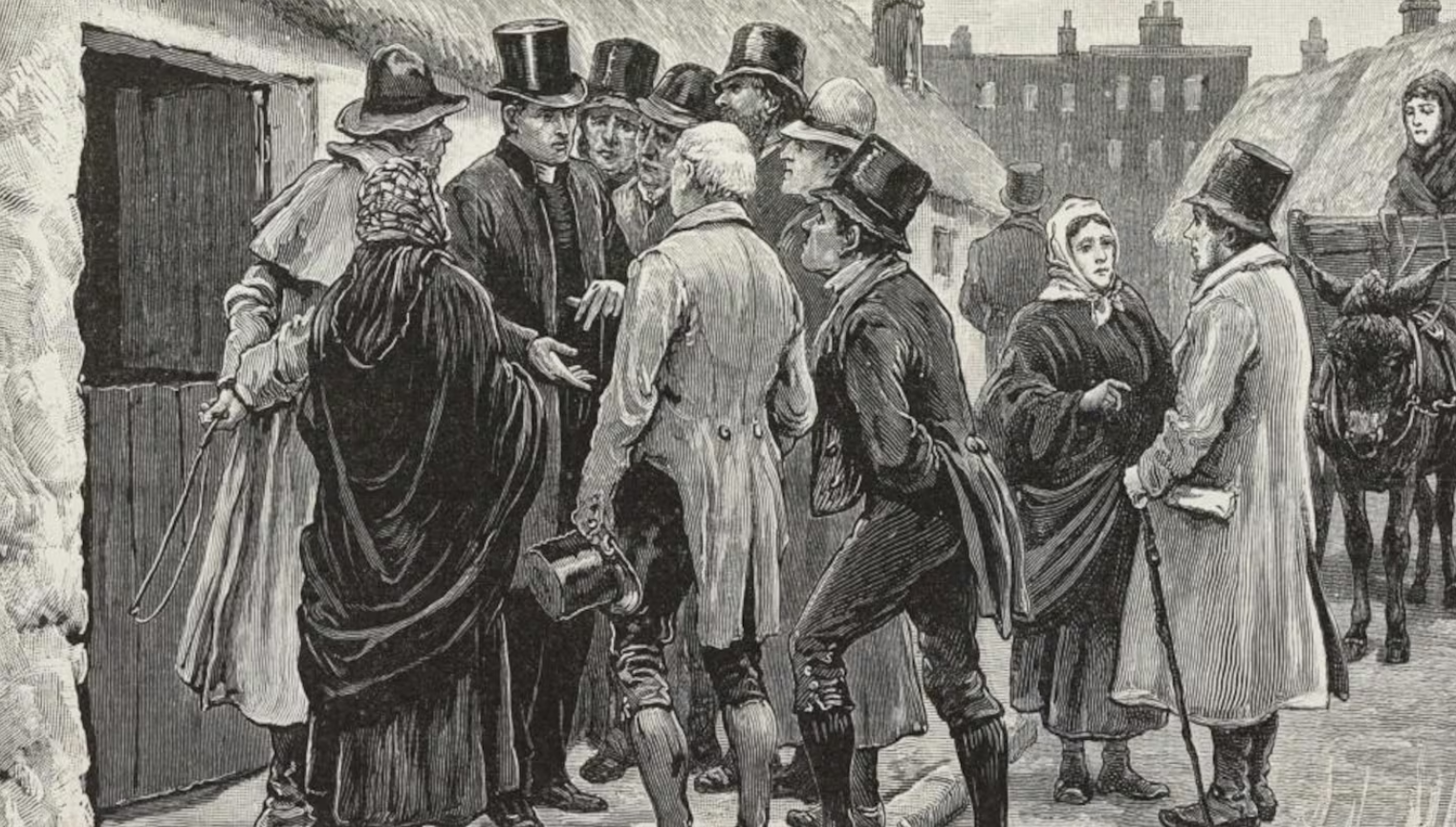
The following is a rather interesting piece in an old edition of the Bulwark Magazine. James Begg inquires with Dugald MacColl on the effect of his territorial mission with the Roman Catholic population in Glasgow.

See also this post on Thomas Chalmers’ outlook on Protestant parochial missions to Irish Roman Catholics.

“Yet I must say I liked the Irish part of my parishioners. They received me always with the utmost cordiality, and very often attended my household ministrations, although Catholics” (Works 16:243).

This and the following are selections from Thomas Chalmers on his attitude and outlook on reaching the poor Irish “papists” of his day, both domestically through aggressive, Protestant territorial missions, as well as on the Emerald Isle itself. Much here that is relevant, especially when so many Western nations have swarms of un-Christianized immigrants on our very doorstep.

* * * * *

Chalmers here refutes the notion that the Protestant establishment in Ireland ought to respect parochial bounds of Romanists. No! Parish lines are only relevant for the sake of the Gospel, and ought valiantly to be transgressed when the strong man’s house must be plundered: “We do not say that the maxim has been universally acted on, but it has been greatly too general, that to attempt the conversion of a Papist was to enter another man’s field; and that, in kind at least, if not in degree, there was somewhat of the same sort of irregularity or even of delinquency in this, as in making invasion on another man’s property. In virtue of this false principle, or false delicacy, the cause of truth suffered, even in the hands of conscientious ministers; and when to this we add the number of ministers corrupt, or incompetent, or utterly negligent of their charges, we need not wonder at the stationary Protestantism, or the yet almost entire and unbroken Popery of Ireland. We now inherit the consequences of the misgovernment and the profligacy of former generations. They may be traced to the want of principle and public virtue in the men of a bygone age. Those reckless statesmen who made the patronage of the Irish Church a mere instrument of subservience to the low game of politics—those regardless clergymen who held the parishes as sinecures, and lived in lordly indifference to the state and interests of the people—these are the parties who, even after making full allowance for the share which belongs to the demagogues and agitators of the day, are still the most deeply responsible for the miseries and the crimes of that unhappy land (Chalmers T 1838m; Works 17:304).

Continue Reading »

“Remember what all the manuals that teach effective work practices tell you to do? Do the difficult things first. Give them priority. My own experience, for what it is worth, is that disciplined, faithful attendance at corporate prayer times can slowly transform them into some of the best and most important meetings you attend. Apart from other considerations, the privilege of hearing the burdens on the hearts of Christian friends is a better way to get to know them than having coffee with them! In no other context in life will you hear the kind of speech that is expressed when believers share their needs and desires with God. The quickest way to get into the heart of a church is to gather with it when it turns to prayer.”

From Devoted to God’s Church.

Comedian John Mulaney once joked that one of Jesus’ greatest miracles was having twelve close friends in his thirties. Sadly, the modern decline of friendship is real, and anything but a punchline.

The Survey Center on American Life reports that that in 1990, almost 70% of men had five or more close friends. By 2021, just 40% reported having that many. And the number who said they had no close friends quintupled. Women haven’t fared well, either, though their friend groups haven’t shrunk as rapidly.  

Part of the challenge is that time together is the oxygen of friendship. Deprive it of that, and friendship tends to die or at least become more distant. And today, perhaps due to a faster pace of life and more “stuff” piled into our schedules, spending time with friends requires more effort and intentionality than in decades past. Research shows that Americans now spend half as much time with their friends (three hours a week) as they did just a decade ago.  

Read the rest of this article by John Mulaney at Breakpoint.

I’ve recorded several chapters of Cotton Mather’s great Magnalia Christi Americana: Or, The Ecclesiastical History of New-England: from Its First Planting, in the Year 1620, Unto the Year of Our Lord 1698. Here are the opening words of the first chapter, “Discoveries of America.”

* * * * *

“It is the opinion of some, though ’tis but an opinion, and but of some learned men, that when the sacred oracles “of Heaven assure us, the things under the earth are some of those, whose knees are to bow in the name of Jesus, by those things are meant the inhabitants of America, who are Antipodes to those of the other hemisphere. I would not quote any words of Lactantius, though there are some to countenance this interpretation, because of their being so ungeographical: nor would I go to strengthen the interpretation by reciting the words of the Indians to the first white invaders of their territories, we hear you are come from under the world to take our world from us. But granting the uncertainty of such an exposition, I shall yet give the Church of God a certain account of those things, which in America have been believing and adoring the glorious name of Jesus; and of that country in America, where those things have been attended with circumstances most remarkable. I can contentedly allow that America (which, as the learned Nicholas Fuller observes, might more justly be called Columbina) was altogether unknown to the penmen of the Holy Scriptures, and in the ages when the Scriptures were penned. I can allow, that those parts of the earth, which do not include America, are, in the inspired writings of Luke and of Paul, stiled all the world. I can allow, that the opinion of Torniellus and of Pagius, about the apostles preaching the gospel in America, has been sufficiently refuted by Basnagius. But I am out of the reach of Pope Zachary’s excommunication. I can assert the existence of the American Antipodes: and I can report unto the European churches great occurrences among these Americans. Yet I will report every one of them with such a Christian and exact veracity, that no man shall have cause to use about any one of them the words which the great Austin (as great as he was) used about the existence of Antipodes; it is a fable, and nulla ratione credendum.

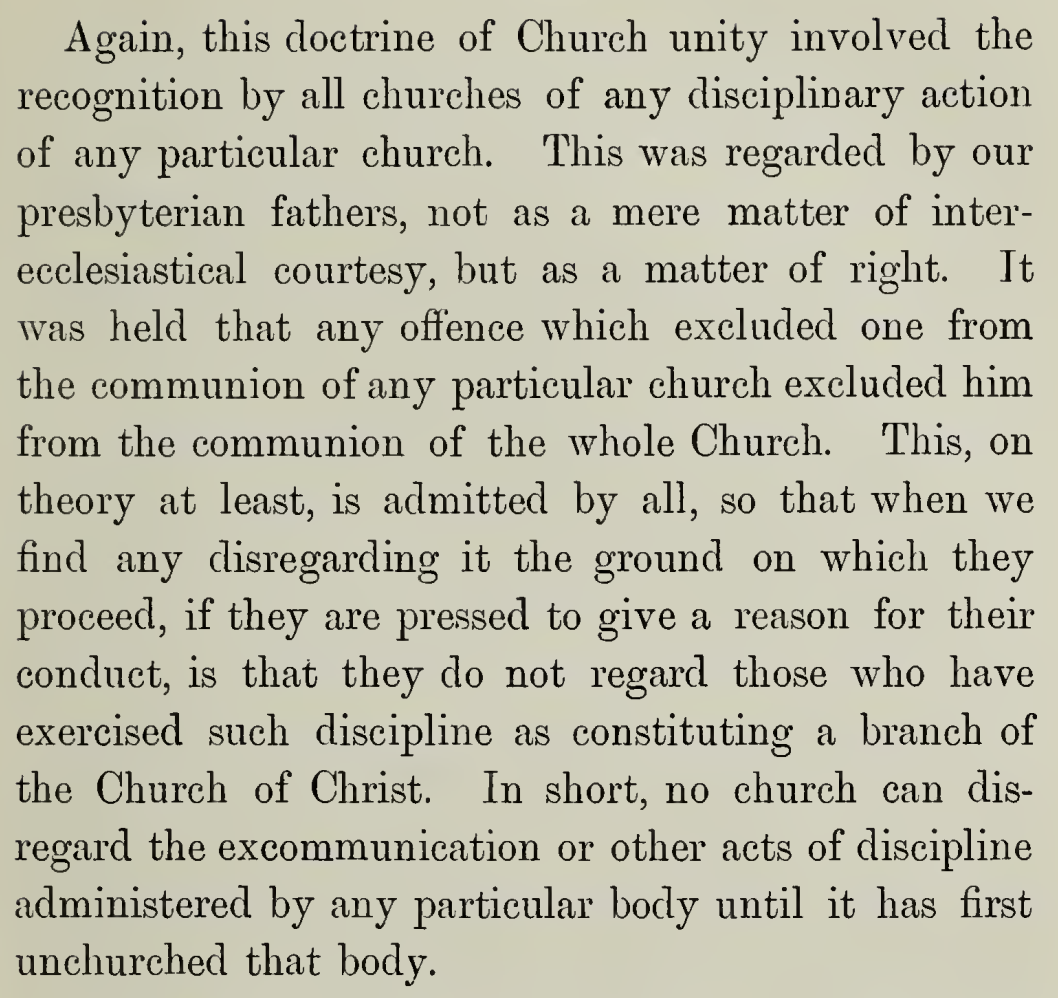
MacPherson explains the radically catholic ecclesiology of our Scottish Presbyterian forbears. Listen to an audio recording of the chapter where he treats this subject here.

Whole doctrine catholicity | “Who is she that looketh forth as the morning, fair as the moon, clear as the sun, and terrible as an army with banners” (Song 6:10)?