Feeds:
Posts
Comments

Archive for the ‘Covenant Theology’ Category

Joseph Receives His Brothers on their Second Visit to Egypt, a painting by Bacchiacca, ca. 1515.

The following are some passages from Scottish Presbyterian fathers on the Christological theme of our Lord’s mediatorial “stewardship.” Sublime:

“And if there be varieties of temperature of saints, some rough and stiff, some mild, some old men, and some babes, 1 John 2:13. And as there be some lambs, some fainting, weak and swooning tender things, that Christ feeds like kings’ sons, with wine of heaven: so there be others that are under the care of the steward Christ, who are heifers and young bullocks, like Ephraim not well broken yet, Jer.31:18, 19 and there be hoping and waiting saints, that must bear the yoke in their youth, Lam. 3:26, 27 and sundry kinds and sizes of children; every one must have their own portion and diet, 2 Tim.2:15; Mat. 24:45. One man’s meat is another’s poison, and yet they are both the sons of one Father.”

-Samuel Rutherford, Christ’s Dying and Drawing Sinners to Himself

“You have cause to hold up your heart in remembrance and hope of that fair long summer day, for in this night of your life, wherein you are in the body absent from the Lord, Christ’s fair moon-light in his word and sacraments, in prayer, feeling, and holy conference, hath shined upon you to let you see the way to the city. I confess our diet here is but sparing; we get but tastings of our Lord’s comforts; but the cause of that is not because our steward Jesus is a niggard, and narrow-hearted, but because our stomachs are weak, and we are narrow-hearted. But the great feast is coming, and the chambers of them made fair and wide to take in the great Lord Jesus . Come in, then, Lord Jesus to hungry souls gaping for thee!”

-Samuel Rutherford, Letters

(more…)

Read Full Post »

Came upon this choice piece from Boston’s Memoirs. A series of questions put to a prospective communicant. The first question I find rather insightful—I’ve long tended to think that a working understanding of the Shorter Catechism is basically the cognitive side of Presbyterian terms of communion. Without reaching that bar, the session ought to delay that applicant and give further instruction (L. Cat. 173). Also, there is explicit submission to church discipline.

I am aware that Boston arguably had some “independent” aspects to his presbyterianism, and perhaps this reflects too much a likeness to the old Congregational “church covenants?” But whatever the case, I find this explicit consent and covenanting commendable:

“And if the Session be satisfied in this also, the party is to be put explicitly to consent to the Covenant (whereof he desires the seal), to be the Lord’s, live under Him, and serve Him all the days of his life, by answering expressly the following (or the like) questions: 1. Do you believe the doctrine of the Shorter Catechism of this Church, so far as you understand the same, to be the true doctrine agreeable to the Holy Scriptures, and resolve through grace to live and die in the profession of the same? 2. Do you consent to take God in Christ to be your God, the Father to be your Father, the Son to be your Saviour, and the Holy Ghost to be your Sanctifier; and that, renouncing the devil, the world and the flesh, you be the Lord’s for ever? 3. Do you consent to receive Christ, as He is offered in the gospel, for your Prophet, Priest and King; giving up yourself to Him, to be led and guided by His Word and Spirit; looking for salvation only through the obedience and death of Jesus Christ, who was crucified without the gates of Jerusalem; promising in His strength to endeavour to lead a holy life, to forsake every known sin, and to comply with every known duty? 4. Lastly, do you promise to subject yourself to exhortation, admonition, and rebuke, and the discipline of the Church, in case (which God forbid !) you fall into any scandalous sin?”


Memoirs, Appendix 3, § 10, p. 488.


Read Full Post »

Years back, my heart got large for missions — especially urban missions to those on the ‘other side of the tracks.’ At about the same time, I became Reformed (a high octane, old school Presbyterian no less!), putting me in a a sub-subset of a subset. My life and ministry has ever since lived somewhat in the frontiers the unlikely and the implausible. A straightlaced, tall gringo Presbyterian goes out among immigrants, trying to evangelize in broken Spanish and recruit sinners to the “outward and ordinary means” in a humble, little Reformed church 15 minutes to the south. And to sing Psalms. Without musical accompaniment. In English.

I admit that there are all kinds of problems with this model, from a human perspective. But it is actually more plausible than one might think. Yet before I deal with the plausibles, let me first set forth some principles.

The first principle is principle! Principle precedes the practical. We must first determine whether something should be done before we decide whether or not we think it is practical. We ought to go out and bring the Gospel to all. None excluded. Politics quite aside, we may and must not discriminate based on sex, ethnicity, gender, or for that matter even sexual ‘preference.’ By the mandate of our King, we must go and tell them. Yes, as Calvinists, we know that not every “all” means “all.” But “every creature” does in fact mean “every creature.” Even if they don’t look like us, eat like us, or even use our language. It doesn’t matter whether they ‘have papers’ or not, vote Democrat or not. How they got here and whether they should by law be here, is a separate issue for a different discussion (and full disclosure: I lean quite “red” when it comes to immigration policy!). But that they are here means they are here for us to evangelize. And not just gripe about and avoid them as much as possible.

(more…)

Read Full Post »

I try to avoid promoting my own sermons very often. But after giving a short, three-part series on the doctrine of hell, I continued with a second short series on the subject of biblical, Reformed church growth, something very near my heart. Specifically, I spoke from Matthew 16:18 about building up the church from within by training up, winning over, and thus retaining our baptized, covenant children. We must promote and encourage Christian child-bearing and so helping populate the (visible) Kingdom through these “federally holy” sinners, a mission field in its own right. (More on that subject here.) Then, I laid out in the final messages a call and battleplan for aggressive, local and regional missions. As Prof. Murray said when personally engaging in church-planting in New England, we must “go where the people are, not where you hope they will come.”

I have been serving in New England and now New Jersey for 18+ years. Let us pray earnestly and labor believingly for the extension of confessional Presbyterianism here in our northeastern “Samaria.” It may be spiritually ‘rocky soil,’ but God can create sons of Abraham from these stones. He did it before! If things go from bad to worse, a strategic retreat is possible. But let us not give up the Messiah’s ground without a fight! And who knows? Perhaps the Lord will make this “desert to blossom as the rose” again, and restore the pure worship of our godly Puritan forbears.

Do you live in the northeast—in New England, New York, or New Jersey? Are you committed to the old paths of the Puritans and Presbyterians? Do you long for a Third Great Awakening today? Would you be interested in hosting special meeting in your area? Please get in touch with me at 515-783-5637 or michael@reformedparish.com. [Note, 7/25/24: we would seek to do so in a collaborative way with area NAPARC and other more faithful churches, where possible.]

And if you don’t live in the northeast, would you pray for us? And maybe even consider joining us, if Providence opens a door?

Read Full Post »

Below is an expanded and updated set of diagrams I’ve worked on to explain covenant theology in its various dimensions. The earlier version was posted here.

I ended up making three interrelated diagrams so as to avoid things becoming too convoluted. These should be pretty intuitive for the average Reformed office-bearer and the better-educated Reformed believer. (And note, ‘construct covenants’ is a term I’ve coined. If there is a more standard one of which I’m ignorant, by all means let me know.)

Read Full Post »

I could use some helpers, from near or far. Here’s the situation.

I’ve been doing a series in our second services on “Reformed Biblical Theology” (or Covenant Theology, if you like), tracing the one unfolding plan of God to save His people through Christ. The original purpose – beyond edifying our own folks locally – was to build a distance learning course for Westminster Theological Academy, our denomination’s program to train Liberian pastors and theological students. Since then, opportunities to use it among Spanish speakers have developed, both at home and abroad. A theological academy in Latin America has expressed interest in it, and now I’ve been approached by a Hispanic pastor here in Providence who is trying to get a Bible school off the ground.

Because my Spanish is not yet at the level where I can preach and teach in it, I need to utilize helpers. I’m considering a subscription to a transcription service to render my sermons/lectures into English manuscripts. Before they are translated into Spanish, I just need a volunteer (or more) to listen to the original audio, edit, and perfect the English manuscript. Then, I could a bilingual helper – fluent in English & Spanish – to translate the English manuscript into a Spanish one. We can then take it from there, whether reading and recording into audio, or utilizing for video subtitles.

To give you an idea of what you’d be working with, this sermon/lecture has been transcribed here.

Interested in helping? Drop me a note: mjives dot refparish at gmail dot com. Or, 401-484-8089.

Read Full Post »

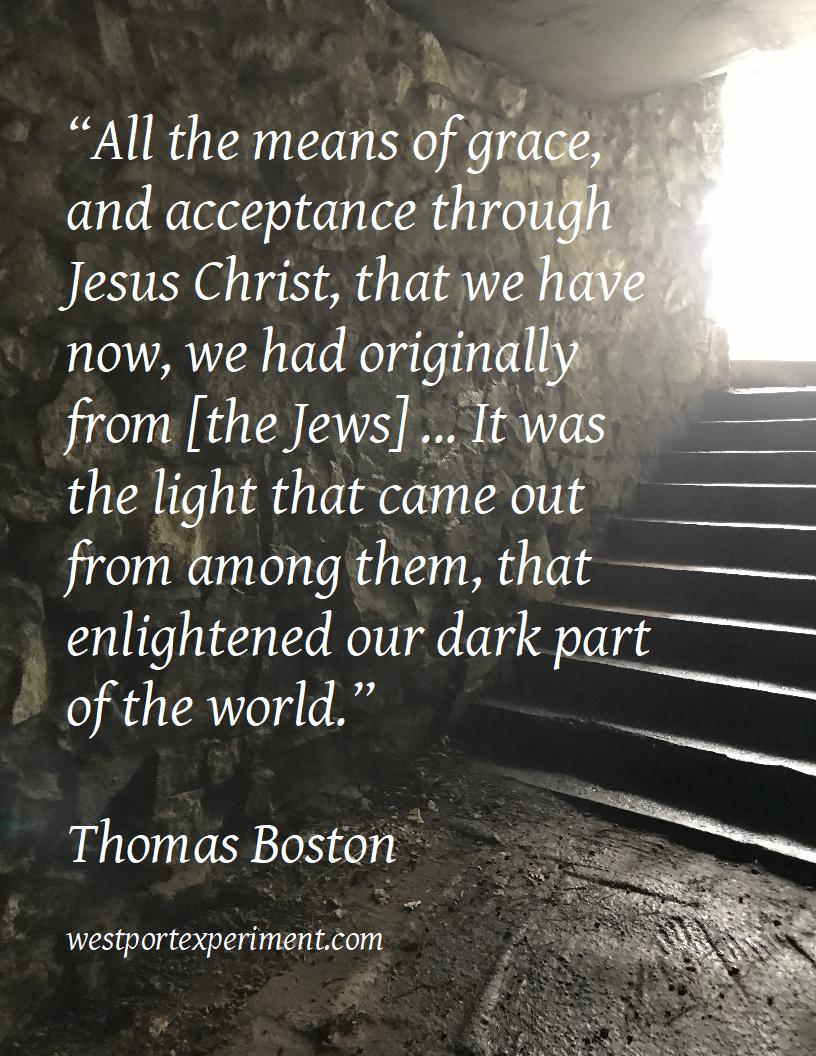
Boston, The light of the Jews

“A Griegos y á bárbaros, á sabios y á no sabios soy deudor” (Rom. 1:14) —

Chalmers, Orator of the Species [Esp]

More quotes, sans image …

Communion of the Saints

“The speech of one hearty friend cannot but revive the spirits of another. Sympathy hath a strange force, as we see in the strings of an instrument, which being played upon, as they say, the strings of another instrument are also moved with it. After love hath once kindled love, then the heart, being melted, is fit to receive any impression. Unless both pieces of the iron be red hot, they will not join together. Two spirits warmed with the same heat will easily solder together.”

-Richard Sibbes

Faith & the Promise

“The faith of the promises is the door at which the accomplishment of the promises doth enter in: according to the word, Luke 1:45, Blessed are they that believe, for there shall be a performance of those things that are spoken of the Lord unto them. If we were more in waiting for the accomplishment of the promises, the vision should speak, and should not tarry: and no doubt, a mercy coming to us, as the fruit and performance of a promise, will make it an exceeding refreshful thing, when a Christian getteth leave to sing that song, which is in Isa 25:9, Lo, this is our God; we have waited for him, and he will come and save us. And when a mercy is the fruit and accomplishment of the promise, there is a beautiful lustre and dye upon that mercy, which no art could set on, but only the finger of the love of God.”

-Andrew Gray

Regeneration of Children

“The education of children should proceed on the principle that they are in an unregenerate state, until evidences of piety clearly appear, in which case they should be sedulously cherished and nurtured. . . . Although the grace of God may be communicated to a human soul, at any period of its existence, in this world, yet the fact manifestly is, that very few are renewed before the exercise of reason commences; and not many in early childhood.”

-Archibald Alexander, Thoughts on Religious Experience

Honesty in Confessional Subscription

“Honesty is as important in theology as in trade and commerce, in a religious denomination as in a political party. Denominational honesty consists, first, in a clear, unambiguous statement by a Church of its doctrinal belief, and, second, in an unequivocal and sincere adoption of it by its members. Both are requisite. If a particular denomination makes a loose statement of its belief, which is capable of being construed in more than one sense, it is so far dishonest. If the creed of the denomination is well drawn and plain, but the membership subscribe to it with mental reservation and uncertainty, the denomination is dishonest. Honesty and sincerity are founded in clear conviction, and clear conviction is founded in the knowledge and acknowledgement of the truth. Heresy is a sin, and is classed by St. Paul among’the works of the flesh,’ along with ‘adultery, idolatry, murder, envy and hatred,’ which exclude from the kingdom of God. (Gal. v. 19-21). But heresy is not so great a sin as dishonesty. There may be honest heresy, but not honest dishonesty. A heretic who acknowledges that he is such, is a better man than he who pretends to be orthodox while subscribing to a creed which he dislikes, and which he saps under pretence of improving it and adapting it to the times. The honest heretic leaves the Church with which he no longer agrees; but the insincere subscriber remains within it in order to carry out his plan of demoralization.”

– W. G. T. Shedd, Calvinism: Pure and Mixed, 152

Trials in the Womb of the Covenant of Redemption

“Whatever trials you have, whatever troubles you have, whatever difficulties you have, they come from the same covenant as Christ came for your salvation. They come from the same covenant as your regeneration came. They come from the same covenant as your hope of heaven comes. And they come with the same love, and they come for the same purpose, and that is that you might be to the glory of his grace throughout eternity.”

-Hugh M. Cartwright (1943-2011)

The Virgin Mary’s “Low Estate”

“​In the following words she teaches us how worthless she felt of herself and that she received by the heavenly grace that was lavished on her every sort of good merit that she had. She says, “For he has considered the humility of his handmaid. For behold from this time on all generations will call me blessed.” She demonstrates that in her own judgment she was indeed Christ’s humble handmaid, but with respect to heavenly grace she pronounces herself all at once lifted up and glorified to such a degree that rightly her preeminent blessedness would be marveled at by the voices of all nations.”

-Venerable Bede

The Right Veneration of the Virgin

But that she was eminently a saint; that her faith, and resignation, and absolute devotion to God, on the message of the angel, were most extraordinary and exemplary; that her relation to our common Saviour should render her name dear and venerable to us all; and that we should fulfil our part of her own prediction, that “henceforth all generations shall call me blessed,” [Luke 1:48]—all this is not only to be admitted, but remembered and regarded​. . .  Yet in counteracting this error, the veneration and affection due to her true character, has, I think, been sometimes refused, or impaired. Let us avoid both extremes. Let us worship God alone; but let us love and venerate all his saints, and the mother of our Lord among the chief.”

-Ashbel Green

A Penitent Marveling at Common Grace

“Her self-conceited heart is self-convict’d,
With barbed arrows of compunction prick’d;
Wonders how justice spares her vital breath,
How patient heav’n adjourns the day of wrath;
How pliant earth does not with open jaws
Devour her, Korah-like, for equal cause;
How yawning hell, that gapes for such a prey,
Is frustrate with a further hour’s delay.”

-Ralph Erskine

“Social” Christianity & the Individual

“Nevertheless, the attempts to apply Christianity socially have profoundly affected the meaning which the Christian faith has for the average man and ordinary churchgoer. The emphasis on the social has largely stifled the spiritual nature of the faith. It has obscured the revealed fact that the Christian message was primarily to and for individuals. . . For the business of the Church in its God-given mission is to the individual and through the individual to society. Moreover, the Christian revelation holds out no hope for society except in so far as the men and women who form it are Christian, which for the secular State is a futile and unattainable ideal. It is therefore all the more essential that the truth should be understood that a Christian society can only be fashioned out of and by Christian men and women. . .”

“Evangelical ministers, holding their high commission as ambassadors of Christ, must ever plead with men to be reconciled to God. When people are reconciled to God they are in fact at peace with one another. From this peace, conditioned by faith in Jesus Christ, can alone arise a state of mutual peace among peoples of nations and a fellowship in peace of the states constituted of these reconciled peoples. . .”

“To-day, therefore, as at all times, the primary privilege and service of this ministry must be the regeneration of men who will become creators of a better and more really Christian civilisation.”

-Donald Maclean (1869–1943), Principal of the Free Church of Scotland and co-founder of the Evangelical Quarterly. From “An Evangelical Ministry.”-

Read Full Post »

IMG_5335District, door-to-door evangelism done right is distinctly Reformed, being a distinctly household-oriented approach to Gospel outreach.

Follow me here. Doesn’t God administer His grace to individuals as well as to households? Doesn’t it start with the head and flow to the members? Isn’t it interested in reconciling the father to the son and the son to the father? Abraham, Joshua, Cornelius, Lydia. “Believe on the Lord Jesus Christ, and thou shalt saved, and thy house” (Acts 16:31). We aim for the heads of households; and if we get them, we get the family. (more…)

Read Full Post »

Tennent, Adam's Stock

Read Full Post »

[NOTE: The diagram below has since been expanded and reposted here on March 10, 2022.]

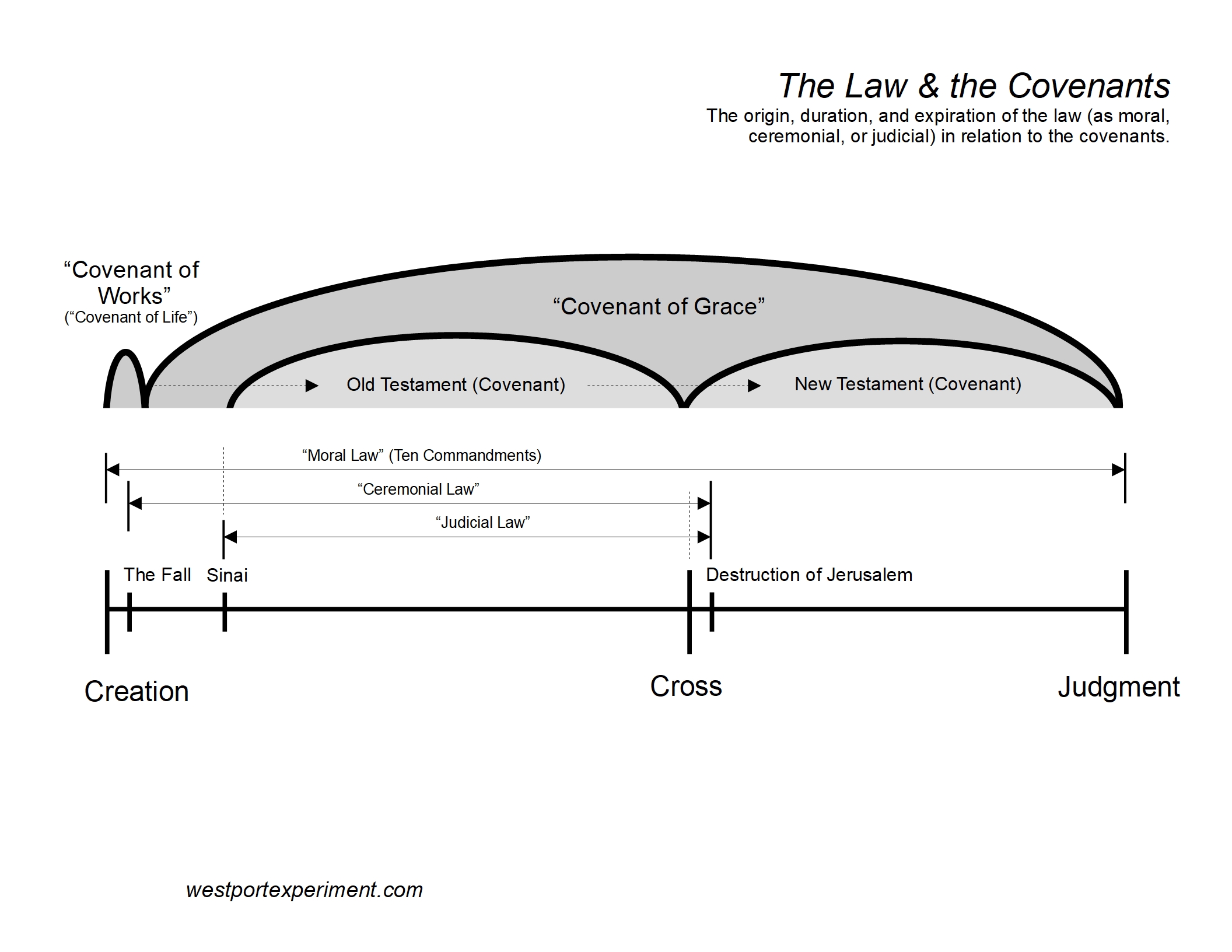
Here is something I designed for our catechism class to help young and old track with the main contours of Covenant Theology and its bearing on redemptive history. Comments below.

S Cat 020 The Covenants [CCat]

Much of this is self-explanatory for those with a working knowledge of Reformed doctrine. But a bit of clarification on my design. I added a dashed, horizontal line & arrow from Covenant of Works moving through the OT and NT dispensations to help reduce the impression that it is somehow a cipher after the Fall. I also configured the OT period to begin at Sinai (as technically it does), though canonically it usually embraces everything from Genesis to Malachi. Third, the dashed, vertical line above Sinai intersecting the horizontal lines of the Moral and Ceremonial law is intended to reflect the development and institutionalization of the latter and the explicit publication of the former. Last, the dashed and hard vertical lines at the cross represent the distinction between the definitive abolition of these laws at 33(-ish) A.D. and their actual, outward end with the destruction of the Temple and Jerusalem in 70 A.D.

I omitted the ‘biblical’ covenants (Noahic, Abrahamic, Davidic), leaving that for another day and another diagram.

And now you’ll need a chart to understand all that! Seriously, though, if you can help me perfect this further, I’m open. Just as long as you’re no Dispy, Hyper-Preterist, or any of the countless bunny trails from good old 1646 Federalism.

Read Full Post »

Older Posts »