Feeds:
Posts
Comments

The Practical and the Pious – 1
Chalmers the Bridge Builder: Lessons in Translating the Faith

Forth Road BridgeMargot Butt, in her essay entitled “The Chalmers Papers” includes an insightful quote from the daughter of Thomas Chalmers most like him in personality. Grace Chalmers wrote concerning herself, “I’ve always been a kind of outlier between the practical and the pious. I have a liking for both. I can’t get people with both about me so either I have the pious that look down on practicality as a secular thing, or the practical that nauseate the piety” (189). It is obviously from this quote that A. C. Cheyne’s compilation The Practical and the Pious: Essays on Thomas Chalmers (1780-1847) draws its name.

And rightly so. Thomas Chalmers was eminently pious, himself kindling many a ‘bright and shining light’ in the 19th century Scottish Kirk. Giants such as Robert Murray M’Cheyne, Alexander Duff, and Andrew Bonar owed a tribute of the greatest respect to him. And at the same time, he was eminently practical. An organizer, a campaigner, a delegator, and a plain, roll-up-your-sleeves doer. Yes, his head was in the clouds; but his hands and feet were quite busy here on the earth.

As I take a step back, having read and processed these fascinating scholarly articles gathered from the Chalmers Bicentenary Conference (1980), three striking features of this great ‘practical pietist’ come into sharper focus for me. In the first of three parts, I’d like to talk about Thomas Chalmers as – to use the metaphor of John McCaffrey – a bridge builder.

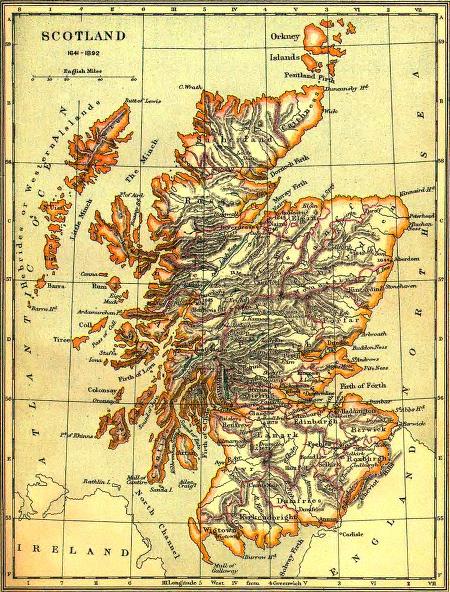
First, the idea itself. It’s not very easy to chop and hack up history into nice, convenient segments. We use dates and events to define when once era has begun and another has ended. Yet, it is rather arbitrary. But even if it is arbitrary, we all acknowledge that times change, and we categorize history according to periods. Chalmers stood in a transitional time. Things were rapidly changing: in philosophy, in politics, in religion, and in society. He had a foot in the older age, and one in the new. He began His life in rural Fife, so much a picture the old order, and ended it working in the slums of Edinburgh, the underbelly of the new.

Change is unpleasant. And yet to survive, we must change. Adapt or die! That’s not Darwinism; that’s life.

Chalmers did – or attempted to do – what all must do to survive. And more to the point for us as the Church, he led the Church of his day to adapt and thrive. Not to cut loose from the past, or to change what is unalterably the sum and substance of Christianity. No, Chalmers wasn’t a radical wrecking ball. He was a conservative through and through. But he was not insensitive to the winds of change, and he insisted that the ‘auld Kirk’ must build a bridge from its past to the present. And from there, into the future.

Christianity is not a static fixity. Now, don’t get me wrong. We believe that the central truths of Scripture are timeless and unchanging. But Christianity is more than the timeless body of truths, contained in Sacred Scripture and expressed in well-chiseled creeds. It involves always an adaptation, an application of the timeless truth to the present context. Otherwise, Christianity becomes freeze-dried. It becomes de-incarnated, and so ceases to be true Christianity.

We must build bridges from the text and its timeless truths to our own situation, which is not exactly the way things were when the apostles and prophets first spoke. Yes, sin remains sin in essence today as then. But the uniqueness, the particularity of the sin requires a particularization of God’s Word. The particularity of our personal, family, and social tragedies require a application of God’s superabounding grace.

The same holds true for the history of the Church. We must also learn how the Church in past ages applied that truth in their day for our instruction. Now, we must not go back into the annals of our forefathers and simply transport what they said and did, part for part. This is the idolatry of romanticism – like Israel worshipping the bronze serpent. Our forbearers sought to apply the timeless text to their own day (often hitting the mark, but sometimes missing it). Our day calls not for blind reproduction, but for a modification of what they said and did . . . when they were right. Not because the Word of God is a wax nose, nor because their applications were biblically illegitimate then. But because Christ will have a comprehensive dominion over every particularity of this fallen world, not just those of certain times and places.

This is what Chalmers was – a bridge-builder for Christianity. He was quite self-conscious about it. McCaffrey writes,

… there was his feeling that he stood at the crossing of two worlds, that it was his duty to make his contemporaries aware of the changing nature of their society and readier to accept change in such a way that the human values he himself prized so highly would be preserved intact in an increasingly uncertain world. He saw himself as a bridge-builder. He sensed from a quite early date that his life and actions had to be validated by a wider set of values than the merely contemporary. He took initiatives in public life not from a sense of his own importance (indeed, in his private journal he often deprecated the fame which contemporaries ascribed to him), but because he consistently struggled with all his failing to be true to himself. His analysis of a contemporary issue could, thus, often fail to be sufficiently flexible but this inflexibility came precisely because he approached each different issue, amidst the cares of a busy life, honestly with the weapons he had to hand in his own intellectual powers and his own reading. In a changing world he had only his own judgment and faith to steer by (33).

In what areas, then, did Chalmers act as a bridge-builder for Christianity?

First, he was a bridge builder in the core discipline of the Church – theology. Roxborogh quotes Chalmers, “Although the subject matter of theology is unalterably fixed . . . is there not a constant necessity for accommodating both the vindication . . . and the illustration of this subject matter to the ever-varying spirit and philosophy of the times? . . . In theology, as well as in the other sciences, there is indefinite room for novelties both of thought and expression” (175). Chalmers, the man of his times that he was, approached the study of theology inductively.

In order to appreciate the motivation here, one must realize that Chalmers was a missionary at heart. Theology must not be a discipline chained in the ivory tower. It must be articulated to the modern mind to fulfill the Gospel mandate. How do we translate the timeless Gospel?

Roxborogh notes that, for example, some of Chalmers’ conservative associates, such as William Cunningham, balked at his willingness to call unregenerate men ‘good.’ But he explains, “Cunningham was mainly concerned about the danger of compromising orthodox Calvinism; Chalmers about the necessity of communicating the Gospel. He did not believe he could do this if he ignored people’s own use of language and their best aspirations” (176-77). It is not as though Chalmers was unconcerned about dotting his i’s and crossing his t’s; rather, he wanted to make sure that people could read and understand the i’s and t’s!

Naturally, then, Chalmers was a bridge builder in various intellectual disciplines. In short, he was an apologist for his generation. Already a keen student of mathematics, Chalmers turned his naturalist interests heavenward and composed the popular Astronomical Discourses. The University of St. Andrews then hired him in 1823 to fill the chair of Professor of Moral Philosophy. Later, as Professor of Theology at Edinburgh, Chalmers left this legacy to the ministry of the Kirk. Interestingly, Roxborogh notes that at the end of his career, Chalmers insisted that the New College enable its divinity students critically to engage in the issues of modern science (176).

But without doubt, he sought to bring one discipline in particular under the aegis of Christian truth. At St. Andrews, he turned to “the most voguish of all the new sciences, political economy,” says Boyd Hilton. “The Christian reconciliation of economics became the ‘favourite child of his intellect’, despite the dangers of ‘secular contamination’ involved in such an ‘earthly’ field of inquiry” (141). Chalmers’ major contributions in this field were Commercial discourses (1820), The Christian and civic economy of large towns (1821-6), On political economy in connexion with the moral state and moral prospects of society (1832), and the Bridgewater Treatise of 1833.

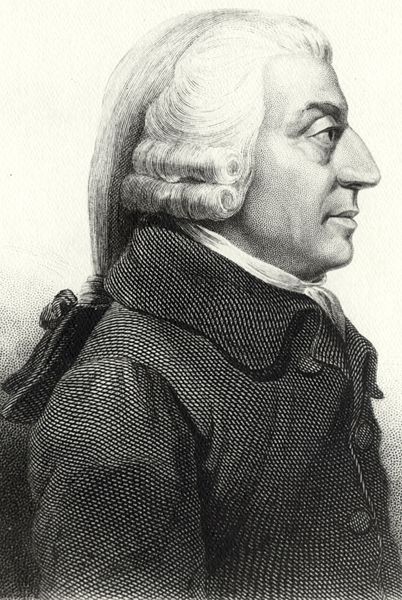
Given our present economic crisis in the United States, Hilton’s essay “Chalmers as Political Economist” is especially illuminating. Chalmers, says Hilton, reconciled the profit motive with Christianity. Self-interest, the axiomatic source of common weal in Adam Smith’s universe, may in fact receive God’s imprimatur. He simply posited a natural rate of economic growth. Men, however, must not transgress that natural rate by greed, and so indulge in excessively risky ventures. In brief, there is legitimate enterprise and there is speculation. And God judges speculation in the form of economic crises. God is the one who ‘pops the bubbles.’

In Chalmers’ view, fears of possible economic crises have two God-ordained positive effects on society. First, they serve as a dissuasive of excess. The inevitable “intervals of bankruptcy and alarm” in free markets “were not altogether a matter for dismay . . . for though Chalmers never says so explicitly, he seems to have regarded the threat of bankruptcy (with its harsh concomitant, imprisonment for debt) as a sort of positive check, commensurate with pestilences, working to force businessmen into moderation, to deter them from economic temptation, so that by subduing the sins of the flesh-pots they might find spiritual redemption” (148). Second, the crises have a certain purgative effect. “Impending crises were an essential part of God’s providential plan for regenerating and redeeming individual sinners and hence society as a whole” (145). Very naturally, then, Chalmers was an anti-interventionist like Adam Smith, albeit for evangelical reasons. He “held it essential that government should not thwart the dispensations of Providence by trying to prevent or alleviate business failure, any more than they should dole out alms to the poor” (148). Let God’s rod reclaim the transgressor!

Hilton rejects Chalmers’ distinction between legitimate business and speculation as “absurd” (147). “In practice the only way to decide whether a particular item of business was legitimate was by its outcome; like rebellion, it might be presumed to have had God’s blessing only if it succeeded” (147). To borrow our theme, Hilton thinks that Chalmers’ bridge just isn’t bridging. I would take strong exception to this. At the risk of sounding too much like an old Scotsman, I would say that Chalmers’ view is just plain common sense. Everyone acknowledges a distinction between legitimate, natural desire and greed. We have two distinct terms here, and the one is by definition the illegitimate excess of the former. Moderation means something, even if it isn’t always easy to ascertain.

But regardless, Chalmers’ old school, evangelical turn on Political Economy did not retain whatever popularity it enjoyed. The bridge was built, but increasingly it fell into disuse. By the end of Chalmers’ life, poor law reform was in full swing, dooming the old Scottish system of voluntary, parish-based charity in favor of ‘legally assessed’ – government mandated and funded – social welfare. And shortly after his life, limited liability legislation was passed into law, which “effectively emasculated the retributive mechanism of business failure” (153).

Hilton’s take on the failure of Chalmers’ outlook politically is that there was something deeper in his economic theory that was hostile to the prevailing mood of the age. It was his evangelical Calvinism:

Writers like Chalmers and Thomas Nolan who believed in the fever of speculation as a vital part of the economy of redemption were also men who held to a literal interpretation of the doctrines of Atonement, Eternal Punishment, Vicarious Sacrifice, Substitutionary Punishment, and the like. Defenders of this Evangelical scheme of salvation invariably adopted the Calvinist terminology of likening sin to a debt which was owed to God; God would have to exact his recompense in return but – by analogy with Christ’s atonement – did not care who precisely repaid the debt so long as it was repaid by someone (152).

It is not surprising, then, says Hilton, “when, in the middle decades of the century, fashionable theologians abandoned the doctrine of a literal and endless hell-fire, they too were opting out of the capitalist-spiritual system adumbrated by Chalmers; they were, in fact, limiting the liability of sin” (153). Hmm. Are today’s big government bailouts a direct consequence of a retreat from historic evangelical theology?

Closely allied to this bridge-building effort was Chalmers’ writings and activity in philanthropy or ‘social work.’ The ‘Christian good of Scotland’ was the great, burning desire of his heart. He believed that Christianity should pervade every facet of society and should be realized in acts of charity towards those who are in need. He was distraught to witness the dreadful physical, moral, and especially spiritual conditions of his countrymen, holed up like rats in the tenements of Industrial Age slums. And so when he accepted the call to Tron Church, Glasgow, moving from the quaint rural parish of Kilmany, he was determined to build a bridge. Thus, the ‘St. John’s experiment,’ in which he heroically retooled and re-implemented the parish model first for evangelization and second for diaconal work.

Having emerged from the experiment with (reportedly) great results, all eyes were on St. John’s. Here was living proof that by close, regular, personal interaction of the deacons with the poor of Glasgow, that the old system of voluntary benevolence could work in the new situation. The system appeared to be quite efficient on paper – the cost-benefit analysis blew the government plan out of the water. So why not implement this on a large scale within Scotland? Let the territorial churches take over the task of managing the poor without legal assessment, he argued.

Others in his day, however, roundly criticized Chalmers’ ‘bridge building’ here as unrealistic. Checkland informs us of William Pulteney Alison, a contemporary of Chalmers and a notable physician who also worked with the poor. Alison thought that Chalmers was out of touch with the new and complex order of society by advocating the St. John’s model for national care for the poor. Checkland quotes Alison, “In a complex state of society . . . there is no other way in which the lower ranks can be permanently preserved from an extremity of suffering” than by legal assessment (133). Chalmers rejoined with his famous On the Sufficiency of the Parochial System without a Poor Rate, for the right management of the poor (1841). But the future of poor relief, says Checkland, lay with Alison.

And rightly so, he suggests. “Chalmers took no real account of the fact, palpable to Alison and others, that good workmen were at the mercy of the booms and slumps of the trade cycle. Chalmers neither knew nor understood the evils of unemployment; it is hard to understand how he, living in Glasgow between 1815-1822, could have failed to appreciate so obvious a phenomenon. Chalmers was in effect helpless, locked into Malthusian theory and neo-classical economics. According to his interpretation, if any concession were made the whole fabric would disintegrate” (137).

Thankfully, his essay is not a total kibosh. Some things hadn’t changed and still ought to be recognized and applied. So Checkland concedes,

Chalmers did comprehend important truths about society. He insisted on the importance of the family as the basic social unit, a source of psychic support for its members. He urged that the neighborhood or ‘locality’ should become a focus for community activity; for social coherence to be effective it was necessary to work in terms of units that were manageable and which could command loyalty. He revived John Knox’s ideas of the deacons acting as concerned ‘social workers’; by so doing he was emphasizing the need for a social bond between classes, expressed in commitment. By stressing the need for the gathering of information, together with sustained contact, he presaged the need for professionalism in social work. Though these ideas were in a sense anticipated by Knox, they were of continuing value (137).

Maybe the bridge needs an overhaul, we might say; but there is a decent connection.

Friedhelm Voges, in his essay “Chalmers’ Thinking Habits: Some Lessons from His Theology,” also joins in the critique of his social program. He does acknowledge that Chalmers, “moved by a genuine Christian love especially for the common people” was “looking to restore the Christian Scotland of old [and] wanted to raise the working classes at least in a moral sense” (157). But Chalmers was subject to limitations, he says. “How did Chalmers come, for instance, to regard the assimilation of a town to a country parish as possible – even after his experiment had had to be discontinued” (157)?

He suggests that his limitations lay in certain failures of his theological and philosophical system. Voges, for example, asks how Chalmers could remain so optimistic about his social experiments when he so strongly affirmed total depravity? Shouldn’t Chalmers have been more skeptical about a plan run for sinners by sinners? And shouldn’t Chalmers have distrusted his own senses and sympathies more, rather than blindly following them under the justification of common sense?

His defense of the old Scottish poor laws as applicable in the new context reflects Chalmers’ conviction in the naturalness of God’s inviolable order in the world. By instituting the system of legal assessments, the English have traversed, to quote Chalmers, “the processes of a better mechanism instituted by the wisdom of God” (162). That ‘better mechanism’ is the old, voluntary system embodied in old, rural and parochial Scotland. But Voges argues that there is a serious defect here, in a system that brushes systemic human failure under the carpet.

Last, Voges points out another crack in Chalmers’ bridge. Obviously, Chalmers’ concern for evidence in scientific experiment strongly conditioned the St. John’s ‘experiment,’ both its trial and the publication of its results. As we have seen, Chalmers approached theology inductively, like a scientist; and that carried over to his foray in the (emerging) social sciences. But it is, says, Voges, problematic to approach sociology with the same confidence as a natural scientist. “Being used to the scientific approach, Chalmers probably fell for this temptation quite easily. His readiness to propose easy solutions for social problems, particularly poor relief, may well have its root here” (163).

But like Checkland, Voges leaves a little room for praise. While Chalmers was unduly optimistic and saw things as too easily explained and fixed, yet he writes, “there is also a strength in this approach: where Chalmers moved into immediate action, a greater realist might well have hesitated” (165).

Closely related to the area of philanthropy or social work is the area of evangelism. Here, Chalmers endorsed the same, tried and true vehicles for improving man’s inward condition as he did their outward. He didn’t give up on the old territorial principle and religious establishments, but sought that they should be reapplied in the new contexts.

It must be underscored that when Chalmers advocated the territorial principle, he was doing it to improve the outward condition of the poor in a secondary way. But, as Mary Furgol helpfully observes, this was not his primary reason. “The main purpose behind the plan, however, was still the religious one of bringing the Good News to the poor, and it is vital to understand this when examining his later solution of the problem of poor relief and assessing its impact and success” (128). The St. John’s and West Port experiments are usually – even by evangelicals who write about Chalmers – regarded primarily as philanthropic success stories. If they were successes in this regard, however, it was not this that Chalmers was after primarily. Chalmers was after the good of the soul, then the good of the body. In that order. Territorialism worked for both purposes.

Chalmers’ leadership in the Church Extension campaign of the 1830s, according to Maciver, was a way to implement his evangelistic territorialism of St. John’s on a national level. “He gained national fame through the vehemence with which he urged his vision of reinvigorated ecclesiastical Establishments altered to meet the changing state of 19th-century society” (31).

The evangelistic bridge builder that he was, Chalmers acknowledged the realities of the shifting political and socio-economic scene. Traditionally, it was the landed aristocracy that would be solicited to endow ventures such as the building of new churches. But in the Church Extension campaign, he came to rely heavily on the financial support of the rising middle-class, the merchants and industrialists. Though an establishmentarian, he was clearly not at all coy about employing ‘voluntaristic principles’ (fundraising), and so drawing the scorn of the Dissenters. He even became a de facto Voluntary himself at the Disruption, when the Church of Scotland would not budge on the patronage question. The Free Church later benefited from Chalmers’ experience that he obtained in leading the Church Extension campaign, and charted a course for a profoundly successful new denomination. Through all these vicissitudes, Chalmers remained what he always was; but given changing circumstances, he adapted.

It is interesting to note, in passing, how very practical Chalmers was when it came to issues of Church organization. Roxborogh writes,

For Chalmers the organization of the Church, like the organisation of theology, was subservient to the task of proclaiming the Gospel. On reading a sermon which argued that the Church was free in different times and circumstances to alter its government, worship, and discipline, since its ‘institutions stand not on the strength of statute, but in that of their fitness to fulfill the great objects of her mission’, Chalmers felt moved to write to the author agreeing that it was ‘competent on mere human discretion to decide on questions of ecclesiastical regulations and polity’ (180).

I cannot help but wonder, however, how well this mentality went over with his conservative colleagues. Surely this outlook does not represent standard jus divinum Presbyterianism.

McCaffrey further illumines Chalmers’ evangelistic, bridge-building priorities within the Church organization. Bridges must be built to the common man, and to that end, certain things were prominent in his thinking. “Whether the question concerned pluralities, veto, or church extension, one idea was common to all and in publicizing he made his reputation. Two things were essential to it: character and locality. The quality of the population would be assured by an effective teaching Church. The appointment of ministers to parishes and popular assent to these appointments had to be reconciled to ensure orderly progress. The common man and his attitudes were the key” (43).

Having examined a few areas in which Chalmers sought to bridge the gap of Christian truth – biblically and historically – to the contemporary age, it will be helpful reemphasize why.

Why was Chalmers a bridge builder? Roxborogh is most helpful on this point. Again, it was because he was interested in ‘Christianization.’ He longed for the gracious dominion of Christ to find expression in every age, among every people, in every facet and dimension of human life, from the private individual to the structures and institutions of civilization. For Chalmers, Christianity ought to be applied to the whole of society. “Every part and every function of a commonwealth should be leavened with Christianity” (181). Christ must rule in the natural sciences, in mathematics, in economics, and in social issues of the day, especially welfare. “The kingdoms of the earth,” says Chalmers, “may become the kingdom of God and his Christ with the external framework of these present governments . . . . There must therefore be a way in which Christianity can accommodate itself to this framework – a mode by which it can animate all the parts and all the members of it” (181).

There can be no doubt that Chalmers was a bridge-builder and why he was one. But was he effective?

Part of the answer depends on our values. In her essay, Mary Furgol emphasizes the fact that Chalmers sought to convert first and clothe second. The greater question, then, is whether Chalmers’ preaching and pastoring was effective in the conversion of the poor and whether his influence on other ministers and missionaries brought in a gleaning worthy of their calling. I think the question about Chalmers’ ultimate success is similar to asking, was Jesus successful? Well, it depends on what index you’re using. By the measurements of the Jewish religious establishment, he was a resounding failure. “He saved others; himself he cannot save” (Matt. 24:42). But to his followers, and in the judgment of many successive generations, the verdict is far otherwise. The servant must be content to be as his Master and to endure the critique of those who judge with a human judgment.

Further, much depends on whether one presumes that bridge building is a good thing to begin with in the first place. There are two alternatives to biblical bridge building. There is retreatism and isolationism on the one hand and syncretistic absorption in the culture on the other. It’s not always easy to define either extreme, I admit. But if you’re a retreatist, building your bunker and waiting for the sweet by and by to come, Chalmers is not your guy. And if you’re such a progressive that the Christian tradition of the past has nothing to say (norma normata), much less the antiquated rule of our faith, the infallible Scriptures (norma normans), then you might as well not be a Christian. To be a Christian means building bridges – not failing to build them, either because you are unwilling to embark from your shore or because you are prepared to bid adieux to it once and for all.

But the question is fair – and one that Chalmers would ask of himself anyway! Assuming that we share Chalmers’ values as well as the Christian ideal of bridge building, the results are mixed. Let’s face it. No one is perfect. Certainly Chalmers didn’t think that he was. Perhaps the lion share of criticisms above is fair.

Yet, his successes must not be underrated. Chalmers has left his indelible imprint upon Reformed and evangelical Christendom in Scotland and beyond – not to mention the field of Sociology, Christian or otherwise.

I would suggest that too few followed Chalmers at the pivotal point of the mid-19th century when the old order was passing. In terms of evangelism, Dissenters wanted to abandon establishments and the territorial model of Christianizing a land. These structures were viewed as outdated and invalid. There was too quick an embrace of a lasseiz faire model of Christianity and a rejection of the ‘planned economy’ of the older order. In terms of poor relief, it seems that the pendulum swung away from the localized, voluntary plan of old, rural Scotland, without resting at a golden mean that might have involved a cooperation between central government and territorial church-based poor relief. But now we have the Welfare State, and Chalmers’ plan remains an interesting historical footnote.

In these and other areas, I fear that too few tried to build bridges. But perhaps Chalmers can inspire us to understand and appreciate the old better and seek to implement in the present day the timeless essence of what made it good – without selling our soul to the culture. A delicate balance indeed. Sort of like being a practical pietist.

[Go to part 2]

Anstruther Parish ChurchIn the modern day, old orders are forced to give way to new ones.  This is the inevitable process of capitalism.  In 1942, Joseph Schumpeter coined a phrase for this, that apparently became a buzzword in the dot-com boom of the 1990s.  He called it “creative destruction.”  It is a “process of industrial mutation that incessantly revolutionizes the economic structure from within, incessantly destroying the old one, incessantly creating a new one” (http://www.investopedia.com/terms/c/creativedestruction.asp).

As I was reading further in Greenspan’s Age of Turbulence, he illustrated the opposite of this principle on a holiday with his wife in Venice.  “Venice, I realized, is the antithesis of creative destruction. It exists to conserve and appreciate the past, not create a future. But that, I realized, is exactly the point. The city caters to a deep human need for stability and permanence as well as beauty and romance. Venice’s popularity represents one pole of a conflict in human nature: the struggle between the desire to increase material well-being and the desire to ward off change and its attendant stress” (181).

There we have it again.  A deep human need for the once-familiar and once-enjoyed ‘rootedness.’  We wish we could have it again, and enjoy what once was – true community.  “Sometimes you want to go / where everybody knows your name, / and they’re always glad you came.”  

The Anstruther of Thomas Chalmers’ childhood was his Venice.  It hadn’t changed in his memory, and it would never change in that sense.  Only, Chalmers wasn’t going to let Anstruther remain locked up in the past or remain only as a quaint tourist attraction for future generations.  He fully realized that the idyllic parish community of his childhood would never remain exactly the same; yet he sought to transplant its essential features to the slums of St. John’s in Glasgow and the West Port in Edinburgh.  That is, I think, part of the genius of Chalmers.  In an age of change, he didn’t pay homage to creative destruction.  He reckoned with its reality, yes – perhaps successfully, perhaps not so successfully.  But the past was worth preserving; or better, the past was worth reimplementing.

“By 2006, nearly 69 percent of households owned their own home, up from 64 percent in 1994 and 44 percent in 1940.  The gains were especially dramatic among Hispanics and blacks, as increasing affluence as well as government encouragement of subprime mortgage programs enabled many members of minority groups to become first-time home buyers.  This expansion of ownership gave more people a stake in the future of our country and boded well for the cohesion of the nation, I thought.  Home ownership resonates deeply today as it did a century ago.  Even in a digital age, brick and mortar (or plywood and Sheetrock) are what stabilize us and make us feel at home” (Alan Greenspan, Age of Turbulence, p. 230).

Notwithstanding the subprime debacle that has thrown Wall Street into a tailspin since this quote, Greenspan’s last observation struck me.   The preconditions for community in the historic sense are vanishing in our day with advancements in travel, technology, and communications.  As we are annexed into the Global Village, we become the neighbors of all and none at once.  But we will never shake our longing for rootedness.  And as social beings, we want to be rooted together.  So as long as we have houses and as long as we have neighbors, we have the raw materials for the old community to be revived.  What is needed is the Spirit of God to breathe into these dead bones and constitute true communities again. 

But God’s Spirit is at work today, and He is rebuilding true community.  It can be found in the Visible Church, consisting of those who profess the Christian gospel and their children.  Yes, we bear the imprint of our culture.  More often than not, we no longer live in geographic community.  We have drifted far from that ideal that we discover in the ancient church of Jerusalem, “And all that believed were together . . . and they continuing daily with one accord in the temple, and breaking bread from house to house, did eat their meat with gladness and singleness of heart . . .” (Acts 2:44, 46).  But though we must travel by car, call by phone, or communicate by e-mail, God’s people have discovered that God has preserved and is remaking community in a day when it seems past repair.  There is still a “togetherness,” a “one accordness” in our congregations. 

And yet I for one haven’t given up on hoping for the reemergence true, Christian communities on a large scale.  I hope to see the kind of communities that prevailed in Scotland, the Netherlands, and New England.   Communities leavened with the Gospel – people walking to church once again.  Neighbors enjoying brotherly fellowship, older matrons giving a helping hand to harried young mothers, baptized children playing together in front of their own houses.  Those same children growing up, falling in love, marrying, and ushering in third and fourth generation to the church of their childhood.  Ministers working in tandem for the Christianization of cities, regions, and states, not resting until the lump of the nation has been filled.

I hold out that hope because, as Greenspan has said, people still want to put their roots down.  And they still want to live in community.  And even more importantly, God is still at work, preserving and building true community up.  If He is building true community, and that community is constantly seeking to enfold the alienated (Eph. 2:12), then the neighborhoods in which our people live can easily be future parishes in the old fashioned sense.  Within our church communities, there are still ‘brick and mortar’ houses.  And these can – they must! – become beachheads from which our church communities expand and realize themselves. 

Greenspan is right.  Community is not dead.  But more to the point, God has said it – and He is at work!

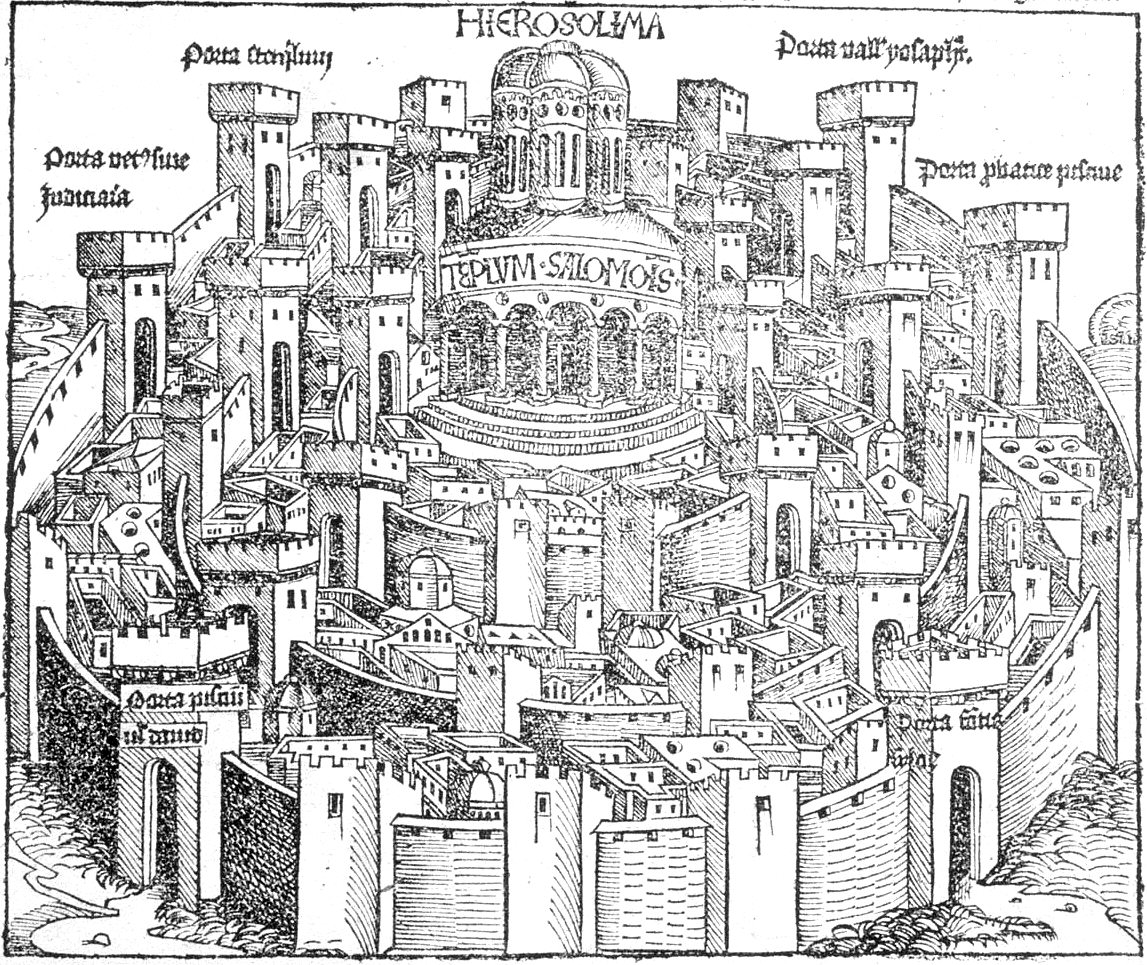
“Thus saith the LORD; I am returned unto Zion, and will dwell in the midst of Jerusalem: and Jersualem shall be called a city of truth; and the mountain of the LORD of hohsts the holy mountain.  Thus saith the LORD of hosts; there shall yet old  men and old women dwell in teh streets of Jerusalem, and every man with his staff in his hand for very age.  And the streets of the city shall be full of boys and girls playing in the streets thereof” (Zech. 8:3-5).

As I was on the road a couple nights ago, NPR’s All Things Considered was broadcasting a piece educating Joe the Plumbers like me concerning a major, yet overlooked catalyst contributing to the present economic crisis.  That villain is called the ‘Credit Default Swap.’  Very briefly, what was once a sober mode of obtaining a form of investment insurance degenerated into what professionals concede was nothing less than gambling.  For the full text and/or to listen to the piece, go to How Credit Default Swaps Spread the Financial Rot.

Interestingly, I just came across an insightful quote that bears directly, I think, on this whole financial debacle from an biblical perspective:

We believe that in this speculating world, amid all these risks and ventures which perhaps must be entered into to make business prosperous and to keep pace with the age, it is only a very strong religious spirit, a practical exercise of religion, that can make anyone judge accurately between legitimate and reckless commercial speculation. . . . From the danger we are all in of taking our moral standard from the tone of the common morality of society, we are apt to forget the higher standard of the law of Christ. [But] we are every now and then recalled to a sense of the difference of these two standards by some tremendous commercial failure; in which we see that speculation has been carried so far into the region of uncertainty and risk, that trust and confidence has been abused, and the ruin of one man has invovled in it that of hundreds, who trusted in him.  Now we only see this by reason of the failure of speculation, not from the speculation itself: had that proved successful instead of disastrous, many would not have seen the immorality at all (Anonymous review in The Ecclesiastic and Theologian, vol. XXII, 1860: 261-64).

I am temporarily putting the review of Parish and Parish Church on hold.  I have another volume on interlibrary loan, here, that is due soon.  So if you are among the small readership, I haven’t forgotten!  And since I am on this side note, if anyone knows any fans of Thomas Chalmers, the history of the Disruption / Free Church of Scotland, and especially those who are interested in the old parish model of church organization and witness, please let them know about this blog.  I am an amateur in these areas and would appreciate any helpful, constructive comments that could help shape my grasp of things.

* * * * * * * * * * * * * * * *

Owen Chadwick has a very interesting essay entitled “Chalmers and the State” in A. C. Cheyne’s collection The Practical and the Pious: Essays on Thomas Chalmers (1780-1847). It sheds some more light on Chalmers’ approach to church establishments, a subject which I have recently treated (https://westportexperiment.wordpress.com/2008/08/22/chalmers-on-church-establishments-part-1/).

Chadwick rises to Chalmers’ defense of establishments, clearing him from unjust aspersions cast against him during his day.  He stresses the point more clearly than I think I did previously, that what drove Chalmers to a defense of religious establishments was his largehearted, Christian concern for the poor.

The praise which no one could ever deny him is that he cared about the poor with a compassion which was also the leading passion of his life.  How he cared about the poor, what methods he proposed to care for the poor (some of the methods seem peculiar, and not many of them would b e acceptable to the Welfare State of the 20th century), and also the practical results of the compassion, are in question.  What is not in question is that he cared.  His entrie theory of an established Church rested on this compassion for the poor.  At the Tron Church in Glasgow he learned for the first time the nature of the urban slum, and this experience conditioned the rest of his life.  He saw that no voluntary system could cope.  Chapels supported by their member were chapels of the middle class.  They might be chapels of the lower middle class but they were not chapels of working men and they were not in the right place.  No system of raising money by gifts and bazaars could ever be enough.  Therefore the State must act and supply, or at least must supplement all that voluntary effort could achieve (70).

His 1830 lectures on establishments in London were well-received by the Conservative Party, who continued to view the aristocracy as placed by God to be benevolent patrons of the common people.  In these lectures,

His love for the poor was very evident when he talked of slums, only recently regarded as unsafe for members of the middle class to enter, but now visited by a minister, which had become places of cheerfulness and friendliness and welcome.  When he speaks of the apostolic drive towards a better people and a higher morality and an enlightened education among the once illiterate areas, the lectures, and indeed the whole theory, are stamped with a deep sense of optimism: the Church moving forward powerfully into the new age on behalf of the poorest people.  The lectures were not only strong because they were just what English Tories wanted to hear.  They were strong because the idea of Establishment was so obviously rooted in compassion for suffering humanity (75).

We might think such ideas highbrow.  But they were genuinely benevolent.

Sadly, the Dissenters used their political influence to quash Chalmers’ hopes for the Melbourne government to help the Kirk build more churches in the sprawling, unchurched cities.  They unjustly feared that he and his party aimed at the destruction of Dissent, whereas he only “cared about the poor” and was “friendly to Dissenters as workers in the same field” (71).

These comments of Chadwick’s prompts a related observation.  In terms of policy, Chalmers would have been totally antithetical to the 20th/21st century Welfare State.  He had no time for non-localized charity, managed directly by a central state bureau.  Yet, was Chalmers against the government’s intervention to secure the welfare of the poor?  Of course not.  Rather, he thought that government should subsidize the Christian ministry to evangelize and pastor the poor, caring first for their imperishable souls, and secondarily to assist them materially through responsible face-to-face involvement.  Such a plan, modelled in his St. John’s Experiment and later on in the West Port, tended to preserve the dignity and promote the industry and independence of the poor.  The government certainly ought to intervene in the situation, even if only as a matter of sound fiscal policy.  To establish a Church would be, in Chalmers’ calculations, to save the state huge sums of money.  But the state must intervene for the welfare of the poor indirectly.  To indulge in an anachronism, Chalmers did in a sense believe in the Welfare State – only as outsourced to the Christian ministry.

It is interesting to note that, in Chadwick’s appraisal of the man, Chalmers thought that “it would be relatively easy to reunite the Protestant denominations in a single established Church” (74).  Chalmers was clearly a broad evangelical for his day.  Some have called him ‘the Apostle of Union.’  I don’t doubt that statements in his lectures on establishments tend in the direction of supporting a pan-evangelical establishment.  They are reminiscent of Rabbi Duncan’s quaint credo, “I’m first a Christian, next a Catholic, then a Calvinist, fourth a Paedobaptist, and fifth a Presbyterian. I cannot reverse this order.”  But whether Chalmers thought it would be easy to unite the evangelical denominations under the umbrella of the 1830s Church of Scotland is another thing.  Maybe there is evidence for it in his unpublished manuscripts.

But Chadwick is spot on when he says that, after a broad Protestant consensus, the (secondary) basis for a Church establishment in Chalmers’ thought is the principle of territorialism, not a more nuanced doctrinal stance.  “The idea that you should choose a Church on grounds of polity was not all to his liking” (74).  He had the goal of Christianizing Scotland always uppermost in his mind, and the best way to Christianize is to localize.

Last, I found it quite helpful to have the following points in greater clarity.  Chadwick indicates that the handwriting was on the wall for Church establishments in the 1800s not only because of the huge demographic shift from country to city, but also because of the changing political environment with the push to and the achievement of full political freedoms for Roman Catholics and Dissenters.  The “relation of new quasi-democracy to old oligarchy” was pushing at the seams of the old order (77).  With the political forces shifting, the purse strings from the State were bound to be cut.  The voting blocs were not remaining static.

A Review with Observations on Parish and Parish Church: Their Place and Influence in History, by P. D. Thompson

Part 1

In Parish and Parish Church, the ‘Baird Lecture for 1935,’ P. D. Thompson traces the origins, development and significance of the parish system in Western Civilization. It is a very useful volume, stimulating a number of interesting observations in my mind on the institution that has become interwoven in the fabric of Medieval and Reformation Church life and mission. And if the old parish model is to be of any contemporary application as I suggest (see About ‘West Port Experiment’), this book will go a long way for modern day pastors and missionaries. To know the past is to have a roadmap for the future.

Thompson’s treatment of the birth of the ecclesiastical parish is very enlightening. His main contention is that the early Church basically took over an organizational unit or division typical within Greco-Roman civilization. The original parish or paroikia in the first place “signified that section of the inhabitants, living within the bounds of a town or city, who were not citizens in the strict sense of the word, but foreigners or sojourners. In the second place, it signified a community living outwith the bounds, either in a detached suburb or in more widely scattered hamlets and villages in the surrounding rural area” (1). Analogous to the first sense are the ethnic ‘quarters’ or ‘districts’ of Industrial and Post-Industrial era cities.
Now, the New Testament Church did not consciously adopt the ancient division. It is not as though Paul drew up a map of the Mediterranean nations and parceled the area out into a nice and tidy parish system. But insofar as he and his associates strategically infiltrated cities first and the outlying rural (‘pagan’) areas second, they did in a way adopt the parish model. They evangelized the cities and countryside in all their pre-existing districts, enclaves, and regions. Paul intentionally went into the Jewish quarters of each city. He sought to leaven them, and from them to leaven the cities. The first district to become Christianized was thus the beachhead into the city, and the city with its several house churches (Acts 2:46, 20:20; arranged by district?) was the beachhead into the countryside.

While Thompson does not particularly reference New Testament passages in support of the concept directly, I would contend that certain verses show that Paul operated on a territorial principle, which is merely the genus to the species of the parish system (Rom. 15:18-24, 2 Cor. 10:14-16; see my treatment of this elsewhere, https://westportexperiment.wordpress.com/2008/06/04/the-settled-ministry-itinerancy).

In any case, I think Thompson is quite correct to say that the New Testament Church properly and wisely took up the territorial organization of the ancient world for its ecclesiastical organization and missionary strategy. This was only natural since the structures lay ready to hand.

It was entirely in keeping with the policy of the Church from the beginning and for many a century that it should have laid hold of such a secular institution as the ancient parish, adapted it to its own purposes, and ended by transforming it into something wholly different from what it originally was. Wherever throughout the long course of its history the Church came across any pagan institution or custom that could by any means be used to advantage or turned to Christian ends, it sought to breathe into it the Christian spirit, impart to it a Christian significance, and shape it accordingly. That was its deliberate and invariable policy and practice. Like its Master, the Church ‘came not to destroy but to fulfil’ (7).

The charter of Christ permitted and even called for His Church to repossess the strong man’s spoils.

I do think, however, that Thompson oversteps biblical warrant when he continues, “in the same way [the Church] adopted pagan popular customs, such as nature festivals and the like, breathed into them the Christian spirit, gave them a Christian stamp and significance, and transformed them into observances of the Faith and allies of the Gospel” (7). Now, there is nothing wrong with taking over indifferent customs and practices into the bosom of the Church’s life and witness. The Puritan divines put it well when they wrote “that there are some circumstances concerning the worship of God, and government of the church, common to human actions and societies, which are to be ordered by the light of nature, and Christian prudence, according to the general rules of the Word, which are always to be observed” (Westminster Confession of Faith 1.6). But there is a world of difference between indifferent customs and unredeemable ones. Certainly the Ephesian Christians didn’t think that Diana icons should be rededicated to the Blessed Virgin, or that their books of sorcery were useful for any other purpose than for kindling (Acts 19:19)! There is nothing inherently idolatrous in a civic unit of organization; there is in pagan nature festivals. That explains why Calvin and Knox retained the parish system and rid the Church of Christmas, Easter, and the myriad of saints’ days.

Thompson’s sketch of the early Church’s appropriation of preexisting territorial structures does seem quite plausible, fitting with the facts as we have them. First, Thompson notes that there was the practical problem of the administration of charity recorded in Acts 6, which may have lent itself to the adoption of a kind of parochial organization as it certainly did to the emergence of the office of the deacon. Diaconal care had to be centrally organized in the city church, with the resources of the various district or house churches pooled in what he calls the Mother-Church, “so that none should receive preferential treatment and none be neglected” (15). Seven deacons were appointed to superintend the fair distribution of the common resources throughout the church, doubtless as it was organized in its subdivisions.

Even anterior to this contributing development was the logistical problem of meeting places in the context of a burgeoning church. “As the Gospel was preached in the original Mother-Church and propagated by the life and witness of believers, and as the number of believers multiplied and spread throughout the city, there would neither be room for them to worship together in one building, even if they could conveniently reach it, nor would there be facilities for their Christian instruction. As occasion required, therefore, meeting-places, which became churches in their turn, must needs be provided in ward after ward, until the whole city was adequately churched” (15). And with designated meeting-places came the deployment of ministerial manpower for the services, ward by ward.

Just like the parish, the diocese (dioikesis) was also an ancient territorial division. The development of the diocese, however, reflected more the circumstances of a developing episcopacy. As certain bishops were elevated in status and recognition over their peers, “it was [deemed] fitting that the territorial area under the bishop’s supervision and administration should be correspondingly enlarged, and receive an added dignity and importance. This was done by extending the bounds of the episcopal parish, and giving it a lordlier name” (18).

Perhaps it is for this reason that the Reformed Churches took over the parish system, but not the dioceses. The latter went hand in hand with episcopal preeminence from the very beginning. But obviously the Reformers had no qualms with larger territorial units of ecclesiastical organization, provided that they didn’t facilitate or support episcopacy. One thinks of how ‘presbyteries’ and ‘synods’ were used interchangeably for governing bodies as well as for territorial divisions of labor.

I just started reading Thomas Chalmers’ Discourses on the Application of Christianity to the Commercial and Ordinary Affairs of Life. Here is a profound quote that strikes me as a prophesy fulfilled this week on Wall Street.

“Without offering any demonstration, at present, upon this matter, we simply state it as our opinion, that, though the whole business of the world were in the hands of men thoroughly Christianised, and who, rating wealth according to its real dimensions on the high scale of eternity, were chastened out of all their idolatrous regards to it – yet would trade, in these circumstances be carried to the extreme limit of its being really productive or desirable.  An affection for riches beyond what Christianity prescribes, is not essential to any extension of commerce that is at all valuable or legitimate; and in opposition to the maxim, that the spirit of enterprise is the soul of commercial prosperity, do we hold, that it is the excess of this spirit beyond the moderation of the New Testament, which, pressing on the natural boundaries of trade, is sure, at length, to visit every country, where it operates with the recoil of all those calamities, which in the shape of beggared capitalists, and unemployed operatives [workers], and dreary intervals of bankruptcy and alarm, are observed to follow a season of overdone speculation.”

Once again, Chalmers being dead yet speaketh.


Chalmers on Church Establishments, Part 4
Some Closing Observations & Questions

Now that we have completed an overview of Chalmers’ Lectures on the Establishment and Extension of National Churches (1838), I’d like to make a number of observations and raise some questions. I’ll start with general ones and then cover some specifics by subject.

So first, some observations and questions on the whole.

One cannot read through Chalmers long without figuring out that he was a practical thinker. He had goals to which varies strategies and experiments were subservient. Strategies, further, are only as good as they work efficiently. Chalmers argued for religious establishments because they were, in his judgment, very useful and proven expedients.

And the goal? In a word, ‘Christianization.’ Or, more specifically, ‘the Christian good of Scotland.’ His vision was the infiltration of the Gospel throughout his home country and its anticipated leavening effects socially. He dreamed of realizing within the darkness of industrialized Britain the old Christian communal ideal of his childhood memories. So really, we should say that Chalmers was a practitioner second and a visionary first.

It is also clear that Chalmers was a large-hearted philanthropist. He was concerned with the well being of the poorest of Scotland. They needed an endowed establishment because they did not have the financial wherewithal to support the ministry. And, more often than not, they lacked not only money to support the ministry, but even the religious impulse to go and seek after the good of their souls. Should they be left to themselves, sitting in the sink of their moral, economic, and especially spiritual squalor?

This dovetails into Chalmers’ view of government, which manifests itself in these lectures as thoroughly paternalistic. Frequently, he appeals for national establishments on the principle that parents should “lay up for the children” (2 Cor. 12:14). “What is true of the smaller family of a household, holds true of the greater family in an empire. If both the parent in the one case, and the governor in the other, be chargeable with a guilty indifference who should suffer their respective families to remain unschooled – there is guilt of a deeper die, if, by the indifference or neglect of either, they are suffered to remain unchristianized” (92). If a Christian father is duty-bound to provide Christian instruction to his children at home, ought not the ‘city fathers,’ as it were, patron-ize a religious establishment to school their citizens in the teachings of Jesus?

The last general observation is that it seems the tone of his lectures fail to reflect a strong evangelical concern for personal salvation. He does speak about the civilizing influence of Christianity (167) and urges the endowment of a national Church as reflecting a “true and enlightened patriotism” (170). This, of course, does not show that Chalmers lacked a passionate zeal for the personal salvation of those who would benefit from a robust establishment. He most certainly did. But if I am at all putting my finger on something here, my guess is that this subdued evangelicalism reveals a broader audience, even those influenced by the Moderatism of his time (from which his evangelical conversion had freed him!). The Moderates were all for education, all for civilization, and even for Christianity insofar as it furthered man’s intellectual, moral, and social condition. If they could stand with him in this cause, then so be it. In short, I think it is important for us to read these lectures, not as seminary addresses on Missiology for churchmen, much less as a series of sermons to rally the troops back at church. But we should read them with the sensitivity that they were delivered and published for many, not the least of whom were MPs sitting on the fence of a pressing, political question.

Now, some specific observations and questions; and first, on the particular establishment theory of Chalmers. His arguments strike me as distinctively post-Enlightenment. For him, a national establishment means the endowment of a national Church in an environment of political tolerance. His Scotland was a “land of perfect toleration” (182). And so his establishment is one that encourages and promotes, but doesn’t discourage, much less impose sanctions on the Kirk’s enemies. There is no sword here to back up the Church, and it is here where I sense a break with the original establishmentarianism of the 16th century magisterial Reformers and their 17th century heirs. One searches in vain to find language in the Lectures that comes anywhere near the words of the Westminster Confession of Faith on this point, that it is the duty of magistrates to ensure that “all blasphemies and heresies be suppressed, all corruptions and abuses in worship and discipline prevented or reformed, and all the ordinances of God duly settled, administrated, and observed” (WCF 23.3).

However, while I do perceive a break here, there does seem to be strong continuity between the magisterial Reformers and Chalmers in a shared paternalistic view of government. Chalmers followed in well-worn paths when arguing that magistrates should be “nursing fathers and mothers” to the Church (Isa. 49:23). There is also continuity in his argument against indifferentism on religion in the affairs of the state; and so he here appears to be in open conflict with the Enlightenment trajectory. “It is reckoned to be in the magistrate the very perfection of enlightened patriotism on this subject, when like Gallio he cares for none of these things” (92). Such make a distinction between “Christian governors and a Christian government” (94). But Chalmers will have none of it, much as his spiritual forbearers.

By way of humble criticism, it appears as though Chalmers’ arguments against the Voluntaries are too simplistic. He puts the onus back on them to demonstrate why they should hold aloof from the established Kirk, when the differences that separate them from her are so minor. But what of confessional subscription? And even if the Voluntaries had wanted to return, would the Kirk have been as willing as Chalmers to re-welcome them into the fold?

I am also unsettled as to Chalmers’ arguments for the basis on which the government should select one Protestant denomination over another. He argues that it is a purely practical one. Which denomination is best for the goal in view, that is, the Christian education of the people? Here again, the highly practical character of Chalmers comes through. But what is meant by ‘best?’ Does this mean the most efficient organ for teaching the people? If so, then this is a question of teaching performance, not of teaching content. If this is the basis, couldn’t the government occasionally test the performance of the established Church, and finding it unsatisfactory, experiment with the performance of, say, the Methodists? He does argue that doctrine counts in the selection process when the choice is between Roman Catholicism and Protestantism, but does it count for nothing after that choice is resolved? What place, then, do the Westminster Standards hold in this matter?

The second specific observation is on his treatment of free trade and Christianity. I find this section absolutely fascinating and do not know of anyone before or since who has dealt with it as capably as he. It is spot-on! Chalmers seems to have put his finger on the beginnings of a market-oriented paradigm in the evangelical world long before it flowered [or degenerated] into the seeker-sensitive paradigm of today. And I think he has defined the issues in clearer philosophical terms than I have come across even in modern critics of that movement. One could say that Willow Creek is a natural consequence of importing the principles of liberal economics – the free, uninhibited exchange of goods and services by the operation of the law of supply and demand – into the work and witness of the Church.

A related observation needs to be made here. Chalmers presumes a Calvinistic anthropology in his arguments against free trade in Christianity. Man is totally depraved. “Nature does not go forth in search of Christianity; but Christianity must go forth in search of nature” (53). That is why it is profoundly flawed to subject Christianity to Adam Smith’s economic principles. But this rejection of laizzeis faire religion, so to say, only makes sense within the Calvinistic orbit in which Chalmers then moved. Could he have envisioned the ascendancy of evangelical Arminianism in Great Britain and America, with its somewhat more optimistic anthropology, he might have been able to predict Willow Creek. That is, he might have forecasted the adaptation of Christianity to the unsaved man. Make the supply of Christianity more attractive, and the demand in the spiritually ‘sick’ will be teased out. There were really two enemies at work, then. Free trade, the commodity, and evangelical Arminianism, the willing buyer.

Last, some observations on what I call Chalmers’ secondary strategies in Christianization. The primary strategy is the funding – for which an establishment exists. The secondary strategies are territorialism and education. (I’m not totally comfortable with ‘primary’ and ‘secondary’ strategies, since he contends that the great strength of establishments lies in its usefulness to implement territorialism.)

I’ve written elsewhere on Chalmers’ advocacy of the locality principle, or territorialism. But before simply passing on, a couple of comments are in order.

The first is that Chalmers has explained for me something that I think I hadn’t understood – or fully understood. The language of a ministerial ‘charge’ has been a longstanding part of Reformed ecclesiastical jargon. A minister is installed into a pastoral ‘charge.’ He therefore has a responsibility placed upon him by God and superintended by his colleagues. Is he faithful or unfaithful in his charge? I think, however, that contemporary Reformed Christianity has lost a significant element of what Chalmers, following in the steps of the Reformation forefathers, understood in a ‘charge.’ A charge for them was more than a defined congregational responsibility. It was that, but it also included the assigning of a district to a minister for evangelistic efforts. The congregation and the parish, related but distinct, were his twofold charge. Ideally, the meetinghouse would be located within the assigned geographical district to evangelize that the minister could more easily and efficiently perform both duties in his charge. Incidentally, I suspect that the same flattening of meaning occurs today with the language of presbyterial ‘bounds.’ But that rabbit trail will have to wait for another day!

I would also like to raise a question about a somewhat peripheral matter on territorial visitation. Chalmers responds to those who suggest that district visitation is idealistic by saying that warmth and appreciation should be the natural response among those visited (156). And that was, he says, his and others’ experience. However, one might ask whether the people whom Chalmers and others visited responded with such warmth in large part because they enjoyed fond memories of ministerial visitation in their past. Those who lived in these large, industrialized urban centers in the 19th century were largely former country-dwellers of rural Scotland. And so they (and if not they, then their parents) probably would have had exposure to a regular parochial ministry that would have included house-to-house visitation. If that is the case, then one should not necessarily expect such a warmth for clerical visitation in a place where this had never really been the practice, such as the United States. This is not an argument against the territorial principle, of course. I am fully behind a modern-day application of it. But I think that people will be tend to react with more coldness to such visitations in part because it was never a cherished memory. And then, of course, there is the pesky problem of the Russellites.

The other ‘secondary’ strategy that Chalmers touches on is education. This has had a long history as a tool in the Kirk’s handbag for the Christianization of Scotland, going back to the magisterial Reformation under John Knox. It is not surprising then for Chalmers to place a bulk of his hopes for the success of the territorial plan on the work of the parish schools.

Our best hopes, we confess, are associated with the coming up of another generation; and under a right treatment of the ductile and susceptible young, congregated in parish-schools, and trained from earliest boyhood to a punctual attendance on the ministrations of the parish clergyman. He [a territorial minister], if put in possession of a complete parochial economy, is on mighty vantage ground . . . Over and above the juvenile influence, which, through the medium of their youth, he transplants into the bosom of families, these schools become the direct nurseries of the church, – the feeders, as it were, of that grand reservoir, which, in return becomes the center and the fountain-head of a rich moral dispensation, to the neighborhood around it; and so more prolific blessings every year, as it rises onwards from its first slender beginnings – till filled to an overflow, even before the expiry of the present, or commencement of the succeeding age (168).

For Chalmers, both territorialism and education are expedients in the program of the Church’s extension, and expedients in the life and witness of the Church are not ipso facto wrong. But I question whether education ought to come under the direct auspices of the Church, like an agency within an organization. There are two reasons I raise this doubt. The first is biblical, the second more theological.

In terms of the biblical objection (and I raise it very hesitantly, before such a revered figure as Thomas Chalmers), education – vocational or literary education, that is – is more of a distinct institution. And as an institution, it does not appear to have been placed by Christ under the direct government of the Church. The ascended Christ has lavished officers upon His Church and has committed to them the keys of the kingdom of heaven. They preach, teach, administer the sacraments and exercise discipline. But vocational/literary education of the young doesn’t factor here. This would seem to come under the auspices of parents, who are to provide for their children (2 Cor. 12:14 – and maybe this argument can be used to justify the state’s purview in education, if the government is an assembly of civic fathers). Territorialism, on the other hand, does not appear to me as a distinct institution, but is nothing other than a wise deployment of the Church’s officers and ordinances in the interests of its unity and propagation. It doesn’t ask for a place among the institutions or ordinances of the Church, but simply says, please use them wisely and efficiently! Don’t get me wrong. I am a firm believer in Christian education. And the Church certainly has an interest in the education of the young. But its influence must be indirect.

I could misunderstand Chalmers and his Scottish predecessors on this point. Perhaps they did see education, not as an affair of the Kirk, but of parents, whether immediate, civic, or both. If the Church, in the interests of future generations both in the Church and in the community that it seeks to Christianize, exercises an indirect influence, then I am content. Or, if by ‘Church,’ we distinguish its ‘lay’ element from the ‘clergy,’ I suppose we could say that the Church can directly play a role in the education of its young and the young of the community as a tool in the greater cause of Christianization. But I don’t think that’s how Chalmers conceived it. I could be wrong, however.

My second hesitant objection is more theological. When I was first introduced to Reformed thinking, I was introduced to Covenant Theology. God has throughout human history dealt with man on a federal, representative basis. This also applies to the Gospel, which is the Covenant of Grace. ‘To you and your seed!’ That is the Gospel, both in its essence and in its administration. And so we baptize our entire household as an outworking of that Covenant. If the Gospel is covenantal, essentially and administratively, then evangel-ism must also be covenantal. “For the promise is unto you, and to your children, and to all that are afar off, even as many as the Lord our God shall call” (Acts 2:39). The aim of preaching is then in the first place to win the parents, and only secondarily, through the parents, to win the children. Peter came to Cornelius and Cornelius summoned his house.

But education as a distinct and direct tool in the hands of the Church aims to win the young, and through the young, to win the parents. Chalmers doesn’t shy away from owning this, and I’m not sure I’m comfortable following him. It seems un-covenantal in its administration.

It is on this basis that I’ve long been uneasy about Sunday Schools or Vacation Bible Schools as a method of evangelism. It is not that I don’t want children evangelized. But it seems the natural and biblical way of doing that is getting the parents converted and having them exert their God-given influence to direct their children to Jesus – and to His Church. I would make a distinction, however, between modern day Sunday Schools and those of the 19th century. The latter were first and foremost an expression of philanthropy. The children of those Sunday Schools had no education whatsoever. The large-hearted advocates of Sunday Schools then, like Chalmers, saw masses of children sunken in poverty and having no hope to escape the slums without education. Generosity compelled them. I think evangelism was a happy byproduct, in a sense. But still, I am uneasy about having education as an official tool in the Church’s program, especially if it aims to side step the covenantal approach to households. And this federal approach, I might add, does seem to be compatible with territorialism. When its ministers knock at the door, they are asking first, ‘are your parents at home?’

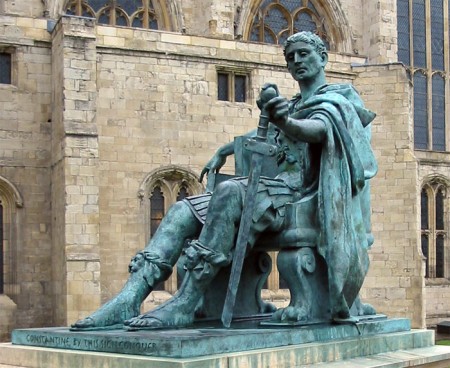
Statue of Emperor Constantine I in York, England

Statue of Emperor Constantine I in York, England

Chalmers on Church Establishments, Part 3
Further Considerations on Establishments

In Lectures 4 through 6 of his Lectures on the Establishment and Extension of National Churches, Chalmers treats some related and pertinent issues. We will continue our survey of these lectures here and close in the final installment with some observations on the whole.

Lecture 4, treating the circumstances that lead up to and justify the state’s selection of a Christian denomination for the instruction of its people in matters of faith and morals, begins with the observation of an ideal. It is ideal when leaders and those who are led are at one and not locked in a struggle of wills, the one against the other. It is ideal when they find themselves in complete harmony and sharing a unity of sentiment. When this actually occurs, we observe “community in its best and happiest mood – when one simultaneous feeling pervades all classes; and, in the pulsations of one mighty heart, the breath of one actuating and reigning spirit, the wealth and efforts of all are consecrated to one common object, and all jealousies are forgotten” (115). Religion has oftentimes been the banner under which governments and the governed have rallied, when the legal and the voluntary principles fused together and acted as one in spiritual concerns. This occurred, of course, in the days of the godly kings of the Old Testament.

But ought religion be the rallying point for national unity between the state and its subjects today in the Christian epoch? The New Testament seems to be quite silent on the matter. So to answer this question, Chalmers turns to the two great instances where this occurred in the Christian era – the first, under Constantine, and the second, at the Protestant Reformation. By examining the circumstances leading up to these establishments of a state Church, it is suggested that the justifications for them will readily appear.

In the first instance, by the time of the Edict of Milan in 313 A.D., Christianity had significantly leavened the Roman Empire. Constantine’s adoption of Christianity as the state religion was by no means an act of coercion; it had very much become a popular religion. Whatever his motivation for the Edict and his later patronage of the Church – a subject that has continually been disputed – he enshrined this obscure, oriental faith as Rome’s own, without general dissent. The government and the governed had happily come together under the aegis of Christ. Further, it should be noted that the Church did not demur at the offer of patronage. She gladly accepted this as nothing other than a clear blessing from heaven. To justify this action biblically, Chalmers observes, “We read of the earth helping the woman. But we nowhere read, that it is the duty of the woman to refuse this help, or to refrain from the facilities which are opened up to her by the hand of Providence, for the multiplication of her converts” (119).

In the second instance, both people and governments of the Reformation came together around the doctrines of the Gospel as it began to enjoy renewed success after ages of obscurity. And this expressed itself structurally much in the same way as it had under Constantine. The Reformed Church was owned and endowed in nations across Europe, to the rejoicing of all (except within the Vatican!).

This great question, whether the state may join the popular sentiment of the people in matters of religion, was before the Parliament of England at the time of the publication of these lectures. Their decision was first a decision of moral and theological consequence; and second, it was one that had ramifications on the outward, economic well being of the people. It was imperative that these considerations be weighed, says Chalmers, when the cry is not for the joining of the people and the rulers around the Gospel, but for their separation.

But can or should the government really enter into the theological disputes of churchmen? “We are aware of the summary and contemptuous rejection to which this proposition is liable – as it would transform the senate-house into an arena of theological conflict . . . and senators into wrangling polemics” (125). This is an exaggeration, says Chalmers. The greatest questions on the matter of religion are well within the capability and are rightly in the purview of the government. A decently educated man in office, with filial respect for sacred scripture, can and ought to decide between the merits of Roman Catholicism and Protestantism. He can consequently select one of these two rival faiths for the doctrine to be taught to his people. But even if the exaggerated objection is granted, Chalmers contends that one should be able to select one of these two on purely economic grounds. There is more than enough evidence, he contends, to select Protestantism as that expression of the Christian faith that best tends to the improvement of the outward conditions of a people. And conversely, “all history and experience tell” us that Romanism is of all religions “most fitted to blind and vitiate a population” (132).

Chalmers concludes the lecture by turning to the then contemporary question of the Protestant Establishment of Ireland, appealing for its continued subsidy, then apparently under threat in Parliament. He freely acknowledges that in prior days, it had been filled with less than perfectly diligent laborers and so had warranted some criticism. Interestingly, he critiques many of the ministers of that establishment for having failed to evangelize Roman Catholics within their parishes.

But over and above this, there was a mistaken policy, maintained and avowed even by their best clergymen, in the form of an honest, though still of a grievously mistaken principle – as if they went beyond their legitimate province if they at all meddled with the Catholic population; at which rate the primitive Christians went beyond their legitimate province, when they meddled with the Pagans of the Roman empire. . . In virtue of this false principle, or false delicacy, the cause of truth suffered, even in the hands of conscientious ministers (135).

The parish plan is an efficient one for the extension of the Gospel. But boundary lines were made for man, not man for the boundary lines!

To continue, the failures of the operators, however, ought not to warrant the dispensing of the machine. And its patronage should continue, especially in light of the renewed and revived ministry that had emerged in his day, who stood in need of the support of the state. If however, the powers that be decided to pull the financial plug, that Church would have to toil valiantly as her unendowed predecessors had in the pre-Constantine era.

The hand of power may strip it of its temporalities; but we trust that its indomitable spirit in the cause of a pure and scriptural faith, will not so easily be quelled. Though despoiled of their rights, they will not abandon their duties. Like the Christians before the days of Constantine, they may perhaps have to win the ground over again – when the Church, purified by the discipline of adversity, will again arise in its strength; and repeating the conquest of truth over the errors of a degrading superstition, will add another victory to the triumphs of former generations (137).

This however is no argument, he contends, that statesmen ought to do evil that good may come. Those deliberating on the matter should be very careful, further, not to give over too soon to the vacillating impulses of the shortsighted masses. Let the fathers have the foresight to provide for their children what is best.

In the sixth lecture, Chalmers turns to the consideration of a previously untreated dimension of a religious establishment. We observed in the opening lecture what an establishment is in essence: it is a sure, legal provision for the Christian education of a nation. But there is a distinction to be made. An establishment can be endowed, but not territorial. While an establishment may exist without a territorial plan, it is inefficient until it adopts and enacts one. An establishment is a very helpful stepping stone to what Chalmers was really after – a mechanism for the effective Christianization of a nation.

This naturally raises the question as to the distinction Chalmers is making. What is territorialism? It is certainly more than a stipend for a clergyman to preach in a church. It is, in addition to this, the giving of an assigned “geographical district” in which “he is expected to take an ecclesiastical cognizance of all the families within its limits” (143). He adds,

To perfect this arrangement, [such subsidized, territorial ministers] must stand so related to his church, as to have a right of preference over all extra-parochial families to the occupation of its sittings; and he, on the other hand, should be so related to his parish, as, if not to have a right of entry into all the houses, at least to be bound in point of duty to make a tender to every householder who is willing to receive him, of such ecclesiastical attentions and services as his time will permit to him bestow, and which might be conducive to the Christian good of himself and of his family. In other words, he is bound to superadd, as far as the people will let him, week-day and household to his Sabbath-day and pulpit ministrations. He is the minister not of a congregation only, as far the greater number of our unendowed ministers are; but he is the minister both of a congregation and of a parish (143-44, emphasis mine).

This distinction is key. ‘Church’ and ‘parish’ are not equivalents for Chalmers. They are concentric circles, the one inside the other, but quite distinct from each other. A territorial minister is not just a parish minister (evangelist), nor is he just a congregational minister (pastor). He is both – a pastor-evangelist, if you will – with distinct responsibilities to both circles.

To illustrate it, he instances two religious establishments that were legally endowed but did not operate on a territorial plan – the Protestant Establishment of Ireland and the establishments active during the American colonial era. Ministers and churches were state-funded, but there was no defined, territorial evangelistic responsibility for anyone in particular. These men served their own congregations, but were not obliged to go after any particular group in the surrounding area. Such a minister, says Chalmers, “has to do with his hearers [those who voluntarily, of their own impulse, come to church]; but there is nothing in such an economy, which at all necessitates him to do with those who are not his hearers. They may choose to attend him if they like; but if they do not choose, they may accumulate in any numbers without the sphere of his observation . . . If they do not come to him, there is nothing in this congregational, even though endowed system, which insures that he should go to them” (145).

Territorialism is the great strength of an establishment. In Chalmers’ thinking, establishments are only valuable as means by which territorialism can be most efficiently established and operated. And it is territorialism alone by which “we can recover a people from the moral degeneracy into which they have fallen” (146).

To argue the virtues of the territorial plan, he suggests an experiment. He challenges anyone to go through some poor city neighborhood, including not more than 2000 souls, and perform a house-to-house survey. How many live there? How many regularly attend church? The result, he is confident from past experience, will be quite surprising. Let the voluntary or the free trade principles reign, and human nature that does not ‘seek after God’ will show itself. Few will be found church-attenders. Even if a Voluntary chapel were placed within the vicinity, few if any of the people in that neighborhood would come. Yes, you might have others “from all distances” beyond the area attending, all with “a predisposition for the services of the sanctuary, and a power as well as a willingness to pay for them” (149). But what of the lost next door? Will they come if they are not sought?

To reclaim these people from their irreligion, Chalmers suggests the territorial model:

Now the specific business which we would like to put into the hands of a Christian minister is, not that he should fill his church any how – that he may do by the superior attractiveness of his preaching, at the expense of previous congregations, and without any movement in advance on the practical heathenism of the community: But what we want is, to place his church in the middle of such a territory as we have now specified and to lay upon him a task, for the accomplishment of which we should allow him to the labour and preference of a whole lifetime; not to fill his church any how, but to fill this church out of that district. We should give him the charge over head, of one and all of its families; and tell him, that, instead of seeking hearers from without, he should so shape and regulate his movements, that, as far as possible, his church-room might all be taken up by hearers from within. It is this peculiar relation between his church, and its contiguous households, all placed within certain geographical limits, that distinguishes him from the others as a territorial minister (151).

Now, if this model is one best suited to reclaim the lost on the lesser level, why not on the greater? So “let the whole country be parceled out into such districts and parishes, with an endowed clergyman so assigned to each, and each small enough to be overtaken by the attentions of one clergyman – we should thus, as far as its machinery is concerned, have the perfect example of a territorial establishment.”

But how, practically speaking, would this territorial plan be carried out within the proposed neighborhood? He suggests picking a neighborhood with the lowest likely church attendance – in his days, some slum of one of the sprawling industrial cities of the United Kingdom – and let the minister frequently visit the people throughout the week over the space of many years. The result should be a gradually increasing attendance of the people in that district of the stated services of worship in the church.

One might object, however, that this proposal seems too idealistic, too romantic. But Chalmers rejoins that experience has shown that ministers who have acted on the territorial principle, visiting the people ‘from house to house’ over a period of time, have discovered only reciprocal warmth and respect. And it is only natural for such a response when men are visited by a truly genuine, caring individual who has taken a concern for their spiritual, physical, moral, and economic well being. Sincere benevolence is naturally drawing. And so he assures his readers that if such an honest Christian philanthropist will but “go forth on such a territory as we have ventured to chalk out for him; and more especially, if he reside within or upon its confines – there is not a month will elapse, before that by his presence and his labours, he will light a moral sunshine throughout nearly all the habitations” (160).

Now, one must retain a measure of sobriety. This plan requires time and diligence for its right operation. “We know it to be a work of slowness and difficulty” (161). It could also be that the older generation will prove past such influences. They may be too hardened in their ways. But it may be that the next generation will be favorably influenced by this “parochial economy,” particularly through the parish schools under the superintendence of the church. This being said, Chalmers wouldn’t give up on the likely effects of a regular, territorial visitation of the older, sin-hardened folk. The following words of encouragement are apt for those weary in well doing:

The most reckless, the most resolute in their moral hardihood, are not beyond the operation of these. Even let them carry it so far, as to barricade their houses, even as their hearts are barricaded, against the first approaches of this apostolic clergyman; and he need not yet give them up in despair. He has only to watch his opportunity and Providence will work for him. The hand of death may at length open a door for him – even to the worst habitation of aliens in the parish. Let him be ever ready with his services; and, in the house of family disaster or family bereavement, the most sullen and else impracticable of these outlaws from all the decencies and humanities whether of Christian or civilized life, may at last give way (168).

In due season we shall reap, if we faint not!

And of course, all of this is of no avail if unspiritual men are set to operate this territorial establishment. Hirelings will only squander the subsidies and leave the territory uncultivated. But these real facts should not dissuade us from eschewing the “random economy” and embracing the endowed, territorial plan as the most expedient way for the seeking and saving of the lost.

The last lecture turns to the thorny question as to how a government can justify the selection of one particular denomination of Christianity for its religious establishment, to the exclusion of others equally legitimate. The very simple answer is that the alternative is highly impractical. The government “will not find it so convenient, if, attempting to be even-handed with all sects, and at the same time to provide a Christian education for all the people, it shall make the further attempt of arranging” the assortment of evangelical denominations “into parishes” (171). There is a twofold problem here. First, the people “cannot thus be made over, at the arbitrary will either of civil or ecclesiastical superiors … in sections of contiguous households, to this one or that other denomination, just according to the locality in which they happen to reside” (171-72). Second, the government cannot effectively provide Christian education to its people without “the medium of one correspondence, and . . . the simplicity of one management” (174).

So on what principle shall the selection be made? We have already seen that statesmen, if they are thoughtful Christians, should be able to decide in favor of Protestantism. But of which variety? And how shall this choice be made without eliciting the outcry of injustice to those left standing in the rain?

Chalmers reminds statesmen that they ought not retreat from their duty, the provision of a Christian education for their people, because of the complexities and even the delicacies involved. Someone will complain; someone will be offended. But “the moral well being of the nation is not to stand at abeyance, till an adjustment shall have been made among controversies not yet determined, and perhaps interminable” (178). Government, further, in choosing one denomination over another for the religious establishment, should not fear accusations of favoritism. She contracts with one that suits her for the greater good envisaged, the national good, and with a clear conscience leaves the others to their own business.

Turning from defense to offence, Chalmers asks the objectors whether or not the minor differences that separate them should hinder the upholding of a common faith and a common cause, the spiritual well being of mankind? And if the objectors outside the establishment demand to know why they are kept out for such minor differences, he retorts that they should answer as to why they stay out for such minor differences? Then with a frank bluntness, he observes that it is only “through the very wantonness of freedom in this land of perfect toleration” that men “have chosen to besport themselves, and so [have] broken forth into their party-coloured varieties; each having a creed, or rather, I would say (for substantially speaking nine-tenths of the people in Britain have all the same creed), each having a costume and a designation of their own” (182-83).

To close, Chalmers calls for unity. Not unity for unity’s sake, however; unity for the sake of the cause! It is our conviction, he writes, that “only by an undivided church, only by the ministers of one denomination, can a community be out and out pervaded, or a territory be filled up and thoroughly overtaken with the lessons of the gospel. Tell, whether it is of greater consequence that minor differences be upholden, or that the universal Christian education of our families shall be provided for? But, in truth, these minor differences may co-exist with the operations of an effective establishment” (188).

[Go to Part 4]

Map of Scotland, 1641-1892 (from mackenziefamilytree.com)

Map of Scotland, 1641-1892 (from mackenziefamilytree.com)


Chalmers on Church Establishments, Part 2
The Foundations of Church Establishments

[Note. For those interested in reading this work firsthand, an edition can be found online on GoogleBooks here.]

Turning now to the lectures themselves, we begin with an overview of the first three of six, which lay the foundation work of Chalmers’ thought on the warrant and function of a religious establishment. In Lecture 1, he defines an establishment and removes some typical prejudices that in his day prevented some from giving it serious consideration. In Lectures 2 and 3, he counters and refutes the two 19th century rivals of establishmentarianism, namely, the liberal ‘free trade’ economists and the Voluntaries, and in so doing vindicates the questioned institution. With this roadmap before us, we turn our attention to Lecture 1.

Chalmers recognizes at the outset that there is a “felt indisposition” on the part of many to religious establishments (9). It seems as though this reliance upon the “machinery” of an establishment betrays a mistrust of simple dependence upon heaven for spiritual blessings. But this over-pious mindset fails to appreciate the harmony between divine activity and human responsibility. One only has to observe the analogy between human cultivation of the soil and the churchly cultivation of the soul. If in the former sphere, there is nothing inappropriate with intelligent, vigorous endeavors to improve the land and a trust in the God who alone controls the weather and the elements, then there is nothing inappropriate with “spiritual husbandry” (11).

The part which God takes in the operation, does not abrogate the part which man ought to take in it. They are the overflowings of the Nile which have given rise to the irrigations of an artificial husbandry in Egypt, for the distribution of its waters. And there is positively nothing in the doctrine of a sanctifying or fertilizing grace from heaven above, which should discharge us – but the contrary – from what may be termed the irrigations of a spiritual husbandry in the world beneath. It is not enough that there be a descent; there must be a distribution also, or ducts of conveyance, which, by places of worship and through parishes, might carry the blessings of this divine nourishment to all the houses and families of a land (12-13).

This being said, he certainly does concede that such an economy of spiritual distribution cannot save in and of itself. If you build it, they will not necessarily come. “Its channels of distribution, however skillfully drawn, will, if dry and deserted of Heaven, convey nothing for human souls; and the goodly apparatus of a strong and thick-set Establishment in the land will neither prevent nor alleviate the curse of its spiritual barrenness” (14). Yet, it is a firm principle of Scripture that God employs humble means to usher in His salvation to this world of sinners. He uses the reading and the preaching of the Word. He uses men, ordained and sent by the Church. “God gives the increase,” to be sure. But He also does so by the “planting” and “watering” of Paul and Apollos, whom He calls as His “fellow laborers” (1 Cor. 3:5-10).

With this in the back of our minds, the question that next confronts us, says Chalmers, is what is the best expedient, the most efficient economy of distribution for ensuring that the blessings of the Gospel will be conveyed to every creature under heaven (Mk. 16:15)? He will be contending in the following lectures that it is a religious establishment that suits the purpose.

Now, what is a religious establishment? In short, it is “a sure legal provision for the expense of [the] ministrations” of the Church within a nation (17). There may be other nonessential elements that are frequently considered in establishments; but this is the core, the essential nature of an establishment according to Chalmers.

This sure legal provision for the maintenance of the established Church does not imply, however, any further connection. The Church, when patronized by the state, is independent from the state in all things spiritual. “For their food and their raiment, and their sacred or even private edifices, they may be indebted to the state; but their creed, and their discipline, and their ritual, and their articles of faith, and their formularies, whether of doctrine or of devotion, may be altogether their own” (20). Chalmers is heading an objection off at the pass here. Those who oppose religious establishments contend that the Church, by receiving state endowment, thus becomes enslaved to an earthly master, and so morphs into mere department within Caesar’s bureaucracy. The Church is then domesticated and enslaved to the ‘hand that feeds her.’ Yet, says Chalmers, this is not necessarily the case. When, for example, a merchant chooses to hire and support a missionary in his West India plantation, the missionary does not necessarily become a spiritual vassal of his financier. His stipend is from men, but His orders are not. This missionary takes the endowment as a blessing from heaven and labors to bring the good news to that district where the hand of Providence has led and provided. If this little model on a small plantation in the West Indies is acceptable, why may it not on a far greater scale?

Ah, but there is the testimony of history. Didn’t Constantine’s adoption of Christianity as the state religion mark the spiritual downfall of the Church? Is it not here that Mystery Babylon had its birth? Chalmers responds that the causes of the spiritual downgrade had begun before Constantine. The misfortune of the Edict of Milan lay in “the ascendancy wherewith the [pre-existing] superstition and ignorance both of princes and people had vested the ecclesiastical power, of which it most unworthily availed itself, to its own enormous aggrandizement in things temporal – at once supplanting the rightful authority of God in His Scriptures; and substituting both a doctrine and discipline of its own, by which to blind the souls of men and subjugate them to its sway” (24).

And if the opponents of the establishment, he writes, want to enlist history, what of the Reformers? They, as their heirs in the 19th century, yearned for the Christianization of Scotland. John Knox cried to heaven, ‘Give me Scotland, or I die!’ Now, did this mean for Knox and company demolishing the old machine, with its universities and parishes, handed to them by Medieval Christendom? No. “They did not, with blind and headlong zeal, demolish the old apparatus of distribution. They substituted the true gospel for a false one; and sent forth its now amended and purified lessons along the old pathways of conveyance” (26). In short, they distinguished between a good expedient, tried and proven, and its bad operators. For the Reformers, they kept the business intact, but changed the management – and with good effect, we might add.

And so, Christians ought not to be so hasty to scrap the means that could be effectively employed for Christianizing the masses merely because it has been misused. “Were the water of London to take on a deleterious tinge from the accession of some impurity – the way surely is to purge it of this, or, if possible, to bar the ingress of it, rather than make insensate attacks on the subterranean machinery, by which distribution is made of it through the streets of the city and into the houses of the citizens” (34).

Having thus dealt with removing initial prejudices to the question, Chalmers turns to the positive argument for religious establishments in Lectures 2 and 3.

To appreciate the warrants for a religious establishment, one must see how it stands opposed to the system of free trade in commerce. The liberal economists of the 19th century, following Adam Smith’s doctrine laid down in his Wealth of Nations, argued that the greatest good would accrue to society by the free and uninhibited trade of goods and services, by allowing the simple laws of supply and demand to prevail. Government should not intervene, for whatever motives. This will only disrupt things and inhibit the greatest good for all.

Adam Smith himself applied these principles to Christianity as a good in society. It ought to be left unregulated by government interference and “limited to the extent of the market” demand (48). However, says Chalmers, Christianity must necessarily fail as a good in society on this plan.

A free trade in commerce, only seeks to those places where it can make out a gainful trade; but it is sure to avoid or to abandon those places, where, whether from the languor of the demand or the poverty of the inhabitants, it would be exposed to a losing trade. By a free trade in Christianity, let the lessons of the gospel follow the same law of movement; and these lessons will cease to be taught in every place, where there is either not enough of liking for the thing, or not enough of money for the purchase of it: Or that religion, the great and primary characteristic of which was that it should be preached unto the poor, must be withheld from those people, who are unable by poverty to provide maintenance for its teachers (49).

Why, then, does the good of commerce work to the fullest advantage upon society by the unfettered laws of supply and demand, while on the same laws the good of Christianity is retarded? Simply put, man does not naturally perceive and so desire Christianity as a good. “There is no such intensity of desire or of demand for the article of Christian instruction” in the marketplace as there is for material goods and services (51). “There is no natural hungering and thirsting after righteousness; and before man will seek that the want should be supplied, the appetite must first be created.” Adam Smith must reckon with St. Paul, who said, “There is none that seeketh after God.”

This reality accords with the historical facts of the Christian movement prior to its establishment in the Roman Empire. Christianity was not a naturally attractive commodity. Consequently, missionaries went out, thrust forth into a world that had no pre-existing taste for the teachings of Jesus of Nazareth. And at whose expense did the pagans receive this doctrine of heaven? Who paid (or housed and fed) the laborers who were worthy of their wages? It was not the beneficiaries: at least not initially. Christianity was heavily subsidized in its movement throughout the Mediterranean world and beyond, through a nameless host of private benefactors. And sometimes, the laborers even paid themselves in order to preach without fees (Acts 20:34, 2 Thess. 3:8)!

Non-establishment missionaries in Chalmers’ day certainly acknowledged that Christianity could only be introduced into a new territory by the underwriting of others. Their home and foreign mission societies were proof of this: the pagans would not pay for what they needed most! Now, one could plausibly counter that once missionaries are introduced to a foreign country and find some success that a “native demand will be set agoing” (68), sufficient to maintain the ministry without subsidy. Yet this will not obviate the need to press still further in the cause of the Gospel in that land. And that is precisely the raison d’être of an establishment. It is not the whole that need a physician, as it were, but the sick.

Further, the dissenting chapels of Chalmers’ day, though unendowed by the state, did not strictly operate by the laws of free trade. The plain facts are that these churches had from time to time run into needs that those with deeper pockets, either within their congregations or associations, benevolently supplied. “Unlike to the other articles which are brought into a market, and of which the supply is continued only because of an adequately returning price – unlike to these, the returns for the article of Christian instruction are very often beneath the prime cost incurred in the preparation of it” (66). As long as there are lost souls to be reclaimed in this world, the Christian enterprise will require subsidy.

Yet this does not answer the question as to why it must be the state and not the Christian public that must subsidize the program of Christianizing a land. Chalmers’ response is that, very practically speaking, the operation of free trade in Christianity, as exhibited in the efforts of the Dissenters, had not Christianized the burgeoning, unchurched massed of Scotland. One can feel the pathos of deep evangelical sentiment when Chalmers bemoans the situation of his day:

Let [there] be a church, for distribution amongst [these unevangelized poor] of the bread of life, or for the supply of their moral and religious wants: and its presence in the midst of them, with the weekly invitations of its Sabbath-bell, will fail to attract beyond the veriest handful of the surrounding population to this house of prayer – and, more especially, if the market-price for the accommodation and the service be expected at their hands. It may or it may not be filled to an overflow by hearers from all distances, who have both the wealth and the will to pay for their attendance. But hundreds often are the families in the precincts of this temple of piety, so near that the voice of its psalms may enter their dwellings, yet not awaken them from the insensibility of their spiritual death (72-73).

Let the rules of unregulated commerce apply, and this population will perish for lack of knowledge.

Finally, in a flourish of righteous passion, Chalmers exposes and excoriates the “cold and secular utilitarianism” behind this imposition of free trade on Christianity. To draw a close analogy between articles of commerce in this world with the grand article of salvation, and with all the moral, intellectual, and social blessings that it entails, is crude at best and heartless at worst. What measure is there between profit and human worth and dignity? Between gaining this world and losing the soul? Further, Chalmers states positively, “after all, there is not only false sentiment but even false arithmetic in the views of these gross mercantile calculators. The universal scholarship for which we are contending, would, if carried into effect, be indeed the cheapest defense of our nation – whether its expenses shall be defrayed in the form of a liberality by the hands of private individuals, or from the public treasury in the form of an endowment” (75).

Clearly, there is no ultimate concord between Christianity and commerce. But is there another model to put in its place, other than the old establishment? Consequently, Chalmers turns in his third lecture to deal with the argument of the Voluntaries to confirm his thesis.

To begin, many confuse liberal economic principles as applied to Christianity with the system of Voluntaryism, which is simply the evangelical contention that the Church should have no connection with the state, financial or otherwise. Chalmers distinguishes between the things that differ. There is within Christianity two types of voluntaryism: internal and external. Internal voluntaryism is the willing financing of the ministry by the people directly benefiting from that ministry. Concretely, this could be a local church membership committing to pay its minister entirely from its own resources. No one is coerced, for they are all quite willing. And no money is taken from other sources, much less the state. This is a commendable scheme, and, incidentally, fits quite nicely with the economic dogmas of Adam Smith. The beneficiaries pay for the benefits, and so supply meets demand. External voluntaryism, on the other hand, is the giving or receiving of financing from other quarters due to monetary shortfalls within struggling churches and ministries. In external voluntaryism, benefactors willingly contribute to the Christian instruction not of themselves but of others who either cannot or (in the case of the unconverted) will not pay. Missions, foreign or domestic, operate on this version of voluntaryism.

Here, it becomes clear that the Voluntaries are not free traders, pure and simple. They finance struggling churches and ministers and underwrite the cost of sending missionaries to the pagans. They, therefore, are external voluntaries, and seriously interfere with the free trade of the commodity of Christian instruction. They subsidize it, “repairing the deficiencies of the market price” (85), and so violate liberal economics. Free trade in Christianity and Voluntaryism must not be confused.

To replace the establishment with Voluntaryism, then, throws us back to another question. We are all agreed, says Chalmers, Churchmen and Dissenters alike, that internal voluntaryism is insufficient to extend the Gospel where it cannot or will not be financed. “We presume it to be agreed on both sides, that the outcast millions ought to be reclaimed from the ignorance and irreligion of heathenism. The only difference relates to the party at whose expense this great achievement ought to be perfected – whether by private Christians, under the impulse of religious benevolence; or by an enlightened government, under the impulse of a paternal regard for the highest weal of its subject population” (87, emphasis mine). The Voluntaries obvious argued for the former, Chalmers and company for the latter. “We, the advocates of a National Establishment, hold it the duty and wisdom of every state, thus to undertake for the education of the great family under its charge, and to provide the requisite funds for the fulfillment of the enterprise – and this without prejudice, but the contrary, to the liberality of those individuals, who might choose of their own means to build more churches, and maintain more ministers – thus adding to the amount of Christian instruction in the land” (87).

When the Voluntaries plead that the establishment should be abolished, Chalmers merely raises the question, with what success have they showed to warrant the scrapping of the old engine for Christianizing the masses? Have they prevailed upon the mushrooming numbers of unchurched in Glasgow or Edinburgh? The numbers do not look promising, he observes. The establishment may be an expedient in Chalmers’ mind. But it is a tried and tested one.

It should also be further asked, why the objection to state-funded Christian education (i.e., the teaching and preaching of the Gospel) of the citizens, when state-funded ‘secular’ education is accepted? Why should the fathers of a commonwealth provide temporal education for their children and on principle (!) withhold spiritual education?

And whence this ‘enlightened indifference’ to religious matters in the state? Is it of heaven or of men? Those who vociferously argue against establishments have imbibed an unbiblical philosophy that presumes that government should be “lifeless to all … things sacred” (93). Those in power, “maintaining a calm and philosophic indifference to all the modes and varieties of religious belief, should refuse to entertain the question, in which of these varieties the people ought to be trained” (93). But would God have those in office indifferent to His will and ways, as though their position granted them an ethical immunity? Further, this enlightened detachment about religion doesn’t even agree with the very human character of the state. “The corporation of a state cannot be … denaturalized, or reduced to a sort of caput mortuum, discharged of all soul and sentiment – as if by a process of constitution-making in the crucibles of a laboratory. The cold metaphysical abstraction that is thereby engendered, may exist in the region of the ideal; but it does not exist in the region of the actual, nor even in the region of the possible” (94). Legislators and governors also have feelings for other issues that concern the good of the commonwealth. Can they be altogether detached on that which most affects the good of those under their care? Would they not wish to patronize, even as a matter of policy, the Christian cause, if it yields “an incalculable saving of the wealth, and still more a saving to the happiness of the nation … [by] the prevention of crime rather than its punishment” (97)?

Then, picking up a thread he had left earlier, Chalmers points out how one branch of the Voluntary principle – external voluntaryism – can actually complement the function of an establishment. Private philanthropy can induce public philanthropy. In fact, “we behold in an ecclesiastical provision by the state, an example of external voluntaryism, or a willing public contributing of their wealth to the Christian instruction of the common people, through the medium of a willing government. It only differs from a separate or a personal contribution, by the channel of conveyance through which it passes” (100-101). And this is precisely what Chalmers was doing in his Church Extension campaign in the Church of Scotland – fundraising and building new church facilities for the impoverished, unchurched classes in the hopes that such a demonstration of initiative and benevolence would help loose the purse strings of the government to assist. He saw no inconsistency, but only the greatest harmony of principle “between the legal and the voluntary part of our conjunct operation” (106). At the time of the publication of these essays, he cites 180 buildings that had been funded and built through the free-will offerings of donors throughout the land.

But lest some should entertain the suspicion, the cause that he advocated was emphatically not a self-serving one. The men of the Church Extension campaign did not seek to line their wallets. Rather, their “sacred object is,” he writes, “the moral well-being of that mighty host who swarm and overspread the ground-floor of the fabric of our commonwealth” (110), who had no money and often no interest for the provisions of the Gospel. And so Chalmers wrote as the man from Macedonia, “Come over … and help us” (Acts 16:9).

And so we have the theoretical foundations of religious establishments in the thought of Thomas Chalmers. In the next installment, we will treat the final three lectures on related matters.

[Go to Part 3]