Feeds:
Posts
Comments

This blog is largely devoted to the theory and applicability of the ‘locality principle’ in missions.  Thomas Chalmers advocated the principle as a practical means of Christianizing cities.  But while I agree that locality should factor prominently in mission strategy, what place does place itself hold in Scripture?

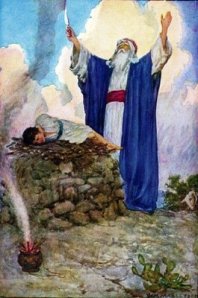
So in recent days, I’ve been reading through the passages of the Old Testament (for starters) that contain the Hebrew word for ‘place,’ maqom. I realize that this is not a study in the heavy-weights of biblical concepts.  Place cannot be set next to propitiation, atonement, justification, etc.  And yet, as I read through these passages, it strikes me that the idea is rich with meaning.  Genesis 22, the great narrative of Abraham’s call to sacrifice Isaac, illustrates this.

In four instances, ‘place’ (maqom) is mentioned, vv. 3, 4, 9, & 14.  As Abraham and Isaac on Mount Moriahone reads these verses in their context, not only is attention called to place, but place is given special significance.

Place in this passage is the destination of Abraham.  He is called from a place of blessing, rejoicing in Issac, to a place of trial.  There and not elsewhere, he will be put to the test.

Place then passes from the agonies of the trial to the triumph of faith.  Instead of being a site of tragedy with the promise going up in flame, it becomes the place of renewed celebration.  Faith overcomes.

But faith rests on a higher plane.  It reaches out for God.  Yet, it reaches out to God at the very place where He gracious comes down.  There, at Mount Moriah, they converge.  There, God gloriously reveals that His promise stands.  There, in the thicket, God has provided a substitute.

On that spot, the sacrifice assumes the place of Isaac.  And so the ground receives a name. “And Abraham called the name of that place Jehovah-jireh: as it said to this day, In the mount of the LORD it shall be seen” (v. 14).

Someday, that place would be hallowed with a greater Sacrifice.  There, He would suffer in our place that we might be released.  From that place all the families of the earth would be blessed.

“A Plea and Plan for a Coöperative Church Parish System in Cities,” by Walter Laidlaw

In this essay, published in the American Journal of Sociology (1898), Walter Laidlaw advocates among the Protestant church a voluntary ‘cooperative parish system’ in the large cities of the United States for the spiritual, moral, and socio-economic benefit of the people. His argument is threefold. First, it is the mandate of Christ to seek the entire well-being of men, both body as well as soul. Secondly, Laidlaw contends that the Church owes it to the taxpayers to seek the ‘moral uplift’ of the working classes. They ought not receive tax exemption for nothing in return. Quite an interesting take on the role of the Church in relation to a non-establishmentarian state! Last, the particular plan he advocates is the surest way to satisfy the mandates both of heaven and of earth.

Map of Lower Manhattan, 1847Positively, I think the article reproduces both the zeal of Thomas Chalmers on the need of Church to evangelize (and that wholistically) the burgeoning modern cities and his level-headed practicality in how the work ought to be done. Energetic, cooperative territorialism is the answer. While Chalmers is not mentioned, his fingerprints are all over it.

Further, Laidlaw certainly continued this legacy by endorsing the elevated philanthrophy that gives intelligently.

My only qualm is the faint note of evangelicalism throughout. It is there, but it is too subdued for my comfort. Presently, I’ve not found out much about Laidlaw’s theology (if anyone can shed some light, I would welcome it). I’m not sure whether he was an advocate of the Social Gospel or whether he retained a distinctive evangelical stance. But the essay is almost altogether devoted to the cooperative parish plan for the relief of outward human misery. I would say ‘Amen and Amen’ to Laidlaw if he unequivocally made the efficient dissemination of the apostolic Gospel the ultimate justification of the system. But right now, I’m at just one ‘Amen.’

Below are some great quotes, with a few comments interspersed.

* * * * * * *

“Originated by the Holy One from one of the largest cities of Judah, commissioned in Palestine’s largest city, her literature christened with the names of the ancient world’s greatest cities and city, her social ideal a city let down from heaven, the church has the opportunity to take the primacy, beyond all question, in altruistic movements, by the institution of a coöperative parish system in cities” (796).

Lamenting over the relative failure of Protestant over Roman Catholic churches to retain their adherents in the large cities, Laidlaw writes,

“Protestantism’s families are not in Protestantism’s church because Protestantism’s church representatives, attending to the people on their communion and pew rolls, scattered all over the 13,000 acres of Manhattan island, have not time or plan to discover and recover the families found on no communion or pew roll.

“It should be a humiliation to Protestantism in New York that three Roman Catholic churches get at more families in the district than do ninety-five Protestant churches, among which are three resident churches. It is idle to ascribe the difference of efficiency in the district to denominational tendency, or national characteristics. It is rather due to the difference between regimentation and somnambulism [sleepwalking]. “Except the Lord keep the city, the watchmen waketh but in vain,’ says Protestantism; and she does on underestimating human wide-awakeness and gumption through her admirable reverence for divine grace. She walketh in a dumb show of saving the city for herself or her Lord” (799-800).

Appreciating the work of the Evangelical Alliance (itself a brainchild of Chalmers) before him in seeking to bring the Gospel wholistically to the cities, Laidlaw critiques the over-idealism of a previous plan that had doomed it to failure. That plan failed in part precisely because of an overemphasis on cooperation:

“It is too ideal … in intermingling denominational visitors. The first step to be taken would [rather] seem to be to induce the churches to regard a geographical area as a special responsibility, and many a church would undertake this if, as a church, it were held responsible for the area, when it might not be willing to share the responsibility with workers from other churches. Spiritual life is systole and diastole indeed, both organization and individual discharging both organic functions at time, but if the church is a divine organization, we must concede her arterialism and assume that individuals are venous” (801).

“Christianity’s warm heart will say to her cool head, when she sees that her alms and uplift must be with both left hand and right hand: ‘Had, you must direct this business for me, or I shall fail in meeting this need. The Master himself did not feed the multitude by Galilee as a mob. He divided the five thousand into companies, and gave each of the twelve his sections to care for. And they did all eat and were filled, no one was overlooked. And they gathered up twelve baskets of fragments, a basket for each disciple, more food than they started with. Head, this need is so great that some hungry one is sure to be underfed, and some greedy one is sure to be overfed, unless there is method.’ And when Christianity talks in this strain, it will not indicate a cooling heart, but a glowing one, one that responds to the Redeemer’s desire, and ‘mind and soul, according well, / will make one music as before’” (803).

Last, Laidlaw gives a number of guidelines for such a cooperative parish system. Cooperation is more than inter-church – it also involves cooperation with civic officials for the ultimate blessing of the community. He gives one interesting instance of such cooperation in New York City during his time:

“For instance, the committee on parks recently circulated a petition, signed by everyone of the pastors in the area, asking the city authorities to locate a small park in the region. When the park is actually opened, it cannot but advertise throughout the whole neighborhood the fact that the church is interested in the people’s well-being” (806-7).
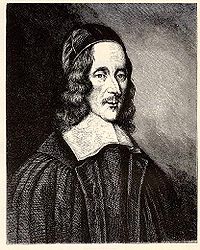
Not long ago, I stumbled across a great treatise in Pastoral Theology from the Puritan era, The Country Parson: His Character and Rule of Holy Life, by George Herbert (better known for his poetry).  Herbert, though a conformist to the Church of England, was obviously highly regarded among the non-conformists.  Richard Baxter had George Herbertthis to say of him, “Herbert speaks to God like one that really believeth a God, and whose business in the world is most with God. Heart-work and heaven-work make up his books.”  High praise, coming from the ‘Reformed Pastor’ himself!

There are many things in the work that doesn’t directly apply to the modern day pastor.  But there is much to glean.  I offer just a few quotes from his chapter entitled, “The Parson in His House,” since it builds on the material of a previous post on the strategic role of the manse:

The Parson is very exact in the governing of his house, making it a copy and model for his parish.  He knows the temper and pulse of every person in his house; and, accordingly, either meets with their vices, or advanceth their virtues (25).

His parsonage is but the workroom of grace in his family, which in turn serves the blessing of salvation to the neighborhood.

He is not a one-man show, however.  His children are commissioned into the service of their ‘parson’ father:

His children he first makes Christians, and then commonwealth’s men: the one he owes to his heavenly country, the other to his earthly, having no title to either, except he do good to both.  Therefore, having seasoned them with all piety – not only of words, in praying and reading; but in actions, in visiting other sick children, and tending their wounds; and sending his charity by them to the poor, and sometimes giving them a little money to do it themselves, that they get a delight in it, and enter favor with God, who weighs even children’s actions (1 Kings, xiv. 12, 13).

The exhortation in Deuteronomy 6 is to be taken quite literally in the manse:

Even the walls are not idle; but something is written or painted there, which may excite the reader to a thought of piety: especially the 101st Psalm; which is expressed in a fair table, as being the rule of a family (26).

And that’s just a sampling.

No doubt its obscurity is due to its identification with ‘conformist’ Puritanism, if that is even an appropriate term.  It’s too bad, though.  Quite a treasure trove of Pastoral Theology.

Locality & Zeal

Lately, I’ve been considering that the commitment to give oneself to the spiritual care of a particular locality and the zeal to do so are cooperative. Zeal for evangelism is a kindled sense of duty to one’s neighbor. It will impel a Christian to go after him, precisely because he will never come himself.(from flickr.com) Commitment to a locality is the product of this zeal. Yet, that very commitment can serve as the stimulant to our zeal. Let’s face it: few if any of us are always evangelizing with full wind in our sails. But to know that we are bound to our neighbors and are appointed for their deliverance draws us to our fulfill our duty, even when our hearts aren’t in it. And by following through in faith, God can reignite the passion once again.

Here’s an intriguing biography of a 19th century Scottish missionary, Alexander Somerville. The following passage is illustrative of the visitation evangelism promoted in the Church of Scotland and also performed by his colleagues, the Bonar brothers and Robert Murray M’Cheyne:

The Students’ Missionary Society, founded by John Wilson of Bombay, continued to meet every Saturday morning of the session; and the meeting for prayer, in which none were more earnest than the three friends. They were impelled by the spiritual instincts of the new nature to work for Christ as well as to worship Him, and founded a Visiting Society for the poor and churchless of the High Street, from the Castle Hill to Canongate and Holyrood. Here Somerville first began home missions, but in a way which other earnest students would do well to imitate. ‘Our rule was,’ writes Dr. A. Bonar, ‘not to subtract anything from our times of study, but to devote to this work an occasional hour in the intervals between different classes, or an hour that might otherwise have been given to recreation. All of us felt the work to be trying to the flesh at the outset, but none ever repented of persevering in it.’ So thorough was Alexander Somerville in the visitation that he kept a book in which, on a page given to each of forty-seven families or persons, he recorded the date of each visit, the passage of Scripture read, the subject of his talk, and the apparent results” (George Smith, A Modern Apostle: Alexander N. Somerville, D.D. 1813-1889, London, 1891, pp. 13-14).

Now here’s some hands-on practical theology for zealous seminarians!

Here’s a great quote from Thompson’s Parish and Parish Church (1948 ) concerning the flexibility of the old parish principle to the modern urban context.  While it was written from within the milieu of the established Church of Scotland, I would suggest that the idea carries over:

“The problem which faces the Church, therefore, is mainly confined to large towns and cities, and it is twofold: how to organize itself so as to minister effectively to these communities as a whole, and not in piecemeal fashion and with indiscriminate or overlapping agencies; and how to revive in them that intimate sense of community which has been so largely dissipated and all but lost.

“In general, and with many practical suggestions in detail, the solution proposed for this twofold problem is an emphatic endorsement of the territorial system along parochial lines, and its thorough-going application in every type of community large or small. The territorial system is described as a cardinal principle of the Church, and the parish remains as the territorial unit. Every ‘several kirk’ should be a parish church, and should bear that name, with a parish of its own as its special field, to be cultivated intensively by regular and systematic parochial visitation, and by all the agencies for old and young with which the Church can foster the spiritual, social, and cultural life of the community. This of course has always been the ideal, however imperfectly it may have been realized. Its significance in this connection is that it is put forward as the best, and indeed the only, plan which can be devised whereby the community as a whole can be evangelized, brought under Christian influences, and enabled through a common fellowship to share consciously in a finer and fuller quality of community life. The age-long method of the Church has been emphatically reaffirmed.

“To meet the special conditions in large towns and cities various expedients are proposed. These are prefaced by the readjustment of the Church’s agencies and the realignment of its forces – a process which has been in operation and must be steadily kept in view. Parish churches and parishes must be as nearly as possible in the midst of that portion of the community which they are meant to serve. Given that fundamental premise, three main suggestions are made whereby the work of the Church and its impact upon the community may be unified and strengthened, and the community itself be made practical aware not only of the unity of the Church but of its own unity.

“These are (1) the grouping of parishes into what is styled a ‘Common Parish,’ and close co-operation among their churches in united services, common evangelistic efforts, and joint meetings of office-bearers to discuss local problems; (2) the formation of Church Councils in towns of 50,000 and under, composed of four representatives from each congregation, to plan and organize united efforts, and to see that no interest of the community is overlooked and no essential service left undone; and (3) the appointment of team ministries where circumstances seem to demand it, each minister having his own distinctive office and function, but all together responsible for the work of the Church from a common center and over a wide area.

“Two outstanding features of this survey have a special relevance to the subject of this book. This first has already been noted – the emphatic endorsement of the parish as the territorial area in which the Church can most effectively exercise its ministry and fulfill its mission. Under modern conditions the parish remains the organic unit of the Church’s life and work, as it was in the earliest days of the Faith, and as it has continued to be throughout the ages. The second feature is no less noteworthy. It is that the parish is not a rigid but a flexible conception. It never has been stereotyped, either in respect of its size and population or in respect of the ecclesiastical agencies and methods at work within it. It is adaptable to changing conditions and changing methods, just as the Church is which has used it as its chosen instrument. What is essential is that, however modified, it consist of a defined area and community, with the Church in the midst as the spiritual power-house of the communal life” (288).

The minister’s house has historically been much more than a place for the man of God to hang his hat.  It was a base for mission, a fountainhead of mercy, a refuge for strangers.

Solomon Stoddard's House (flickr.com)

Private residences of course played a major part in the growth of Christianity in the early church.  “Greet the church that meets in their house.”  This strategic utilization of private brick and mortar passed into the practice of successive generations and particularly the Reformers and their successors.  As I understand it, ministers often resided in large manses (‘parsonages’ in America) precisely because they were to be used as tools for doing Christian good in the community.  Just look at Solomon Stoddard’s home  in Northampton, Massachusetts (right).

Here, I think, is one major strategy we can glean from the past in our witness to modern day communities.  Let Christians use their homes as tools – and especially ministers.  May they become once again channels of Christian mercy to God’s people and catalysts for recreating Christian communities from our socially atomized neighborhoods.  Our home can be an oasis in the spiritual desert of those who reside near us.  From the living waters God has put in our home, let us irrigate the streets, lanes, and drives nearby.  And may God give us the increase.

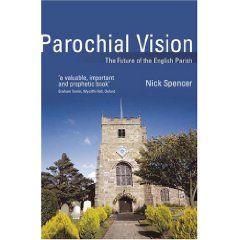
Parochial VisionIn Parochial Vision: The Future of the English Parish System (2004), Nick Spenser offers a very intriguing argument for the reimplementation of the ‘minster’ church model of England’s early medieval period. His main argument is that parish system of the Church of England is in major decline due to demographic shifts, the disappearing of traditional communities, and especially the spiritual declension of the British people. Spenser doesn’t reject the parish system, yet he contends that it needs recasting into a more flexible, regional, and collegial (cooperative) pattern. This pattern is the old ‘minster’ model.

Regrettably, this valuable book won’t find a wide readership this side of the pond, since the entirety of the book pertains to the U.K. situation and to the Anglican Church in particular. This is too bad, since Spenser gives a very compelling example of strategic, ecclesiastical proactivity within the tumult of social change. And he does this without giving up on the age-old principles of territorialism and locality. Like Thomas Chalmers, he analyses the human and brick-and-mortar realities, harvests strategic principles from the Church’s past that are relevant, and suggests the how an old model can successfully be redeployed.

My own criticisms of the book are from an evangelical perspective. Spenser is too theologically inclusive. He advocates this model for both ends of the doctrinal spectrum, conservative and liberal. Certainly, he reflects the via media ethos of the Church of England. Yet there can be no middle way when the alternates today are light and darkness (2 Cor. 6:14). I am stimulated by his overall suggestion, but add a strong qualifier that unity must be in truth.
Second – and in light of the first, this should come as no surprise – there is little if any place dedicated to preaching as the means of renewing the Church in Britain. The whole book suggests a fix by changing administrative models. Now, I’m all for improving efficiency and open to strategy changes consistent with the Word of God and common sense. But if rigorous, expository and applicatory preaching is not central, changing forms will yield a formal change at best.

These reservations notwithstanding, Spenser’s book is a fascinating read.

The labor of the Gospel is the labor of sowing seed.  The seed is the imperishable doctrine of Christ, and His ministers are privileged to share in this service.  We scatter the Word.  For many who hear it, there is no lasting benefit.  For others, there is.  And when it does, it bears fruit – thirty, sixty, or a hundredfold.

This dissemination is both narrow and systematic on the one hand, yet broad and sporadic on the other.  In recent years, I’ve been quite taken with the narrow and systematic type of dissemination.  It’s the main focus of this blog, a focus that seems to have been lost in contemporary Reformed evangelism.  The modern day ministry ought to reengage in localized, systematic district visitation.  We ought to rediscover and reapply the old parish principle amid the disarray of the American, market-governed scene.  Without focus and system, we will not subdue the inheritance of Christ.

And yet, this model isn’t everything.  The parish plan is not the evangelistic silver bullet.  Dissemination is also broad and sporadic.  We must preach the Gospel indiscriminately.  Not just to folks in parishes that we define and adopt.  But folks passing through, on the bus, at work, on the plane – even on the (cough!) information superhighway.  Folks we will likely never see again, but folks who, having the imperishable seed planted in their souls, might take root where they land.

Both approaches are necessary, and both are complementary.  Who knows what God will do?  Let us sow narrowly and sow broadly.  Let us sow systematically and let us sow sporadically.

And once we have sown, let us look to God who alone gives the increase.

Special offer

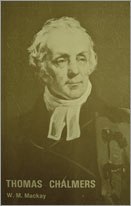
One main purpose of this blog is to  facilitate renewed interest in Thomas Chalmers, the great 19th century Scottish preacher, churchman, and social reformer.  I am convinced that he needs to be rediscovered again, A Short Appreciationespecially in the place of his spiritual birth – the Reformed community.

As a small contribution to getting the word out, I’ve decided to make a special offer.  I am going to give away 5 copies of W. M. Mackay’s Thomas Chalmers: A Short Appreciation randomly to church leaders or those preparing for the ministry.  For the next two weeks, from today until January 21, anyone who would like to get a free copy can enter the drawing by e-mailing me (michael@reformedparish.com) with your name & e-mail address.  If you are selected, I’ll let you know on Jan. 22 and will then request your mailing address.

If you aren’t a church leader, feel free to check back in a week.  If I don’t get many responses, I’ll open it up to anyone.