Feeds:
Posts
Comments

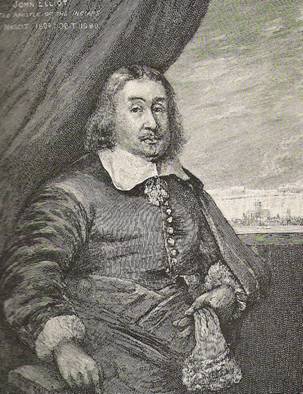
The following is a continuation of this post.  The material below is drawn from a biography of John Eliot (1604-1690), missionary to the Native Americans of Massachusetts.

* * *

In the second visit which Mr. Eliot made to the Indians at Nonantum, he began to catechise the younger children. He framed three questions only, that their memories might not be overloaded. Theimage003 questions and answers were these :
1. Who made you and all the world. Ans. God.

2. Who do you think should save you and redeem you from sin and hell ? Ans. Jesus Christ.

3. How many commandments hath God given you to keep. Ans. Ten.

By the time that the questions reached the smaller children, they had learned the answers perfectly, from hearing the others repeat them, and the parents had become familiar with them, and they were requested to use this Shorter Catechism of three questions, in teaching their children, against the next visit.

An old man rose up after Mr. Eliot had finished his sermon, and asked whether it was not too late for such an old man as he, who was near death, to repent or seek after God.

This question affected Mr. Eliot and his companions with compassion. They told him what is said in the Bible about those who were hired at the eleventh hour, and drew a parallel to his case by describing a son who had for very many years been disobedient, and afterwards penitent, and the feelings of his father towards him.

Question. How came the English to differ so much from the Indians in the knowledge of God and Jesus Christ, seeing they all had at first one father?

Question. How may we come to serve God?

Question. How comes it to pass that the sea water is salt and the land water fresh?

Answer. This is one of the wonderful works of God. As strawberries are sweet and cranberries sour, by the appointment of God, so was it in this case. To this was added some account of natural causes and effects in connection with this subject, which they less understood, yet did understand somewhat, as appeared by their usual signs of approving what they understand.”

Question. If the water is higher than the earth, how comes it to pass that it doth not overflow all the earth?

The missionary took an apple and illustrated the shape of the earth, the motion on its axis, and round the sun; then showed them how God made a great hollow ditch for the waters, which was so deep as to hold the waters by the attraction of gravitation, so that notwithstanding their convexity, they could not overflow the earth.

During a recess in this interview, the Indians were busily employed in discussing these several subjects among themselves, their minds being evidently excited by them, through the effect of new ideas upon subjects which were new or had always been incomprehensible to them. Being afterwards asked if they wished to propose any further questions, one asked,

If a man has committed some great sins, (stolen goods, &c.,) and the Sachem does not punish him, and he is not punished, but he restores the goods, what then? is not all well now? meaning to ask whether restoration made sufficient amends to the law of God.

He was told that though men be not offended at such sins, yet God is angry. The holiness of God was here illustrated. Such a sinner should seek forgiveness as much as any other sinner through the blood of Christ.

Upon hearing this answer, the Indian who proposed the question drew back and hung down his head, with an appearance of great sorrow and confusion, and finally broke out saying, “Me little know Jesus Christ, or me should seek him better.” Mr. Eliot comforted him by telling him that as it is early dawn at first when there is but little light, but the sun rises to perfect day, so it would be with him and his people with regard to a knowledge of the favor of God if they would seek Him.

One of the Indians who had received religious impressions in his acquaintance with the colonists, said he would propose this question. A little while since he said he was praying in his wigwam to God and Jesus Christ, that God would give him a good heart; that in his prayer another Indian interrupted him and told him that he prayed in vain, because that Jesus Christ could not understand what Indians speak in prayer; he had been used to hear Englishmen pray, and so could well enough understand them, but Indian language in prayer he was not acquainted with. His question therefore was, “Whether God and Jesus Christ did understand Indian prayers?”

At the close of one interview, Mr. Eliot prayed for above fifteen minutes in the Indian tongue, that they might feel that Christ understood such prayers. The Indians stood about him in grotesque figures, some of them lifting up their eyes and their hands to accompany the prayer, and one of them holding a rag to his eyes and weeping violently, and after prayer retiring to a corner of the wigwam to weep in secret; which one of Mr. Eliot’s companions observed and spoke with him, and found him to be deeply affected with a sense of his guilt.

…. At the fourth meeting with the Indians, the children having been catechised, and the vision of the dry bones, which seems to have impressed Mr. Eliot from the first in speaking to the Indians, being explained, they offered all their children to the English to be educated by them.

At this time one of them being asked, What is sin? he answered, A naughty heart. He did not seem to feel that sin consists only in outward acts.

… The son of a sachem, 14 or 15 years old, had been intoxicated; and being reproved by his father and mother for disobedient and rebellious conduct, he despised their admonition.  Before Mr. E. heard of it, he had observed that on being catechised, the fifth commandment being required of him, he reluctantly said, “Honor thy father,” but left out “mother.”

George, the Indian, who asked, in a public meeting, “Who made sack?”  killed a cow, and sold it at the college for a moose.  President Dunster was unwilling that he should be directly charged with it, but wished Mr. Eliot to inquire of him as to the crime.  But being brought before the assembly, he freely confessed his sin.

The Indians were never weary of asking questions in the public meetings.  An old Powaw once demanded, Why, seeing the English had been in the land twenty-seven years, they had never taught the Indians to know God till now?  He added, many of us have grown old in sin, whereas had you begun with us earlier, we might have been good.

The answer was that the English did repent that they were not more earnest at the first to seek their salvation, but the Indians were never willing to hear till now, and as God has now inclined their hearts to hear, the English were striving to redeem the time.

Another question was of deep interest. One of them said, That before he knew God, he thought he was well, but since, he had found his heart to be full of sin, and more sinful than it ever was before; and that this had been a great trouble to him; that at that day his heart was but little better than it was at first, and he was afraid it would be as bad as it was before, and therefore he sometimes wished that he might die before he should be so bad again!  Now, said he, my question is, Is this wish a sin?  Mr. E. says this question was evidently the result of his own experience and seemed to be sincere.

Another question was this:

Whither do our little children go when they die, seeing they have not sinned?

This led to an exposition of the depravity of man’s nature, and of the part which it is hoped dying infants have in the redemption made by Christ, and the covenant relation of the children of believers, which last doctrine Mr. Eliot says, “was exceedingly grateful unto them.”

The whole assembly at one time united and sent a question to Mr. Eliot by his man, as their united question, viz:

“Whether any of them should go to heaven, seeing they found their hearts full of sin, and especially full of the sin of lust?” At the next lecture held at “Dorchester mill,” occasion was taken to preach to them from Matt. 11: 28, 29, “Come unto me all ye that labor and are heavy laden,” &c., when the justifying grace of Christ to all who are weary and sick of sin was fully and earnestly set forth.  But at this time they repeated their fearful apprehension that “none of them would go to heaven.”

A question which uniformly troubled all who began to think of embracing religion was this:

“If we leave off Powawing and pray to God, what shall we do when we are sick?”  For though they had some knowledge of the medicinal qualities in certain roots and herbs, they of course had no knowledge of the human system, and hence no skill in applying their remedies, but relied on the antics and unearthly gestures and incantations of their Powaws to make the medicines take effect. Mr. Eliot expressed the desire that the Lord would stir up the hearts of some people in England to give some maintenance towards a school or academy, wherein there should be “Anatomies, and other instructions that way.”  Mr. E. had himself showed them an anatomy, the only one he says the English had ever had in the country.  By a course of instruction in medicine Mr. E. believed that he could most effectually, and perhaps, in the only way, “root out their Powaws.”

The Indians proposed this question to Mr. Eliot:

“What shall we say to some Indians who say to us, What do you get by praying to God, and believing in Jesus Christ?  You go naked still, and are as poor as we.  Our corn is as good as yours; and we take more pleasure than you; if we saw that you got any thing by praying to God, we would do so.”

Mr. E. answered to them on this point as follows : “First, God gives two sorts of good things; 1. little things, which he showed by his little finger, (‘for they use and delight in demonstrations ;’) 2. great things, (holding up his thumb). The little mercies he said are riches, clothes, food, sack, houses, cattle, and pleasures, all which serve the body for a little while, and in this life only.  The great mercies are wisdom, the knowledge of God, Christ, eternal life, repentance and faith; these are for the soul, and eternity.  Though God did not give them so many little things, through the knowledge of the Gospel, he gave them the greater things which are better. This he proved by an illustration: when Foxun, the Mohegan Counselor, who is counted the wisest Indian in the country, was in the Bay, I did on purpose bring him unto you; and when he was here, you saw he was a fool in comparison of you, for you could speak of God, and Christ, and heaven, &c.; but he sat and had not one word to say unless you talked of such poor things as hunting, wars, &c.”

He also told them that they had some more clothes than the wicked Indians; and the reason why they had so few, was because they had so little wisdom; but if they were wise to obey God’s commands, for example, “Six days shall thou labor,” they would have clothes, houses, cattle, and riches, as the English have.

Many questions and cases of dispute arose out of their old practice of gaming, to which they were greatly addicted. The irreligious Indians demanded the old stakes of some who had been convinced of the sin of gaming, and had declined to pay their forfeits. The winners however, insisted on being payed. Mr. Eliot had no little trouble in settling the matters of casuistry and conscience which thus occurred. But he took this method in many cases. He prevailed on the creditor to accept one half of his demand, having first showed him the sinfulness of gaming. He then told the debtor in private that God requires us to fulfill our promises though to our hurt, and then asked him if he would pay half. In this way such cases were many of them settled, for the creditors refused Mr. Eliot’s proposition, that whoever challenged a debt incurred by gaming should go before the Governor with his demand.

The following is an article that appeared in the ARBCA Quarterly Update, Feburary 2012, by the Rev. David Campbell, on Thomas Chalmers’ famous West Port Experiment of the mid-1840’s.  (British punctuation retained! Proper.)

* * * *

“The Most Joyful Event of My Life”

So Dr. Thomas Chalmers describes it in a letter to his friend, Mr. Lennox, of New York City. Explaining, he says, “I have been intent for thirty years on the completion of a territorial experiment, and I have now to bless God for the consummation of it. Our church was opened on the 19th of February…I presided myself, on Sabbath last, over its first sacrament. There were 132 communicants, and 100 of them from the West Port.”

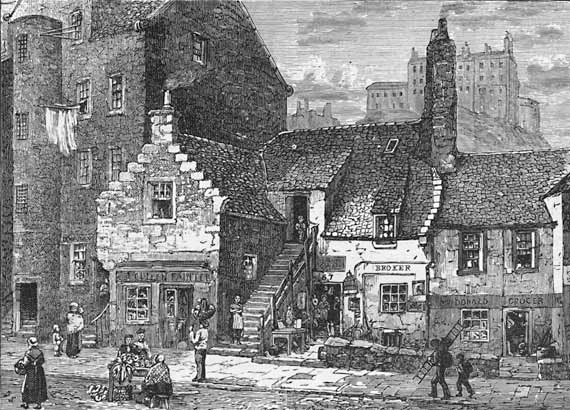
0_engraving_-_one_2_224_west_portAnyone know where the West Port is? When I was a student in Edinburgh in the mid 1980s I occasionally walked through it as I made my way to the Free Church College. I recollect it as decent enough, just a little run-down and nondescript. It was very different in the early 1840s. Back then it was one of the worst districts in the city, notorious as the scene of the Burke & Hare murders, and infested with beggars, thieves, and prostitutes. The following will give you a sense for just how bad it was:

“When Mr. Tasker, the minister of the West Port, made his first visits to some of the filthiest closes, it was no uncommon thing for him to find twenty to thirty men, women, and children, huddled together in one putrid dwelling, lying indiscriminately on the floor…Upon one occasion he entered a tenement with from twelve to twenty apartments, where every human being, man and woman, were so drunk they could not hear their own squalid infants crying in vain to them for food…He went once to a funeral, and found the assembled company all so drunk around the corpse, that he had to go and beg some sober neighbours to come and carry the coffin to the grave.”

It was this poor and depraved district that Dr. Chalmers selected for his “territorial experiment”. As the term is his so also will be the explanation: “The very essence of our scheme lies in the thorough operation of what we have called the territorial principle. We limit our attention to a single district or locality, itself split into sub-districts, having each a Christian agent attached to it; so that not a home or family which might not be frequently and habitually visited by one having the charge of not more, if possible, than twenty households.”

Chalmers believed this to be the only effective way of evangelising the degraded and over-crowded districts of major towns and cities, and for years he had been eager to demonstrate what, with the divine blessing, could be achieved. With its 411 families and 2000 inhabitants, its poverty and depravity, the West Port of Edinburgh was an ideal place for the attempt. It was a work, he admitted, “greatly too much for my declining strength” (he was then almost 65). But he threw himself into it heart and soul – and with wonderful results.

The first step was the opening of a school. Almost three-quarters of West Port children were growing up without any education at all. So successful, however, were the district visitors in persuading parents to take advantage of the provision (even though it wasn’t free), that when the school opened on 11th November 1844 there were 64 day students and 57 evening students. In the course of the first year the numbers grew to 250. Most of them were from the West Port.

The school was located in an old tanning-loft. In the same place, on Sunday morning the 22nd of December 1844, public worship was held for the first time. It was a far from attractive location: “The interior was bare and dilapidated; the walls coarse and unplastered, pierced her and there with little, dingy, unsightly windows; the roof low and scantily slated, scarcely affording decent shelter; the floor decayed, uneven, and shaking at every tread.”

Dr Chalmers’ son-in-law and future biographer, William Hanna, was present at the evening service. “When we looked round and saw that the whole fruit of the advices, and requests, and entreaties which for many previous weeks had been brought to bear upon all the families by the visitors, was the presence of about a dozen adults, and those mostly old women, we confess to strong misgivings as to the result.” In April 1845, however, Chalmers secured the help of William Tasker, later the West Port minister, and attendance grew under his ministry.

Dr. Chalmers himself, as health permitted, met with the district visitors once a week for discussion, encouragement, counsel, and prayer. He also habitually attended the Sunday services, sometimes as a preacher, often as a hearer. An eyewitness records that “when he was a hearer only, one would see him near the pulpit, in a crowd of deaf old women, who were meanly clothed, but who followed the services with unflagging attention and interest. His eye was upon every one of them, to anticipate their wishes and difficulties. He would help one old woman to find out the text; he would take hold of the Psalm-book of another, hand to hand, and join her in the song of praise. Any one looking at him could see that he was in a state of supreme enjoyment; he could not be happier out of heaven.”

The West Port was deeply upon his heart. In prayers that only came to light after his death we hear requests like this: “Moving fearlessly onward, may I at length obtain such possession of the West Port, as that the gospel of Jesus Christ shall have the moral ascendancy over a goodly number of its families”. “O that I were enabled to pull down the strongholds of sin and of Satan which are there”. “Do thou plentifully endow him [Mr. Tasker] with the graces and gifts of the Apostle Paul. May he have many souls for his hire”. “O may he not only be himself saved, but may he be the instrument of salvation to many.”

On Friday 19th February 1847, the West Port Church was formally opened by Dr. Chalmers. On the 25th of April, as we noted in the opening paragraph, Chalmers presided at the Lord’s Supper. On the following Monday he wrote to William Tasker: “I have got now the desire of my heart – the church is finished, the schools are flourishing, our ecclesiastical machinery is about complete, and all in good working order. God has indeed heard my prayer, and I could now lay down my head in peace and die.” And thirty-five days later that is exactly what he did.

It was feared that that the work would founder with him gone. It did not. Three hundred seats had been let when the church opened and attendance continued to grow steadily. By 1879 the membership was in excess of eleven hundred. By 1896 the number of communicants was upwards of 1300. Also, and almost from the beginning, through the educating of the children, through the efforts of the visitors, and through the public preaching of God’s word, the district itself began to visibly change for the better. It was all a magnificent monument not just to Chalmers’ labours and prayers, but to his faith. He loved the maxim of John Eliot, missionary to native Americans, that “prayer and pains can do anything”. He used to quote it often. And be believed it.

Parish_church_of_St_Nicholas_Fisherton_de_la_MereHere’s a great lecture (/sermon!) recently delivered on Thomas Chalmers’ passionate advocacy of Reformed parish ministry.  Good stuff all round.

patrick-fairbairnI’ve recently been picking away at a great 19th century treatise on pastoral theology by Free Church of Scotland minister and professor, Patrick Fairbairn.  A must read!  In the introductory chapter, he deals with foundational issues of ecclesiology that shape and mold the practice of shepherding souls.  Without the foundation, the house is shaky at best.  Here’s a very insightful quote on the bearing of right views of the Church as visible and invisible on the pastoral office:

“To the visible Church, then, belongs the public administration of the means of grace; and as it is by the instrumentality of these means that the true Church is gathered in, it is obvious that it is no more possible to sever the one from the other, than it is to sever the inward grace of the sacraments from the outward sign; and that, in fact, as in the sacraments the outward sign and the inward grace are not two sacraments, but the two aspects, the inward and the outward, of one and the same ordinance, so the visible and the true Church are not distinct communities, but one and the same, regarded from different points of view. The true Church depends for the maintenance of its existence on the visible Church; and, in turn, the visible Church is supported by the true. Thus a reciprocal action is ever going on : the visible Church, as such, dispensing the means of grace by which Christ works to the gathering in of His elect; and the true Church, as such, upholding and perpetuating the visible use of those means by furnishing faithful recipients of them.”

Sadly, it’s out of print.  But there appear to be several used copies on Amazon, and you can access it on GoogleBooks.

From Flickr.com“In a newly formed mind, there is no idea of nature or of a single object in nature – yet no sooner is an object presented, or is an event observed to happen, than there is elicited the tendency of the mind to presume on the constancy of nature. At least as far back as our observation extends, this law of the mind is in full operation. Let an infant for the first time in its life, strike on the table with a spoon, and, pleased with the noise, it will repeat that stroke with every appearance of a confident anticipation that the noise will be repeated also.”

-Thomas Chalmers, On Natural Theology, Vol. 1

Here’s a really helpful introduction to Thomas Guthrie (1803-1873), a prominent minister in the Church of Scotland and later Free Church of Scotland and a champion of biblically sound poor relief.

download

Recently, I’ve been curious about the historic place of “preaching stations” and their relevance for modern missions. It could just be me, but there seems to be little discussion or usage of the construct in “church planting” efforts.  Not sure of the reason for this. Maybe it’s because of the subdued place of preaching as the prime vehicle for conversion—at least within broader evangelicalism.  I fear that within Reformed circles, it may reflect church planting that engages more in picking up Calvinist proselytes (at best) or bald sheep-stealing (at worst). That is, church growth that aims not so much at the lost community as an ever-recycling Christian one.  

Whatever the case may be, historically and in the contemporary situation, I’m liking what I read from Chalmers on the topic:

“I should not hold it wise to rush precipitately on the formation of a parish church, till a preaching station, upheld by household assiduities, had been tried and found to be successful. Such a preaching station is the germ of the future church, as the missionary is of the future clergyman; but not till the germ had so far germinated, would we venture on a full parochial apparatus for any locality whatever.”

First, preaching stations are forward-moving Gospel efforts, in the direction of full-fledged congregations. They are missionary endeavors.  Second, they operate in the right order with respect to sacraments. Word first; then assuming reception, baptism and the Lord’s Supper.  Throw the Gospel net far and wide, but keep the sacraments out of the equation until there are “fruits worthy of repentance.”  Third, aggressive, territorial household visitation as an indispensable adjunct to the preaching station.

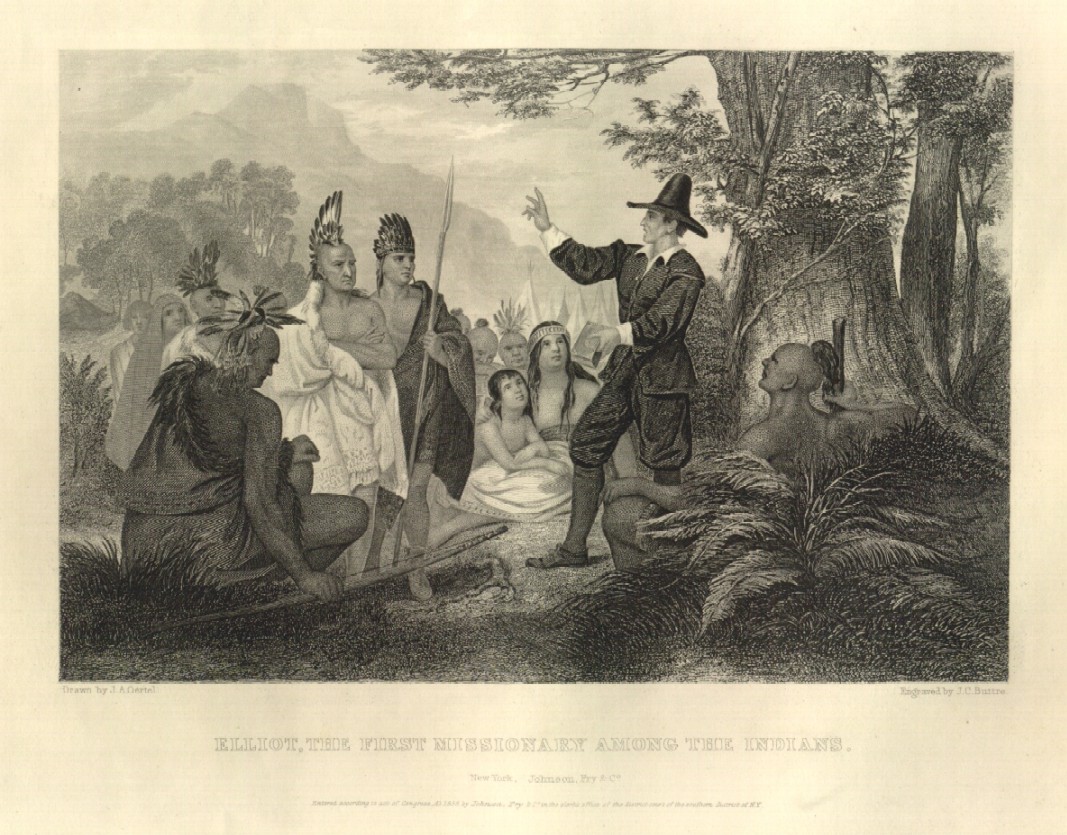
The following are anecdotes from the labors of Puritan missionary John Eliot (1604-1690) among the Native Americans of early Massachusetts.  The extract is drawn from The Life of John Eliot by Nehemiah Adams (1847).

Specifically, we witness Eliot and company catechizing the heathen, ushering them into the holy knowledge of the faith and so into the bosom of the Church.  Obviously, our Puritan forbears entertained a broad view of this discipline.  It was not simply for those in the Church seeking to deepen their understanding of  but also for those laying hold of the skirt of a Jew and begging for guidance to Zion’s God.

After one or two more posts, I’ll conclude with some reflections on Eliot’s evangelistic catechesis.

* * * *

An hour and a quarter was occupied in the discourse. Mr. Eliot gave the Indians first a brief exposition of the ten commandments, showing the wrath and curse of God against those who break the least one of them. The subject was then applied, and the law having been brought to do its work in their hearts, and their sins being pointed out to them, as Mr. Eliot says, with much sweet affection, Jesus Christ was preached to them as the only Saviour. He told them who Christ was, and what he did, and whither he had gone, and how he will come again to judge the wicked and burn the world. The creation and fall of man, the greatness of God, heaven and hell, the pleasures of religion and the miseries of sin were then explained in language and with illustrations suited to their capacity.

The sermon being finished, Mr. Eliot proposed some questions to them, and first inquired whether they understood what had been said, and whether all or only some of them understood it ? A multitude of voices exclaimed that they all understood every thing which had been spoken. Leave was then granted them to put questions, and it is interesting to notice the first questions which these children of the wilderness proposed. The first questions were, “What is the cause of thunder?” “What makes the sea ebb and flow?” “What makes the wind blow?”

But there were some questions proposed by them which Mr. Eliot says some special wisdom of God directed them to ask, as, for example, How may we come to know Jesus Christ?

Mr. Eliot told them that if they could read the Bible they would see clearly who Jesus Christ is, but inasmuch as they could not then read, he desired them to remember what he had told them out of the Bible, and to think much and often upon it, when they lay down on their mats in their wigwams and when they rose up, and to go alone in the fields, and woods, and muse on it, and so God would teach them.

He told them that if they would have help from God in this thing, they must begin to pray, and though they could not make long prayers as the English did, yet if they did but sigh and groan, saying, “Lord, make me to know Jesus Christ for I know him not,” and if with all their hearts they persisted in such prayers, they might hope that God would help them. But they were especially to remember that they must confess their sins and ignorance to God and mourn over them and acknowledge how just it would be in God to withhold from them any knowledge of Christ, on account of their sins.

This instruction was communicated to them by Mr. Eliot through the Indian interpreter whom he had brought with him, but he says he was struck with the fact that a few words from the Preacher had much greater effect than many from the interpreter.

One of them asked, whether Englishmen were ever at any time so ignorant of God and Jesus Christ as they themselves?

Another put this question: Whether if the father be naughty and the child good, will God be offended with that child ? because in the second commandment it is said that he visits the sins of the fathers upon the children.  They were told in reply to this that every child who is good will not be punished for the sins of his father, but if the child be bad, God would then visit his father’s sins upon him, and they were bid to notice that part of the second commandment which contains a promise to the thousands of them that love God and keep his commandments.

One of them asked, How is all the world now become so full of people, if they were all once drowned in the flood? This led to the story of the ark and the preservation of Noah.

Mr. Eliot then proposed some questions to them, for example, Whether they did not desire to see God, and were not tempted to think there is no God because they could not see him?  Some of them answered, They did desire to see Him if it could be, but they had heard from Mr. Eliot that he could not be seen, and they did believe that though their eyes could not see him, he was to be seen with their soul within. Mr. Eliot endeavored to confirm them in this impression, and asked them if they saw a great wigwam or a great house, would they think that raccoons or foxes built it? or would they think that it made itself? or that no wise builder made it, because they could not see him who made it?

Knowing that the doctrine of one God was a great stumbling block to them, Mr. Eliot asked them if they did not think it strange that there should be but one God, and yet this God be in Massachusetts, and in Connecticut, in Old England, in this wigwam, and the next, and every where at the same time?  One of the most sober of them replied that it was indeed strange, as every thing else they had heard preached was strange, and they were wonderful things which they never heard of before, but yet they thought “It might be true, and that God was so big every where.” Mr. Eliot illustrated the truth by the light of the sun, which, though it was but a creature of God, shed its light into that wigwam, and the next, in Massachusetts and Old England, at once.

He inquired of them if they did not find something troubling them within after the commission of murder, theft, adultery, lying; and what would comfort them, and remove that trouble of conscience when they should die and appear before God?  They replied that they were thus troubled, but they could not tell what they should say about it, or what would remove this trouble of mind, whereupon Mr. Eliot enlarged upon the evil of sin and the condition of the soul which is cast out of the favor of God.

Having spent three hours in this interview, Mr. Eliot asked them if they were not weary, and they said, no. But thinking it best to leave them with an appetite, Mr. Eliot concluded the meeting with prayer.


Downtown_Providence,_Rhode_Island

Here is a great contemporary summary of Thomas Chalmers’ (1780-1843) ‘district visitation’ or parish model for evangelism and holistic, biblical philanthropy.   It was originally published in 2000, in Foundations, the theological journal of the British Evangelical Council (now Affinity).

Ad urbem!

FAMILY CATECHISING.

[From the United Presbyterian Magazine, Scotland, 1851.]

Of all the periods of human life, youth is the most favourable for religious impression. At first the judgment, though weak, is not pre-occupied; the heart, though depraved, is not yet hardened; and the conscience, though evil, is not yet seared as with a hot iron. Then, like the young sapling, the mind will take any bend you are pleased to give it. But when it has long been inured to sin, it becomes stubborn as the sturdy tree that resists our pressure. We are told, on the best authority, it is as unlikely for one to do good who has been accustomed to do evil, as for the Ethiopian to change his skin, or the leopard his spots. Hence it is that so little can be done with the aged, and many think that few are converted after their twentieth year. It is true we must not limit the Holy One of Israel, and we know he can save even at the eleventh hour. But though a man may be born again when he is old, few, we fear, are changed at this time of life, and most of the aged who are coming to the grave like a shock of corn in its season, are those of whom God says, “I remember the kindness of thy youth.”

Since these things are so, can too much attention be paid to the training of the young? And should not every expedient be resorted to for improving the precious season of youth? In what follows, we intend to confine our remarks to one branch of the subject—family catechising. Of the importance of this department of parental duty, we cannot form too high an estimate. A family thus instructed, becomes a little nursery for the church and for heaven. The advantages of the practice have been seen in the lives and in the deaths of multitudes, and yet the day of judgment alone can reveal them fully.

But this practice, so invaluable to the young, has sadly declined in these degenerate days. The time has been, when no head of a family, who pretended to the name of a Christian would have dared to neglect it; but, as with family worship, what was once the rule has, we fear, become the exception. Nay, there is too much reason to doubt, that rare as is the worship of the family, the family catechising is still more rare; and some who observe the former duty have no relish for the latter. The chief cause of this is, no doubt, the decline of vital religion; but there are particular circumstances at the present day, which cannot be held as evincing such a decline, and yet have had their influence in producing the result we are deploring. Since Sabbath-schools have become so numerous, many parents think the work of family catechising is taken out of their hands. Now this is a great mistake. Sabbath-schools are a blessing, and a great blessing, to the country. But they are at the best but a remedy for a prevalent disease, and if every father could, and would, instruct his own household, Sabbath-schools would be quite uncalled for. No Christian parent is at liberty to devolve on a proxy the religious training of his offspring. And what instruction can be compared to that of a father? The school teacher may be very kind, and deeply concerned for the salvation of his pupils. But the child knows that his parent has far more interest in him than any stranger can have; and if the lessons of the school are not seconded by home tuition, they will in general be in vain. The neglect of this duty we believe to be one great reason of a fact which all Christians deplore, that while Sabbath-schools were never more numerous, juvenile wickedness was never more prevalent.

The frequency of preaching on the Sabbath evenings, especially in towns, may be another cause which has led to this evil. These sermons are extensively placarded and earnestly pressed on attention. The names of the preachers and their particular subjects are diligently advertised and intimated from every pulpit, as if it were some performance where men go to be entertained. Parents think they are well employed when they are hearing the word; and, as this is felt to be much easier than doing their more appropriate work at home, it is often preferred. Now, no head of a family should ever think, in ordinary circumstances, of going to these evening discourses. He is the priest in his own household, and his work at home is far more important than hearing the most popular preacher, on the most exciting theme he can bring before them.

The neglect of the good old way has been most disastrous. It is owing to this that such ignorance now prevails among the members of churches, and that the attainments of most professors are so very circumscribed. None who examine candidates for communion, or parents who are seeking baptism to their children, but must be pained at this. Many people can make but little of sermons, as preachers cannot be always dwelling on first principles; and as church examinations, either from the neglect of the pastor, or the pride of the people, are now almost entirely obsolote, unless the examination be practised in the family, ignorance must increase. And is it not owing to the same neglect that the grossest errors and wildest views on religious subjects are so rampant in the present day? Though the age be distinguished for shrewdness and acuteness in detecting flaws in science and literature, what monstrous opinions are entertained on religion!

Now, if in early life a systematic view of Christian doctrine were obtained, and digested and stored in the memory, the analogy of faith would be seen; the bearing of one doctrine on another would be apparent, and the pernicious dogmas, which gain assent so easily, would be at once rejected. In times of change like the present, when a respect for all that is sacred is sneered at by many as weakness and superstition, when the march of intellect, as they call it, is the pretext for so much change, and when all the foundations have gone out of their course, how important for the young especially to be rooted and grounded in the truth, that they may not be the dupes of every impostor, and be tossed about by every wind of doctrine!

In catechising a family, much will depend on the mode of procedure. To be efficient, it must be done frequently, seriously, intelligently, affectionately, attractively, and prayerfully.

It must be done frequently. Not at rare intervals, as before a communion, or when about to ask admission into the church, or when the visit of the pastor is expected. It must be very regular, and often repeated. For many years it was the custom to require an answer to a question every morning, and the greater part of Saturday was devoted to a revisal of the Catechism. But in this age of bustle and business, when even the day of God is encroached on, and there is time for everything but religion, such important seasons may not be convenient. Yet once in the week is surely not too often, and the evening of the Sabbath may be employed by all.

It must be done seriously,—not like some secular exercise, but as a work involving eternal interests. The subjects of examination are all of the most solemn and tremendous moment. And yet how often are the questions repeated with scarcely a solemn sound, and by a thoughtless tongue! Now this is not only hateful to God, but hurtful to the young. On such occasions all levity must be banished from the mind. They must be taught, when examined, that they have now to do with God, and that the place they occupy is like the “holy ground.”

It must be done intelligently; without this it will be labour in vain. Many have the form of sound words to which they can attach no meaning. They can repeat the questions with the greatest accuracy; but if you vary the language and ask what is meant by the thing expressed, there is no reply but the stare of ignorance. In this matter an improvement has taken place in recent editions of the Catechism. But still there is need for more explanation, that milk may be given to babes as well as meat to the stronger man.

It must be done affectionately, in the spirit of the father when he said, “O my son, if thine heart be wise my heart shall rejoice, even mine;” or of the mother who, leaning over the darling of her heart, exclaims, “O my son, and the son of my womb, and the son of my vows, and the son of my prayers.” The young must be drawn with the cords of love as the bands of a man. We cannot compel them to be religious. We may force them to read the Bible, and to repeat the questions, but we cannot compel them to love the Redeemer. In conducting this duty, the father must try to convince his child that he loves him as his own soul, and travails as in birth that Christ may be formed in his heart.

It must be done attractively,—not in a scolding, scowling manner, which would discourage children, and beget an aversion to the exercise; not as a task or piece of drudgery, so many questions inflicted as a kind of punishment. Unless the duty is made a delight, it will be little relished. The pious Philip Henry, as his son tells us, made the work of catechising so delightful to himself and his household, that he would sometimes say, at its close on the Sabbath evening, “Well, if this is not heaven, it must be the gate to it.”

And it must be done prayerfully. The parent who knows anything of true religion, is well aware that all his efforts will be useless without the Spirit of God. He may succeed in imparting theoretical knowledge; his child may be able to answer with promptitude and precision every question he is pleased to put to him; but without the grace of God, it is all like the sounding brass or the tinkling cymbal. The knowledge which is all intellectual may exist in the memory or the head, but it has no communication with the heart. Polish the marble as you please, it may display its spots and its veins, but it is marble still. No father can convert his son. Flesh and blood cannot do this; none but the Father in heaven. While, therefore, the parent questions, he must also pray; and while in the morning he sows the seed, he must look up for the early and the latter rains.

Were the exercise so conducted, might we not expect the most happy results? We know it is corruption and not grace that runs in the blood; and that many a pious father has had a wicked Absalom. But this is the exception and not the rule, and for such exceptions reasons may often be assigned, as in the case of David and Eli. Manasseh had a good father who would take care to instruct him in the things of God; and yet for a while he gave no evidence of profiting from his pious education. But see him caught among the thorns; carried captive to Babylon; lying in the dungeon, and there making supplication to the God of his father. It was his early impressions which were then revived. It was the seed sown into his mind when a child, that then sprung up and produced such a blessed harvest. And such cases are by no means rare. Parents may sometimes think they have laboured in vain. Their instructions may be buried long under the clods of corruption, but their words may be remembered when they are sleeping in the dust, and when their souls are in heaven. They may have occasion to say on hearing of the conversion of their poor prodigal, “It is meet to make merry, and be glad, for this my son was dead, and is alive again; he was lost and is found.”

If a parent, then, is reading these lines, we would say—for your own sake, for your children’s sake, and for the sake of the Lord Jesus, early instruct your offspring in the things of God. If your children perish through neglect of this, how can you meet them in the other world? “O father! O mother!” they might say, “if you had taught me the Catechism, if you had taken pains to instruct me in the things that belong to my peace, I might not have come to this place of torment. You took care, indeed, to cultivate my mind, and refine my manners; you sent me to every school but the school of Christ; you were careful that I should learn everything but the way of salvation. You often examined me on questions of science, but you had no anxiety to know my attainments in religion. You were proud when you saw me excelling others in branches of literature, but you thought no shame though you saw me ignorant of religion as the wild ass’s colt. The things that belonged to my peace you hid from mine eyes, and now I cannot but curse you for ever as the cause of my misery.”

But O, how different the meeting when by instructing your children in religion you have not only kept them from error, but become the means of their eternal salvation! Then how will they hail you, as, under God, the parents not of their first only, but of their second birth! And how transported will you be when called to account for your charge, you can say, Lord, here are we, and the children thou hast given to us—given to us first by nature, and then by grace! Happy family in heaven! Here you enjoyed your domestic gatherings, but they were soon over. But now your Sabbath’s sun never goes down—your meetings never break up! The Catechism is left behind you, and also the Bible, for now you know even as you are known. But being pious and happy in your lives, in your deaths you are not divided; for they who are a family in Christ are for ever with each other and for ever with the Lord!