Feeds:
Posts
Comments

I try to avoid promoting my own sermons very often. But after giving a short, three-part series on the doctrine of hell, I continued with a second short series on the subject of biblical, Reformed church growth, something very near my heart. Specifically, I spoke from Matthew 16:18 about building up the church from within by training up, winning over, and thus retaining our baptized, covenant children. We must promote and encourage Christian child-bearing and so helping populate the (visible) Kingdom through these “federally holy” sinners, a mission field in its own right. (More on that subject here.) Then, I laid out in the final messages a call and battleplan for aggressive, local and regional missions. As Prof. Murray said when personally engaging in church-planting in New England, we must “go where the people are, not where you hope they will come.”

I have been serving in New England and now New Jersey for 18+ years. Let us pray earnestly and labor believingly for the extension of confessional Presbyterianism here in our northeastern “Samaria.” It may be spiritually ‘rocky soil,’ but God can create sons of Abraham from these stones. He did it before! If things go from bad to worse, a strategic retreat is possible. But let us not give up the Messiah’s ground without a fight! And who knows? Perhaps the Lord will make this “desert to blossom as the rose” again, and restore the pure worship of our godly Puritan forbears.

Do you live in the northeast—in New England, New York, or New Jersey? Are you committed to the old paths of the Puritans and Presbyterians? Do you long for a Third Great Awakening today? Would you be interested in hosting special meeting in your area? Please get in touch with me at 515-783-5637 or michael@reformedparish.com. [Note, 7/25/24: we would seek to do so in a collaborative way with area NAPARC and other more faithful churches, where possible.]

And if you don’t live in the northeast, would you pray for us? And maybe even consider joining us, if Providence opens a door?

XIV. The rest of God, from the work of the creation, was a type of a far more glorious rest of God from the work of the glorification of the whole universe. When God had created the first world, so as to be a commodious habitation for man during his probation, and an illustrious theatre of the perfections of the Creator; he took pleasure in this his work, and rested with delight. For he bestowed upon it all the perfection which was requisite to complete that state. But he had resolved, one day, to produce a far more perfect universe, and, by dissolving the elements by fire, to raise a new heaven and a new earth, as it were, out of the ashes of the old: which new world, being blessed with his immutable happiness, was to be a far more august habitation for his glorified creatures; in which, as in the last display of his perfections, he was for ever to rest with the greatest complacency. And besides, as God, according to his infinite wisdom, so wisely connects all his actions, that the preceding have a certain respect to the following; in like manner, since that rest of God after the creation was less complete than that other, when God shall have concluded the whole, and which is to be followed by no other labour or toil; it is proper to consider that first rest of God as a type, and a kind of prelude of that other, which is more perfect. In fine, because it tends to man’s greatest happiness, that the whole universe be thus glorified, and himself in the universe, that God may altogether rest in him, as having now obtained his last degree of perfection, he is said “to enter into the rest of God,” Heb. 4:10.

Continue Reading »

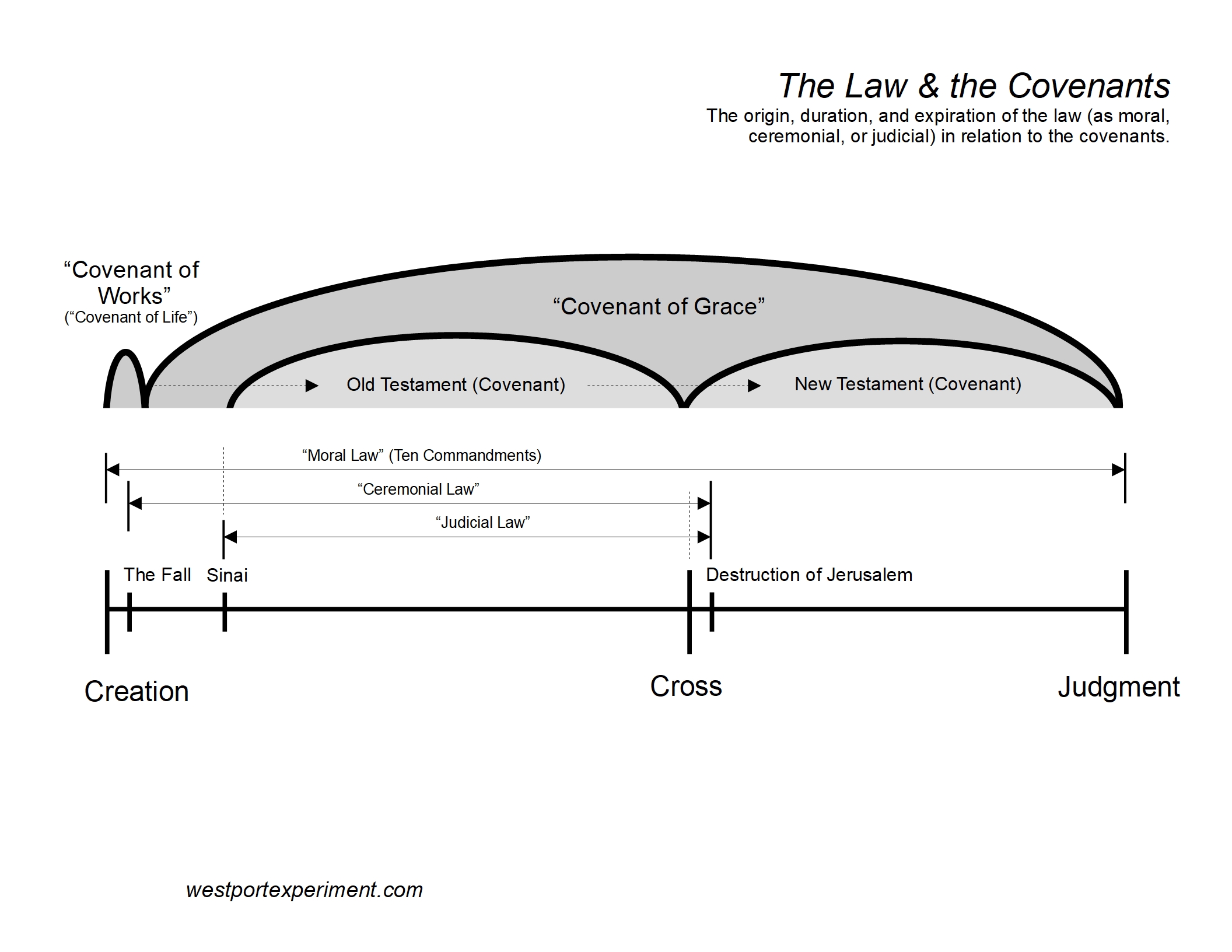
Below is an expanded and updated set of diagrams I’ve worked on to explain covenant theology in its various dimensions. The earlier version was posted here.

I ended up making three interrelated diagrams so as to avoid things becoming too convoluted. These should be pretty intuitive for the average Reformed office-bearer and the better-educated Reformed believer. (And note, ‘construct covenants’ is a term I’ve coined. If there is a more standard one of which I’m ignorant, by all means let me know.)

God’s design was perfectly to restore all the ruins of the fall, so far as concerns the elect part of the world, by his Son; and therefore we read of the restitution of all things. Acts 3:21, “Whom the heaven must receive, until the times of the restitution of all things; and of the times of refreshing from the presence of the Lord Jesus.” Acts 3:19, “Repent ye therefore and be converted, that your sins may be blotted out, when the times of refreshing shall come from the presence of the Lord.”

Man’s soul was ruined by the fall; the image of God was defaced; man’s nature was corrupted, and he became dead in sin. The design of God was, to restore the soul of man to life and the divine image in conversion, to carry on the change in sanctification, and to perfect it in glory. Man’s body was ruined; by the fall it became subject to death. The design of God was, to restore it from this ruin, and not only to deliver it from death in the resurrection, but to deliver it from mortality itself, in making it like unto Christ’s glorious body. The world was ruined, as to man, as effectually as if it had been reduced to chaos again; all heaven and earth were overthrown. But the design of God was, to restore all, and as it were to create a new heaven and a new earth: Isa 65:17, “Behold, I create new heavens, and a new earth; and the former shall not be remembered, nor come into mind.” 2 Pet 3:13, “Nevertheless we, according to his promise, look for new heavens, and a new earth, wherein dwelleth righteousness.”

The work by which this was to be done, was begun immediately after the fall, and so is carried on till all is finished, when the whole world, heaven and earth, shall be restored. There shall be, as it were, new heavens, and a new earth, in a spiritual sense, at the end of the world. Thus it is represented, Rev 21:1, “And I saw a new heaven, and a new earth; for the first heaven and the first earth were passed away.”

[from A History of the Work of Redemption]

I need your help. Are you Reformed, fluent in English and Spanish, and willing to help us from the comfort of your home, wherever you live? Our urban mission in Providence, R.I. could really use you. We are exploring alternate and backup Spanish translators for our monthly Spanish outreach broadcast—hopefully the embryo of a future mission work in Providence. We are working on a system that enables us to use someone like you from a distance, to translate my preaching into Spanish live.

I also have other English to Spanish translation projects. I’m working with a confessional Presbyterian seminary in Bolivia, El Seminario Teológico Reformado – William Ames, developing a course in English and translated into idiomatic Spanish. I could very much use an extra translator or two to convert English transcripts into Spanish translations for use in video subtitles.

If you have a large heart and a passion for advancing the classic Reformed testimony, please get in touch. You can contact me at mjives dot refparish at gmail dot com, call 515-783-5637, or DM me on Facebook.

Please pray for us. Learn more about Reformed Parish Mission (RPM); and sign up for the West Port Experiment blog at the right to receive periodic updates.

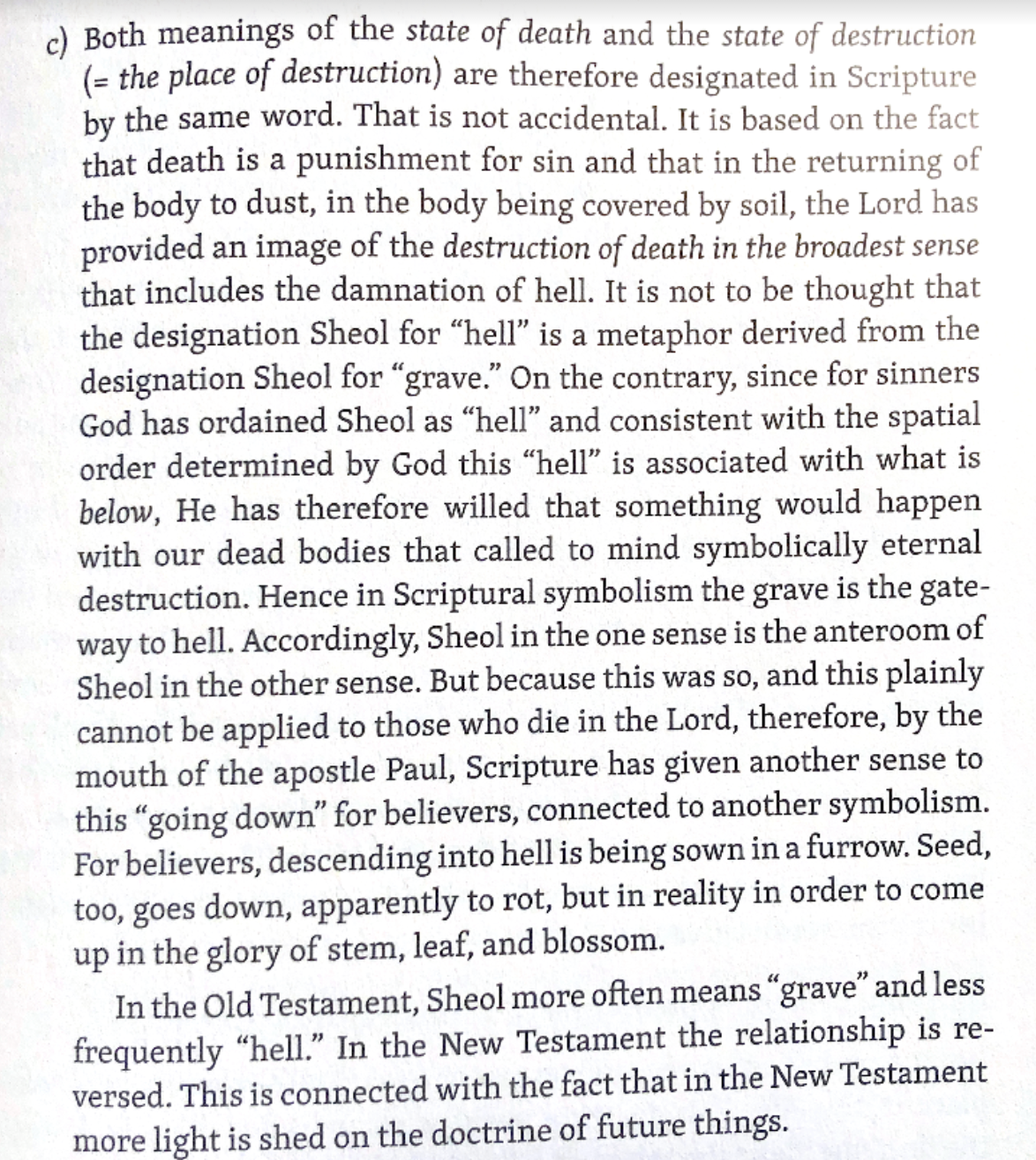
Geerhardus Vos, Reformed Dogmatics, vol. 5. “In Scripture symbolism the grave is the gateway to hell. Accordingly, Sheol in the one sense is the anteroom of Sheol in the other sense.”

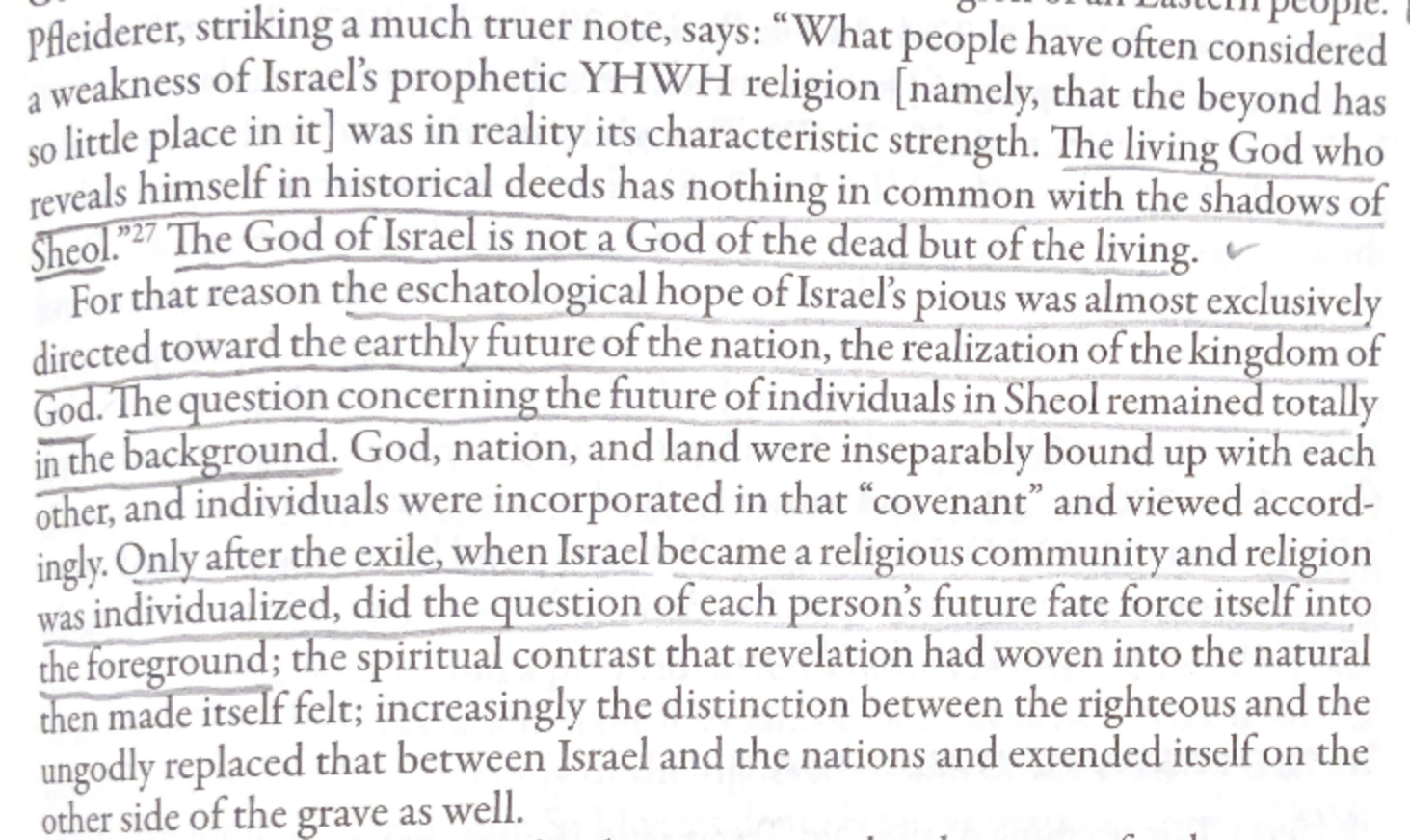
Herman Bavinck, Reformed Dogmatics, vol. 4

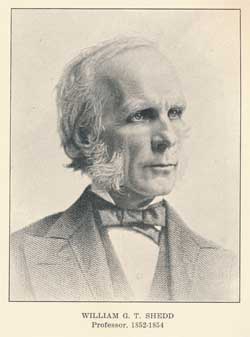
Just finished recording the lengthy chapter “The Biblical Argument” in W. G. T. Shedd’s theological treatise, The Doctrine of Endless Punishment. Truly the definitive modern work on the subject. Listen to them here. Among other insightful and profound passages is the following on the apocalyptic, revelatory nature of death:

“. . . in Scripture death is represented as the deciding epoch in a man’s existence. It is the boundary between the two Biblical aeons, or worlds. Until man dies, he is in ‘this world’ (ho nun aion); after death, he is in ‘the future world’ (aion ho mellon). The common understanding of the teaching of Scripture is, that men are in ‘time,’ so long as they live, but when they die, they enter ‘eternity.’ ‘It is appointed unto men once to die, but after that judgment,’ Heb. 9:27. This teaches that prior to death man’s destiny is not decided, he being not yet sentenced; but after death his destiny is settled. When he dies, the ‘private judgment,’ that is, the immediate personal consciousness either of penitence or impenitence, occurs. Every human spirit, in that supreme moment when it ‘returns to God who gave it,’ knows by direct self-consciousness whether it is a child or an enemy of God, in temper and disposition; whether it is humble and contrite, or proud, hard, and impenitent; whether it welcomes or rejects the Divine mercy in Christ. The article of death is an event in human existence which strips off all disguises, and shows the person what he really is in moral character. He knows ‘as he is known,’ and in this flashing light passes a sentence upon himself that is accurate. This ‘private judgment’ at death, is reaffirmed in the ‘general judgment’ of the last day.”

In recent months, we have begun a monthly livestream broadcast on the 2nd Lord’s day evening of each month at 7:00 p.m., especially to reach Spanish speakers in my parish and beyond. The Morales family has joined us, and Pr. Luis Morales has been translating for me. So grateful for his labors and his fellowship in the Kingdom-building.

God willing, I hope to take him out in the parish to visit my more receptive Spanish-speaking contacts, in the hopes of getting them to come to our regular services where we now have translation facilities. My hope and prayer ultimately is to see the Spanish side of my parish mission blossom, folks attending the our regular services, and our monthly bilingual meeting expanding and moving to the next level of usefulness. Again, the Reformed faith is a heritage too rich and full to be confined to white middle-class churches. So, all you Westminsterians and Three-Formers, let us take this to the city. ¡Vámanos!

To watch more of these broadcast messages, visit here. And learn more about RPM here.

The following is the text of a new leaflet introducing visitors to our worship practice.

Out of the Ordinary

Our worship practice is certainly a very different experience for many who visit us. We are certainly not your conventional evangelical church; and in many ways, we may stand out from even other modern Reformed and Presbyterian churches. To some, this worship is unique, even quaint; to others it may seem strange, overly solemn, and even off-putting.

One thing is for sure: we don’t worship this way to conform to trends, much less to attract those who already know what they want in a church. While our practice is very historic—this once was, after all, the universal practice among Reformed churches in Puritan New England, and other Reformed Churches in continental Europe—that’s not the reason either. The church, after all, is the house of God, not a museum! And just because something is ancient does not make it biblical.

Continue Reading »

Somehow I was voted into it. Last year, on December 24 no less, I was invited by Les Lanphere to debate Rev. Joseph Spurgeon on the lawfulness of Christmas. (Other platforms.) Joseph was for, while I was against; and Les did a great job of moderating. I thought it went really well, and I came away feeling that I did a service to this unpopular position. I also endeavored to be as charitable as possible. Perhaps I overshot things by being so affable; but I’d rather fall into that error than the other way, lest folks think that being against Christmas is somehow a function of a grumpy predisposition. After all, I consider myself the merriest neo-Puritan I know. Ask my kids!