Feeds:
Posts
Comments

The following are quotes from Thomas Chalmers (1780-1847) who was passionate about relieving the poor and above all, bringing them the glad tidings of the Gospel.

* * * *

“Such is the peculiar adaptation of the Gospel to the poor, that it may be felt in the full force of its most powerful evidence by the simplest of its hearers” (Chalmers, Works 6:256).

“The proper work of an establishment . . . is to reclaim and christianize the common people” (Chalmers, Works 18:206).

“In respect of immortality, the great and the small ones of the earth stand on an equal eminence” (Chalmers, Works 6:288).

“Yet I must say I liked the Irish part of my parishioners. They received me always with the utmost cordiality, and very often attended my household ministrations, although Catholics” (Chalmers, Works 16:243).

“The main impulse of [the parish minister’s] benevolence, lies in furnishing the poor with the means of enjoying that bread of life which came down from heaven, and in introducing them to the knowledge of those Scriptures which are the power of God unto salvation to every one who believeth” (Chalmers, Works 11:290).

“There is none we think of correct moral taste, and whose heart is in its right place, that will not rejoice in such a spectacle, as far more pleasing in itself, and, if only universal in our churches, far more indicative of a healthful state of the community, than the wretched system of the present day, when the gospel is literally sold to the highest bidders among the rich, and not preached to the poor” (Chalmers, Works 11:381).

* * * *

And some longer quotes:

“Now the great aim of our ministry is to win souls; and the soul of a poor man consists of precisely the same elements with the soul of a rich. They both labour under the same disease, and they both stand in need of the same treatment. The physician who administers to their bodies brings forward the same application to the same malady; and the physician who is singly intent on the cure of their souls will hold up to both the same peace-speaking blood, and the same sanctifying Spirit, and will preach to both in the same name, because the only name given under heaven whereby men can be saved” (Chalmers, Works 11:356).

“It was saying more for the common people of Judea that they heard the Saviour gladly, than for the Scribes and Pharisees who heard him with envy, prejudice, and opposition; and it is saying more for the common people of this country, that they hear the doctrine of Christ gladly, than for those learned who call that doctrine foolishness, for those men of taste who call it fanaticism, for those men of this world who call it a methodistical reverie, for those men of fashion and fine sentiment who shrink from the peculiarities of our faith, with all the disgust of irritated pride and offended delicacy” (Chalmers, Works 11:358).

“If a poor child be capable of being thus transformed, how it should move the heart of a city philanthropist, when he thinks of the amazing extent of raw material, for this moral and spiritual manufacture that is on every side of him—when he thinks, that in going forth on some Christian enterprise among a population, he is in truth, walking among the rudiments of a state that is to be everlasting—that out of their most loathsome and unseemly abodes, a glory can be extracted, which will weather all the storms, and all the vicissitudes of this world’s history—that, in the filth and raggedness of a hovel, that is to be found, on which all the worth of heaven, as well as all the endurance of heaven can be imprinted—that he is, in a word, dealing in embryo with the elements of a great and future empire, which is to rise, indestructible and eternal, on the ruins of all that is earthly, and every member of which shall be a king and a priest for evermore” (Chalmers, Works 6:260).

“It was not thus with the ancients of our Church when spoiled of her endowments by the rapacity of the Crown, and of those nobles who formed the all-powerful aristocracy of that generation. True there was but the population of a million in these days; but whole tracts of country were rifled by the hand of violence of their ecclesiastical patrimony, and no means were left for the Christian education of the people who would have sunk into a state of moral barbarism but for the efforts of so many patriots as courageous and enlightened as the world ever saw,—the fathers and founders of the Kirk of Scotland. The territory had been desolated of its provision both for churches and schools; but they went forth upon it notwithstanding, and chalked out their parishes, and planted their stations for the ministry of the word, and without the visible means of sustenance or support, laboured both with the Church’s plat, and the Church’s polity, till the God in whom they trusted overthrew the counsels of their adversaries, and forced out of their sacrilegious hands a hardwon maintenance for an order of men whom now it is the fashion to stigmatize, but who have ever proved, throughout all the periods of our bygone history, and have now the opportunity of proving still, that they are the best friends of the poor man and of the labourer” (Chalmers, Works 18:289).

“To give money, is not to do all the work and labour of benevolence. You must go to the poor man’s sick bed. You must lend your hand to the work of assistance. You must examine his accounts. You must try to recover those debts which are due to his family. You must try to recover those wages which are detained by the injustice or the rapacity of his master. You must employ your mediation with his superiors. You must represent to them the necessities of his situation. You must solicit their assistance, and awaken their feelings to the tale of his calamity. This is benevolence in its plain, and sober, and substantial reality; though eloquence may have withheld its imagery, and poetry may have denied its graces and its embellishments. This is true and unsophisticated goodness” (Chalmers, Works 11:303-4)

[image source]

The following passages come from Thomas Chalmers’ sermon, “Heaven: A Character, Not a Locality.” Is the future state one that leaves the earth behind? Not according to Chalmers! Profound thoughts here. Heavenly ….. and earthy!

* * * *

“This may serve to rectify an imagination, of which we think that all must be conscious—as if the grossness of materialism was only for those who had degenerated into the grossness of sin ; and that, when a spiritualizing process had purged away all our corruption, then, by the stepping stones of a death and a resurrection, we should be borne away to some ethereal region, where sense, and body, and all in the shape either of audible sound, or of tangible substance, were unknown. And hence that strangeness of impression which is felt by you, should the supposition be offered that in the place of eternal blessedness, there will be ground to walk upon; scenes of luxuriance to delight the corporeal senses ; or the kindly intercourse of friends talking familiarly, and by articulate converse together; or, in short, any thing that has the least resemblance to a local territory, filled with various accommodations, and peopled over its whole extent by creatures formed like ourselves—having bodies such as we now wear, and faculties of perception, and thought, and mutual communication, such as we now exercise. The common imagination that we have of paradise on the other side of death, is, that of a lofty aërial region, where the inmates float in ether, or are mysteriously suspended upon nothing –where all the warm and sensible accompaniments which give such an expression of strength, and life, and colouring, to our present habitation, are attenuated into a sort of spiritual element, that is or meagre, and imperceptible, and utterly uninviting to the eye of mortals here below—where every vestige of materialism is done away, and nothing left but certain unearthly scenes that have no power of allurement, and certain unearthly ecstasies, with which it is felt impossible to sympathise. The holders of this imagination forget all the while, that really there is no essential connexion between materialism and sin—that the world which we now inhabit, had all the amplitude and solidity of its present materialism, before sin entered into it that God so far, on that account, from looking slightly upon it, after it had received the last touch of His creating hand, reviewed the earth, and the waters, and the firmament, and all the green herbage, with the living creatures, and the man whom He had raised in dominion over them, and He saw every thing that He had made, and behold it was all very good. They forget that on the birth of materialism, when it stood out in the freshness of those glories which the great Architect of Nature had impressed upon it, that then “ the morning stars sang together, and all the sons of God shouted for joy.” They forget the appeals that are made everywhere in the Bible to this material workmanship—and how, from the face of these visible heavens, and the garniture of this earth that we tread upon, the greatness and the goodness of God are reflected on the view of His worshippers. No, my brethren, the object of the administration we sit under, is to extirpate sin, but it is not to sweep away materialism. By the convulsions of the last day, it may be shaken, and broken down from its present arrangements; and thrown into such fitful agitations, as that the whole of its existing framework shall fall to pieces; and with a beat so fervent as to melt its most solid elements, may it be utterly dissolved. And thus may the earth again become without form, and void, but without one particle of its substance going into annihilation. Out of the ruins of this second chaos, may another heaven and another earth be made to arise; and a new materialism, with other aspects of magnificence and beauty, emerge from the wreck of this mighty transformation; and the world be peopled as before, with the varieties of material loveliness, and space be again lighted up into a firmament of material splendour.”

Works 7:283-285

“And it is indeed an homage to that materialism, which many are for expunging from the future state of the universe altogether—that ere the immaterial soul of man has reached the ultimate glory and blessedness which are designed for it, it must return and knock at that very grave where lie the mouldered remains of the body which it wore-and there inquisition must be made for the flesh, and the sinews, and the bones, which the power of corruption has perhaps for centuries before, assimilated to the earth that is around them and there, the minute atoms must be re-assembled into a structure that bears upon it the form and the lineaments, and the general aspect of a man—and the soul passes into this material framework, which is hereafter to be its lodging place for ever—and that, not as its prison, but as its pleasant and befitting habitation—not to be trammelled, as some would have it, in a hold of materialism, but to be therein equipped for the services of eternity-to walk embodied among the bowers of our second paradise-to stand embodied in the presence of our God.”

Works 7:286-287

“Ministers are the fishers of men; and the effect of an endowment is to lengthen their line, and enable them to reach downward to the lowest gradations of the commonwealth. The voluntaries are a kind of fly-fishers—whose operations do not reach to the muddy bottoms, to those depths and those fastnesses of society, which to them are inaccessible. And a chapel of ease, give it any ecclesiastical organization you like, is just such a voluntary [entity]. Nominally, you may give it the title of an established church; but you will never give it the power or the properties of an established church without an endowment” (Works 18:101-102)

In this quote, Chalmers is contending within his historical situation for the full inclusion of “chapels of ease” (more or less preaching stations) within the established Church of Scotland. But what is crucial, he argues, is that they should be territorial, assigned to focus pastorally and evangelistically on one defined neighborhood, and endowed, so that they do not have to be beholden to the more privileged classes attending from beyond their ‘parish.’ Without these two pillars, the ability to minister to all, both rich and poor, becomes extremely difficult. In fact, it becomes impossible when contemplated as a system for the entire nation, which is what an establishment is built to guarantee. In the end, you are back to the religious marketplace, and those who lack “wealth and will” are left to sink to the bottom.

[image source]

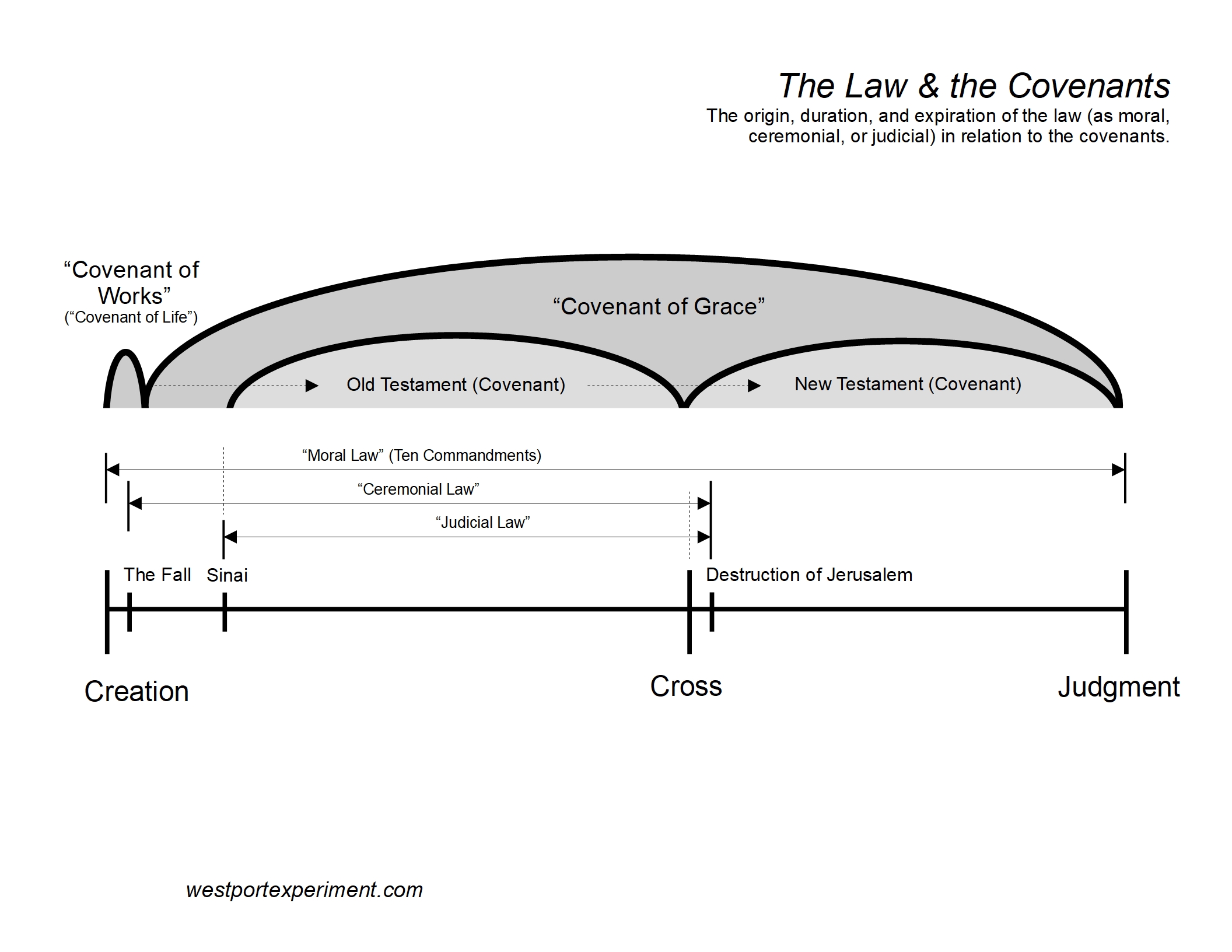
Another theological diagram as a teaching aid for my next lesson on the Westminster Shorter Catechism this Sabbath. I designed this some time back and got some feedback on it from a couple of my ministerial colleagues.

Like any diagram, it doesn’t say it all. But I think it helps distinguish the Reformed position from extremes on either side. What think ye?

Interested in learning more about Chalmers? Here are several helpful resources (in addition to mine) for those who want to explore his life and thought further.

(1) Introductions online

(2) Audio/visual resources online

(3) Biographies & scholarly references

  • Sandy Finlayson, Thomas Chalmers (Bitesize Biographies)
  • John Roxborogh, Thomas Chalmers, Enthusiast for Mission
  • Hugh Watt, Thomas Chalmers and the Disruption
  • Stewart J. Brown, Thomas Chalmers and the Godly Commonwealth in Scotland

Below is an alphabetically arranged catalogue of several of Thomas Chalmers’ primary sources with the digital files made accessible. Where I’ve audio-recorded the resource, the title has been hyperlinked. So click to listen away, all you multi-taskers! [A work in progress here; and starting with his material directly or indirectly related to his advocacy of parish missions.]

Continue Reading »

Last week, I had a Puritan Seminary student join me (Puritan alum, Class of 2005), for some intensive urban outreach in central Rhode Island. Anderson Oliveira, a Brazilian Presbyterian student, had sat in on my Reformed Parish Mission presentation in Grand Rapids last February and expressed interest in interning. So he flew out last Wednesday, and we logged many hours together over several days bringing the Gospel of the Kingdom to my Warwick and especially South Providence parishes. It was a joy to have him tag along and participate.

He started out helping me in the mundane task of printing and folding Gospel leaflets. Not glamorous, but ever-so-necessary. The particular one we used for most of the visits included the prophecy of the Suffering Servant of Isaiah 53. We often used this text as a launchpad – as Phillip of old – to announce to sinners the vicarious Remedy. Each doorstep talk was a doorway to heaven, opened on earth. But alas! Though heaven’s door is set open to sinners, the Spirit of God must move them to take that vital step. And so Anderson and I frequently stopped to plead with the Lord, that He might send forth His irresistible Wind, who blows where He wills.

Continue Reading »

Any confessionally Reformed pastors, elders, or theological students, want to read and study Thomas Chalmers on parish missions? Interested in also talking application, the nuts and bolts of how these principles might be applied in the modern day? Have you “chalked out” a parish yourself and want to compare notes, share trials and successes, and troubleshoot problems? Or are you a church member who is mission-minded and interested in learning more?

I’ve been reading, researching, and writing on Chalmers’ parish mission model for about 15 years and have been trying to apply his principles in my own pastoral ministry almost that long. If you’d like participate in a group by video call to talk through readings in Chalmers and other Reformed figures who advocated and practiced parish missions, let me know.

Drop me a note. My e-mail is mjives dot refparish at gmail dot com, text me at 515-783-5637, or message me through Facebook. You’ll then be on the invite list with the Zoom call-in information for each meeting.

Next Meeting: Thursday, November 18, 2021 @ 4:00 p.m. EST

“A Charge to New Elders at the Tron Kirk, Glasgow” (1816)

AUDIO / TEXT

For some background reading on this period of Chalmers’ ministry, here are selections from James Dodd’s, Thomas Chalmers: A Biographical Study (1870).

[source]

* * * *

Listen to past sessions below (developing), with the primary sources we’ve discussed:

Session 1: Wednesday, July 28, 2021

“On the Duty and Means of Christianizing Our Home Population” (1820)

AUDIO / TEXT

Classic Presbyterianism has been enjoying a small renaissance. It seems like every day I’m encountering new people and pastors embracing the “regulative principle of worship,” singing psalms exclusively, removing instruments in church, and objecting to holy days of human origin, such as Christmas. Sacred cows are a-falling, or at least are being questioned.

With respect to Christmas, then, it’s been reassuring to see more and more voices pointing out its pagan origins, and more and more being willing to cross the personal Rubicon … and not looking back. I rejoice in these things and thank the Lord for any and all Reformation gains. But I am concerned that for some, even good fathers and brothers in the faith, certain concessions are made that I fear leave a weed in place to grow back in full force. In other words, I respectfully express my concern about the informal retention of Christmas while officially going on the record as against it.

Continue Reading »

While reading through a dissertation treating confessional subscription among Presbyterians prior to the Adopting Act of 1729, I came across a discussion of the English Presbyterian Daniel Wilcox. Apparently, the influence of Enlightenment thinking regarding authority and toleration was infiltrating English Presbyterians at that time in a big way, and even Arianism began to rear its ugly head. If I’m not mistaken, this would be the caldron from which Unitarianism basically took over Presbyterianism in England.

During this intermediate period, Wilcox published a short justification for confessions and the practice of confessional subscription. Very interestingly, he puts it in the form of a catechism! Just recorded it, which you can access here.

And the original text is here: