Feeds:
Posts
Comments

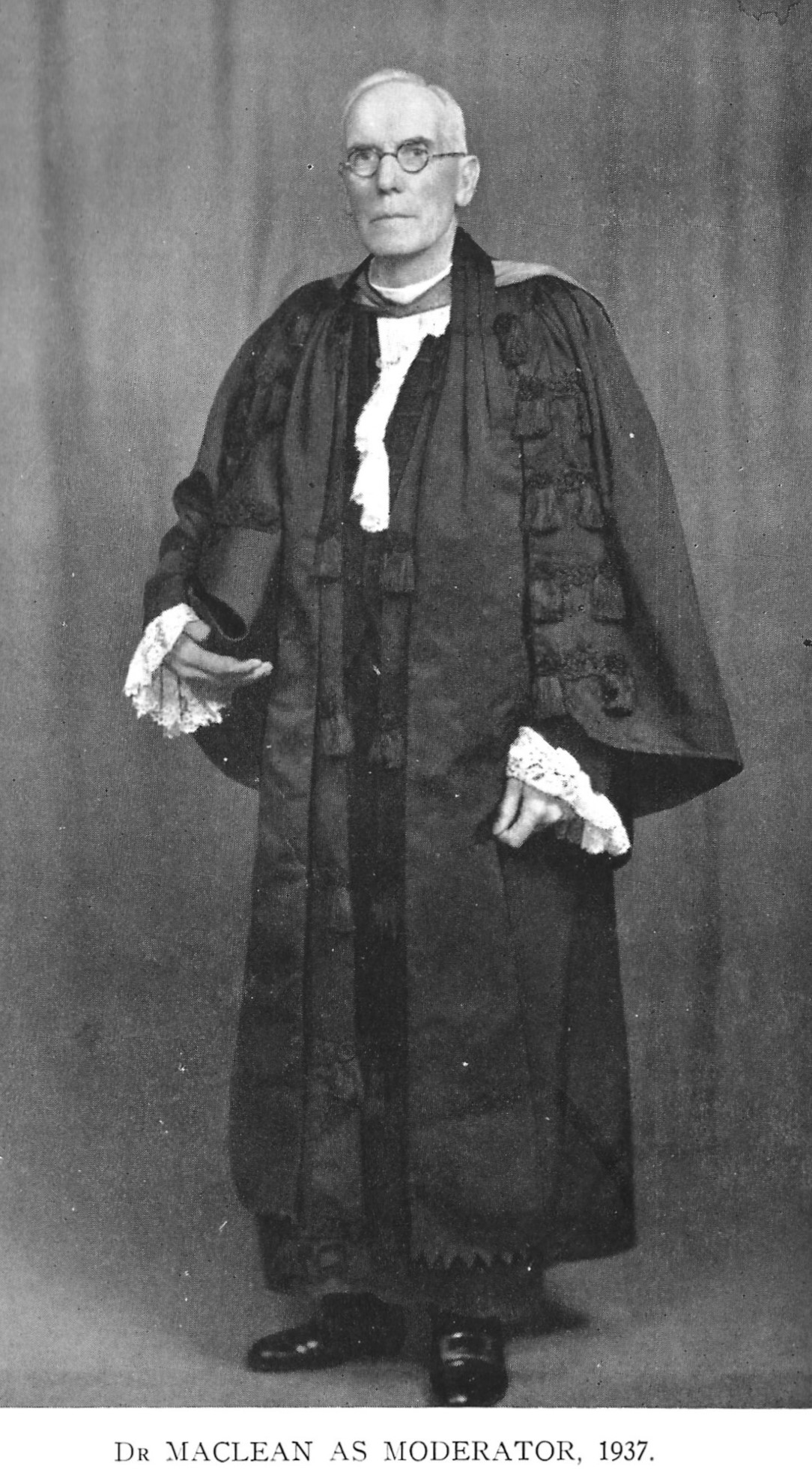
Just recently audio-recorded two articles by Free Church of Scotland Principal Donald Maclean (1869-1943). I have found several of the men of that generation not only profoundly rich theologically and spiritually, but that their English prose is also quite compelling. We are generally below the mark these days, I fear.

The following quote is a sample, from Maclean’s “An Evangelical Ministry.” Here, he answers the question as to the effect of Anglo-American Christianity’s emphasis on the social application of Christian around the turn of the 20th century: “The answer is sadly easy. The flood-tide to the Churches has, alas, not set in. The prejudices and hostility of sinful man have not been softened by the undoubted social amelioration effected. The heedless multitude still pass by. But even more serious is the reaction which the social application of Christianity has had upon the faith itself. Revealed truth itself cannot be affected by human reactions, for the Word of the Lord endures for ever. Nevertheless, the attempts to apply Christianity socially have profoundly affected the meaning which the Christian faith has for the average man and ordinary churchgoer. The emphasis on the social has largely stifled the spiritual nature of the faith. It has obscured the revealed fact that the Christian message was primarily to and for individuals. That the Son of God became man, and that man must be born again, are sufficiently strong reminders to us of the divine estimate of the immortal soul of man. The great doctrines of grace which the Bible so unmistakably connects with the redemption of the human personality, have been so rarely emphasised during more than a generation that, not only have these doctrines become unknown, but the spiritual faculties of hearers have been so weakened by disuse that spiritual discernment has faded away. The Church of to-day is consequently faced with the difficult but necessary task, arising from her former neglect, of re-educating her people in the fundamental elements of the faith which give it the character and distinction of being the Christian faith of revelation. For the business of the Church in its God-given mission is to the individual and through the individual to society. Moreover, the Christian revelation holds out no hope for society except in so far as the men and women who form it are Christian, which for the secular State is a futile and unattainable ideal. It is therefore all the more essential that the truth should be understood that a Christian society can only be fashioned out of and by Christian men and women.”

Special thanks to the Rev. John Keddie for assistance with photo above. More historic audio resources from the heritage of the Free Church of Scotland available here. All Thomas Chalmers titles are separate, here. And visit our entire audio library here.

Listen to Thomas M’Crie’s The Life of Alexander Henderson.

Robert Baillie, in a speech delivered before the General Assembly in 1647 upon the death of this great churchman, declared of his late friend, “That glorious soul of blessed memory, who now is crowned with the reward of all his labours for God and for us, I wish his remembrance may be fragrant among us, so long as free and pure Assemblies remain in this land, which we hope shall be to the coming of our Lord. You know he spent his strength, and wore out his days, he breathed out his life in the service of God and of his Church. This binds it on our back, as we would not prove ungrateful, to pay him his due. If the thoughts of others be conform to my inmost sense, in duty and reason, he ought to be accounted by us and posterity, the fairest ornament, after John Knox, of incomparable memory, that ever the Church of Scotland did enjoy.”

And check our our entire audio library here.

Here is the latest quarterly update. If you missed the last one from February, you can read it here.

For more information about RPM or to make a donation, click here.

Pray for our Gospel effort this June in Vineland, 30 minutes west of us. We are going to do a lot of door-to-door and literature canvassing, to share the good news and try to get folks to come to some special, bilingual evangelistic meetings on three consecutive Saturday evenings.

“Fear not; from henceforth thou shalt catch men.” Luke 5:10

In this marvelous account, Jesus catches Peter. Now this may seem strange, given that Simon Peter had already become a follower of the Nazarene. Andrew, Peter’s brother, had been a following of John the Baptist. But the Baptist redirected his disciples to Jesus, for Jesus “must increase,” and he “decrease.” Andrew dutifully went, but soon was himself caught by the Master. From there he went to his brother for another catch. “We have found the Messiah” (Jn. 1:41)! Andrew drew Peter to shore, as it were, and Jesus did the rest! Peter began following Jesus.

But still, he kept one foot on dry land. He held on to his day job—better safe than sorry, after all! Following is one thing; forsaking all quite another. But Jesus would not let this one go. So on this morning, after he finished teaching the crowds, he bade Peter go fishing. “Launch out into the deep, and let down your nets for a draught.” What! Peter was the fisherman, Peter knew these waters like the back of his hand, Peter went when the fish were out, and Peter had done everything right. Yet Peter that night had come up empty. Yet out of respect, he yielded to Jesus. Reluctantly no doubt, but reverently. He believed the Master; at least, generally speaking. But what did the carpenter-preacher really know about this trade?

Read the rest of this article below, published in the Banner of Sovereign Grace Truth

Here is the latest quarterly update. If you missed the last one about our move to S. Jersey and my new endeavor to go full time with RPM, you can read it here.

For more information about RPM or to make a donation, click here.

The following is a trifold that I use to introduce myself and the church, and to get something of Jesus into the hands of the lost. I’ll occasionally change up the contents, but this is the basic format.

The following is taken from J. C. Ryle’s exposition of John 3:22-36.

“On one account, this passage deserves the special attention of all devout readers of the Bible. It contains the last testimony of John the Baptist concerning our Lord Jesus Christ. That faithful man of God was the same at the end of his ministry that he was at the beginning. the same in his views of self–the same in his views of Christ. Happy is that church whose ministers are as steady, bold, and constant to one thing, as John the Baptist!

“We have, firstly, in these verses, a humbling example of the petty jealousies and party-spirit which may exist among professors of religion. We are told, that the disciples of John the Baptist were offended, because the ministry of Jesus began to attract more attention than that of their master. ‘They came unto John, and said unto him, Rabbi, he that was with you beyond Jordan, to whom you barest witness, behold the same baptizes, and all men come to him.’

“The spirit exhibited in this complaint, is unhappily too common in the Churches of Christ. The succession of these complainers has never failed. There are never lacking religions professors who care far more for the increase of their own party, than for the increase of true Christianity; and who cannot rejoice in the spread of religion, if it spreads anywhere except within their own denomination. There is a generation which can see no good being done, except in the ranks of its own congregations; and which seems ready to shut men out of heaven, if they will not enter therein under their banner.

“The true Christian must watch and pray against the spirit here manifested by John’s disciples. It is very insidious, very contagious, and very injurious to the cause of religion. Nothing so defiles Christianity and gives the enemies of truth such occasion to blaspheme, as jealousy and party-spirit among Christians. Wherever there is real grace, we should be ready and willing to acknowledge it, even though it may be outside our own pale. We should strive to say with the apostle, ‘If Christ be preached, I rejoice, yes! and will rejoice’ (Phil. 1:18.). If good is done, we ought to be thankful, though it even may not be done in what we think the best way. If souls are saved, we ought to be glad, whatever be the means that God may think fit to employ.”


Just added a recording in two parts of John Witherspoon’s farewell sermon to his congregation in Paisley, Scotland before sailing over to the American colonies to take up the presidency of the College of New Jersey in 1768. It is a profoundly moving and historic sermon, and especially one that ministers of the Gospel would do well to read. I began recording it soon before my transition to a pastorate in New Jersey, which added to its personal significance for me. Here are the opening words of the sermon. And to access more titles from my growing audio library, go here.

“My brethren, these words [Acts 20:26-27] are a part of the apostle Paul’s discourse to the elders of Ephesus, when taking leave of them, under a firm persuasion, or rather a certain knowledge, that he would never again see them in the body. My present situation, of which none of you is ignorant, has determined me to the choice of this passage, as a very proper subject from which I may conclude the exercise of my ministry among you. I had once occasion, on leaving another charge, to have taken a formal farewell of a very affectionate people, but had not courage to attempt it. The circumstances attending the removal, which, if Providence prevent not, seems now to be at hand, are such as do not lessen, but greatly increase the difficulty of speaking from such a subject. And yet, in another view, they seemed to urge it so strongly, and to present such an opportunity of being useful, as I durst not wholly decline. Every Christian ought to be an observer of providence. Nothing will more effectually promote his holiness and comfort. And both a minister and his people ought to improve the aspect of providence, when it hath any thing peculiar in it, to their mutual benefit.

“Let me therefore intreat you to attend to the following discourse, with patience and composure. This request I the rather hope you will comply with, as there is nothing intended that is personal, further than must necessarily arise from the subject itself, or be unavoidably suggested by your own thoughts. I bless God that I have no complaint to make of want of duty or affection upon your side; neither is it any part of my purpose to justify my own conduct, during the time that I have had the honour and happiness of being entrusted with the ministry of the gospel in this place. I shall therefore only fay, that whether I have been able to deliver my own foul by fidelity in duty, and by purity of principle, I am certain, that very much has been laid to the charge of many of yours. Least of all do I intend to endeavour to satisfy you of the motives which have induced me to accept of a call to a distant part of the world, and, in some degree, a different employment in the Church of Christ. For this, I know that an account must be given, in due time, to a much greater Judge, with whose approbation either the applause or censure of men are not worthy to be laid in the balance. The single purpose, therefore, of the following discourse, shall be to give you such a comprehensive view of the truths of the everlasting gospel, of the importance and difficulty of a minister’s work; as may direct you in the choice of another pastor, increase your esteem of such as are faithful, and excite you to guard against every thing that may either discourage them in their work, or prevent their success.”

The following two quotes are taken from George Gillespie’s An Assertion of the Government of the Church of Scotland (1641). They seem to me to have a bearing on the question of the ‘indigenous principle’ that our denomination, the Presbyterian Reformed Church, has advocated since its inception in 1965. That is, presbyterian churches ought ideally to develop their own nationally autonomous bodies distinct from others outside their borders; or, trans-national denominations, especially when ‘centered’ in one particular nation, should be avoided or superseded as impractical, and liable to hierarchicalism or a kind of church-imperialism. These quotes in particular demonstrate that historic presbyterianism, while holding out a gradation of church courts, nevertheless accepts as valid smaller and even the smallest church units when circumstances on the ground prevent more.

“Add unto these a distinction betwixt a congregation lying alone in an island, province or nation, and a congregation bordering with sister churches. If either there be but one congregation in a kingdom or province, or if there be many far distant one from another, so that their pastors and elders cannot ordinarily meet together, then may a particular congregation do many things by itself alone, which it ought not to do where there are adjacent neighbouring congregations, together with which it may and should have a common presbytery” (43).

Continue Reading »