Feeds:
Posts
Comments

Comedian John Mulaney once joked that one of Jesus’ greatest miracles was having twelve close friends in his thirties. Sadly, the modern decline of friendship is real, and anything but a punchline.

The Survey Center on American Life reports that that in 1990, almost 70% of men had five or more close friends. By 2021, just 40% reported having that many. And the number who said they had no close friends quintupled. Women haven’t fared well, either, though their friend groups haven’t shrunk as rapidly.  

Part of the challenge is that time together is the oxygen of friendship. Deprive it of that, and friendship tends to die or at least become more distant. And today, perhaps due to a faster pace of life and more “stuff” piled into our schedules, spending time with friends requires more effort and intentionality than in decades past. Research shows that Americans now spend half as much time with their friends (three hours a week) as they did just a decade ago.  

Read the rest of this article by John Mulaney at Breakpoint.

I’ve recorded several chapters of Cotton Mather’s great Magnalia Christi Americana: Or, The Ecclesiastical History of New-England: from Its First Planting, in the Year 1620, Unto the Year of Our Lord 1698. Here are the opening words of the first chapter, “Discoveries of America.”

* * * * *

“It is the opinion of some, though ’tis but an opinion, and but of some learned men, that when the sacred oracles “of Heaven assure us, the things under the earth are some of those, whose knees are to bow in the name of Jesus, by those things are meant the inhabitants of America, who are Antipodes to those of the other hemisphere. I would not quote any words of Lactantius, though there are some to countenance this interpretation, because of their being so ungeographical: nor would I go to strengthen the interpretation by reciting the words of the Indians to the first white invaders of their territories, we hear you are come from under the world to take our world from us. But granting the uncertainty of such an exposition, I shall yet give the Church of God a certain account of those things, which in America have been believing and adoring the glorious name of Jesus; and of that country in America, where those things have been attended with circumstances most remarkable. I can contentedly allow that America (which, as the learned Nicholas Fuller observes, might more justly be called Columbina) was altogether unknown to the penmen of the Holy Scriptures, and in the ages when the Scriptures were penned. I can allow, that those parts of the earth, which do not include America, are, in the inspired writings of Luke and of Paul, stiled all the world. I can allow, that the opinion of Torniellus and of Pagius, about the apostles preaching the gospel in America, has been sufficiently refuted by Basnagius. But I am out of the reach of Pope Zachary’s excommunication. I can assert the existence of the American Antipodes: and I can report unto the European churches great occurrences among these Americans. Yet I will report every one of them with such a Christian and exact veracity, that no man shall have cause to use about any one of them the words which the great Austin (as great as he was) used about the existence of Antipodes; it is a fable, and nulla ratione credendum.

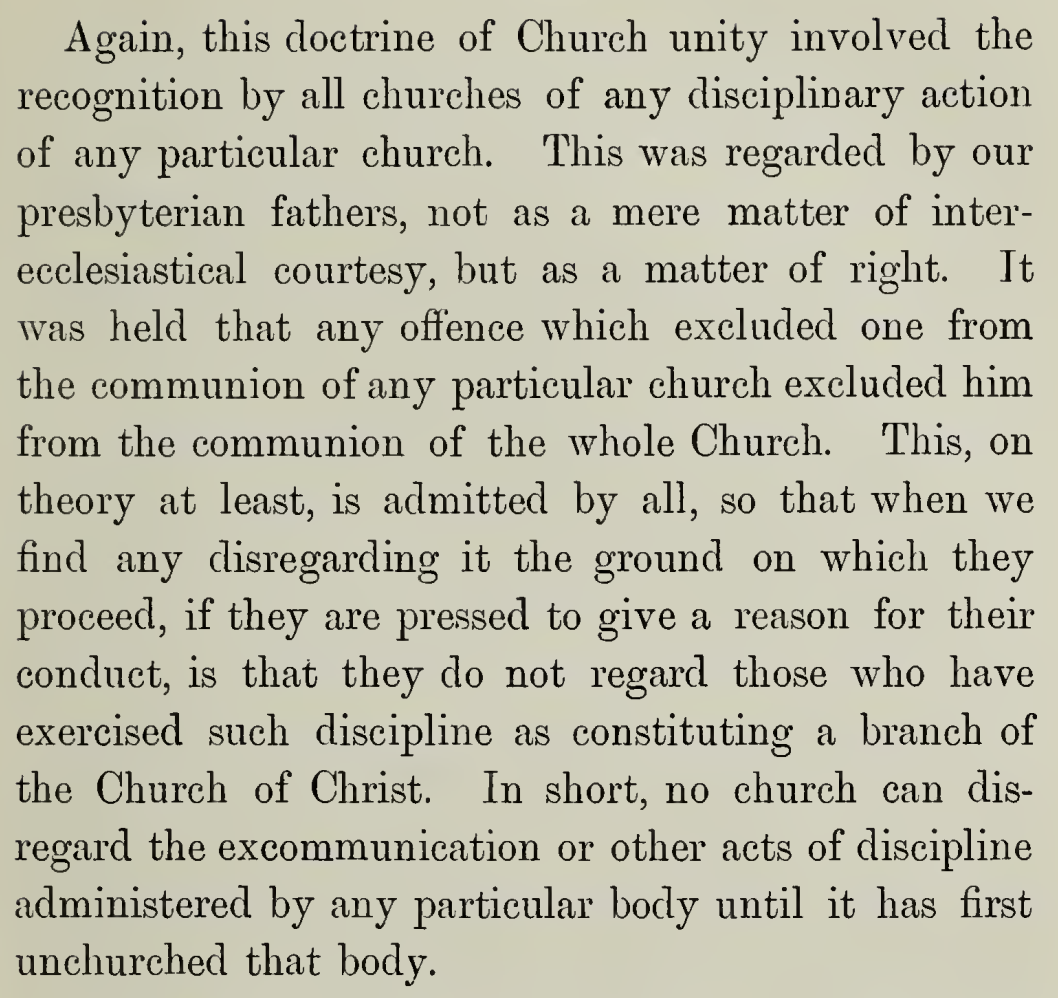
MacPherson explains the radically catholic ecclesiology of our Scottish Presbyterian forbears. Listen to an audio recording of the chapter where he treats this subject here.

Whole doctrine catholicity | “Who is she that looketh forth as the morning, fair as the moon, clear as the sun, and terrible as an army with banners” (Song 6:10)?

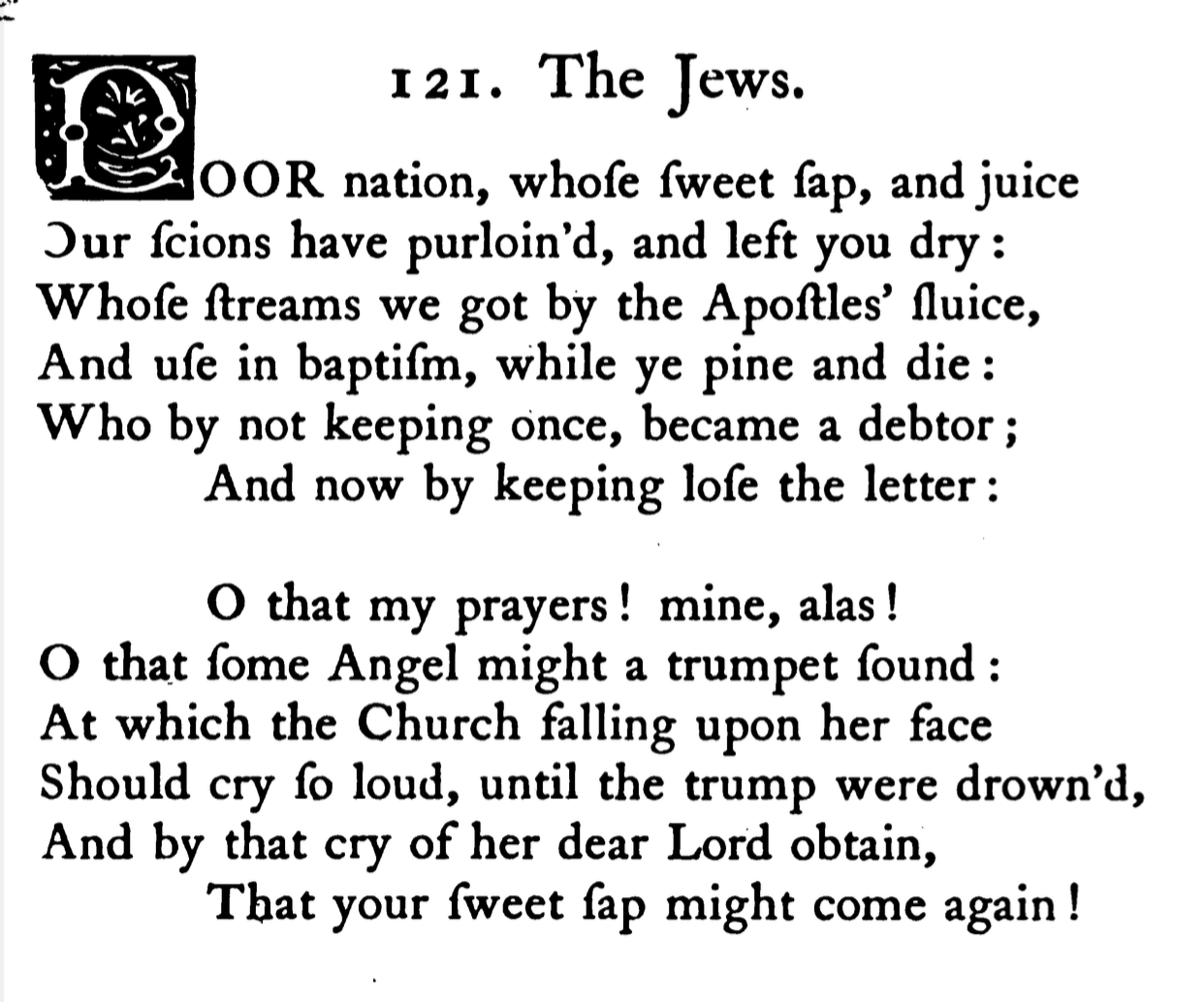
“For if thou wert cut out of the olive tree which is wild by nature, and wert graffed contrary to nature into a good olive tree: how much more shall these, which be the natural branches, be graffed into their own olive tree” (Romans 11:24). This poem of Herbert beautifully and tenderly expresses the right attitude of the believing Gentiles toward the disinherited Jews, with Pauline longings for their final restoration by repentance and faith in their own, rejected Messiah.

1. scion: a young shoot or twig of a plant, especially one cut for grafting or rooting. 2. purloin: to steal. 3. sluice: a sliding gate or other device for controlling the flow of water, especially one in a lock gate.

This was very, very good. Especially in light of a resurgent antisemitism in the West, and even in the Church. Remember, Satan’s grand conspiracy is multi-front. And the Jews, while “enemies for our sakes,” are yet “beloved for the fathers’ sakes.”

My role under presbytery is twofold. First is a conventional, pastoral one. I join my elders in pastoring our local congregation in S. Jersey, and I preach on average 1 out of every 2 of our Lord’s day services throughout the year. We are blessed with edifying pulpit supply for the balance of the pastoral ministry. The congregation is able to support me to a certain degree.

Second, I have what may be called a ‘home mission’ function. In 2023, presbytery formally approved my raising of funds for Reformed Parish Mission under the oversight and with accountability to our denominational missions committee. My presbytery also has committed to a measure of monetary support, but has limited means to do more. Together, those means are less than half of what my family and I require.

While not the ideal from a Presbyterian point of view (such missionaries would receive their full support from their own denomination), practical considerations lead me to raise funds for myself in a fashion similar to independent evangelicals. I am too convinced of the worthiness of the cause to allow it to wither for lack of funding; and so I have overcome my natural inhibitions and actively solicit funds for Reformed Parish Mission from friends, family, and churches within and beyond the Presbyterian Reformed Church.

Please pray for me. And if you could contribute—or even commit to monthly support—I would be in your debt. The Lord bless you and yours.

Recently as I was doing parish outreach visits, I came across a gentlemen with a rather interesting question. Rhetorical and somewhat cynical, to be sure; but a great opportunity to discuss the things of God with a lost sheep.

As this fellow, an African-American probably in his 50s, stood outside his house, I introduced myself. Very soon he raised this objection. “Alright. The Tower of Babel. Why should God even care? If He is so great and infinite, and human beings are just ants, how does their little building project matter?” Thus spake the ant.

So I, but another measly ant, took up the question. “David felt extremely small when he, in Psalm 8, looked up into the heavens and beheld the sun, the moon, the stars.” And so he exclaimed, “What is man, that thou art mindful of him, and the son of man, that thou visitest him?” Indeed, Father Abraham confessed that he was “but dust and ashes,” and Isaiah wondered at the nations as a mere “drop in a bucket and as the very small dust of the balances.”

I sense he was a bit flat-footed and struck that the Bible had actually considered these kinds of things. “But here’s the thing, Malcolm [pseudonym], the wonder is that God actually took such interest in His creation, and especially one speck of matter on which he impressed His very own image.” And when these image-bearing creatures rebel against Him, defy and dishonor Him, indeed, He cares! In fact, He is profoundly angry. And thus, Babel.

We talked for some time as the autumn sun set amid the changing colors. I got his number, parted from him, and thanked the Lord for another rebel ant who was open to talk. May God confound and confuse poor Malcolm, so that he may throw off the wisdom of this world for the “foolishness of God.”

For more information about RPM, click here. To receive quarterly updates, e-mail me at michael@reformedparish.com, or sign up for West Port Experiment on the right near the top.

Standard caveats, Rom. 12:9.

I’ve been meditating on these most mysterious and weighty words of our Lord in John 17:3, “As thou hast given him power over all flesh, that he should give eternal life to as many as thou hast given him.” Here is indication of the Father’s donation authority and right of Christ, as God-man, to dispense salvation to the elect out of the world over which He has been given all authority. Found this passage from Manton especially illuminating in light of it:

“There is no entrance into this kingdom but by coming into the kingdom of Christ. Besides the kingdom which belongeth to Father, Son, and Holy Ghost, one true and only God, there is the kingdom of Christ considered as mediator; a new right of empire and sovereignty over the creature, not destructive of the former,but accumulative, as superadded to it, that the government of God might be the more comfortable and beneficial to us in our lapsed estate.” Read the rest below.

[image source]