Feeds:
Posts
Comments

Archive for the ‘WPE Editor’ Category

On Saturday, made some more progress in my S. Providence district. Hoping to get it finished before it gets too cold.

Beech St. (changed) has a lot of history for me. It was there I met a Liberian who seemed like he was just waiting for a fisher of men to come after him. In the same building now is a refugee family of the Karen tribe from Southeast Asia. One of the young Liberians in our church had invited the daughter, a good friend of hers, to church some time back and came for a number of weeks. And a Congolese family that live next door, very dear Christian people, worshipped with us regularly for some nine months. They are living stones amid the rubble of sin and misery.

Prayer_in_Cairo_1865Saturday was no disappointment. Above our Congolese friends is a small Somali family. The young man, a Muslim, was very polite and listened to the Gospel of the “Lamb of God” who takes away the sin of the world. Above them we met a single Iraqi woman, also Muslim, complete with prayer carpet and ornately decorated Qu’ran lying out. She was clearly needy, in more ways than one. A lonely soul who needed friends, and of course, the Friend who sticks closer than a brother. We spoke of the story of Joseph (“Yousef” as she recalled from the Qu’ran), and how he was lonely and abandoned, yet not abandoned by God. And we shared that he was a picture of the Christ to come, who would be abandoned by his friends that He might die and redeem them. We got her contact information and hope to follow up with her on some practical levels – and hopefully she continues to be open to the Gospel.

Please pray for our new Muslim friends. Pray that God would open their hearts to Jesus, the True Asylum from those on the run.

Please also pray for a special evangelistic meeting we are holding within walking distance of their homes on Nov. 3. It will be held in English with Spanish translation.

More about RPM.


Update. It’s been a number of months since this post. During that time, my wife and I have visited our female Iraqi friend, Fatima (changed), a number of times, and had her over for dinner with another sister in the church. We were able to help her get a stable job, though she’s looking for something better. She lets us read the Bible to her with comment, and she’s come to church once. Please pray that she would see the beauty and glory of ‘Isa (Jesus) as the Son of God and Savior of the world.

Read Full Post »

Sowing_seedWent out in my nearby Lakewood parish Friday. Very encouraging overall. First, approached a couple of fellows who were talking in their driveway. Not wanting to interrupt, I handed them my literature. “Don’t let me interrupt you … unless you’re open to talking religion!” Well, they were. The one fellow, a 40-something biker type with a braided beard, told me that Christianity was suspect, having come down to us through the ages through oral tradition. He didn’t mention the telephone game illustration, but that was the gist of it. I explained to him and his friend the radical concern the early Christians had in bearing witness to the truth. Eventually, I gave the great ‘for instance’ in Saul of Tarsus. Open enemy. Jihadi type. A card-carrying, high profile Jew who hated the Christians. Then he claimed he witnessed the risen Christ, then began “preaching the faith he once destroyed.” At the very least, we should sit up and take notice. I invited him to church, and he indicated that I would probably see him someday.

Another fellow was on his phone, standing outside of his car. This chap professed to be a Christian and named a local, evangelical church where he had attended. But life had got in the way and his employment wouldn’t let him off to worship on Sundays. In the course of the conversation, I admonished him about his duties to follow Christ all the way. “Remember the Sabbath day to keep it holy.” I told him I was rather concerned about his soul and that he was really taking a gamble spiritually. He took it well, but I fear not well enough.

My third talk was a briefer one. The fellow was on his way, and I try to be courteous. But we did talk long enough to hear a similar story to the neighbor above, though this one was Roman Catholic in his background. I did urge him to consider the call of God, “Seek ye the Lord, while he may be found …”

Last, the second ‘none’ (no religion) was a 30-sometime white lady. Very nice, but had her doubts about God. I began to speak to her of reasons for God, when her husband/partner came up, asked what all this was about, and tried to wrap things up. “Could I possibly finish my thought?” As I did, it seemed as though a chord was struck. Something in the first none’s eyes told me that the second none was getting in the way of something important. Someone important. The One who is All.

More about RPM.


Read Full Post »

One day several years back, I was making my way door-to-door on a short dead end street in my South Providence district. It could very well have been an unremarkable day – no one answering the door, or just short interchanges. Thanks, but no thanks.

Then I knocked on the door at the end of the block, a typical three level, three household rental home in urban New England. A short, dark fellow answered. When he spoke, it was clear he ‘weren’t from these parts.’ Of course, then again, neither was I! Henry (not real name) was originally from Liberia. After we spoke some, I invited him to church. He was very interested. Now, I’ve heard that before. But sure enough, he was there at church the following Lord’s day – only, we had to make arrangements to get him there since he didn’t have his own vehicle.

His family soon began coming as well. A sweet, quiet wife, and two special children. Eventually, he got his own car and came without our help. They worshipped very consistently with us for about six months and were a joy to have. It did my h800px-Africa_(satellite_image)eart good to see our congregation reflect something of the multi-colored army of the Church Triumphant. And I admired their willingness to be different in a very different kind of church.

Sadly, they fell off for whatever reason. I eventually lost track of him, when at one point his number went out of service. And when I went to his apartment, I realized they had moved.

But after perhaps a couple of years, I thought I’d try to find Henry again. It was probably futile, like searching for the proverbial needle in a haystack. But I had a contact with connections with many different African communities, so I called her up and told her my story. She said she’d see what she could do. Later that evening (!), she called back. “I have found him, and I have his number.” “What? That fast?” I exclaimed. She explained that she knew a leader of the Liberian community – and refugee communities are tighter-knit than others. Of course he knew Henry and had his new number. So I called. When he answered and realized who it was, I could hear the big smile on his face. “Ohhh! Hey, Revreh!” (=Revrend)

Since then I have invited him back to church, and he has come a couple of times. I’ve also gone to visit him in his home, sometimes with my family and sometimes on my own. We’ll visit, then read the Scriptures and pray. For a while, he was getting mixed up with the Mormons. Now I’m not sure he’s attending anywhere. He professes Christianity, but as I see it, his profession is shaky at best. But we’ve forged a connection. And I still have his phone number.

Liberians are beautiful people. Ever since I went there some years back, it has had a special place in my heart. I’m glad I’ve got a little Liberia to visit back here.

Please pray for Henry, that he will develop a deep hunger for the Word of God and its faithful preaching. Pray for his wife, who has dealt with difficult health issues, and for his children, that they may become children of the Most High.

More about RPM.

Read Full Post »

I’m beginning a new series of occasional posts on my ‘parish’ outreach efforts in R.I., mostly vignettes from door-to-door district visitation. If you would, please pray for these efforts. New England truly has ‘rocky soil’ spiritually – but we know that stones stand no chance before Jesus. More at ‘Reformed Parish Mission‘ page.

* * *

Last Friday I was doing outreach in my neighborhood in Warwick, R.I. A number of doors remained closed, one after the other. Some days are busy, some are slow. Nearing the end of my time, I approached a house with a car in the driveway – plastered with secular, left-leaning bumper stickers. You know the type. Would this be a clash of two very different fundamentalists?

Not surprisingly, the fellow who came to the door fit the bill. He sported an armful of tats, his head shaved on the sides with a shock of purple hair flowing down, and a black shirt with pro-science imagery. We talked for a good while, his two children occasionally interrupting. He told me he was a science teacher in a middle school and was an atheist. A former Roman Catholic, he had given up on religion, though he didn’t tell me why.

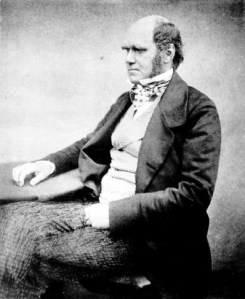
John (not his real name) was rather polite. Kind of nice, for a strident atheist! After some discussion, I engaged him about whether there is any transcendent value or worth to human beings. Something that justifies our shared belief that we should treatCharles_Darwin_aged_51 them with dignity. We cut down trees for our benefit and harvest wheat for our consumption. Why wouldn’t we do that with humans? What makes some matter more valuable than other forms?

We eventually wrapped things up after I shared a verse with him summarizing the Gospel, “But we see Jesus, who was made a little lower than the angels for the suffering of death, crowned with glory and honour; that he by the grace of God should taste death for every man” (Heb. 2:9). May the Fisher of men save one of Darwin’s footed fish!

Read Full Post »

I am a conservative Christian. I also homeschool. I head to the range every month or so. Not only that, but I’m a Calvinist, a psalm-singer, and to boot, someone who believes that the state has an obligation to embrace and support Christianity. So really, I’m not your mainstream, happy-clappy evangelical. For most, I would be just to the right of Attila the Hun. I’m in a subculture of a subculture of a subculture.

And yet, I am increasingly concerned about how reactionary and polarizing folks like me can be. We often tend to be overly suspicious of anyone in government, education, or any institution that we feel encroaches on our freedoms. We can indulge in conspiratorialism, thinking that every government official or educator or doctor has made a self-conscious Faustian bargain with the Devil and is actively plotting our destruction. And then we respond accordingly.

I am concerned about all of this for two reasons. First, ethically, we have a responsibility to “honor all men” and make the Gospel we represent as winsome as possible. Our “light should so shine before men” that they might see our “good works and glorify our Father which is in heaven.” Yes, we must at times offend, but only if it is for “righteousness’ sake.” Yes, we must stand our ground when sacred truth is at stake. But we must do it only when necessary and in a manner that involves no personal offense. Otherwise, we should, “as far as it lies within us, be at peace with all men.”

Second, I have very practical concerns as well. The more we are hyper-suspicious, unreasonable, and just downright cantankerous, the more we court the overreaction of those in positions of power. Tit for tat. “Whoso diggeth a pit shall fall therein: and he that rolleth a stone, it will return upon him.” If we are proud and stubborn as Christians, how much more will the graceless respond in kind? If we want to preserve our freedoms, we should act worthy of them and not bait the enemy. “For what glory is it, if, when ye be buffeted for your faults, ye shall take it patiently?” You’re just reaping what you’ve sown, says Peter.

I think we need to re-tune our theology and ethics here, in order to re-tune our practice. The following points I think are worth bearing in mind.

First, total depravity has been checked – sometimes very significantly – by common grace. To be sure, “there is none righteous, no not one.” And “the carnal mind is enmity against God, and is not subject to the law of God, neither indeed can be.” But unconverted people can be restrained, sometimes greatly. There is a real sense in which we can speak about ‘good pagans.’ I know some really good pagans! They are decent people. Some of them are more decent than some Christians I know. Consequently, there are some decent liberal Democrats, some decent members of the National Education Association, some decent doctors, lawyers, psychiatrists and social workers. Many of them mean well and want to do good, at least on a human level. We ought to realize this and keep it in mind.

Second, the law of love dictates that we assume the best of people, including non-Christians. Love “beareth all things, believeth all things, hopeth all things, endureth all things.” Our ethical responsibility is not suspended the moment we leave the church. Our unconverted neighbors – including government officials, educators, and doctors – are innocent until proven guilty. Would we want them to treat us with suspicion upon no clear, justifiable grounds? Even so, let us do unto them as we would have them do unto us. And all the while, let us not forget simple courtesy. “Be ye courteous.”

Third, two wrongs do not make a right. If someone does us wrong – if they give us a hard time for our homeschooling curriculum or our decisions on immunizations – then let us be very careful not to “repay evil with evil.” Rather, our Master tells us, “Bless them that curse you, do good to them that hate you, and pray for them that despitefully use you and persecute you.” We can all be tempted to get bitter and retaliate when we are mistreated. But it is not the will of our good and gracious Father, and it will usually only make matters worse.

Fourth, in God’s world, personal liberty must be counter-balanced with social responsibility. We owe it to our society (and yes, to our government!), to educate our children to the best of our abilities. They have a vested interest, as do we, in their academic success. If we turn out illiterates, this is not good for the economy or the tax revenues. It is just plain bad policy to say, let folks do what they will with their children. Now, mind you, I’m hardly advocating statism here. I really don’t want local school officials showing up on my doorstep to scour our textbooks and school records. Yet if they make reasonable requests – or even requirements – let us make sure that they are in fact unreasonable before we just tell them to take a hike.

And my doctor and the rest of society has a vested interest in my health. If I only eat fatty foods and exercise once every two decades, this is bad for me and for others. And if a whole demographic is just like me, then it bodes ill for all. If my mental health deteriorates and I become a risk to myself or others, yes, others have a vested interest in helping me before the unthinkable comes to pass.

Don’t misunderstand. I’m not promoting a lemming-like acceptance of conventional wisdom or the judgments of the establishment.  There’s a healthy place for critique.  Nor am I suggesting we roll over and play dead when someone oversteps their bounds. I’m all for insisting on personal rights, especially when it concerns the well being of my family. We can and may involve others to help protect those rights. But we must at once learn how to be actually in the world and yet not of it, as well as to be “angry and sin not.”

Let’s be careful to avoid the bunker mentality. Let’s remember that we represent God and Christ before a perishing world of lost and blinded sinners. Let’s remember that we were just like them, whistling down the broad path on the way to destruction. And let’s make very sure that if we cross them, we do it for the Lord’s sake and not for our own agendas. And then we can live with quiet conscience in peace or persecution. “And who is he that will harm you, if ye be followers of that which is good? But and if ye suffer for righteousness’ sake, happy are ye: and be not afraid of their terror, neither be troubled; but sanctify the Lord God in your hearts: and be ready always to give an answer to every man that asketh you a reason of the hope that is in you with meekness and fear: having a good conscience; that, whereas they speak evil of you, as of evildoers, they may be ashamed that falsely accuse your good conversation in Christ.”

Read Full Post »

Only a few days away from Halloween, I’ve been thinking more about why we don’t celebrate it, as well as reviewing online why other Christians do. I realize that there are many good believers who don’t see a problem with the festivities, and I’m not prepared to discount the evident grace of God that they have. Further, we are, every one of us, filled with sins and blind spots, myself included. But it is troubling to me how little argument is made against Halloween within the Church. So if you’re on the fence – and even if you’re not – may I at least challenge you with the following questions, friend?

(more…)

Read Full Post »

The following is especially written for young men.  It’s advice I hope to give to my own son when he comes of age.  But of course, there are principles that carry over for females as well.

* * *

1. It is billus-08etter to marry than to burn. If you are not called to be celibate, be honest with yourself (Matt. 19:12, 1 Cor. 7:9). Then make three things your full-time job, in this order. First, become outwardly ready. If you’re miles away from financial readiness, don’t waste time and energy by toying with what you can’t yet have. Yet, don’t wait for a perfect readiness that may never come, or you may tempt yourself. Second, seriously begin finding a suitable partner. Finally, get married as soon as reasonably possible. Don’t prolong things unnecessarily. This is a recipe for trouble.

2. Do not be unequally yoked. This means that you ought to seek a sincere, orthodox Christian, above all (1 Cor. 7:39, 2 Cor. 6:14). Then after this non-negotiable, seek one of relatively the same spiritual maturity, of relatively the same confessional and practical convictions, and of relatively the same outward circumstances – age, appearance, socio-economic background, etc. Race, however, should not be a factor. As a rule, the better the match, the better the marriage. The more mismatched, the more occasions for problems down the road.

3. Keep perspective on attraction. Don’t discount attraction or feel unholy for desiring it – God made it (Gen. 24:16, Prov. 30:18, 19). But don’t let it override your better judgment, as the flesh can make it a snare (Judg. 14:3). Give greater weight to piety than to appearances (1 Sam. 16:7, Prov. 11:22, 31:10-31, 1 Pet. 3:3, 4). Also keep in mind that beauty is somewhat subjective. It is multi-faceted, and some aspects can take time to discover and appreciate. Marriage is but the beginning of a journey in discovering a partner’s beauty – and seeing beyond imperfections. Last, be aware of the influence of our culture’s paradigms on your remaining corruption. It wants to condition your ideals, and you must manfully resist it (Rom. 12:1, 2).

4. Navigate safely to shore. In terms of process, start with friendships in safe contexts. You can always make friends, but you should never break hearts if you can help it. Reserve your affections (as far as possible) for after engagement and your body for after marriage (1 Cor. 6:18, 2 Tim. 2:22).

5. Weigh the whole package. Look at pros and cons as impartially and prayerfully as you can. Be an intelligent reader of providence. Weigh such things as proximity, ‘availability,’ ‘attainability,’ personalities, the interest you sense or don’t sense, the in-law advantages and disadvantages, church situations, the prospect’s outlook on important life-issues, such as family, career, education, etc., and the time investment necessary in working through all this. Remember #1 and that time is ticking.

6. Ask advice and help from your parents and trusted friends – and pray. There is wisdom in a multitude of counselors. They will often give you helpful perspective – and perhaps help you make connections. But don’t ever forget to bring this all before the Lord. All answers are with Him (Jas. 1:5). “Delight yourself in the Lord, and he shall give you the desires of your heart.”

7. Never give your ‘all’ to anyone but Jesus, and love Him above anyone else. He is the best match, and will never disappoint. And remember that the married state is temporary, while heaven is for eternity (1 Cor. 7:29-31).

Read Full Post »

From "A Christmas Story" (1983)It’s Christmas Eve, and we’re among the very precious few nowadays who aren’t doing anything special. Though we are committed Christians, we don’t observe this holiday – though we love and embrace all sincere Christians who celebrate the God who entered our world of sin and misery through a virgin’s womb. Yet, unlike the masses both of saints and seculars, for us this is just another Monday. And tomorrow is just another Tuesday. (more…)

Read Full Post »

In the previous post on building multi-generational churches, I focused mainly on the duties of parents and especially fathers.  On their shoulders, in large part, rests the future of the Church.  But of course, as we observed, the church ‘fathers’ must cultivate them, and so really it does come back to the teaching and ruling ministry of the Church at the end of the day.

The following extract from Samuel Miller (1769-1850) comes from his masterly work, The Christian Education of Children and Youth. In this passage, he urges one particular duty of church officers in raising up and retaining a godly seed for the Church.  It is the time-honored Reformed practice of pastoral catechizing of the youth:

It follows, of course, that the pastor who does not diligently attend to the religious instruction of the young people of his charge, is blind to the comfort, the acceptance, and the popularity of his own ministry. Why is it that so many ministers, before reaching an infirm old age, grow out of date with their people, and lose their influence with them? Especially, why is it that the younger part of their flocks feel so little attraction to them, dislike their preaching, and sigh for a change of pastors? There is reason to believe that this has seldom occurred, except in cases in which pastors have been eminently negligent of the religious training of their young people; in which, however respectable they may have been for their talents, their learning, and their worth, in other respects, they have utterly failed to bind the affections of the children to their persons; to make every one of them revere and love them as affectionate fathers; and, by faithful attentions, to inspire them with the strongest sentiments of veneration and filial attachment. Those whose range of observation has been considerable, have, no doubt, seen examples of ministers, whose preaching was by no means very striking or attractive, yet retaining to the latest period of their lives, the affections of all committed to their care, and especially being the favourites of the young people, who have rallied round them in their old age, and contributed not a little to render their last days both useful and happy. It may be doubted whether such a case ever occurred excepting where the pastor had bestowed much attention on the young people of his charge.

Such are some of the evils which flow from neglect on the part of the Church to train up her children in the knowledge of her doctrines and order. She may expect to see a majority of those children—even children of professors of religion—growing up in ignorance and profligacy; of course forsaking the church of their fathers; leaving her either to sink, or to be filled up by converts from without; turning away from those pastors who neglected them; and causing such pastors to experience in their old age, the merited reward of unfaithful servants (22-23).

Here is one big reason why churches, even Reformed ones, lose their youth.  The ministry has neglected catechizing.  Church catechizing, that is.  Much of the evangelical ministry today, sadly, has farmed out its duty here to ‘youth pastors’ – most of whom are often little better than glorified baby-sitters.  At best, it has delegated church education to pious, but unordained lay people.  But as Miller shrewdly observes, this passing on duty is also passing on a major opportunity.  An opportunity for the ministry to win young people’s minds to the principles of the church of their baptism, as well as an opportunity to win their hearts by sustained care and attention.  A profound insight indeed.

My mind here is taken to a beautiful mental image I have of the good Dr. Luther.   I can’t recall if it was a painting or something I read at some point – but forever irretrievable, I fear.  The master has gathered his pupils around him, and he is imparting a sacred lesson.  The little peasant catechumens are listening with rapt attention, and on occasion one is put on the spot to give an answer.   Here we see the embodiment of duty, of love, and of shrewd church policy, aimed at winning and at retaining the young.

We in the Reformed ministry must imitate our Saviour.  “Suffer the little children to come unto me, and forbid them not: for of such is the Kingdom of heaven.”  And when we are done baptizing them, let us yet hold on to them.  Let us retain them in our hearts, in our prayers, in our attentions – and in our devoted, focused instruction of them.  And combining this discipline with godly parenting in the home, by the blessing of the Spirit, shouldn’t we hope to mend the breaches in Zion’s walls?

Read Full Post »

olaus-magnus-jpeg1I serve in a Presbyterian denomination with congregations generally consisting of first-generation converts to the Reformed faith and their children.  We don’t have swarms of young people, and many of them either leave for ‘greener’ Christian pastures or, sadly, go prodigal.  So retention is a problem, and ‘sustainability’ (to use an overused term) is a regular worry.  Sometimes, it is easy to feel like we’re on the high seas in a leaky rowboat, and the winds are kicking up.

I must confess that I look wistfully at some of those Presbyterian and Reformed congregations that are large, established, and multi-generational.  Without having sold out.  They are not many, of course.  Usually in the present day large equals compromised.  But God has been faithful to some communions.  The ones I know are Dutch Reformed.  They don’t just have Christian but Reformed schools.  That is, teachers have to subscribe to the subordinate standards.  Many of the children usually profess the faith in the congregations where they were baptized.  They then find mates, marry, settle down, bear children and further populate their ranks.  If not in their original congregation, then not far off.  Often in the same denomination. (more…)

Read Full Post »

« Newer Posts - Older Posts »