Feeds:
Posts
Comments

Archive for the ‘Two Kingdoms Theology’ Category

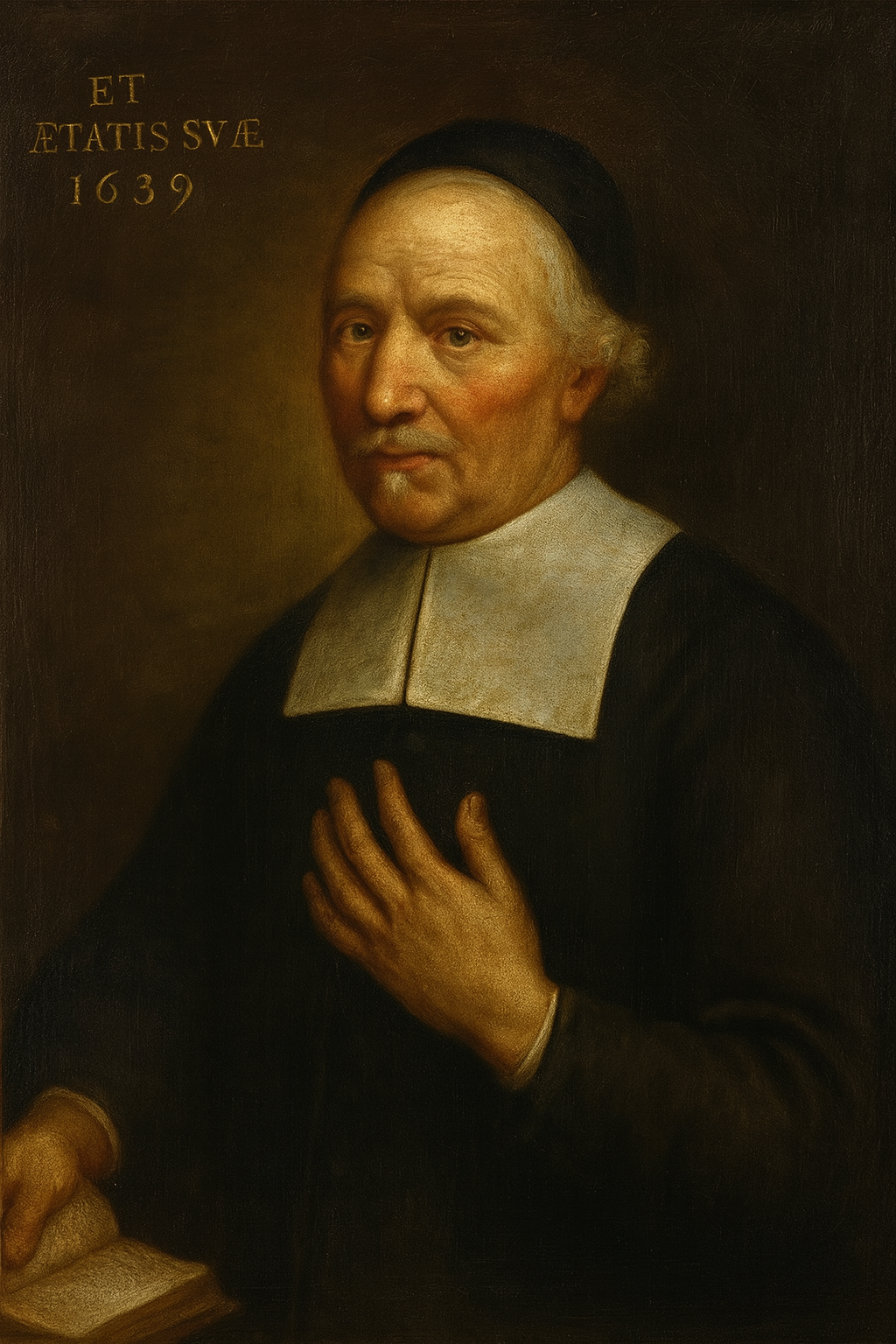
Where all, or the most considerable part of free Planters profess their desire and purpose of enjoying, and securing to themselves and their Posterity, the pure and peaceable enjoyment of the Ordinances of Christ in Church-fellowship with his People and have liberty to cast themselves into that Mold or Form of a Common-wealth, which shall appear to be best for them. Tending to prove the Expediency and Necessity in that case of entrusting free Burgesses which are members of Churches gathered amongst them according to Christ, with the power of Choosing from among themselves Magistrates, and men to whom the Managing of all Public Civil Affairs of Importance is to be committed. And to vindicate the same from an Imputation of an Under-Power upon the Churches of Christ, which hath been cast upon it through a Mistake of the true state of the Question.

Reverend Sir,

The Sparrow being now gone, and one days respite from public Labors on the Lords-day falling to me in course, I have sought out your Writing, and have reviewed it, and find (as I formerly expressed to your self) that the Question is mis-stated by you; and that the Arguments which you produce to prove that which is not denied, are (in reference to this Question) spent in vain, as arrows are when they fall wide of the Marks they should bit, though they strike in a White which the Archer is not called to shoot at.

The terms wherein you state the Question, are these:

Whether the Right and Power of Choosing Civil Magistrates belongs unto the Church of Christ?

To omit all critical Inquiries, in your thus stating the Question, I utterly dislike two things.

* * * * *

Read the rest here or view a facsimile of the original below. I have also recorded it in audio here. Also view all our audio resources at WPE Audio. This discourse is especially meaningful to me personally, since my ancestor, William Ives came over the Atlantic with John Davenport and eventually signed his name to the original town covenant of the New Haven Colony in Connecticut.
Read Full Post »

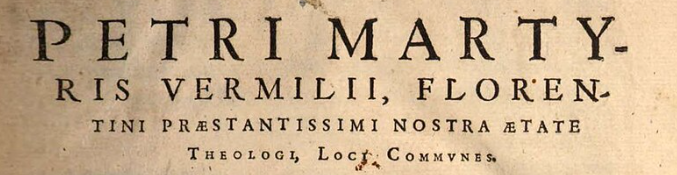
While doing some research in a related area, I ran into this first article by Torrance Kirby in the great Italian Reformer, Peter Martyr Vermigli. I know rather little of him, though he has been recognized as a major figure alongside Calving, Bullinger, etc. I wasn’t aware of how involved he was with the Church of England. As of the moment, I haven’t read the following two I post here, but they look similarly interesting. Here’s the source for these online.

(more…)

Read Full Post »

William Ames (1576-1633), a very notable English Puritan and delegate to the famous Synod of Dort, wrote on the ethics of war and warfare in his work on conscience. If you are patient enough to try to read it with its antiquated typeset, by all means—see below. (A big hint: many “f’s” are actually “s’s.”) Or you can listen to me read it to you here!

Read Full Post »

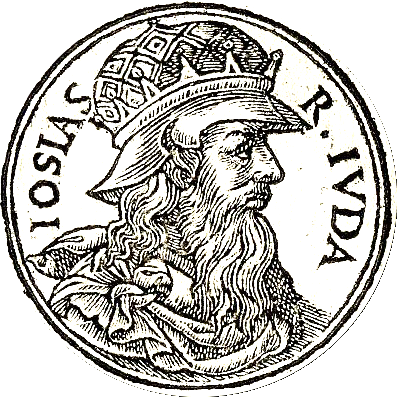
“10.  He may and ought to remove all false worships, and endure no corrupt preaching, or writing, or meetings for that end, or administrating of corrupted sacraments, or any ordinance other than what is allowed; for, Josiah did cause the people stand to the Covenant that was made, and having removed all idolatrous worship, he made Israel to serve the Lord, that is, he made them abandon corrupt worship, and wait on pure ordinances, as keeping of the sabbaths, offering of sacrifices, etc. and that according to the manner prescribed by the Lord.

“Neither was it a wronging of their liberty, to do so, because:

1.  It was the preservation of their liberty, to keep them from the abominable bondage of these evils.

2.  It was their duty to abstain from these, and to follow the ordinances purely, and the magistrate may well put people to that.

(more…)

Read Full Post »

Establishments got some good press last week, at least on a respectable Reformed podcast. Kudos to Christ the Center for welcoming on Timon Cline to a panel discussion last Friday. While I’ve never heard of Timon before, I am sure going to read and listen to more of him. And I’m sure I’m not alone!

The panel discussion focused on Dr. Alan Strange’s newly published book, Empowered Witness: A Panel Discussion on Politics, Culture, and the Spiritual Mission of the Church. Giving feedback and critiques were D. G. Hart, Nick Wilborn, and Timon Cline. I’ve not read Strange’s book, so I’m only commenting on the video. The discussion up to Timon and related rejoinders was interesting enough. But Timon sure rocked the boat pretty hard when he brought up the obvious (at least from a historical Reformed perspective and not an American echo-chamber), that is, what about the spiritual nature in the church in light of the classic, confessionally Reformed and Presbyterian endorsements of religious establishments?

It’s clear that Dr. Strange was a bit flustered, though keeping a gracious demeanor. Sadly, though a respectable and accomplished Reformed scholar whom I otherwise appreciate, Strange’s response to Timon was more or less a rigmarole of informal fallacies and non-answers. Hart, however, just became flummoxed and unhinged. In contrast to Cline’s calm, measured demeanor, and even more importantly, to his much more careful, close, and logical reasoning (they guy’s a practicing lawyer, and it shines), Hart just full-on melted down, notwithstanding a clever little jab about Timon’s alleged tap-dancing like James Cagney. But even that was more amusing than apropos, as it only thinly veiled his chagrin. The young no-namer clearly bested his betters.

(more…)

Read Full Post »

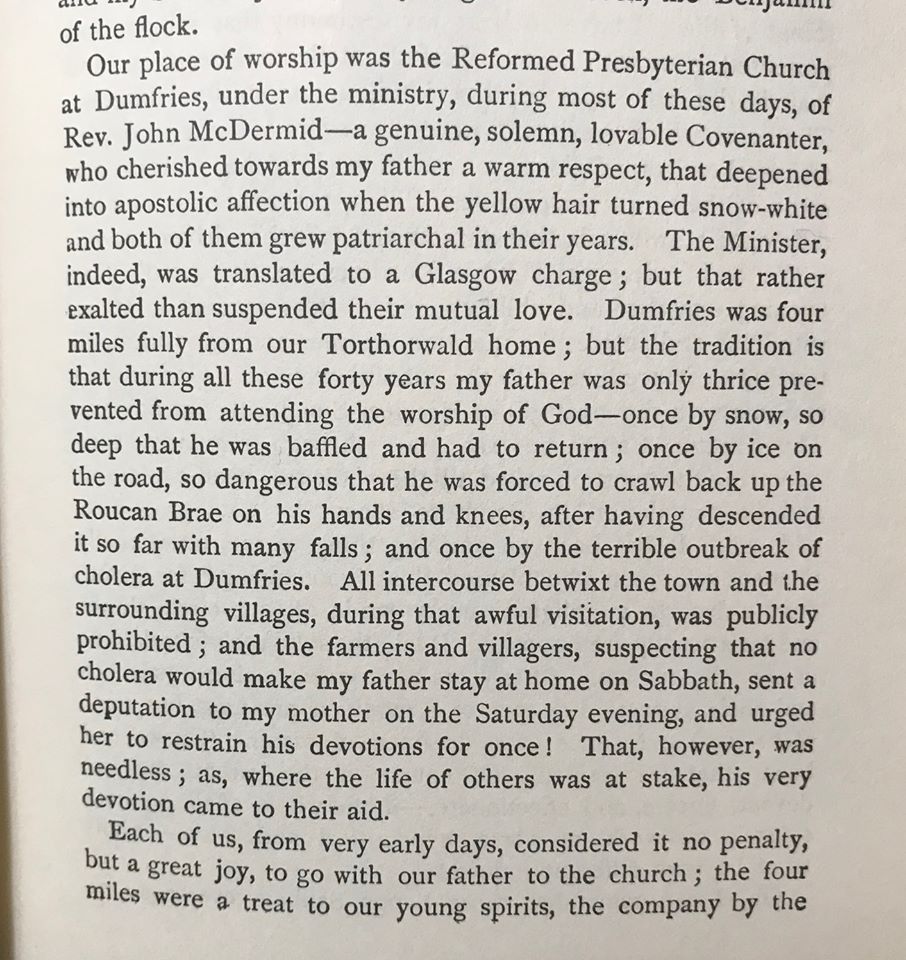
A few striking observations from a favorite anecdote in John G. Paton’s autobiography, below. If I’m not mistaken, this would be referring to a cholera outbreak in 1832 in the U.K.

1. Healthy believers long for the courts of the Lord and don’t let lesser things get in their way. 2. However, it appears that godly Scottish Presbyterians in the early 19th century believed that public health crises could warrant church closures (or at least effectively cause them by population controls). 3. And apparently, the same believed that the state could mandate such closures (or at least effectively, etc.) in the interests of public health.

Not an argument that any of our churches must necessarily close under the present circumstances; just an observation to help put some strong opinions out there in context.

90471480_211006586771078_538897256095416320_o

Read Full Post »

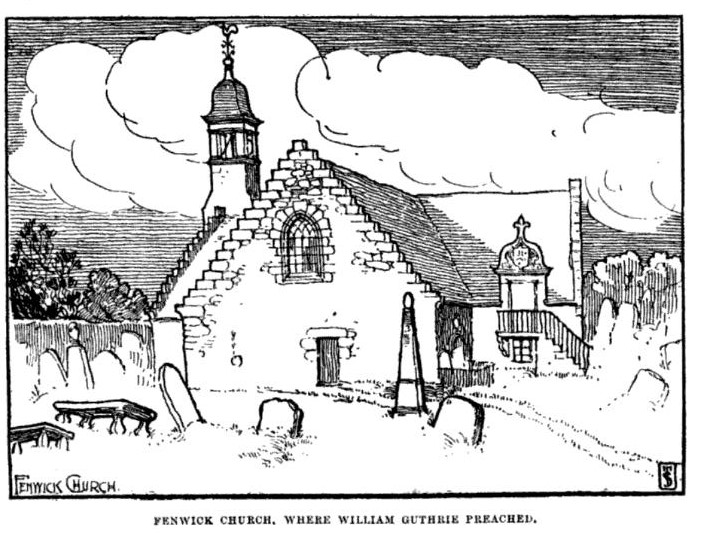
Smellie, Thomas. “Fenwick Church.” 1905

During the recent COVID-19 crisis, many Christian churches have closed their doors, cancelling regular public worships services, though often utilizing telecommunications to facilitate God’s worship in private home contexts. What principles do confessionally Reformed and Presbyterian elders consider when making their decision? These are the ones that factored in to my mind.

1. Worship is priority number one. God’s honor comes before man’s honor, His being before ours. “Thy love is better than life.” We should sooner join the three Hebrew children and lay down our lives than surrender an inch of God’s worship. The First Table comes before the Second, and if there is an apparent conflict, the general rule is to surrender our own interests.

(more…)

Read Full Post »

Another addition to the ‘Chalmers Audio Library.’ A fascinating defense of religious establishments, arguing for them on the ground that they serve as a great, national Home Mission. In my opinion, he counters some of the standard objections well.


Read Full Post »

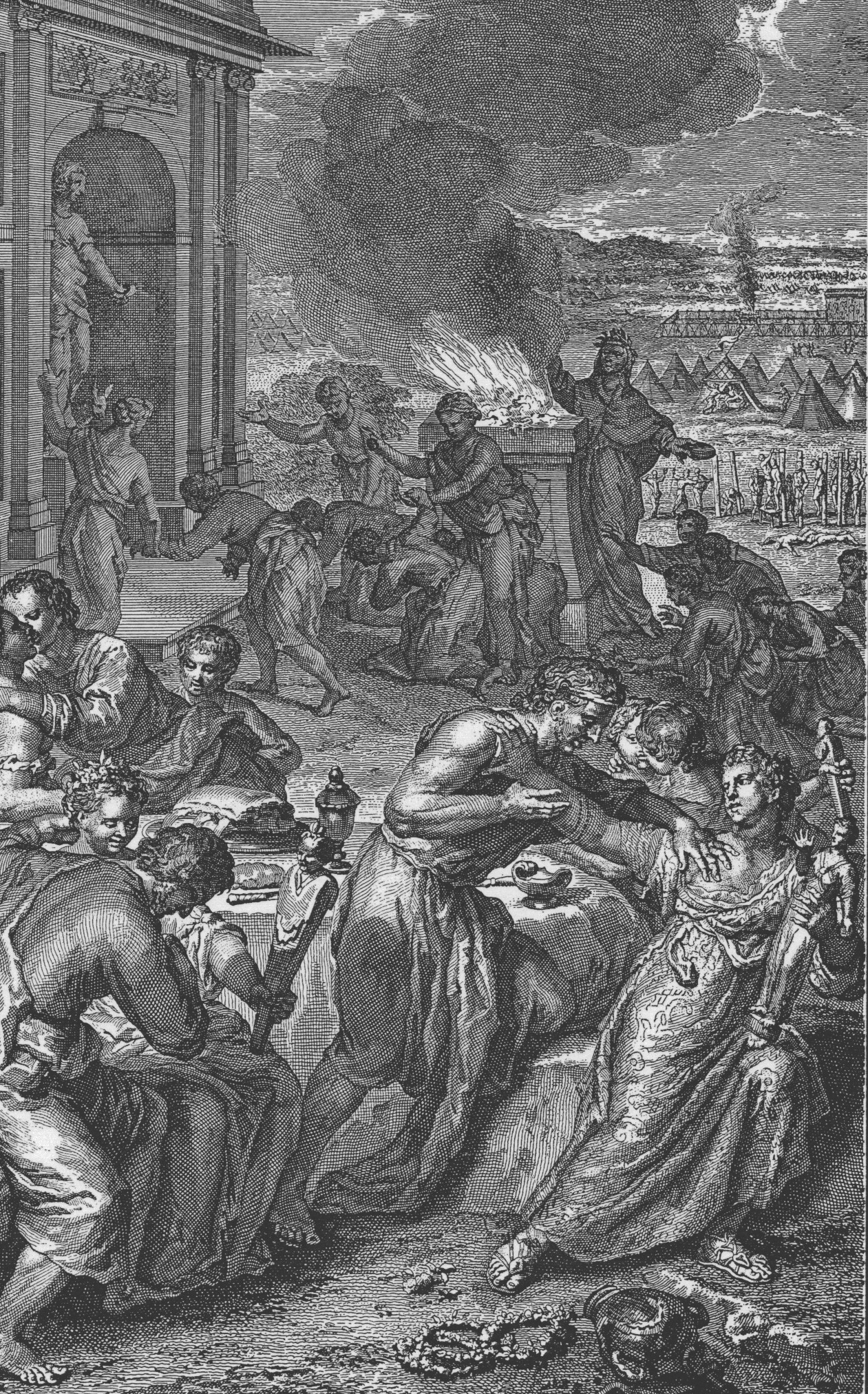
Figures_Moab_Leads_Israel_into_SinThe following passage comes from Rutherford’s Trial and Triumph of Faith (1645), treating the story of Christ and the Syro-Phoenician woman.  In it, he deals with a dimension of sin and repentance that often gets very short shrift in our individualistic age, and sadly even in the Church.  Does this square with the contemporary Two Kingdoms approach?

* * *

THE dispute between Christ and the woman goeth on: Christ bringeth a strong reason, (verse 26,) why he should not heal her daughter; because she, and all her nation, not being in covenant with God, as are the Jews, the church of God, are but dogs, and profane, and unworthy of Christ, which is the bread ordained for the children.

When Christ humbleth, he may put us in remembrance of our nation, and national sins: “Look to the rock whence ye were hewn, and to the hole of the pit whence ye were digged,” (Isa. 51:1). “I alone called Abraham, he was an idolater,” (Hos. 9:10). I found Israel like grapes in the wilderness; they should have been wild grapes rotting in the wilderness, had I not put them in my basket. “Son of man, cause Jerusalem to know her abomination,” (Ezek. 16:2). How? Make them know the stock they came of, ‘And say, Thus saith the Lord unto Jerusalem, thy birth and thy nativity is of the land of Canaan; thy father was an Amorite, and thy mother an Hittite,’ (verse 3). When the Jew was to offer the first fruits to the Lord; “And thou shalt speak and say before the Lord thy God, A Syrian ready to perish was my father, and went down to Egypt to sojourn there,” (Deut. 26:5). Thus, the forgetting what we are by nature, addeth to our guiltiness: “And in all thine abominations, and thy whoredoms, thou hast not remembered the days of thy youth, when thou wast naked and bare, and wast polluted in thy blood,” (Ezek. 16:22). So the Ephesians must be told how unfit they were by nature for Christ, being the very workhouse and shop of the devil, in which he wrought, (Eph. 2:1-3).

National sins have influence in their guilt and contagion on believers: (1.) When they mourn not for them: God’s displeasure should be our sorrow. (2.) When they stand not in the gap to turn away wrath, (Ezek. 22:30). There were godly men that departed from ill, (Isa. 59), but God’s quarrel was, that there was no intercessor, (verse 15). In fasting, believers, though pardoned, may have on them a burden of the sins of three nations, and be involved in that same wrath with them. National repentance is required of every one, no less than personal repentance. Who sorrows for the blood of malignants and rebels?—for their oaths, mocking, scoffing, massing? The sins of the land, idolatry, superstitious days, vain ceremonies, etc., have influence on a believer’s conscience in his approach to God.

Read Full Post »

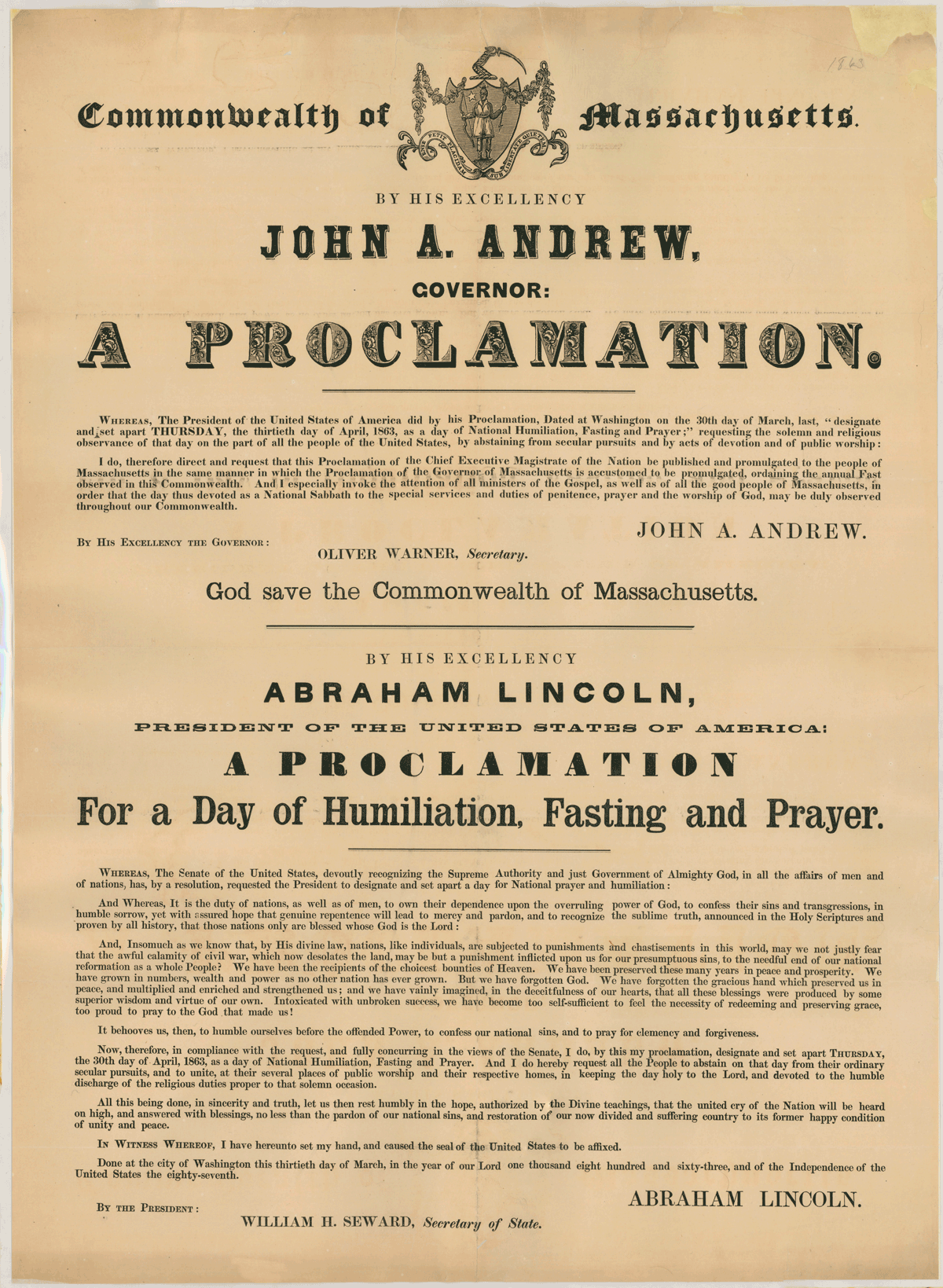
Lincoln_Proclamation_1863While listening to an excellent sermon by Rev. Bill Shishko of the OPC on days of prayer and fasting, I was struck by his final quote of the presidential proclamation of Abraham Lincoln for a national day of humiliation and fasting.  One can read it here.

I am hardly endorsing Abraham Lincoln’s personal theology and practice, much less making commentary on the merits and demerits of each side during the Civil War (or War Between the States, if you prefer).  But I cannot help but ask the modern (contra Melvillian) Two Kingdom advocates (1) whether this was, in the main, a good thing and not inherently a violation of Reformed principles and (2) whether it is ever commendable for a state or its elected officials to call for national days of fasting and humiliation.

I think that any simple Christian will read this and be impressed with how appropriate such a call was and earnestly sigh and cry that God might give us such magistrates again.  And more, for even better and more consistently Christian ones – who explicitly avow Jesus as King of kings and Lord of lords.

At the same time, I would hope that it would give pause to the more thoughtful modern 2K advocates to ask whether their outlook may at least be somewhat misguided.   Are such national fasts, following Westminster and Dort, inherently flawed?  Is this not a fast that the Lord “has chosen” (Isa. 58)?  But sadly, I fear it will make no dent with the more trenchant ones.

Read Full Post »

Older Posts »