Where all, or the most considerable part of free Planters profess their desire and purpose of enjoying, and securing to themselves and their Posterity, the pure and peaceable enjoyment of the Ordinances of Christ in Church-fellowship with his People and have liberty to cast themselves into that Mold or Form of a Common-wealth, which shall appear to be best for them. Tending to prove the Expediency and Necessity in that case of entrusting free Burgesses which are members of Churches gathered amongst them according to Christ, with the power of Choosing from among themselves Magistrates, and men to whom the Managing of all Public Civil Affairs of Importance is to be committed. And to vindicate the same from an Imputation of an Under-Power upon the Churches of Christ, which hath been cast upon it through a Mistake of the true state of the Question.
Reverend Sir,
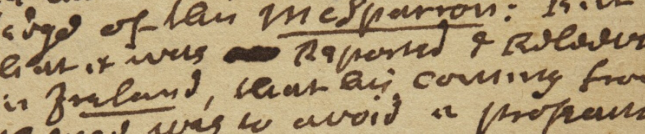
The Sparrow being now gone, and one days respite from public Labors on the Lords-day falling to me in course, I have sought out your Writing, and have reviewed it, and find (as I formerly expressed to your self) that the Question is mis-stated by you; and that the Arguments which you produce to prove that which is not denied, are (in reference to this Question) spent in vain, as arrows are when they fall wide of the Marks they should bit, though they strike in a White which the Archer is not called to shoot at.
The terms wherein you state the Question, are these:
Whether the Right and Power of Choosing Civil Magistrates belongs unto the Church of Christ?
To omit all critical Inquiries, in your thus stating the Question, I utterly dislike two things.
* * * * *
Read the rest hereor view a facsimile of the original below.I have also recorded it in audio here.Also view all our audio resources at WPE Audio. This discourse is especially meaningful to me personally, since my ancestor, William Ives came over the Atlantic with John Davenport and eventually signed his name to the original town covenant of the New Haven Colony in Connecticut.
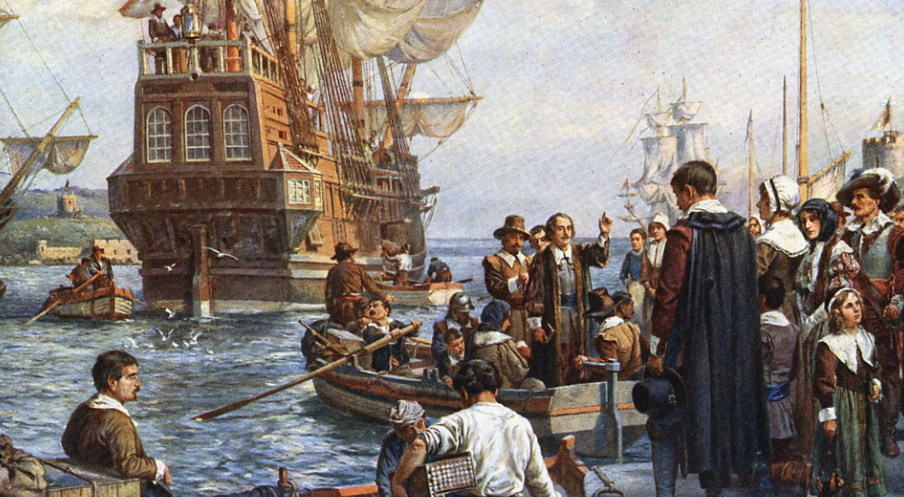
As we turn in deep gratitude to the Most High for all His blessings towards us, let us remember especially the unique favor He has shown to our fathers and mothers of the faith who first came to these shores on a holy “errand into the wilderness.” In the words of the Mayflower Compact (1620), their cause was “undertaken for the Glory of God, and Advancement of the Christian Faith, and the Honour of our King and Country.”
Let me encourage you to listen to our Pilgrim and Puritan fathers. In addition to other amateur recordings, I’ve been steadily adding to this collection of sermons, treatises, and narratives from the pen of these giants of the faith, who helped found this “City on a Hill.” And if you’d like to hear an early account of the Pilgrim colony, check out Cotton Mather’s, “Magnalia Christi Americana 1.1: Discoveries of America.” Also, John Winthrop’s original sermon where he speaks of the “city on an hill,” is available under “A Modell of Christian Charity.”
And as we thank the Lord today, lest us with humility and earnestness implore Him to restore the former glory through national repentance. He did it before, and He can do it again! “Wilt thou not revive us again: that thy people may rejoice in thee” (Psalm 85:6)?
This is an academic article from the earlier 20th century on New England Puritan, Cotton Mather, on his zealous concern for the salvation of the Jews. He develops the account from Mather’s notable journal entry in 1696: “This day, from the dust, where I lay prostrate, before the Lord, I lifted up my cries: For the conversion of the Jewish Nation, and for my own having the happiness, at some time or other, to baptize a Jew, that should by my ministry, bee brought home unto the Lord.”
Continuing to follow with interest Timon Cline et al over at American Reformer. Still parsing the field of contemporary “Christian nationalism” and trying to discern the good and the not-so-good; so I share this with some tentativeness, yet general appreciation thus far. Classical Protestant ethics and socio-political ethics fascinates me, so anyone participating in a retrieval has my attention.
Have enjoyed reading this article about John Witherspoon and the colonial Presbyterian iteration of establishmentarianism, contra Kevin DeYoung’s pluralistic take of the American revision of the WCF 23. Looks like others there have also written on the same. I still wonder to what degree Witherspoon may have been influenced by Enlightenment liberalism and what bearing that may have had on how he approached Christian magistracy. But that there is more continuity with the original WCF 23 than not just seems to sync with what I’ve understood about public religion in colonial America. Absolute separation just seems laughable on so many counts. I am also reminded how Dr. William Young opined that the American revision of WCF 23 did not technically contradict the original 1646 statement. While my denomination is the only NAPARC body committed to the original edition, I am at least coming to appreciate that we may have more of a genetic connection with colonial Presbyterian than I had first thought.
The following is the text of a rather insightful, inspiring, and challenging firsthand vignette of English Puritanism, by John Geree, “The Character of an Old English Puritan, or Non-Conformist.” Listen to a recording of it here; and visit the entire WPE audio library. A digital facsimile is below.
* * * *
The Old English Puritan was such an one, that honored God above all, and under God gave every one his due. His first care was to serve God, and therein he did not what was good in his own, but in God’s sight, making the word of God the rule of his worship. He highly esteemed order in the House of God: but would not under color of that submit to superstitious rites, which are superfluous, and perish in their use. He reverenced Authority keeping within its sphere: but durst not under pretence of subjection to the higher powers, worship God after the traditions of men. He made conscience of all God’s ordinances, though some he esteemed of more consequence. He was much in prayer; with it he began and closed the day. It is he was much exercised in his closet, family and public assembly. He esteemed that manner of prayer best, whereby the gift of God, expressions were varied according to present wants and occasions; yet did he not account set forms unlawful. Therefore in that circumstance of the church he did not wholly reject the liturgy, but the corruption of it. He esteemed reading of the word an ordinance of God both in private and public but did not account reading to be preaching. The word read he esteemed of more authority, but the word preached of more efficiency. He accounted preaching as necessary now as in the Primitive Church, God’s pleasure being still by the foolishness of preaching to save those that believe. He esteemed the preaching best wherein was most of God, least of man, when vain flourishes of wit and words were declined, and the demonstration of God’s Spirit and power studied: yet could he distinguish between studied plainness and negligent rudeness. He accounted perspicuity the best grace of a preacher: And that method best, which was most helpful to the understanding, affection, and memory. To which ordinarily he esteemed none so conducible as that by doctrine, reason and use. He esteemed those sermons best that came closest to the conscience: yet would he have men’s consciences awakened, not their persons disgraced. He was a man of good spiritual appetite, and could not be contented with one meal a day. An afternoon sermon did relish as well to him as one in the morning. He was not satisfied with prayers without preaching: which if it were wanting at home, he would seek abroad: yet would he not by absence discourage his minister, if faithful, though another might have quicker gifts. A lecture he esteemed, though not necessary, yet a blessing, and would read such an opportunity with some pains and loss. The Lord’s Day he esteemed a divine ordinance, and rest on it necessary, so far as it conduced to holiness. He was very conscientious in observance of that day as the mart day of the soul. He was careful to remember it, to get house, and heart in order for it and when it came, he was studious to improve it. He redeems the morning from superfluous sleep, and watches the whole day over his thoughts and words, not only to restrain them from wickedness, but worldliness. All parts of the day were like holy to him, and his care was continued in it in variety of holy duties: what he heard in public, he repeated in private, to whet it upon himself and family. Lawful recreations he thought this day unseasonable, and unlawful ones much more abominable: yet he knew the liberty God gave him for needful refreshing, which he neither did refuse nor abuse. The sacrament of baptism he received in infancy, which he looked back to in age to answer his engagements, and claim his privileges. The Lord’s Supper he accounted part of his soul’s food: to which he labored to keep an appetite. He esteemed it an ordinance of nearest communion with Christ, and so requiring most exact preparation. His first care was in the examination of himself: yet as an act of office or charity, he had an eye on others.
He endeavored to have the scandalous cast out of communion: but he cast not out himself, because the scandalous were suffered by the negligence of others. He condemned that superstition and vanity of Popish mock-fasts; yet neglected not an occasion to humble his soul by right fasting: He abhorred the popish doctrine of opus operatum in the action. And in practice rested in no performance, but what was done in spirit and truth. He thought God had left a rule in his word for discipline, and that aristocratical by elders, not monarchical by bishops, nor democratical by the people. Right discipline he judged pertaining not to the being, but to the well-being of a church. Therefore he esteemed those churches most pure where government is by elders, yet unchurched not those where it was otherwise. Perfection in churches he thought a thing rather to be desired, than hoped for. And so he expected not a church state without all defects. The corruptions that were in churches he thought his duty to bewail, with endeavors of amendment: yet he would not separate, where he might partake in the worship, and not in the corruption. He put not holiness in churches, as in the temple of the Jews; but counted them convenient like their synagogues. He would have them kept decent, not magnificent: knowing that the gospel requires not outward pomp. His chief music was singing of psalms wherein though he neglected not the melody of the voice, yet he chiefly looked after that of the heart. He disliked such church music as moved sensual delight, and was as hinderance to spiritual enlargements. He accounted subjection to the higher powers to be part of pure religion, as well as to visit the fatherless and widows: yet did he distinguish between authority and lusts of magistrates, to that he submitted, but in these he durst not be a servant of men, being bought with a price. Just laws and commands he willingly obeyed not only for fear but for conscience also; but such as were unjust he refused to observe, choosing rather to obey God than man; yet his refusal was modest and with submission to penalties, unless he could procure indulgence from authority. He was careful in all relations to know, and to duty, and that with singleness of heart as unto Christ. He accounted religion an engagement to duty, that the best Christians should be best husbands, best wives, best parents, best children, best masters, best servants, best magistrates, best subjects, that the doctrine of God might be adorned, not blasphemed. His family he endeavors to make a church, both in regard of persons and exercises, admitting none into it but such as feared God; and laboring that those that were borne in it, might be born again unto God. He blessed his family morning and evening by the word and prayer and took care to perform those ordinances in the best season. He brought up his children in the nurture and admonition of the Lord and commanded his servants to keep the way of the Lord. He set up discipline in his family, as he desired it in the church, not only reproving but restraining vileness in his. He was conscientious of equity as well as piety knowing that unrighteousness is abomination as well as ungodliness. He was cautious in promising, but careful in performing, counting his word no less engagement than his bond. He was a man of tender heart, not only in regard of his own sin, but others misery, not counting mercy arbitrary, but a necessary duty wherein as he prayed for wisdom to direct him, so he studied for cheerfulness and bounty to act. He was sober in the use of things of this life, rather beating down the body, than pampering it, yet he denied not himself the use of God’s blessing, lest he should be unthankful, but avoid excess lest he should be forgetful of the Donor. In his habit he avoided costliness and vanity, neither exceeding his degree in civility, nor declining what suited with Christianity, desiring in all things to express gravity. He own life he accounted a warfare, wherein Christ was his captain, his arms, prayers, and tears. The Cross his banner, and his word, Vincit qui patitur.
He was immovable in all times, so that they who in the midst of many opinions have lost the view of true religion, may return to him and find it.
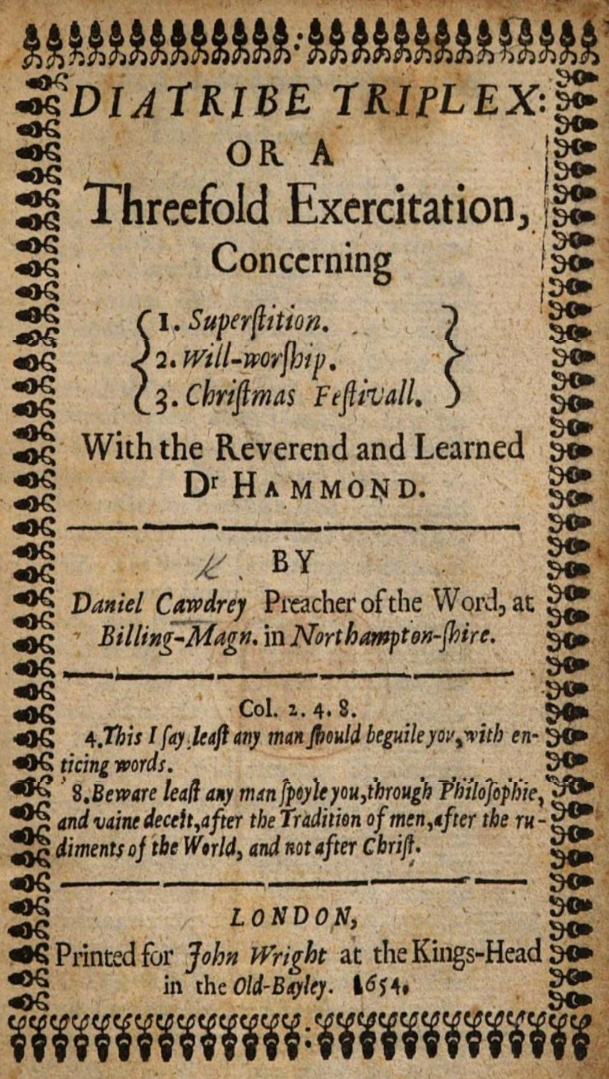
Just finished recording part 2 of 2 of Daniel Cawdrey’s “Of the Festivals of the Church, and Especially Christmas.” Listen to the audio here. This is the third part of a larger work, attached below. The University of Michigan has digitized the text here.
Cawdrey (1588–1664) was a member of the Westminster Assembly, which produced the Westminster Confession of Faith, as well as the Larger and Shorter Catechisms. Like the rest of the Puritans of England and New England, as well as the Presbyterians of Scotland, these godly men rejected all holy days of men’s devising based on what has become called the ‘regulative principle of worship,’ which requires us to have clear and undoubted certainty about the divine, scriptural origin of any worship practice, and that any worship falling short of this standard must be set aside.
The Puritans were not kill-joys or men of bigoted, narrow minds. Anyone who reads their sermons and devotional writings will find them to be the warmest lovers of God, of Christ, and of their fellow men. They were also as a rule generous, catholic-minded men who embraced all those who called upon the Lord in sincerity, even among those who might disagree with them. And above all, they were men who passionately wanted to please God, even if that went against the flow of the opinions of men. I offer these recordings in that spirit.
The following is a sample from Cawdrey, in particular on his contention that the observation of Christmas is ultimately hostile to the proper, apostolic practice of Lord’s day observance:
“[It is said that] The Birth of Christ, is a mercy of such excellent quality, that it can never be overvalued, &c. This is granted; But to Institute a day as Holy, without command of Christ, for an Annual commemoration of this, is above the power of any Church, and a Superstitious presumption: and [altogether] needless; considering that the Lord’s day, (which includes the commemoration, not only of his Birth, but his Resurrection, and the whole works of our Redemption by him) was instituted by himself, or his Apostles, by him authorized and inspired, for this very end; & comes [around] once in every week. To limit it therefore to one day in a year, to remember that Mercy, is not an exaltation, but a derogation from it. If this were done, on his own design[ated] Day, wee need not fixe another day.”
Friend, let appeal to you not to brush off this position. You may in the end disagree with it; by all means, search the Scriptures, and be a Berean. But none of us “have attained,” and we should always be willing to bring any of our views or practices to the touchstone of Scripture. Embracing this position would naturally involve sacrifices, hurt feelings, and misunderstandings. But I can assure you from close to 30 years of experience after becoming convinced, and after raising four children in these principles, it is well worth it. “Them that honor me, I will honor.” And you don’t have to be a Grinch! I’m not—and I keep up many, many friendships with dear brothers who aren’t persuaded.
But of course, they’ll understand sooner or later (1 Cor. 13:12)!
I’ve recorded several chapters of Cotton Mather’s great Magnalia Christi Americana: Or, The Ecclesiastical History of New-England: from Its First Planting, in the Year 1620, Unto the Year of Our Lord 1698. Here are the opening words of the first chapter, “Discoveries of America.”
* * * * *
“It is the opinion of some, though ’tis but an opinion, and but of some learned men, that when the sacred oracles “of Heaven assure us, the things under the earth are some of those, whose knees are to bow in the name of Jesus, by those things are meant the inhabitants of America, who are Antipodes to those of the other hemisphere. I would not quote any words of Lactantius, though there are some to countenance this interpretation, because of their being so ungeographical: nor would I go to strengthen the interpretation by reciting the words of the Indians to the first white invaders of their territories, we hear you are come from under the world to take our world from us. But granting the uncertainty of such an exposition, I shall yet give the Church of God a certain account of those things, which in America have been believing and adoring the glorious name of Jesus; and of that country in America, where those things have been attended with circumstances most remarkable. I can contentedly allow that America (which, as the learned Nicholas Fuller observes, might more justly be called Columbina) was altogether unknown to the penmen of the Holy Scriptures, and in the ages when the Scriptures were penned. I can allow, that those parts of the earth, which do not include America, are, in the inspired writings of Luke and of Paul, stiled all the world. I can allow, that the opinion of Torniellus and of Pagius, about the apostles preaching the gospel in America, has been sufficiently refuted by Basnagius. But I am out of the reach of Pope Zachary’s excommunication. I can assert the existence of the American Antipodes: and I can report unto the European churches great occurrences among these Americans. Yet I will report every one of them with such a Christian and exact veracity, that no man shall have cause to use about any one of them the words which the great Austin (as great as he was) used about the existence of Antipodes; it is a fable, and nulla ratione credendum.
John Cotton gives an extremely helpful list of biblical considerations for the Christian who is trying to decide whether or not to move. This is taken from “God’s Promise to His Plantations” (1630). I’ve left the archaic formatting in place.
* * * * *
Quest. But how shall I know whether God hath appointed me such a place, if I be well where I am, what may warrant my removeall?
Answ. There be foure or five good things, for procurement of any of which I may remove. Secondly, there be some evill things, for avoiding of any of which wee may transplant our selves. Thirdly, if withall we find some speciall providence of God concurring in either of both concerning our selves, and applying general grounds of removall to our personall estate.
First, wee may remove for the gaining of knowledge. Our Saviour commends it in the Queene of the south, that she came from the utmost parts of the earth to heare the wisdom of Solomon: Matth. 12. 42. And surely with him she might have continued for the same end, if her personall calling had not recalled her home.
Secondly, some remove and travaile for merchandize and gaine-sake; Daily bread may be sought from farre, Prov. 31. 14. Yea our Saviour approveth travaile for Merchants, Matth. 13. 45, 46. when hee compareth a Christian to a Merchantman seeking pearles: For he never fetcheth a comparison from any unlawful thing to illustrate a thing lawfull. The comparison from the unjust Steward, and from the Theefe in the night, is not taken from the injustice of the one, or the theft of the other; but from the wisdome of the one, and the sodainnesse of the other; which in themselves are not unlawfull.
To read further, see below. To access the entire sermon and an audio recording, click here.
I thought I might share what I’ve been reading recently. In addition to my devotional and theological recordings, here are some books I’ve finished in recent days of personal interest. In our extremely digital age, we need to stay reading. Let us read good books; and if we read books that are not explicitly Christian, let us do so critically with an eye to Scripture as our absolute authority.
First, Nancy R. Pearcey’s The Toxic War on Masculinity: How Christianity Reconciles the Sexes. In a similar fashion to Carl Trueman’s The Rise and Triumph of the Modern Self, Nancy Pearce frames her book of cultural commentary around a “how did we get here?” question. For Trueman, it was “how did we ever get to the place where a man thinks he is a woman?” For Pearcey, it is “how did masculinity ever become ‘toxic?'” She engages in a historical and sociological inquiry that is quite insightful, from a thoughtful, Christian perspective. I especially found her explanation of the shift of men from cottage-industry and family-integrated work patterns to working outside the home in factories, etc., at the Industrial Revolution, and its negative impact on father-son relationships and family life in general. For a kind of teaser, listen to this interview on Issues, etc.



 West Port Experiment