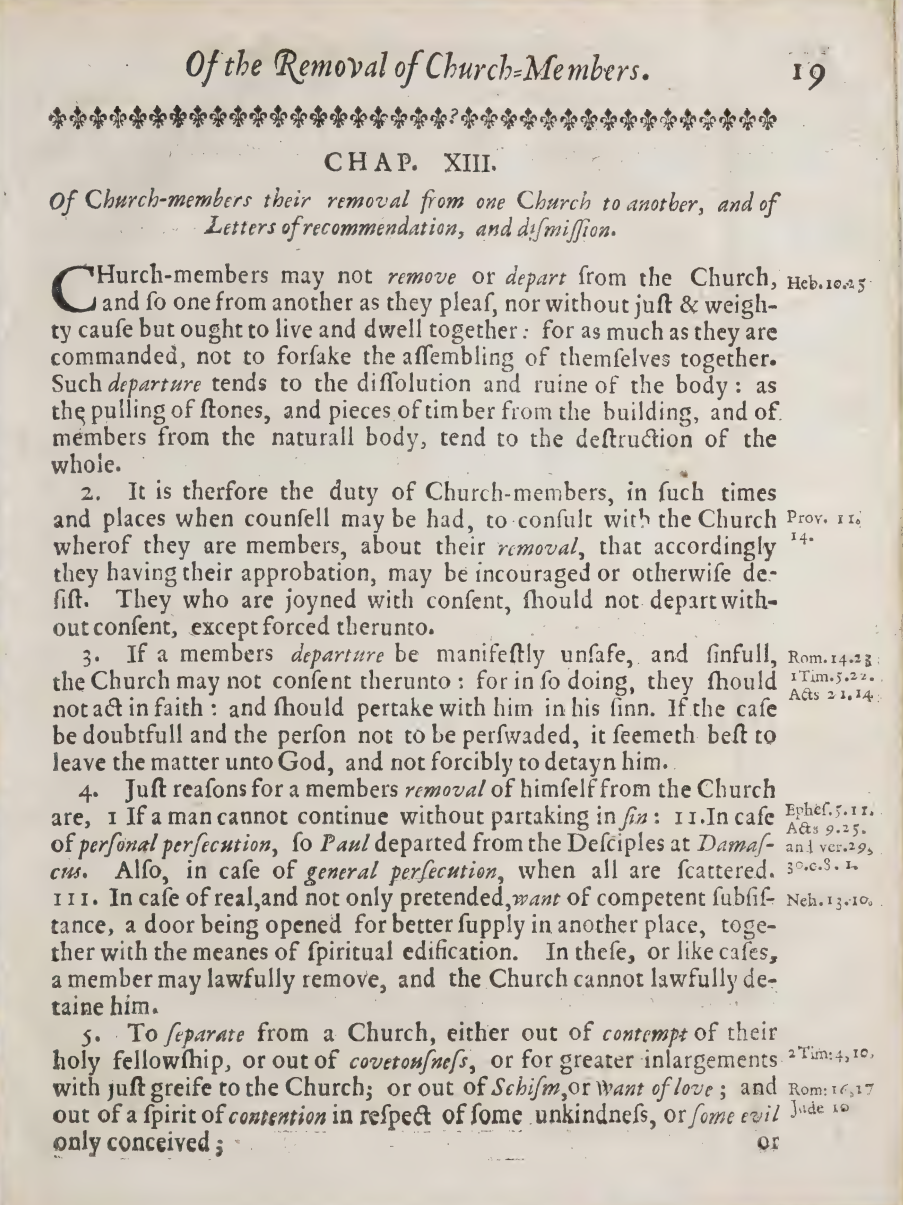
Though I am Presbyterian, I have for years deeply appreciated the great majority of what the New England fathers set forth here in their Cambridge Platform (1649) concerning why, how, and when church members may lawfully leave their local congregation to join another. Would to God we “eat this scroll,” internalizing its biblical principles. And so may we more and more in this individualistic and non-committal age live out the articles of our ancient creed, “I believe an holy catholic church” and “the communion of saints!”
* * * * * * * * *
CHAPTER XIII.
Of church members, their removal from one church to another, and of recommendation and dismission.
1. CHURCH members may not remove or depart from the church, and so one from another as they please, nor without just and weighty cause, but ought to live and dwell together; forasmuch as they are commanded, not to forsake the assembling of themselves together. Such departure tends to the dissolution and ruin of the body, as the pulling of stones and pieces of timber from the building, and of members from the natural body, tend to the destruction of the whole.
Heb. x. 25.
2. It is therefore the duty of church members, in such times and places where counsel may be had, to consult with the church whereof they are members about their removal, that accordingly they having their approbation, may be encouraged, or otherwise desist. They who are joined with consent, should not depart without consent, except forced thereunto.
Prov.xi. 16.
3. If a member’s departure be manifestly unsafe and sinful, the church may not consent thereunto; for in so doing, they should not act in faith, and should partake with him in his sin. If the case be doubtful, and the person not to be persuaded, it seemeth best to leave the matter unto God, and not forcibly to detain him.
Rom. xiv. 23. 1 Tim. v. 22. Acts, xxi. 14.
(more…) Read Full Post »

 West Port Experiment