Some videos I’ve watched in the recent month. The ones with Tom Holland are intriguing, at the very least as an illustration of the persuasive power of Christianity on the modern mind short of regeneration. May the Lord grant academics like Holland not just to be “near” the Kingdom or “almost a Christian,” but inside it and altogether Christian!
And as always, “standard caveats.” I read and watch a wide range of things, some of which I do not agree with in whole or in part. I do commend everyone to “test the spirits.” And even the most mature of Christians should ever be vigilant, knowing that our Enemy is ever on the ready to draw us away.
Since 2025 was the 1700th anniversary of the momentous Council of Nicea, a lot of material online has been produced. This short series by the White Horse Inn was exceptionally good. I would highly commend every intelligent Christian wanting to deepen his knowledge and appreciation of this tremendous formula of faith that has stood the test of time and has left its print upon Protestant confessions and catechisms, not to mention the preaching and piety of the reformed catholic Church.
Where all, or the most considerable part of free Planters profess their desire and purpose of enjoying, and securing to themselves and their Posterity, the pure and peaceable enjoyment of the Ordinances of Christ in Church-fellowship with his People and have liberty to cast themselves into that Mold or Form of a Common-wealth, which shall appear to be best for them. Tending to prove the Expediency and Necessity in that case of entrusting free Burgesses which are members of Churches gathered amongst them according to Christ, with the power of Choosing from among themselves Magistrates, and men to whom the Managing of all Public Civil Affairs of Importance is to be committed. And to vindicate the same from an Imputation of an Under-Power upon the Churches of Christ, which hath been cast upon it through a Mistake of the true state of the Question.
Reverend Sir,
The Sparrow being now gone, and one days respite from public Labors on the Lords-day falling to me in course, I have sought out your Writing, and have reviewed it, and find (as I formerly expressed to your self) that the Question is mis-stated by you; and that the Arguments which you produce to prove that which is not denied, are (in reference to this Question) spent in vain, as arrows are when they fall wide of the Marks they should bit, though they strike in a White which the Archer is not called to shoot at.
The terms wherein you state the Question, are these:
Whether the Right and Power of Choosing Civil Magistrates belongs unto the Church of Christ?
To omit all critical Inquiries, in your thus stating the Question, I utterly dislike two things.
* * * * *
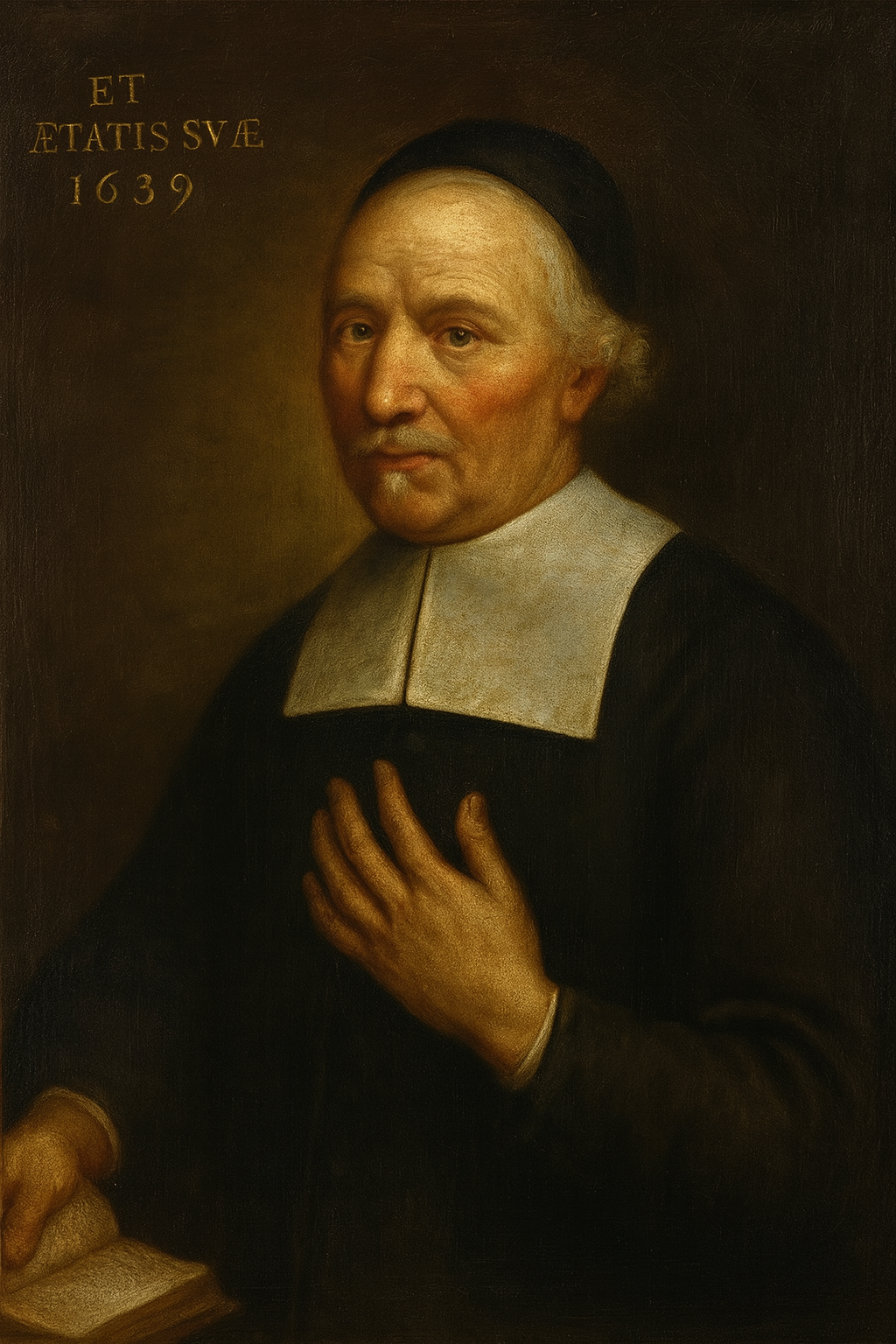
Read the rest hereor view a facsimile of the original below.I have also recorded it in audio here.Also view all our audio resources at WPE Audio. This discourse is especially meaningful to me personally, since my ancestor, William Ives came over the Atlantic with John Davenport and eventually signed his name to the original town covenant of the New Haven Colony in Connecticut.
Continuing to follow with interest Timon Cline et al over at American Reformer. Still parsing the field of contemporary “Christian nationalism” and trying to discern the good and the not-so-good; so I share this with some tentativeness, yet general appreciation thus far. Classical Protestant ethics and socio-political ethics fascinates me, so anyone participating in a retrieval has my attention.
Have enjoyed reading this article about John Witherspoon and the colonial Presbyterian iteration of establishmentarianism, contra Kevin DeYoung’s pluralistic take of the American revision of the WCF 23. Looks like others there have also written on the same. I still wonder to what degree Witherspoon may have been influenced by Enlightenment liberalism and what bearing that may have had on how he approached Christian magistracy. But that there is more continuity with the original WCF 23 than not just seems to sync with what I’ve understood about public religion in colonial America. Absolute separation just seems laughable on so many counts. I am also reminded how Dr. William Young opined that the American revision of WCF 23 did not technically contradict the original 1646 statement. While my denomination is the only NAPARC body committed to the original edition, I am at least coming to appreciate that we may have more of a genetic connection with colonial Presbyterian than I had first thought.
The following are quotes are from A Body of Practical Divinity (1838 edition):
“We glorify God, when we give God the glory of all we do. . . . As the silk-worm, when she weaves her curious work, she hides herself under the silk, and is not seen; so when we have done Constantine did use to write the name of Christ over his door, so should we write the name of Christ over our duties; let him wear the garland of praise” (27).
“The word being begun to be preached, hear it with reverence and holy attention. ‘A certain woman, named Lydia, attended unto the things which were spoken of Paul.’ Acts 16: 14. Constantine, the emperor, was noted for his reverent attention to the word” (381).
An intriguing thought. I’ve frequently thought of how establishments, while nearly a thing of the past in the secular West, might yet be on the horizon in the East. Stranger things have happened. And, of course, there is that ‘little thing’ (!) of prophecy: “Yea, all kings shall fall down before him: all nations shall serve him” (Psalm 72:11). O, brethren, let us pray for this nation, and for any godly magistrates that He might raise up “for such a time as this!” Mark Noll in his New Shape of World Humanity: How American Experience (2010):
“But third, it is a different story where Christianity spreads in regions of economic strength, as especially in Chᴉna. In this rapidly strengthening Asian power, the systems of belief that once guided society are passing away. Before Maoism imploded, it badly damaged ancestral reliance on Confucian precepts. Christianity seems to be taking off in Chᴉna because more and more Chᴉnese seem to be seeking a new moral compass as Chᴉna itself makes a commanding entrance onto the world stage. David Jeffrey, the provost of Baylor University who for fifteen years has been regularly invited to lecture on Christian subjects at premier universities in Chᴉna, has asked a speculative question that should give foreign analysts pause. Once before, Jeffrey remarks, a great world power passed through tumultuous times as Christian ranks expanded on the margins of society. It was the late 3rd and early 4th centuries. In that turmoil the Emperor Constantine was converted and become, from the top of the imperial system, a supporter of Christianity as a new glue for empire. Is it impossible to imagine that a new Constantine might exist somewhere in the junior ranks of the Chᴉnese communist party?”
The following are extracts from John Flavel’s Whole Works reflecting his (and Protestantism’s) mainly positive appraisal of Constantine and the shift to Christendom. The first passage doesn’t mention his name in particular, but employs the “earth helping the woman” trope for Christian magistrates supporting the true religion that I first encountered in Thomas Chalmers, but clearly predates him.
* * * * * * * * * * * *
“Secondly, We shall next enquire how Jesus Christ administers this providential kingdom. And here I must take notice of the means by which, and the manner in which he does it. The means, or instruments, he uses in the governing the providential kingdom, (for he is not personally present with its himself), are either angels or men, “the angels are ministering creatures, sent forth by him for the good of them that shall be heirs of salvation,” Heb. 1:14. Luther tells us, they have two offices, superius canere, et inferius vigilare, “to sing above and watch beneath.” These do us many invisible offices of love. They have dear and tender respects and love for the saints. To them, God, as it were, puts forth his children to nurse, and they are tenderly careful of them while they live, and bring them home in their arms to their Father when they die. And as angels, so men are the servants of Providence; yes, bad men as well as good. Cyrus, on that account, is called God’s servant: they fulfill his will, while they are prosecuting their own lusts. “The earth shall help the woman,” Rev. 12:16. But good men delight to serve Providence; they and the angels are fellow servants in one house, and to one master, Rev. 19:10. Yes, there is not a creature in heaven, earth, or hell, but Jesus Christ can providentially use it and serve his ends, and promote his designs by it. But whatever the instrument be Christ uses, of this we may be certain, that his providential working is holy, judicious, sovereign, profound, irresistible, harmonious, and to the saints peculiar” (Works 1:216).
In this public lecture of the Scottish Reformation Society, I will be discussing Thomas Chalmers’ (1780-1847) defense of church establishments over against Adam Smith’s critique. Chalmers championed such an establishment as a “Great Home Mission.”‘ Yet is this a merely an academic question? Does Chalmers have something to offer is in modern, pluralistic America? You might be surprised. Join us Friday, October 18 at 2:30 p.m. Eastern-U.S. / 7:30 p.m. U.K. Watch throughFacebook Live. More information below:
Establishments got some good press last week, at least on a respectable Reformed podcast. Kudos to Christ the Center for welcoming on Timon Cline to a panel discussion last Friday. While I’ve never heard of Timon before, I am sure going to read and listen to more of him. And I’m sure I’m not alone!
The panel discussion focused on Dr. Alan Strange’s newly published book, Empowered Witness: A Panel Discussion on Politics, Culture, and the Spiritual Mission of the Church. Giving feedback and critiques were D. G. Hart, Nick Wilborn, and Timon Cline. I’ve not read Strange’s book, so I’m only commenting on the video. The discussion up to Timon and related rejoinders was interesting enough. But Timon sure rocked the boat pretty hard when he brought up the obvious (at least from a historical Reformed perspective and not an American echo-chamber), that is, what about the spiritual nature in the church in light of the classic, confessionally Reformed and Presbyterian endorsements of religious establishments?
It’s clear that Dr. Strange was a bit flustered, though keeping a gracious demeanor. Sadly, though a respectable and accomplished Reformed scholar whom I otherwise appreciate, Strange’s response to Timon was more or less a rigmarole of informal fallacies and non-answers. Hart, however, just became flummoxed and unhinged. In contrast to Cline’s calm, measured demeanor, and even more importantly, to his much more careful, close, and logical reasoning (they guy’s a practicing lawyer, and it shines), Hart just full-on melted down, notwithstanding a clever little jab about Timon’s alleged tap-dancing like James Cagney. But even that was more amusing than apropos, as it only thinly veiled his chagrin. The young no-namer clearly bested his betters.
In the following passage (A.D. 324), Constantine shows his support for patronizing Christian mission. I notice nothing of compulsion, and the historical record appears to bear this out. So is state endorsement of the true religion really such a tough pill to swallow after all?
* * *
“When such grievous impiety controls human affairs and the commonwealth is in danger of utter destruction as by some plague and has need of much health-giving care, what alleviation does the Divinity devise, what rescue from our danger? And we must regard as altogether divine that which alone and really exists and whose power endures through all time. It is not vainglorious to acknowledge and boast of the beneficence of the Supreme Power. He sought out and judged fitting for His own purpose my service, starting from the sea which laps distant Britain and from those quarters where the sun is commanded by an ordinance of fate to set, thrusting aside by some mightier power all the dangers that beset me, that the human race might be recalled to the worship of the august law, schooled by my agency, and that the blessed faith might be increased under the guidance of the Supreme Power. Never can I ungratefully forget the gratitude that I owe; believing this to be the noblest service, this the gift granted to me, I advanced to the regions of the East, which, consumed by more grievous ills, called aloud for the greater healing care at my hands.”






 West Port Experiment