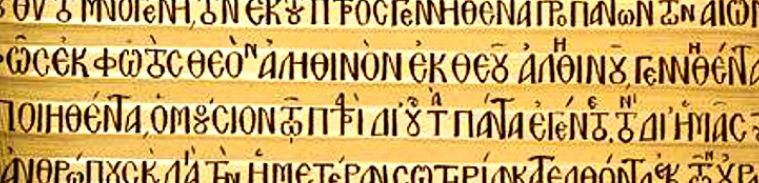
Since 2025 was the 1700th anniversary of the momentous Council of Nicea, a lot of material online has been produced. This short series by the White Horse Inn was exceptionally good. I would highly commend every intelligent Christian wanting to deepen his knowledge and appreciation of this tremendous formula of faith that has stood the test of time and has left its print upon Protestant confessions and catechisms, not to mention the preaching and piety of the reformed catholic Church.
Continuing to follow with interest Timon Cline et al over at American Reformer. Still parsing the field of contemporary “Christian nationalism” and trying to discern the good and the not-so-good; so I share this with some tentativeness, yet general appreciation thus far. Classical Protestant ethics and socio-political ethics fascinates me, so anyone participating in a retrieval has my attention.
Have enjoyed reading this article about John Witherspoon and the colonial Presbyterian iteration of establishmentarianism, contra Kevin DeYoung’s pluralistic take of the American revision of the WCF 23. Looks like others there have also written on the same. I still wonder to what degree Witherspoon may have been influenced by Enlightenment liberalism and what bearing that may have had on how he approached Christian magistracy. But that there is more continuity with the original WCF 23 than not just seems to sync with what I’ve understood about public religion in colonial America. Absolute separation just seems laughable on so many counts. I am also reminded how Dr. William Young opined that the American revision of WCF 23 did not technically contradict the original 1646 statement. While my denomination is the only NAPARC body committed to the original edition, I am at least coming to appreciate that we may have more of a genetic connection with colonial Presbyterian than I had first thought.
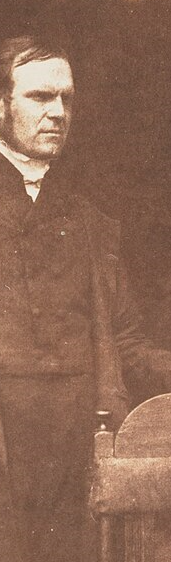
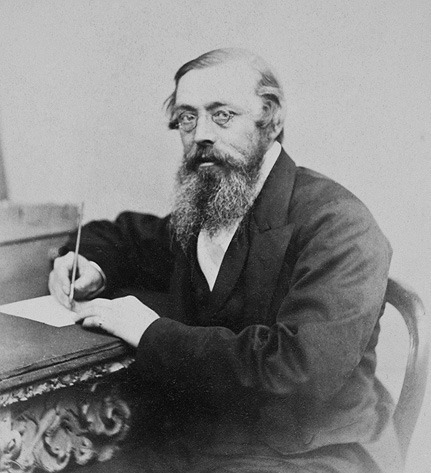
Patrick Fairbairn (1805–1874), Free Church of Scotland theologian and author of The Typology of Scripture, on his understanding of the papacy as the antichrist and “man of sin.”
* * * *
“On the whole, then, the conclusion which forces itself upon our minds from a full and impartial consideration of the apostolic testimony, is that the antichristian apostacy cannot be identified cither with the heathenism ofancient Rome, or with any conceivable form of infidelity or atheism yet to be developed. The conditions of the prophetical enigma are not satisfied by either of these views. So much for the negative side of the question. And in regard to the positive, if we may not say (as, indeed, we by no means think it can in truth be said) that in Romanism and the papacy the anticipated evil has found its only realization; yet we cannot for a moment doubt, that it is there we are to look for the most complete, systematic, and palpable embodiment of its grand characteristics. There, we perceive, as nowhere else, either to the same extent, or with the same firm determination of purpose, a mass of errors and abuses “grafted on the Christian faith, in opposition to, and in outrage of, its genius and its commands, and taking a bold possession of the Christian church.” We see “the doctrines of celibacy, and of a ritual abstinence from meats, against the whole spirit of the gospel, set up in the church by an authority claiming to have universal obedience; a man of sin exalting himself in the temple of God, and openly challenging rights of faith and honour due to God; advancing himself by signs and lying wonders, and turning his pretended miracles to the disproof and discredit of some of the chief doctrines or precepts of Christianity; and this system of ambition and falsehood succeeding, established with the deluded conviction of men still holding the profession of Christianity.” All this meets so remarkably the conditions of St Paul’s prophecy, and in its history and growth also from the apostolic age so strikingly accords with the warnings given of its gradual and stealthy approach, that, wherever else the antichrist may exist, they must be strangely biased, who do not discern its likeness in the Romish apostacy. We may the rather rest in the certainty of this conclusion, as it is matter of historical certainty, that ages before the Reformation, and, indeed, all through the long conflict that was ever renewing itself on the part of kings and men of faith against Rome, the Pope was often denounced as the antichrist, and man of sin. But it is one thing to find a great and palpable realization of the idea there, and another thing to hold, that it is the only realization to be found in the past or the future. And if Romanists have made void the testimony of Scripture in rejecting the one application, we fear Protestants have too often grievously narrowed it by excluding every other. Of this, however, we shall have a fitter occasion to speak, when we have examined that remaining portion of New Testament Scripture, which treats of the same subject, and in a way peculiarly its own. We refer, of course, to the Apocalypse.”
Establishments got some good press last week, at least on a respectable Reformed podcast. Kudos to Christ the Center for welcoming on Timon Cline to a panel discussion last Friday. While I’ve never heard of Timon before, I am sure going to read and listen to more of him. And I’m sure I’m not alone!
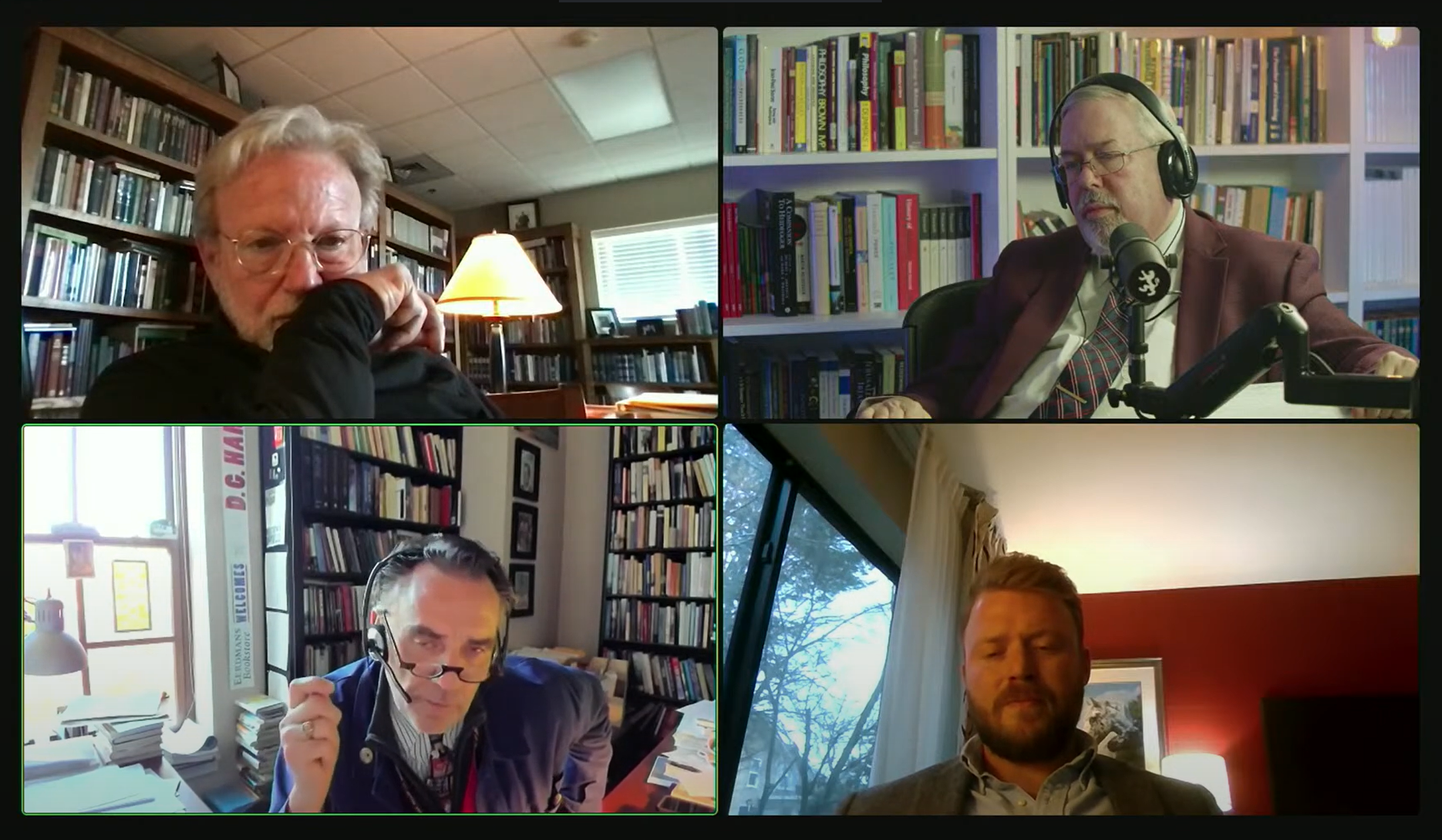
The panel discussion focused on Dr. Alan Strange’s newly published book, Empowered Witness: A Panel Discussion on Politics, Culture, and the Spiritual Mission of the Church. Giving feedback and critiques were D. G. Hart, Nick Wilborn, and Timon Cline. I’ve not read Strange’s book, so I’m only commenting on the video. The discussion up to Timon and related rejoinders was interesting enough. But Timon sure rocked the boat pretty hard when he brought up the obvious (at least from a historical Reformed perspective and not an American echo-chamber), that is, what about the spiritual nature in the church in light of the classic, confessionally Reformed and Presbyterian endorsements of religious establishments?
It’s clear that Dr. Strange was a bit flustered, though keeping a gracious demeanor. Sadly, though a respectable and accomplished Reformed scholar whom I otherwise appreciate, Strange’s response to Timon was more or less a rigmarole of informal fallacies and non-answers. Hart, however, just became flummoxed and unhinged. In contrast to Cline’s calm, measured demeanor, and even more importantly, to his much more careful, close, and logical reasoning (they guy’s a practicing lawyer, and it shines), Hart just full-on melted down, notwithstanding a clever little jab about Timon’s alleged tap-dancing like James Cagney. But even that was more amusing than apropos, as it only thinly veiled his chagrin. The young no-namer clearly bested his betters.
Hugh Martin, great 19th century Free Church of Scotland preacher and churchman, is well-known for his masterful preaching as exhibited in his The Shadow of Calvary. But he clearly had a polemic side in his advocacy of a strict adherence to the Confession of Faith as constitution of the Church, together with its commitment to the due obedience of nations to King Jesus. This speech of his in 1871 was printed in the Watchword is a worthy contribution to ongoing discussions of confessional subscription among Presbyterians. I have recorded it here, and the PDF is available below. See more audio titles from the old Free Church and Church of Scotland legacies.
“The extreme seriousness of the conflict going forward in the Free Church of Scotland arises from this, that the question now raise is that of the preservation or destruction of our Constitution.
“We brush aside at the outset the assertion (and the question grounded on it), that the Church of Scotland changed her Confession in the middle of the 17th century, — and why not do the same again? An utterance like this, in the present discussion, is characterized by such thoughtlessness, if not indeed such moral levity, as to deprive it of all right to serious answer. The Church of Scotland, in adopting the Westminster Confession, declared it to be ‘in no respect contrary to the doctrine of this Church.’ And in amending the formula in 1846, she did so with the avowed purpose not of changing but of expressing, re-affirming, and conserving the principles of the Church. And how men can allege a parallel between that and a proposal to make ‘allowance’ for the principles of another Church, exactly wherein they contradict our own, ought to surpass all powers of honourable imagination. It is not by moral trifling of this description that we are to be turned aside from our argument. . . .”
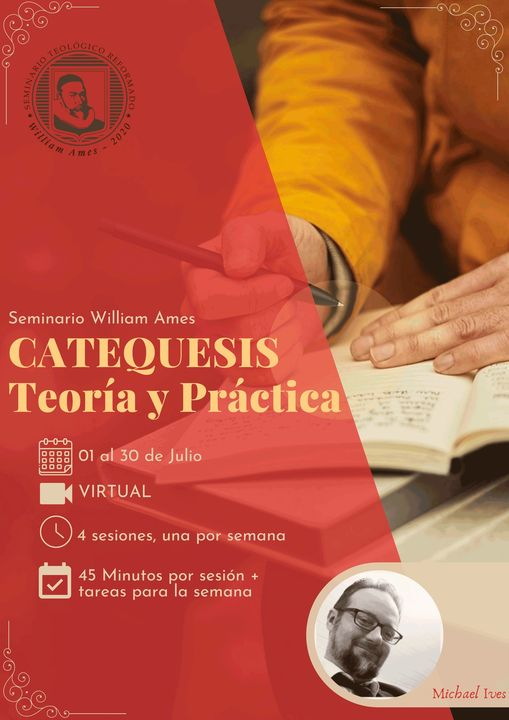
Inscríbase en un curso del seminario sobre la teoría y la práctica de la catequesis. El costo del curso es de sólo $10 USD; y hay vacantes disponibles gratuitamente para un número limitado de quienes deseen auditar el curso.
Comprensión teológica: Los estudiantes adquirirán una sólida comprensión de los principios básicos y las ventajas de la catequesis como disciplina teológico-pastoral dentro de la Iglesia. Serán capaces de analizar y aplicar estos conceptos fundamentales en su vida y práctica cristiana.
Formación doctrinal: El curso capacitará a los estudiantes para formar a otros en las doctrinas fundamentales de la fe cristiana. Aprenderán a transmitir de manera clara y efectiva estos principios, tanto a adultos convertidos como a menores bautizados, fomentando una comprensión profunda y significativa de la fe.
Profesión de fe personal: Los estudiantes desarrollarán la habilidad de realizar una profesión de fe personal y creíble. A través del conocimiento adquirido en el curso, podrán articular su fe de manera coherente y convincente, fortaleciendo así su relación con Dios y su plena pertenencia a la Iglesia.
Just finished recording this masterful article by Principle John Macleod (1872-1948) of the Free Church of Scotland. While it is somewhat encumbered by historical details less familiar to the American reader, it is still a fresh, perceptive, and prophetic appeal for the old adherence to full, good faith subscription to the Confession of Faith. If you’re a historic Presbyterian belonging to or respectful of the old Church of Scotland and Free Church testimonies, you owe it to yourself. The PDF of the article is below; and here is a ‘handful of purpose’:
“The Churches of Scotland were unprepared for the day that had overtaken them. In their halting uncertainty they suffered a tendency that was inimical to their historical faith to effect a lodgment in their bosom. They lost sight of the essential simplicity of the Christian position- “Heaven’s easy artless unencumbered plan.” When John tells us that he wrote his Gospel that we might believe that Jesus is the Christ, the Son of God and that believing we might have life through His Name he thought the witness borne by his fellows and himself to be ground enough for the faith of Christians to build upon. Christian faith through the ages has responded to this claim. It was the claim not only of the Apostle but of the Holy Ghost who spoke in him. It is undoubtedly the mind of the Spirit that the evidence which He thus bore to the truth as it is in Jesus should suffice for the Church of God to the end of time and to the ends of the earth. What was thus in the Gospels claimed by the Apostles for the witness that they bore they claimed for their teaching in the Epistles. They spoke not in the words which man’s wisdom teaches but which the Holy Ghost teaches. They could say, ‘We are of God: he that knoweth God heareth us; he that is not of God heareth not us.’ Such claims were in full keeping with the promises given to them in the Upper Chamber. There has been from the beginning a Holy Catholic Church -define it how we may- to whose care and keeping the New Testament books were committed and from whose hands in successive generations her children have received them as being alike in their witness and in their teaching the crystallised and perpetuated ministry of the Apostles. As many as are willing to sit at their feet, as they thus continue to bear witness and to teach, will learn to treat the Old Testament. Scriptures as the Lord and His Apostles did. Here we have the common view of Holy Writ held throughout historical Christendom. On this view the whole structure of Christian Theology is built. To maintain the superstructure we must defend the substructure.”
Whole doctrine catholicity | “Who is she that looketh forth as the morning, fair as the moon, clear as the sun, and terrible as an army with banners” (Song 6:10)?
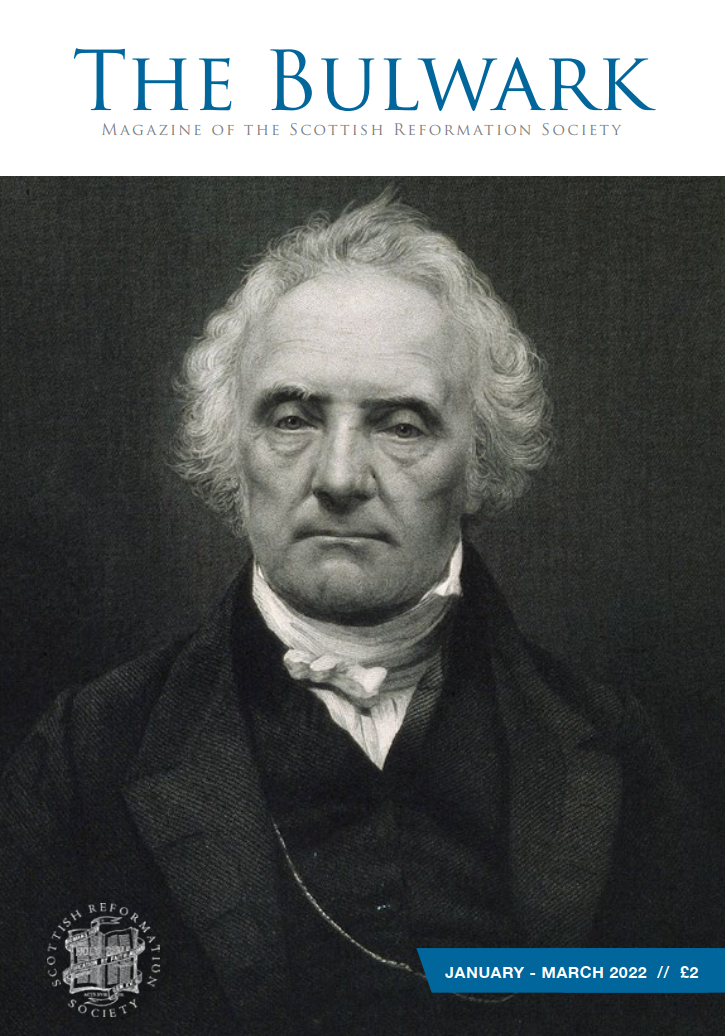
“Chalmers’ method was simple, systematic, spiritual, and unadorned. It was concerned with reaching souls rather than building brands; it sought them out. A gathered team of committed individuals connected with their local community and the lives of individuals through visitation and interaction. Such a method has massive challenges in a society where community has disintegrated but that is not to say it is impossible. No doubt something resembling it is bearing fruit in some communities.”
In this article below, my good friend Matthew Vogan recounts the old national vision of our Scottish Presbyterian forbears like Thomas Chalmers, who maintained confessional fidelity while also aggressively engaged in home missions. Does anyone among the theological heirs of Chalmers have such a national vision? Or even more pointedly, does anyone care?
Well, I for one deeply believe that they do care. And that they have the almighty Spirit of God dwelling in them and resting upon them. Nothing can defeat the sword of the Lord and of Gideon, nothing can stop these ‘sons of oil,’ for it is “not by might, nor by power, but by [His] Spirit, saith the LORD.” They will hear their charge, and they will go, shaking off all inhibitions and possessing the good land that rightly belongs them–and much more, to the Heir of all!
(There. That’s the closest this stodgy Presbyterian will ever get to ‘naming and claiming!’)
* * * *
This article is found in The Bulwark, popular magazine published by the Scottish Reformation Society. To read it more easily, you will likely need to download and rotate view.
The following is a series of messages given to lay out the distinctives of the Presbyterian Reformed Church, a denomination organized through the instrumentality of Professor John Murray in 1965, committed to the principles of historic Scottish Presbyterianism in doctrine, worship, government, and discipline, as enshrined in the original Westminster Confession of Faith (1646).
For a historical sketch of our beginnings, see here.
(Note: The title “Our Testimony” is merely thematic, and does not refer to a supplementary ecclesiastical document besides the Westminster Standards as is done among Reformed Presbyterian brethren.)
While reading through a dissertation treating confessional subscription among Presbyterians prior to the Adopting Act of 1729, I came across a discussion of the English Presbyterian Daniel Wilcox. Apparently, the influence of Enlightenment thinking regarding authority and toleration was infiltrating English Presbyterians at that time in a big way, and even Arianism began to rear its ugly head. If I’m not mistaken, this would be the caldron from which Unitarianism basically took over Presbyterianism in England.
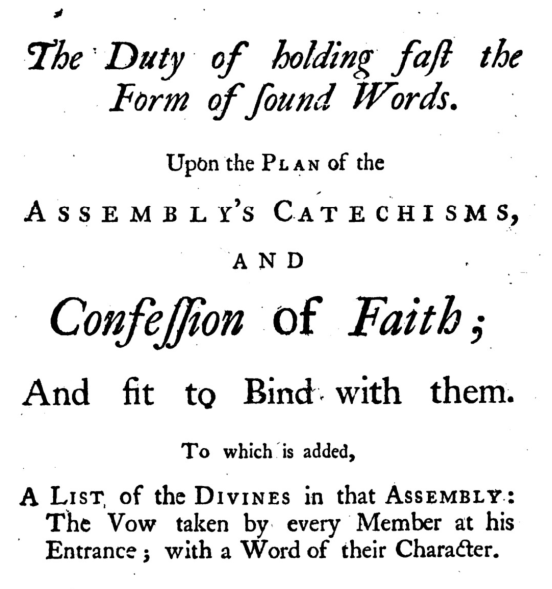
During this intermediate period, Wilcox published a short justification for confessions and the practice of confessional subscription. Very interestingly, he puts it in the form of a catechism! Just recorded it, which you can access here.

 West Port Experiment