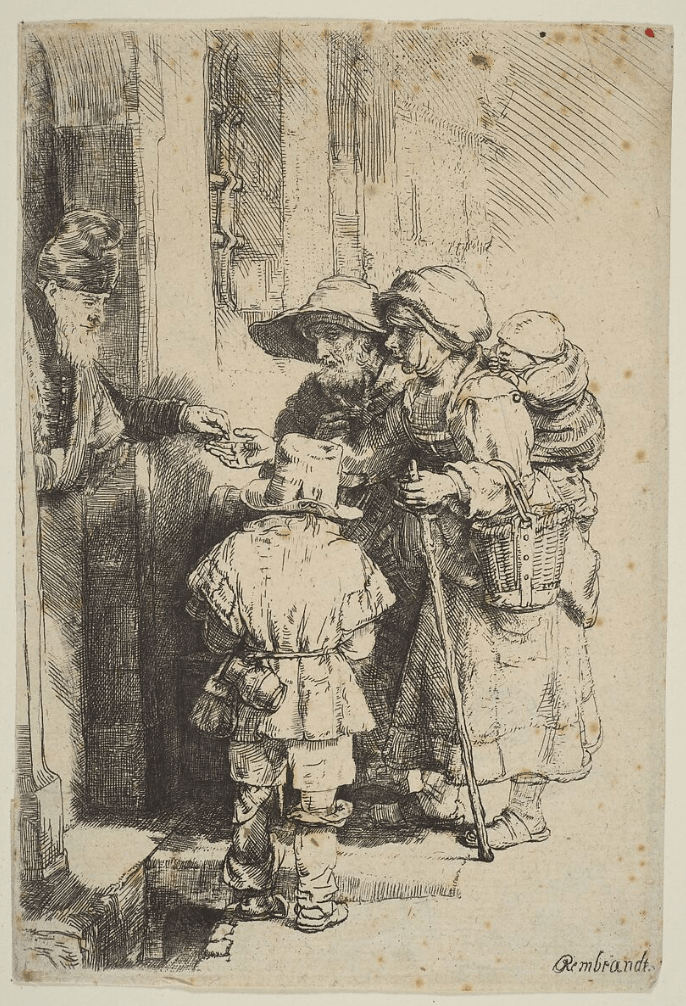
Thomas Chalmers (1780-1847) preached following sermon to two benevolent societies and an orphan hospital in Dunfermline and Glasgow, in 1814 and 1815. Listen to a recording of the sermon here; and a PDF of the sermon follows the text below.
* * * *
“I have shewed you all things, how that so labouring ye ought to support the weak: and to remember the words of the Lord Jesus, how he said, It is more blessed to give than to receive.” —ACTS xx. 35.
John, at the end of his gospel, spoke of the multitude of other things which Jesus did, and which he could not find room for in the compass of His short history. Now, what is true of the doings of our Saviour, I hold to be equally true of the sayings of our Saviour. There are many thousands of these sayings not recorded. The four gospels were written within some years after His death, and though I have no doubt of the promise being accomplished upon the apostles, that the Spirit would bring all things to their remembrance, in virtue of which promise, we have all things told of Jesus necessary for our guidance here, and our salvation hereafter—yet I have as little doubt, when I think of the length and frequency of His conversations with the people around Him, that many, and very many of the gracious words which fell from His mouth, have not been transmitted to us in any written history whatever. They may have been kept alive by tradition for a few years. They may have been handed from one to another by mere oral communication. There is no doubt that they served every purpose for which they were uttered—but, in the lapse of one or two generations, they ceased to be talked of, and have now vanished from all earthly remembrance.
But there is one, and only one, of these sayings, which, though not recorded in any of the gospels, has escaped the fate of all the rest. In the course of its circulation among the disciples of that period, it reached the apostle Paul, and he has thought fit to preserve it. It seems to have obtained a general currency among Christians; for he speaks of it to the elders of Ephesus, as if they had heard it before. He quotes it as a saying known to them as well as to himself. We have no doubt that it was held in reverence, and referred to, and might have been talked of for many years, in the churches. But it would at length have sunk into forgetfulness, with the crowd of other unrecorded sayings, had not Paul caught hold of it in its progress to oblivion; and, by placing it within the confines of written history, he has made it imperishable. It has got within the four corners of that book, of which it is said, “If any man take away from the words of it, he shall be accursed.” He was the Son of God who uttered it; and it is striking enough, that, when unnoticed and unrecorded by all the evangelists, the apostle of the Gentiles, born out of due time, was the instrument of transmitting it to posterity. Precious memorial! There was no chance of its ever being lost to the Christian church, for all Scripture is given by inspiration of God; and without it the volume of inspiration would not have been completed. But surely the very circumstances of its being overlooked by the professed historians of our Saviour—of its being left for a time to fluctuate among all the chances, and all the uncertainties of verbal communication—and its being selected by the revered apostle of the Gentiles, from among the crowd of similar sayings which were suffered to perish for ever from the memory of the world—of his putting his hand upon it, and arresting its march to that forgetfulness to which it was so fast hastening—All these have surely the effect of endearing it the more to our hearts, and should lead the thoughtful Christian to look upon the words of my text, with a more tender and affecting veneration.
In discoursing from these words, I shall first direct your attention to those Christians who occupy such a condition of life that they may give; and, secondly, to those Christians who occupy such a condition of life that they must receive.
I will not attempt to draw the precise boundary between these two conditions. Each individual among you must determine the question for himself. It is not for me to sit in judgment upon your circumstances; but know that a day is coming, when all these secrets shall be laid open—and when the God who seeth every heart shall tell with unerring discernment, whether the selfishness of diseased nature or the charity of the gospel, had the rule over it.
I. First, then, as to those Christians who occupy such a condition of life that they may give. It is more blessed for them to give than to receive. (1.) Because in so doing, they are like unto God; and to be formed again after his image, is the great purpose of the dispensation we sit under. We have nothing that we did not receive, but we cannot say so of God. He is the unfailing fountain out of which every thing flows. All originates in Him. A mighty tide of communication from God to His creatures, has been kept up incessantly from the first hour of creation. It flows without intermission. It spreads over the whole extent of the universe He has formed. It carries light, and sustenance, and enjoyment, through the wide dominions of Nature and of Providence. It reaches to the very humblest individual among His children.
There is not one shred or fragment in the awful immensity of His works which is overlooked by Him; and, wonderful to tell, the same God whose arm is abroad over all worlds, has His eye fastened attentively upon every one of us, compasses all our goings, gives direction to every footstep, sustains us and holds us together through every minute of our existence—and, at the very time that we are living in forgetfulness of Him, walking in the counsel of our own hearts, and after the sight of our own eyes—is the universal Creator at the right hand of each and of all of us, to give us every breath which we draw, and every comfort which we enjoy.
Oh! but you may think it is nothing to Him, to open His hand liberally. He may give and give, and be as full as ever. He loses nothing by communication. But we cannot part with any thing to another, without depriving ourselves. Such an objection as this proceeds from an unscriptural view of God. In the eye of a cold natural theology, He is regarded as a Being who has nothing in Him answering to that which we feel in ourselves—when, by a laborious exercise of self-denial, we perform some great and painful act of liberality. The theology of nature, or rather of the schools, makes an orderly distribution of the attributes of God; and, conceiving His power to be some kind of physical and resistless energy, it also conceives that He can accomplish every deed of benevolence however exalted it may be without so much as the feeling of a sacrifice. Now this I think is not the lesson of the bible. He who hath seen the Father, and is alone competent to declare Him, gives me a somewhat different view of what I venture to call the constitution of the Deity. Does not He tell us, that to be kind to our friends is no great matter; and then He bids us be kind to our enemies, and upon what principle?—That we may be like unto God. Now in the exercise of kindness to enemies, there is something going on in our minds totally different, from what goes on in the exercise of kindness to friends; and I do not see the significancy of the argument at all, unless you grant me, that there must be a difference corresponding to this in the mind of the Deity. In the exercise of kindness to the man who hates you, there is a preference of his good to the indulgence of your own resentment—there is a victory over the natural tendencies of your constitution—there is a struggling with these tendencies—there is an act of forbearance—there is a triumph of the principle of love, over a painful and urgent sense of provocation. Now, if in all this we are like unto God, must there not be something similar to all this in the benevolence of God? Or, in other words, there must be something in His character, corresponding to that which imparts a character of sublime elevation, to the meek and persevering charity of an injured Christian.
But again. When we are told that God so loved the world, as to send His only begotten Son into it, that whosoever believeth in Him should not perish but have everlasting life—what is the meaning of the emphatic so? It means nothing at all, if God, in the act of giving up His Son to death, did not make the same kind of sacrifice with the parent, who, amid the agonies of his struggling bosom, surrenders his only child at some call of duty or of patriotism. If it was at the bidding of God that Abraham entertained strangers, this was some proof of his love to Him. But it was a much higher proof of it that he so loved Him, as to be in readiness at His requirement, to offer up Isaac. Now there is something analogous to this in God. It proves His love to men, that He opens His hand, and feeds them all out of the exuberance which flows from its; but it is a higher proof of love that He so loved them as to give up His only begotten Son in their behalf.
And the argument loses all its impression, if God did not experience a something in His mind, corresponding to that which is felt by an earthly parent—when, keeping all the struggles of his natural tenderness under the control of principle, he gives up his son at the impulse of some pure and lofty requirement. Dismiss then my brethren all your scholastic conceptions of the Deity; and keep by that warm and affecting view of Him that we have in the Bible. For if we do not, we will lose the impression of many of its most moving arguments; and our hearts will remain shut against its most powerful and pathetic representations of the character of God. To come back then upon this objection, that it is nothing to God to open His hand liberally, for He may give and give and be as full as ever. And does God make no sacrifice in the act of giving unto you? A pure and unfallen angel would not detract from the praises of His Creator—by language such as this. And what are you? A rebel to His laws, who will yet persist in saying, that God, by feeding you with His bounty, is making no sacrifice. Why, He is holding you up though you be a spectacle injurious to His honour. He is grieved with you every day, and yet every day He loads you with His benefits. Every sinner is an offence to Him, and what restrains Him from sweeping the offence away from the face of His creation altogether—It is of His mercies that you are not consumed—that He still bears with you—that He keeps you in life and in all that is necessary to life—that He holds on with you a little longer and a little longer—that He plies you with warnings and opportunities: and brings the voice of a beseeching God to bear upon you, calling you to turn and be reconciled and live—What! Has He never for your sakes, given up any thing that is dear and valuable to Himself? Did not He give up His Son to the death for you? All your gifts to the poor are nothing to this. When Abraham lifted up the knife over his son Isaac—he felt that he was making a mightier and more painful sacrifice, than by all his alms-deeds and hospitalities. God had compassion on the parental feelings of Abraham, and He spared them. But He spared not His own Son. He gave Him up for us all. And shall we who are receiving a trifling proportion of our substance to the relief of our poorer brethren, talk of the sacrifice we are making—as if there was nothing like it in the benevolence of God? Talk not then of your deprivations and your sacrifices. But “be ye perfect even as your Father in heaven is perfect.”
Under this particular, I have one practical direction to come forward with. When you do an act of benevolence, think of the extent of the sacrifice you have made by it. It is a delightful exercise to be kind among people who have a sense of your kindness—to give away money, if you get an ample return of gratitude back again—to pay a visit of tenderness to the poor family, who load you with their acknowledgments and their blessings—when you are received with the smile of welcome; and soothed by the soft accents of the widow who prays for a reward upon you, or of the children who hail you as an angel of mercy. Oh, it is easy to move gently along, through such scenes and families as these. But have a care, that you are not ministering all the while to your own indulgence and your own vanity; for then verily I say unto you “you have your reward.” The charity of the gospel is not the fine and exquisite feeling of poetry. It is a sturdy and enduring principle. It carries you through the rough and discouraging realities of life, and it enables you to stand them; and it is only, my brethren, when you can be kind in spite of ingratitude—when you can give to the poor man, not because he thanks you, but because he needs it—when you can be unwearied in well-doing, amid all the bitterness of envy, and all the growlings of discontent—Then, and then only is it, that you endure hardness as a good soldier of Christ Jesus; or can be called the children of the Highest, who is kind to the unthankful and the evil, and sendeth down his rain on the just and on the unjust.
(2.) It is more blessed to give than to receive—for to give as a Christian, is to part with that which is temporal, and to show a preference for that which is eternal. By an alms-deed you give up part of this world’s goods. By a piece of service, you give up a part of this world’s ease. By an act of civility, you give up to another that time which might have been employed in the prosecution of some design or interest of your own. But, lest I flatter you into a delusive security, I again recur to the question “What is the extent of the sacrifice?” For I am well aware, that the part thus given up may be so small, as to be no evidence whatever of a mind lent upon eternity. You may gratify your feelings of compassion at an expense so small, that you cannot be said to have made any sacrifice. You may gain the good-will of all your neighbours by this act of kindness, and count the purchase a cheap one. You may gratify your love of ostentation by an act of alms-giving, and do it upon as easy terms, as you gratify your love of amusement by an act of attendance upon the ball-room or the theatre. You may lay out your penny a-week, and be amply repaid for the sacrifice, by the distinction of being one of a society, and by the pleasure of sharing in the business of it. In all this you have your reward; but I do not yet see any evidence of a soul setting its affections upon the things above in all this. Oh! no my brethren! the benevolent society is a very pleasurable exhibition; and I trust that in the one I am now pleading for, there is much of that genuine principle which shrinks from the pollution of vanity. But were I to bestow that praise upon you, the mere act which only belongs to the principle, I might incur all the guilt of a lying prophet. I might be saying “Peace peace when there is no peace.” I might be proclaiming the praise of God, to him who had already sought and obtained his reward in the praise of man. I might be regaling with the full prospect of heaven, him whose heart tends to the earth, and is earthly—whose trifling charity has not the weight of a straw upon the luxury of his table, or the yearly amount of that accumulating wealth upon which he sets his confidence. Were I, my brethren, who have come from a distance, to adopt the language of a polite and insinuating flattery, and send you all away so safe and so satisfied with the charities you have performed—I might be doing as much mischief, as if I travelled the country, and revived the old priestly trade of the sale of indulgences. None more ready than a Christian to enter into a scheme of benevolence; but let it never be forgotten, that a scheme of benevolence may be entered into by many, who fall miserably short of the altogether Christian. Oh what a multitude of men and of women may be found, who can give their pennies a-week with the hand, while their heart is still with the treasures of a perishable world. Our Saviour was rich and for our sake He became poor. Here was the extent of His sacrifice. Now we may give in a thousand directions for the sake of others; and yet be sensibly as rich as ever. I am not calling upon you to make any great or romantic sacrifice. I do not ask you, in deed and in performance, to forsake all; but I say that you are short of what you ought to be, if you are not in readiness to forsake all upon a clear warning. I say that you may give your name to every subscription-list, and bestow your something upon every petitioner; and yet stand at an infinite distance from the example you are called upon to imitate. The great point of inquiry should be, “Is the heart right with God?” Now I want to save you from a common delusion, when I tell you, that, out of your crumbs and fragments, many a Lazarus may be fed—while yet, like Dives, your heart may be wholly set upon the meat that perisheth. It is well, and very well, that you are a member of a benevolent society; and I shall rejoice to think of it as one of the smaller fruits of that mighty principle which brings the whole heart under its dominion—which makes you willing to renounce self and all its earthly interests at the call of duty—which sinks the pursuits and enjoyments of time in the prospects of eternity—Such a principle as would not merely dictate the surrender of a penny for the poverty of a neighbour, but would dictate the surrender of every earthly distinction and enjoyment on the clear call of conscience or Revelation—Such a principle as has often been put to the trial in those awful seasons, when a sweeping tide of bankruptcy sets in upon a country; and the sanguine speculations of one man, on the false statements of another, have involved many an innocent sufferer, in the loss of all that belongs to him. Could I obtain a view of his heart now, I might collect a more satisfying evidence of the way in which it stands affected by the things of another world, than I possibly could do, from all the odd fractions of his wealth, which he made over to his poorer brethren in the day of prosperity. When stript bare of his earthly possessions, is the hope of eternity enough for him? Is his heart filled with the agonies of resentment and despair; or with peaceful resignation to the will of God, and charity to the human instrument of his sufferings? Now is the time for the fair trial of his principles; and now may we learn if to him belongs the blessedness of enduring it. And it will go further to prove his claim to the kingdom of heaven, than all the charities of his brighter days—if trust in Providence, and prayer for the forgiveness of those who have injured him, shall be found to occupy and to sustain his heart under the fallen fortunes of his family.
There may be no call upon you to surrender all, in which case you are spared the very act of a surrender. But God who is a discerner of the heart, sees whether yours is in such a state of principle, as to be in readiness for the surrender, so soon as a clear requirement of conscience is upon you. Were persecution again to light up its fires in this land of quietness—it is to be hoped, that there are many who would cheerfully take the spoiling of their goods, rather than abandon the cause of the gospel. They have not the opportunity of manifesting themselves to the world; but the discerning eye of God stands in no need of such a manifestation. He can fathom all the secrecies of the inner man; and, in the great day of the revelation of hidden things, it will be seen who they are that would have forsaken all to follow after Christ.
Such as these, may have no opportunity of showing the whole extent of their devotion to Christ, by any actual performance. But though we cannot speak to their performance, we can speak to their principle. They sit loose to the interests of this world, and their heart is fully directed to the treasures which is in heaven. They have the willing mind; and, whenever their means and their opportunities allow, they will show that they have it. The thing given may be in itself so very small, as to be no evidence whatever of the preference of eternity over time. Think not then that by the giving of this thing, you will obtain heaven. Heaven, my brethren, is not so purchased. You are made meet for heaven by the Spirit working in your soul a conformity to the image of the Saviour; and if the charity which filled his heart, actuate and inflame yours, it will carry you forward with a mighty impulse to every likely or practicable scheme for the interests of humanity, and for the alleviation of all its sufferings.
Before I pass on to the second head of discourse, I shall give my answer to a question, which may have been prompted by some of the observations I have already come forward with.
Does not the very object of this society, it may be asked, furnish the opportunity we are in quest of? May it not put the whole extent of a Christian’s principles to the test? Has he it not in his power to forsake all in following the injunction of Christ, “Be willing to distribute, and ready to communicate”? What is to hinder him from selling all his goods to feed the poor? And is his penny a-week be no decisive evidence of the Christian principle which actuates him, may not the evidence be made still more decisive, by throwing his all into the treasury of our beneficence?
When a Christian has a clear and urgent call of conscience upon him, it is his duty to obey that call in the face of every sacrifice, however painful, and however mortifying. But it is also his duty to inform and to enlighten his conscience; and if, with this view, he were to cast about for advice, and do me the honour of making me one of his advisers, I would submit to him the following short representation.
There are many ways in which a man may show, that he has less value for this world’s wealth, than his neighbours around him. Why? He may do so by putting forth his hand to destroy it. He may set it on fire. He may strip himself of all that belongs to him by throwing it away; but none will give to such fanatical extravagancies as these, the credit which is only due to the spirit of love, and of power, and of a sound mind.
It is not enough, then, that you prove your indifference to this world’s wealth by parting with it; you must have an object in parting with it, and the question is, what should that object be? Now the feeding of the poor is only one of the many objects, for which you are entrusted with the gifts of Providence. You are called upon to love your neighbours as yourself; but you are not called upon to love him better than yourself. Your own subsistence is an object, therefore, which it is not your duty to surrender. This is one limit; and there are many others. If you provide not for your own family, you are worse than an infidel. Your parents have a claim upon you. You may be rich; and though I do not speak of it as a positive duty, to maintain the rank and distinction which belong to you, yet you are allowed by Christianity to do so. The New Testament recognises the gradations of society; and it numbers the rich and the noble among the disciples of the Saviour. Add to all this, that if the whole disposable wealth of the country was turned to the one direction of feeding the poor—what would become of the others, ay, and of the worthier objects of Christian benevolence? Have not the poor souls as well as bodies? Must they not be taught as well as fed? Are the narrow limits of our own parish, or even our own island, to be impassable barriers to our charity? Did not the same Saviour who said, Give to him that asketh, say also, Go and preach my gospel to every creature under heaven; and that the labourer is worthy of his hire? Those who cannot preach may at least hire; and if the whole stream of our disposable wealth were turned to the one object of relieving the temporal necessities of others—what would become of those sublime enterprises, by which, under the promise of heaven, we send the light of Christianity, and all its blessings, over the wide and dreary extent of that moral wilderness, that is everywhere around us—by which we carry the message of peace into the haunts of savages, and speed the arrival of those millennial days, when the sacred principles of good-will to men shall circulate through the world, and when the sun, from its rising to its going down, shall witness the people of all the countries it shines upon, to be the members of one great and universal family?
But more than this—if every shilling of the disposable wealth of the country, were given to feed the poor, it would create more poverty than it provides for. It would land us, in all the mischief of a depraved and beggarly population. That subsistence, which they could obtain from the prodigal and injudicious charity of others, they would never think of earning for themselves. Idleness and profligacy would lay hold of the great mass of our peasantry. Every honourable desire after independence, would be extinguished; and the people of the land, thrown loose from every call to the exertions of regular industry, would spread disorder over the whole face of the country. It does not occur to the soft daughters of sensibility, but it is not on that account the less true; that if every purse were emptied in the cause of poverty—there would be more want and hunger and hardship in our neighbourhood, than there is at this moment. With the extension of your fund, you would just multiply the crowd of competitors—each pressing forward for his share, and jostling out his more modest and unobtrusive neighbour, who would be left to pine in secret over his untold and unnoticed indigence. The clamorous and undeserving poor, would in time spread themselves over the whole of that ground, which should only be occupied by the children of helplessness; and, after the expenditure of millions, it would be found that there was more unrelieved want, and more unsoftened wretchedness in the country, than ever.
II. I now come to a far more effectual check upon the mischiefs I have alluded to, than even the judgment and cautious inquiry of the giver. I proceed, in the second place, to the duties of those who are placed in such a situation of life, as to become receivers; and the first thing I have to propose to them is, that, if it be more blessed to give than to receive, then it is merely putting this assertion of my text into another form, when I say that it is less blessed to receive than to give. There may be something in this to startle and alarm the feelings of the poor. What! they may say, is our poverty a crime in the eye of Heaven? Are we to be punished for our circumstances?
Are we to be degraded into an inferior degree of blessedness, because our situation imposes upon us the painful necessity of receiving from another, what, with all our industry, we cannot earn for ourselves? We always understood the gospel to be a message of glad tidings to the poor; that its richest consolations were addressed to them; that through it God had chosen the poor of this world to be heirs of the promised kingdom—And shall we now be told, that the man who gives, because his situation enables him so to do, is more blessed than he who is forced by his situation to be a receiver?
In answer to this I have to observe, that man is neither punished nor rewarded for his circumstances—that the kingdom is only withheld from the rich, when they set their confidence and their affections on the world, and despise the offered salvation; and the poor obtain an interest in the gospel, not because they are poor, but it is because they are rich in faith, that they are heirs of that kingdom which God hath promised to them that love Him.
How often shall we have to repeat it, that it is not the deed of the hand that God looks to, but the dictate of the heart which gave rise to it? On this simple principle I undertake to prove, that the very poorest among you, though you have not a penny to bestow on the necessities of others, may obtain, not the lower blessedness of him who accepts of charity, but the higher blessedness of him who dispenses it; and that even though so humble in situation as to be a daily dependant on another’s bounty, you may stand higher in the book of God’s remembrance, than even he whose liberality sustains you, and by the crumbs and fragments of whose table you are kept from starvation.
Let me first take the case of those poor, who are really not able to give; but who, by the struggles of a painful and honourable industry, have just kept themselves above the necessity of receiving. Had they been a little more idle, and a little more thriftless—a little which every often they might easily have been without censure and without observation, they behoved to come upon your charity. They could have made good a legal claim to a part at least of their maintenance. They could have drawn a certain sum out of your poor’s-fund. But no, they would not. Before they will take this sum they try what they can do by more work and better management. They will not take a fraction from you, so long as they can shift for themselves. They do as Paul the Apostle did before them: they labour with their own hands rather than be burdensome to others; and that sum which they might have gotten, they suffer you to keep entire for the relief of other wants still more urgent, and of other families still more helpless.
Now, the question I have to put to you is—“Who is the giver of this sum?” It may take a list of them. I may put down the names of the original contributors, who made it up by their pennies and their sixpences. But there is one name which does not appear in the catalogue, yet nobler than does all appear, the hard-working and the honest-hearted labourer, who might have obtained the whole sum, but refused to touch a single fraction of it—who shifted it from himself and let it pass unimpaired to the lightening of a burden still heavier than his own—who declined the offer; or to whom the offer was never made, because it was known to all, that his own hands ministered unto his own necessities. He is the giver of this sum. Others may have parted with it out of their abundance. But he has given it out of the sweat of his brow. He has risen up early and sat up late, that he might have it to bestow on a poorer than himself. It was first gotten from the easy liberalities of those who scarcely felt it to be a sacrifice. But it was gotten a second time out of the bones and muscles of a generous workman. I trust there are hundreds of such in this town and neighbourhood. I offer them the homage of my respectful congratulations; nor am I doing them a greater honour, than the sincerity of my admiration goes along with, when I say that they are the best friends of the poor, they are their kindest and most generous benefactors.
But let me go still further down—even to the case of those who are really not able to give; but who, burdened with the infirmities of age or of disease or of sickly and deformed children, have at length given way to the pressure of circumstances, and come under the painful necessity of receiving. They may still carry the same noble principle along with them; and though in outward deed, they are receivers—to them may belong all the generosity of the giver, and all his blessedness. You may not be able so to labour, as not to be burdensome; but all of you are able to do your best—and if you so work and so manage, that you are as little burdensome as you can, your names may be recorded in the book of Heaven among the most benevolent of the species. I love the poor, and I have this very thing to record of them; and I have no doubt that there are some now present, who have witnessed it along with me. Have you never offered any of them a sum, out of the public charity; and received part of it back again? Our necessities force us to take something; but we shall not take to the whole extent of your offer. We request that you will keep a part, and leave us to make a fend with the remainder. Who, I ask again, has given me the sum that is so returned to me? Who is it that has fed the poor and clothed the naked out of it? To whose account am I to put down this sum, more honourable to him who has given it—than the golden donation to be seen on the forehead of many a subscription paper? O, it is easy for us who sit at our warm fire-sides, and our plentiful tables, to throw a gift into the treasury, and live as softly and luxuriously as ever; but when a man of poverty submits to voluntary hardships, and fears to be burdensome—he may have a receiving hand but he has a giving heart; and the eye of the great Discerner may there see the sacred principle of charity, in its purest and most heavenly exercise.
Now, it is not necessary to make the supposition so much money being offered, and a part of it being given back again by each individual in these circumstances. Enough that the individual, by his labour and his frugality and his honest wish to serve others, makes a less sum necessary to be offered than would otherwise have been sufficient for him. I trust that there are many such individuals; and be assured that though they get out of the parish fund, though they get out of the produce of your society, though they get out of the liberality of their wealthier acquaintances, though to the outward and undiscerning eye of the world they are one and all of them receivers—in the sight of that high and heavenly Witness who pondereth the heart of man, they are givers—they are put down as givers in the book of His remembrance—and, if what they do and suffer in this way be done unto Jesus and suffered for His sake—to them will be assigned all the blessedness of givers in the day of reckoning.
The duty which I am now pressing upon the poor of being as little burdensome as they can, is the very lesson to be drawn from the passage now before us. On what occasion is it that Paul says in my text—“It is more blessed to give than to receive?” It is true that he gave the people of Ephesus christian instruction, he ministered to them in spiritual things; but he is speaking of the way in which he obtained a temporal subsistence for himself and for his companions. In reference to meat and to clothing he did not give to the Ephesians; but he wrought for it to himself and his own company, and it was doing this which brought down upon him the blessedness of giving. Think not then, my brethren, that your poverty shuts you out from the same reward. Though you do not give with the hand, you may earn the blessedness of giving that Paul earned; and you may do it in the very same way that he did. You may covet no man’s silver or gold or apparel; and, in as far as age or disease or the pressure of a numerous and sickly offspring will let you, you may say with the apostle “Yea you yourselves know that these hands have ministered unto my necessities, and to them that are with me.”
In this age of benevolent exertion, it is delightful to see the number of societies, and the ready encouragement which comes in upon them from the liberality of the public—an encouragement which I trust will never be withdrawn, till bibles are circulated through all countries, and till missionaries have planted in every land the faith of a crucified Saviour. But while witnessing the splendid names, and the princely donations which appear in the printed lists of these societies, I cannot forbear the reflection that there are many others whose labour of love is unnoticed and unrecorded, who will be registered in the book of heaven as fellow-helpers to the cause. There are poor who cannot afford to give; but who, struggling manfully with the necessity of their circumstances, keep themselves from being burdensome to others—and God, who judgeth righteously, will put down in part to their account, the sum which they have suffered to go untouched and unencroached upon to the interest of the Redeemer’s kingdom. There are others who cannot afford to give; but who strive to the uttermost—and, by dint of sobriety and of frugal management, reduce the supply of charity to a sum as small as possible. God will not treat them as receivers. He will put down to their account all that they have saved to the givers; and He will say, that, by the whole amount of what is thus saved, they have fed the stream of that benevolence which is directed to other objects. The contributors, whose names are presented every year to the eye of the public, are not the only contributors to our Bible and Missionary Societies. I could tell you of more; and though I cannot point my finger to those of them who occupy this town and neighbourhood, I am sure that many of my hearers can do it for me. There is the industrious labourer, who nobly clears his way among all the difficulties which surround him. There is the frugal housewife, who lends her important share to the interests of the young family. There is the servant who ministers out of her own wages—to those parents whom age has bowed down in helpless dependence upon the gratitude of their offspring. In the eye of the world, they may not have given a penny to the cause; but, substantially and in effect, they have supported it. They have circulated bibles; they have sent forth missionaries; through them the stream of Christian light has been poured more copiously on the wilds of Paganism; and many a converted Indian who meets them in heaven, will bear them witness, that they have added to the number of the redeemed by giving the message of peace a speedier circulation.
I now conclude, and I do it with one observation. Ask the giver if he would not feel more disposed to be liberal, and to open a wider hand to the distresses of those around him, were he assured that all he gave went to the alleviation of real distress. It is the experience of imposition which shuts many a heart—and this is a lesson both to the receivers and the visitors of this society. How much is it in the power of the lower classes, to befriend their poorer brethren, by the rigid observance of the duty I have now been pressing upon them. They would bring down upon them an aid and a sympathy from the rich, which they have never yet experienced. The counterfeit and the worthless poor, do a world of mischief to the cause of beneficence. They obtain for themselves that, which the unfortunate and deserving poor should have gotten. And, what is still more than this, they stifle in the hearts of the rich, those emotions of sympathy which would otherwise have kindled in them. They throw the cold damp of suspicion over their charities. The money, which would have circulated as freely as the light of day among the habitations of the wretched, is detained, as by an iron grasp, in the hands of men who have at one time been misled by the dissimulations of the poor, and at another provoked by their ingratitude. Ye amiable and humane visitors of this society, it lies upon you to remedy this evil. Convince the givers around you, of the judicious application of the money in your hands; and more will flow in upon you. Be vigilant, be discerning, be impartial. Your judgment must be brought into action, as well as your sympathy. There is as much of the coolness of principle as of the high ecstacy of feeling in the benevolence of a Christian; and my prayer is, that the kind office you are engaged in may be blessed to your own souls—that a single aim to the glory of God may animate all your exertions—that the glittering parade of ostentation may never deceive you—that, instead of seeking the honour which cometh from one another, you may seek the honour that cometh from God only—that the tenderness you feel for others, may be the genuine fruit of that spirit which is given to them who believe—that the labour you have undertaken may indeed be undertaken in the Lord—and then, I can assure you, it will not be in vain; and I call upon you to be stedfast and immovable, and always abounding therein.
I conclude. It is our duty to relieve actual suffering in all its forms; and, be it ignorance or disease or age or lunacy or hunger or nakedness, the claim upon our beneficence is made out in one and all of these cases, if it just be made out that they exist—and with the same tone of earnestness by which I call upon you to instruct the ignorant, and to harbour the deranged, and to minister to the diseased, do I call upon you to feed the hungry, and to clothe the naked, and to give of your abundance to him who is in need. There is no difference among all these cases in the obligation to grant relief; and the only difference I ever contended for, is in the way of going about it. Do the thing in such a way, as shall relieve the present case; and do not the thing in such a way, as shall have the effect of multiplying the future cases. Now you do not multiply the future cases of disease or derangement or dumbness or blindness, by giving the utmost publicity to your plans for relieving them, by pleading for them from the pulpit, by building hospitals and asylums, and blazoning the names and the payments of subscribers in the columns of a newspaper.
Leave a Reply