Though I am Presbyterian, I have for years deeply appreciated the great majority of what the New England fathers set forth here in their Cambridge Platform (1649) concerning why, how, and when church members may lawfully leave their local congregation to join another. Would to God we “eat this scroll,” internalizing its biblical principles. And so may we more and more in this individualistic and non-committal age live out the articles of our ancient creed, “I believe an holy catholic church” and “the communion of saints!”
* * * * * * * * *
CHAPTER XIII.
Of church members, their removal from one church to another, and of recommendation and dismission.
1. CHURCH members may not remove or depart from the church, and so one from another as they please, nor without just and weighty cause, but ought to live and dwell together; forasmuch as they are commanded, not to forsake the assembling of themselves together. Such departure tends to the dissolution and ruin of the body, as the pulling of stones and pieces of timber from the building, and of members from the natural body, tend to the destruction of the whole.
Heb. x. 25.
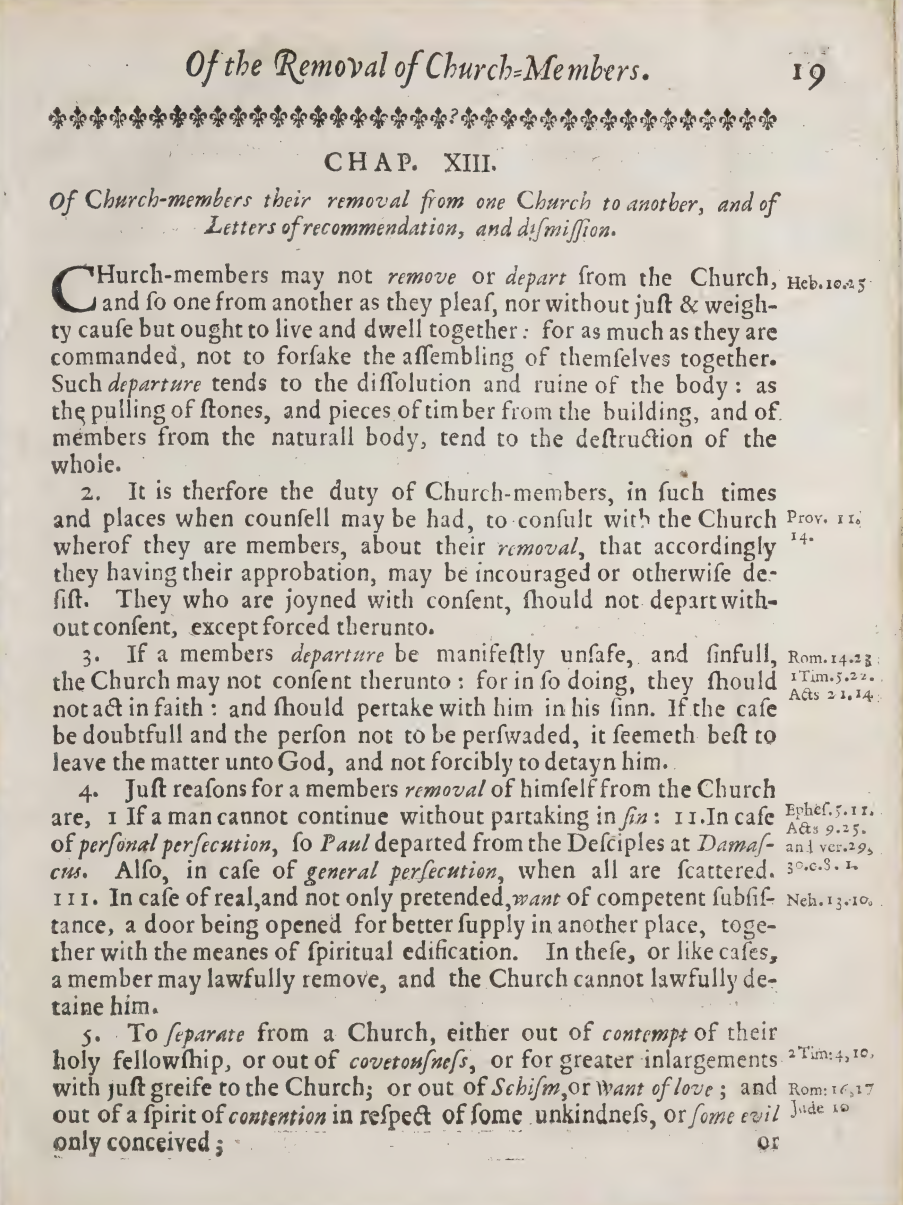
2. It is therefore the duty of church members, in such times and places where counsel may be had, to consult with the church whereof they are members about their removal, that accordingly they having their approbation, may be encouraged, or otherwise desist. They who are joined with consent, should not depart without consent, except forced thereunto.
Prov.xi. 16.
3. If a member’s departure be manifestly unsafe and sinful, the church may not consent thereunto; for in so doing, they should not act in faith, and should partake with him in his sin. If the case be doubtful, and the person not to be persuaded, it seemeth best to leave the matter unto God, and not forcibly to detain him.
Rom. xiv. 23. 1 Tim. v. 22. Acts, xxi. 14.
4. Just reasons for a member’s removal of himself from the church, are, 1. If a man cannot continue without partaking in sin. 2. In case of personal persecution; so Paul departed from the disciples at Damascus. in case of general persecution, when all are scattered. 3. In case of real, and not only pretended want of competent subsistence, a door being opened for better supply in another place, together with the means of spiritual edification. In these, or like cases, a member may lawfully remove, and the church cannot lawfully detain him.
Eph. v. 11. Acts, ix. 25, 29, 30, and viii. 1. Neh. xiii. 20.
5. To separate from a church, either out of contempt of their holy fellowship, or out of covetousness, or for greater enlargements, with just grief to the church; or out of schism, or want of love, and out of a spirit of contention in respect of some unkindness, or some evil only conceived, or indeed in the church, which might and should be tolerated and healed with a spirit of meekness, and of which evil the church is not yet convinced (though perhaps himself be) nor admonished: for these or like reasons to withdraw from public communion, in word, or seals, or censures, is unlawful and sinful.
2 Tim iv. 10. Rom. xvi. 17. Jude, 19. Eph. iv. 2, 3. Col. iii. 13. Gal. vi. 1, 2.
6. Such members as have orderly removed their habitation, ought to join themselves unto the church in order where they do inhabit, if it may be; otherwise they can neither perform the duties nor receive the privileges of members. Such an example tolerated in some, is apt to corrupt others, which if many should follow, would threaten the dissolution and confusion of churches, contrary to the scripture.
Isa. lvi. 8. Acts, ix. 26. 1 Cor. xiv. 33.
7. Order requires, that a member thus removing, have letters testimonial, and of dismission from the church whereof he yet is, unto the church whereunto he desireth to be joined, lest the church should be deluded; that the church may receive him in faith, and not be corrupted by receiving deceivers, and false brethren. Until the person dismissed be received into another church, he ceaseth not by his letters of dismission to be a member of the church whereof he was. The church cannot make a member no member, but by excommunication.
Acts, xviii. 27.
8. If a member be called to remove only for a time, where a church is, letters of recommendation are requisite, and sufficient for communion with that church, in the ordinances, and in their watch; as Phoebe, a servant of the church at Cenchrea, had letters written for her to the church at Rome, that she might be received as becometh saints.
Rom. xvi. 1,2. 2 Cor. iii. 1.
9. Such letters of recommendation and dismission, were written for Apollos; for Marcus to the Colossians; for Phoebe to the Romans; for sundry others to other churches. And the apostle telleth us, that some persons, not sufficiently known otherwise, have special need of such letters, though he for his part had no need thereof. The use of them is to be a benefit and help to the party for whom they are written, and for the furthering of his receiving amongst the saints in the place whereto he goeth, and the due satisfaction of them in their receiving of him.
Acts, xviii. 27. Col. iv. 10. Rom. xvi. 1. 2 Cor. iii. 1.
 West Port Experiment
Hi Michael, thanks for this article. I certainly agree with and sympathetic to the spirit of it, and thank you for giving it attention.
There was a bit of difference between the presbyterians and the congregationalists over this point, whether one needed, as a matter of ecclesiological procedure, in the case of the necessities of providence, to counsel with the local church and to receive her consent in order to leave.
The novel, rising congregationalists made this a distinctive (as well as the necessity of letters of transfer); the presbyterians denied both (all which I could find, and argued from Scripture and nature likewise), and considered these things novel.
One of the motivating forces for congregationalism was their novel notion of the necessity of a particular church covenant for the constitution of a particular church, which the presbyterians (with Scripture) denied.
Here is some material from presbyterians from on it from that era if it is of interest:
Hope it may be interesting and beneficial. Thanks again
Sorry, I meant to link the section on that webpage: “Absenting Oneself or Leaving a Church due to Necessities of Providence”, which has the material on it.