Feeds:
Posts
Comments

Posts Tagged ‘faith’

XX. Sixthly. We may reckon among the benefits of the New Testament the restoration of the Israelites, who were formerly rejected, and the bringing them back to the communion of God in Christ. Paul has unfolded this mystery to the Gentiles, Rom. 11:25–27: “For, I would not, brethren, that ye should be ignorant of this mystery (lest ye should be wise in your own conceits), that blindness in part is happened to Israel, until the fulness of the Gentiles be come in. And so all Israel shall be saved; at it is written, There shall come out of Sion the deliverer, and shall turn away ungodliness from Jacob. For this is my covenant unto them, when I shall take away their sins.”

XXI. On this place observe, 1st. That the apostle here explains some mystery; that is, a secret thing, not known but by revelation, and taken notice of by few, and happening beyond the expectation and judgment of reason; in fine, the whole method and manner of executing which, lies in a great measure concealed; see 1 Cor. 2:7, 15:51, and Eph. 3:3. 2dly. That it is the interest of the Gentiles to be acquainted with this mystery, to prevent their entertaining higher thoughts concerning themselves, and lower concerning the Israelites: we are therefore to take care to enquire diligently, and with attention, into what the prophets have foretold concerning this matter. 3dly. The apostle here speaks of the people of Israel, not figuratively but properly so called; who were at this time blind, obdurate, stupid, and hardened, of which ver. 7. Isaiah foretold this judgment of God against Israel at large, chap. 6:9, 10, compared with Acts 28:26, Isa. 29:10, 11. To this also seems applicable, that whirlwind of the Lord, that fury, and continuing whirlwind, which shall abide on the head of the wicked, of which Jer. 30:23. In short, this is that forlorn condition of the blinded nation of Jews, which taking its rise in the apostles’ time, continues to this our day. 4thly. That this blindness is in part happened to Israel. The whole nation, from its first origin even to the end of the world, is considered as one whole; a certain part of which are those, who either have, or now do, or hereafter shall live in the days of the wrath and indignation of God: blindness has seized that part only. 5thly. That blindness is to continue upon them no longer, than till the fulness of the Gentiles be come in; that is, till the Gospel is preached among all nations of the world whatever. Which, indeed, began to be done by the apostles and their fellow-labourers; but could not be done perfectly, both on account of the extent of the world, and the shortness of human life, and likewise because many nations (as all the American) were at that time unknown. This therefore still remains to be done successively; God, in his admirable providence, paving the way for his word. The offer of grace was first made to the Israelites. When they refused it, it was sent to the Gentiles; but when the fulness of them shall be brought in, it will be again given to the Israelites, “that the last may be first, and the first last,” Luke 13:30; see Luke 21:24. 6thly. That when the fulness of the Gentiles is brought in, all Israel shall be saved; that is, as our Dutch commentators well observe, not a few, but a very great number, and in a manner the whole Jewish nation, in a full body. Peter Martyr has judiciously explained the fulness of the Gentiles, and the whole body of Israel, in the following words: “But we are to understand a limited fulness, and a fixed or determined collection; which is therefore called fulness, because there will be an exact and a very great number of believers, so that the church shall be publicly owned, and had in great esteem among the Gentiles, just as all Israel is to be taken for a great number of Jews, among whom Christ should be publicly acknowledged; not that some, as well of the Gentiles as Jews, shall not be lost.”

(more…)


Read Full Post »

The following extract comes from Thomas Cochrane’s, Home Mission-work; Or, Twenty-five Years in a Mission Field (1873; pp. 51-52). Chalmers earlier advocated these exact same tactics years before. In my parish mission efforts, I’m already seeing the profound wisdom and insight of this policy. If they don’t yet come to church, then (assuming they let you in the door) bring church to them!

“In all Territorial districts there will be found many not only living in entire neglect of the sanctuary, but many of that number who will scarcely be persuaded by prayer and pains to avail themselves of the privilege To meet such cases, the devoted missionary will often be found to try and bridge over the difficulty by taking the church to them; sometimes, perhaps, even taking possession of the home of the neglectful, and making a church in their house. The effect of such little gatherings is often very blessed indeed. By these meetings there is not only opened a way for bringing the Gospel to the very homesteads of the careless and prayerless, but it is also, under GOD, a very fruitful source of augmenting the central gatherings.

“One of the most useful members of the Mission relates, as his own experience, how by this agency especially he was won to the public ordinances of the church. He was ill to gain over. Many months of prayerful effort were spent, but “by keeping at it,” with God’s blessing on the means, he was at last enlisted in the good cause ; and how useful he has been since in gaining others, the future only can reveal. How devoted he has been cannot be told.

“The services at these fireside gatherings should not, as a general rule, be lengthened above an hour, for many reasons. Mothers cannot conveniently give longer time from household duties. Short telling addresses at such meetings will ordinarily be most useful and acceptable. The grand object being to deal chiefly and closely with those who have not been accustomed to much serious thinking about religious subjects, anything fitted to weary and repel should be carefully avoided. How all-important to leave a good impression, and, by this short pithy service, to beget a thirst for the more extended, if not more formal, services of the house of God! It would not be an easy thing to say how many members of the church first found their footing towards the sanctuary through the influence of these district meetings. They will not only prove useful-almost essential-in the forming of a Territorial congregation, but will be of immense benefit after it has been formed, both as a means of dealing with the neglectful members of the congregation, and of reaching those beyond the pale of the church.”

[photo source]

Read Full Post »

Came upon this choice piece from Boston’s Memoirs. A series of questions put to a prospective communicant. The first question I find rather insightful—I’ve long tended to think that a working understanding of the Shorter Catechism is basically the cognitive side of Presbyterian terms of communion. Without reaching that bar, the session ought to delay that applicant and give further instruction (L. Cat. 173). Also, there is explicit submission to church discipline.

I am aware that Boston arguably had some “independent” aspects to his presbyterianism, and perhaps this reflects too much a likeness to the old Congregational “church covenants?” But whatever the case, I find this explicit consent and covenanting commendable:

“And if the Session be satisfied in this also, the party is to be put explicitly to consent to the Covenant (whereof he desires the seal), to be the Lord’s, live under Him, and serve Him all the days of his life, by answering expressly the following (or the like) questions: 1. Do you believe the doctrine of the Shorter Catechism of this Church, so far as you understand the same, to be the true doctrine agreeable to the Holy Scriptures, and resolve through grace to live and die in the profession of the same? 2. Do you consent to take God in Christ to be your God, the Father to be your Father, the Son to be your Saviour, and the Holy Ghost to be your Sanctifier; and that, renouncing the devil, the world and the flesh, you be the Lord’s for ever? 3. Do you consent to receive Christ, as He is offered in the gospel, for your Prophet, Priest and King; giving up yourself to Him, to be led and guided by His Word and Spirit; looking for salvation only through the obedience and death of Jesus Christ, who was crucified without the gates of Jerusalem; promising in His strength to endeavour to lead a holy life, to forsake every known sin, and to comply with every known duty? 4. Lastly, do you promise to subject yourself to exhortation, admonition, and rebuke, and the discipline of the Church, in case (which God forbid !) you fall into any scandalous sin?”


Memoirs, Appendix 3, § 10, p. 488.


Read Full Post »

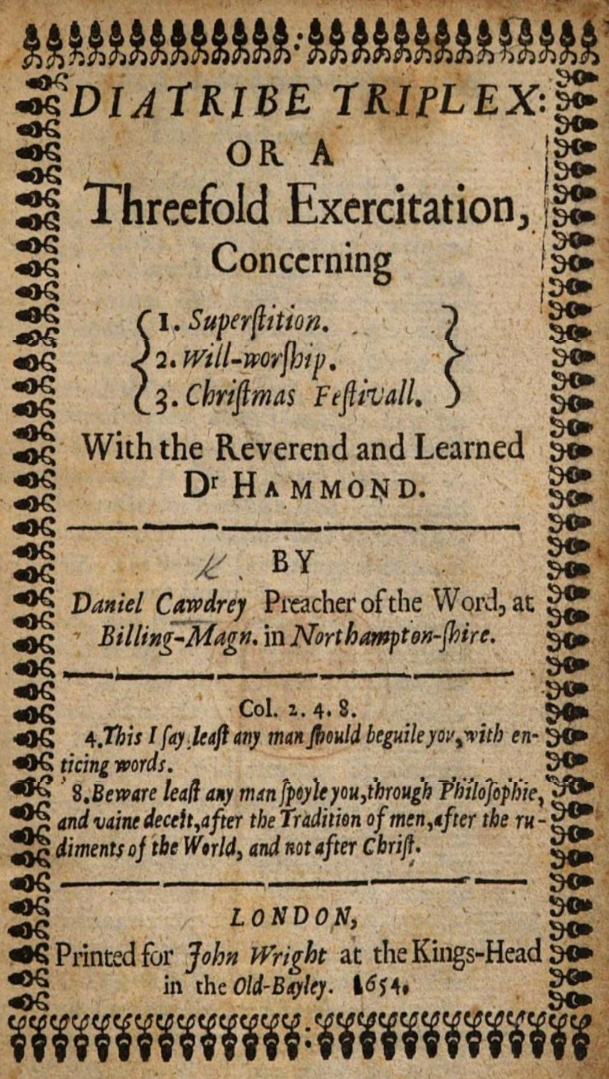
Just finished recording part 2 of 2 of Daniel Cawdrey’s “Of the Festivals of the Church, and Especially Christmas.” Listen to the audio here. This is the third part of a larger work, attached below. The University of Michigan has digitized the text here.

Visit the complete WPE Audio library.

Cawdrey (1588–1664) was a member of the Westminster Assembly, which produced the Westminster Confession of Faith, as well as the Larger and Shorter Catechisms. Like the rest of the Puritans of England and New England, as well as the Presbyterians of Scotland, these godly men rejected all holy days of men’s devising based on what has become called the ‘regulative principle of worship,’ which requires us to have clear and undoubted certainty about the divine, scriptural origin of any worship practice, and that any worship falling short of this standard must be set aside.

The Puritans were not kill-joys or men of bigoted, narrow minds. Anyone who reads their sermons and devotional writings will find them to be the warmest lovers of God, of Christ, and of their fellow men. They were also as a rule generous, catholic-minded men who embraced all those who called upon the Lord in sincerity, even among those who might disagree with them. And above all, they were men who passionately wanted to please God, even if that went against the flow of the opinions of men. I offer these recordings in that spirit.

The following is a sample from Cawdrey, in particular on his contention that the observation of Christmas is ultimately hostile to the proper, apostolic practice of Lord’s day observance:

“[It is said that] The Birth of Christ, is a mercy of such excellent quality, that it can never be overvalued, &c. This is granted; ​But to Institute a day as Holy, without command of Christ, for an Annual commemoration of this, is above the power of any Church, and a Superstitious presumption: and [altogether] needless; considering that the Lord’s day, (which includes the commemoration, not only of his Birth, but his Resurrection, and the whole works of our Redemption by him) was instituted by himself, or his Apostles, by him authorized and inspired, for this very end; & comes [around] once in every week. To limit it therefore to one day in a year, to remember that Mercy, is not an exaltation, but a derogation from it. If this were done, on his own design[ated] Day, wee need not fixe another day.”

Friend, let appeal to you not to brush off this position. You may in the end disagree with it; by all means, search the Scriptures, and be a Berean. But none of us “have attained,” and we should always be willing to bring any of our views or practices to the touchstone of Scripture. Embracing this position would naturally involve sacrifices, hurt feelings, and misunderstandings. But I can assure you from close to 30 years of experience after becoming convinced, and after raising four children in these principles, it is well worth it. “Them that honor me, I will honor.” And you don’t have to be a Grinch! I’m not—and I keep up many, many friendships with dear brothers who aren’t persuaded.

But of course, they’ll understand sooner or later (1 Cor. 13:12)!

Read Full Post »

Recently as I was doing parish outreach visits, I came across a gentlemen with a rather interesting question. Rhetorical and somewhat cynical, to be sure; but a great opportunity to discuss the things of God with a lost sheep.

As this fellow, an African-American probably in his 50s, stood outside his house, I introduced myself. Very soon he raised this objection. “Alright. The Tower of Babel. Why should God even care? If He is so great and infinite, and human beings are just ants, how does their little building project matter?” Thus spake the ant.

So I, but another measly ant, took up the question. “David felt extremely small when he, in Psalm 8, looked up into the heavens and beheld the sun, the moon, the stars.” And so he exclaimed, “What is man, that thou art mindful of him, and the son of man, that thou visitest him?” Indeed, Father Abraham confessed that he was “but dust and ashes,” and Isaiah wondered at the nations as a mere “drop in a bucket and as the very small dust of the balances.”

I sense he was a bit flat-footed and struck that the Bible had actually considered these kinds of things. “But here’s the thing, Malcolm [pseudonym], the wonder is that God actually took such interest in His creation, and especially one speck of matter on which he impressed His very own image.” And when these image-bearing creatures rebel against Him, defy and dishonor Him, indeed, He cares! In fact, He is profoundly angry. And thus, Babel.

We talked for some time as the autumn sun set amid the changing colors. I got his number, parted from him, and thanked the Lord for another rebel ant who was open to talk. May God confound and confuse poor Malcolm, so that he may throw off the wisdom of this world for the “foolishness of God.”

For more information about RPM, click here. To receive quarterly updates, e-mail me at michael@reformedparish.com, or sign up for West Port Experiment on the right near the top.

Read Full Post »

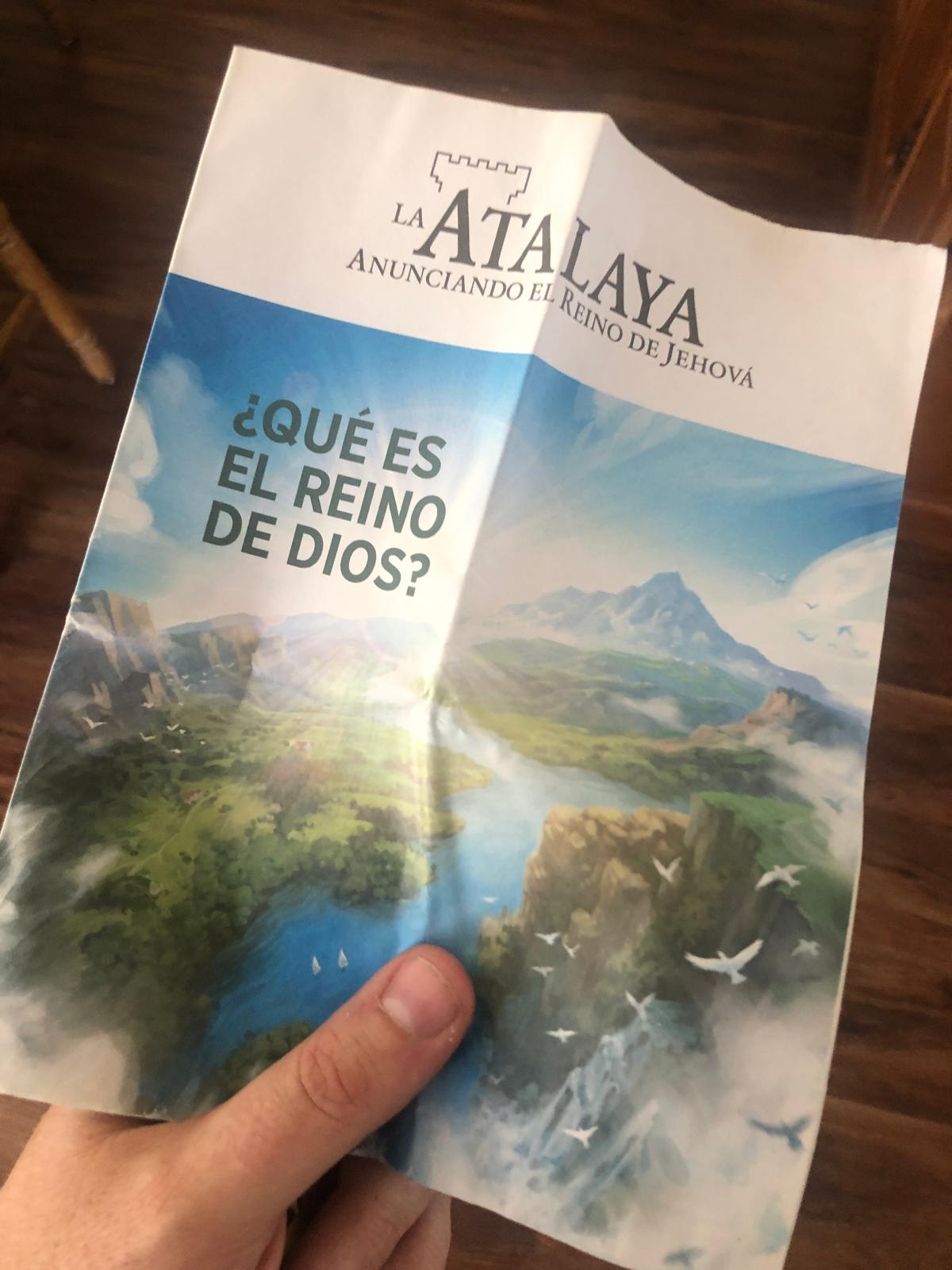
More “shoe on the other foot” last Saturday. I was out with a new friend from Reformation Bible College, Yiourgos, canvassing for our special evangelistic meetings in Vineland. As I was moving down the street, I noticed three nicely-dressed Hispanic people getting out of their car. Had a hunch, and sure enough—they were “Testigos de Jehová” (Jehovah’s Witnesses).

As usual, very polite. And they knew their Bibles. The Watchtower had trained their drones well! With my precarious Spanish, I went to the Philippians 2 usage of Isaiah 45. The language that Paul used and applied to Jesus, “that every knee would bow” and “every tongue would confess,” was the very same language that Isaiah clearly referred to Jehovah! The Jehovah of Isaiah 45 gave to Jesus, according to Paul in Philippians, “the name that is above every name.” And what is that name, Jehovah gave to Jesus? None other than “Jehovah!”

I tracked with only parts of their response. My Spanish comprehension can be shaky; and the wife seemed to be especially zealous, probably accelerating her speech. I recall resonating with her use of Matthew 28:18-20, which God giving Jesus “all authority in heaven and earth.” We Trinitarians do not dispute the subordination of Jesus according to his human nature and in His person and office as Mediator. But clearly, I’ll have to unpack that more in a further conversation. Truly, “great is the mystery of godliness!”

(more…)

Read Full Post »