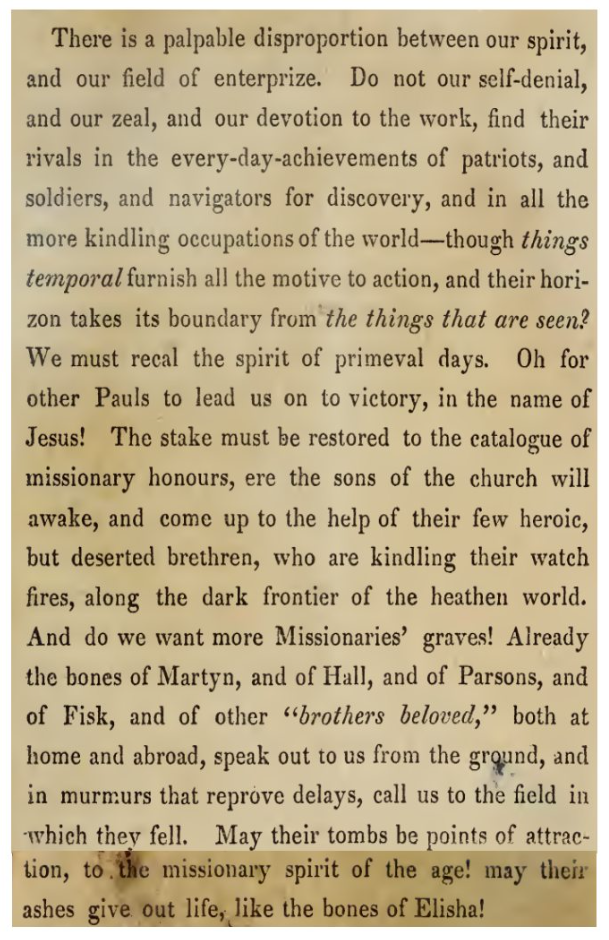
O, that God would stir up the missionary spirit again! Let us humble and abase ourselves, and plead with the Lord for a fresh anointing of the Spirit of God! John Breckinridge (1797-1841):

O, that God would stir up the missionary spirit again! Let us humble and abase ourselves, and plead with the Lord for a fresh anointing of the Spirit of God! John Breckinridge (1797-1841):

Posted in Missiology, The Church in America, The Kingdom of God, The Sacred Ministry | Leave a Comment »
The following are quotes are from A Body of Practical Divinity (1838 edition):
“We glorify God, when we give God the glory of all we do. . . . As the silk-worm, when she weaves her curious work, she hides herself under the silk, and is not seen; so when we have done Constantine did use to write the name of Christ over his door, so should we write the name of Christ over our duties; let him wear the garland of praise” (27).
“The word being begun to be preached, hear it with reverence and holy attention. ‘A certain woman, named Lydia, attended unto the things which were spoken of Paul.’ Acts 16: 14. Constantine, the emperor, was noted for his reverent attention to the word” (381).
Continue Reading »Posted in Christian Ethics, Constantine, Establishments, Puritans & Puritanism, The Civil Magistrate, The Godly Prince | Leave a Comment »
Interested in auditing or participating in a Reformed ethics course, from a historic, Scottish Presbyterian perspective?
A few years back, our small denomination decided to start up an in-house ministerial training program, especially for practical reasons such as preventing more debt for our students and enabling them to remain at home, keep their secular employment, and preserve ties with our congregations.
A committee of presbytery is presently exploring whether we might make our seminary course offerings available at an undergraduate level—with corresponding adaptations of academic requirement—for the personal enrichment of folks in our own denomination, the training and continuing education of our church officers, and then more broadly in the communities where we serve and beyond. (And personally, I would also like to explore making such courses available in Spanish, with sufficient assistance.)
Continue Reading »Posted in Audio Resources, Uncategorized | Leave a Comment »

“Let a man examine himself, and so let him eat of that bread and drink of that cup. For he that eateth and drinketh unworthily, eateth and drinketh damnation [judgment] to himself, not discerning the Lord’s body” (1 Cor. 11:27-28).
How should you prepare for the Lord’s Supper? A few thoughts for those who have come to appreciate the theology, practice, and piety of confessional Presbyterianism around the celebration Communion.
First, dedicate time ahead of time. You cannot put things off until Saturday night. Nor can you just let attendance at a midweek preparatory service ‘check the box.’ You need to begin to schedule in some meaningful time, in addition to your regular personal and family seasons of worship, to be one on one with God. Adjust your week’s schedule early, especially if you have more responsibilities surrounding the weekend, such as food preparation, etc. And husbands, be especially mindful of your wives. Help plan ahead and streamline things so that preparation doesn’t get eclipsed, helping the children step up–and even stepping up yourself!
Continue Reading »Posted in Articles, Audio Resources, Christian Life & Experience, Church of Scotland, Experimental Religion & the Cure of Souls, Free Church of Scotland, Practice of Piety, Sacraments, The Lord's Supper, WPE Editor | 1 Comment »

An intriguing thought. I’ve frequently thought of how establishments, while nearly a thing of the past in the secular West, might yet be on the horizon in the East. Stranger things have happened. And, of course, there is that ‘little thing’ (!) of prophecy: “Yea, all kings shall fall down before him: all nations shall serve him” (Psalm 72:11). O, brethren, let us pray for this nation, and for any godly magistrates that He might raise up “for such a time as this!” Mark Noll in his New Shape of World Humanity: How American Experience (2010):
“But third, it is a different story where Christianity spreads in regions of economic strength, as especially in Chᴉna. In this rapidly strengthening Asian power, the systems of belief that once guided society are passing away. Before Maoism imploded, it badly damaged ancestral reliance on Confucian precepts. Christianity seems to be taking off in Chᴉna because more and more Chᴉnese seem to be seeking a new moral compass as Chᴉna itself makes a commanding entrance onto the world stage. David Jeffrey, the provost of Baylor University who for fifteen years has been regularly invited to lecture on Christian subjects at premier universities in Chᴉna, has asked a speculative question that should give foreign analysts pause. Once before, Jeffrey remarks, a great world power passed through tumultuous times as Christian ranks expanded on the margins of society. It was the late 3rd and early 4th centuries. In that turmoil the Emperor Constantine was converted and become, from the top of the imperial system, a supporter of Christianity as a new glue for empire. Is it impossible to imagine that a new Constantine might exist somewhere in the junior ranks of the Chᴉnese communist party?”
Posted in Constantine, Establishments, Missiology, Sacred & Secular, Secularization | Leave a Comment »
“As the Sabbath Day is the most excellent of all the Days in the week; so a Communion Sabbath is the most desireable of all the Sabbaths in the Year; for, that is a Day in God’s Courts, in an eminent Manner, and is truly better than a Thousand. . . . If ordinary Sabbaths do require great Care and Diligence in preparing for, and improving them; then much more do Communion Sabbaths, being solemn and high Days; wherein we make most near Approaches unto God, and he makes near Approaches unto us: They are Days of Heaven upon Earth, and do most eminently represent the Employments and Enjoyments of the Glorified in Heaven.”
John Willison
Posted in Christian Life & Experience, Experimental Religion & the Cure of Souls, Practice of Piety, Sabbatarianism & the Church Calendar, Sacraments | Leave a Comment »
The following is drawn from the First Book of Discipline (1560), adopted by the Church of Scotland during the Reformation period. Education is key!

* * * * *
Seeing that God has determined that his church here in earth shall be taught not by angels but by men; and seeing that men are born ignorant of all godliness; and seeing, also, God now ceases to illuminate men miraculously, suddenly changing them, as that he did his apostles and others in the primitive church: of necessity it is that your honours be most careful for the virtuous education and godly upbringing of the youth of this realm, if either ye now thirst unfeignedly [for] the advancement of Christ’s glory, or yet desire the continuance of his benefits to the generation following. For as the youth must succeed to us, so we ought to be careful that they have the knowledge and erudition to profit and comfort that which ought to be most dear to us-to wit, the church and spouse of the Lord Jesus.
Of necessity therefore we judge it, that every several church have a schoolmaster appointed, such a one as is able, at least, to teach grammar and the Latin tongue, if the town is of any reputation. If it is upland, where the people convene to doctrine but once in the week, then must either the reader or the minister there appointed, take care over the children and youth of the parish, to instruct them in their first rudiments, and especially in the catechism,[10] as we have it now translated in the book of our common order, called the Order of Geneva. And further, we think it expedient that in every notable town, and especially in the town of the superintendent, [there] be erected a college, in which the arts, at least logic and rhetoric, together with the tongues, be read by sufficient masters, for whom honest stipends must be appointed; as also provision for those that are poor, and are not able by themselves, nor by their friends, to be sustained at letters, especially such as come from landward.
Continue Reading »Posted in Church of Scotland, Education, John Knox | Leave a Comment »
The following are extracts from John Flavel’s Whole Works reflecting his (and Protestantism’s) mainly positive appraisal of Constantine and the shift to Christendom. The first passage doesn’t mention his name in particular, but employs the “earth helping the woman” trope for Christian magistrates supporting the true religion that I first encountered in Thomas Chalmers, but clearly predates him.
* * * * * * * * * * * *
“Secondly, We shall next enquire how Jesus Christ administers this providential kingdom. And here I must take notice of the means by which, and the manner in which he does it. The means, or instruments, he uses in the governing the providential kingdom, (for he is not personally present with its himself), are either angels or men, “the angels are ministering creatures, sent forth by him for the good of them that shall be heirs of salvation,” Heb. 1:14. Luther tells us, they have two offices, superius canere, et inferius vigilare, “to sing above and watch beneath.” These do us many invisible offices of love. They have dear and tender respects and love for the saints. To them, God, as it were, puts forth his children to nurse, and they are tenderly careful of them while they live, and bring them home in their arms to their Father when they die. And as angels, so men are the servants of Providence; yes, bad men as well as good. Cyrus, on that account, is called God’s servant: they fulfill his will, while they are prosecuting their own lusts. “The earth shall help the woman,” Rev. 12:16. But good men delight to serve Providence; they and the angels are fellow servants in one house, and to one master, Rev. 19:10. Yes, there is not a creature in heaven, earth, or hell, but Jesus Christ can providentially use it and serve his ends, and promote his designs by it. But whatever the instrument be Christ uses, of this we may be certain, that his providential working is holy, judicious, sovereign, profound, irresistible, harmonious, and to the saints peculiar” (Works 1:216).
Continue Reading »Posted in Christendom, Constantine, Establishments, Historiography, Puritans & Puritanism | Leave a Comment »
Posted in Christ & the Church, Puritans & Puritanism, Redemption Accomplished, Union with Christ | Leave a Comment »