
I often listen to the Christian news podcast, The World and Everything in It. It’s basically a reformed-ish version of NPR, and produced by the same folks who publish World magazine. I highly commend it (my only quibble being the quasi-benediction at the end of each episode).
There was a really great segment this morning with their regular “Monday Moneybeat” with David Bahnsen. It was an excellent treatment of the masculine malaise of younger men in the U.S.A. and their economic underperformance. Perhaps the most impactful quote for me was “employable men are marryable and marryable men are employable.” Standing ovation! Listen to the episode here; the segment begins at 22:10, and the transcript is below.
* * * * *
MARY REICHARD, HOST: Coming up next on The World and Everything in It: The Monday Moneybeat.
NICK EICHER, HOST: It’s time now to talk business, markets and the economy with financial analyst and advisor David Bahnsen. David heads up the wealth management firm the Bahnsen Group, and he is here now. Good morning to you.
DAVID BAHNSEN: Good morning, Nick, good to be with you.
Continue Reading »Posted in Christian Conduct, Culture, Family & Family Issues, Natural Law, Social Issues | Leave a Comment »
Here is the latest quarterly update. If you missed the last one from February, you can read it here. And visit Reformed Parish Mission to learn more about history and principles of this effort.
Posted in Reformed Parish Mission (RPM) Posts | Leave a Comment »


Among other sins forbidden under the Second Commandment, according to Thomas Boston, are
“All making of things to be sin or duty which God hath not made so, Matth. xv. 2. Whatever be men’s pretences in this, it is an invading of the power and authority of the great Lawgiver, an accusing of his word of imperfection, and very dangerous, Prov. xxx. 6. This is the great occasion of sad divisions and schisms in the church, while men, not content with plain duty appointed of God, make the conceptions of their own hearts sins and duties, which God never made so, and impose them on others as terms of Christian communion, which superstition can never be sanctified by their fathering it wrongously on the scripture, Prov. xxx. 6.”
Thus legalism and pietism are really at their core but idolatrous manufactures of men, narrowing the Lord’s heritage.
* * * *
Whole doctrine catholicity | “Who is she that looketh forth as the morning, fair as the moon, clear as the sun, and terrible as an army with banners” (Song 6:10)?
Posted in Catholicity, Connectionalism & Conciliarism, Separatism & Schism | Leave a Comment »

The following is some rich material on the “divine nature” or the “Godhead” from the Synopsis Purioris Theologiae (1625).
* * * * *
In using the phrase “divine Essence” we mean that what God is; for “to be” is said of Him (Hebrews 11:6, and ho ōn kai ho ēn, Revelation 4:8). To Him are attributed “nature,” phusis (Galatians 4:8), and “divine nature” (2Peter 1:4; although it is restricted to the divine properties), theotēs, “deity” (Colossians 2:9) and theiotēs, “divinity” (Romans 1:20), and to theion, “the divine” or “the godhead” (Acts 17:29), and morphē theou, “the form of God” (Philippians 2:6); and He is called theos, “God” (Acts 17:24, 29). From and in this divine nature all things are and exist, everything by means of its own way of participation. . .
Continue Reading »Posted in Dogmatic Theology, Natural Theology, Theology Proper | Leave a Comment »

“In one way we think a great deal too much of the atomic bomb. ‘How are we to live in an atomic age?’ I am tempted to reply: ‘Why, as you would have lived in the sixteenth century when the plague visited London almost every year, or as you would have lived in a Viking age when raiders from Scandinavia might land and cut your throat at night; or indeed, as you are already living in an age of cancer, an age of syphilis, an age of paralysis, an age of air raids, an age of railway accidents, an age of motor accidents.
“In other words, do not let us begin by exaggerating the novelty of our situation. Believe me, dear sir or madam, you and all whom you love were already sentenced to death before the atomic bomb was invented… It is perfectly ridiculous to go about whimpering and drawing long faces because the scientists have added one more chance of painful and premature death to a world which already bristled with such chances and in which death itself was not a chance at all, but a certainty.
Continue Reading »Posted in Light of Eternity | Leave a Comment »

“The PASTOR procureth the peace of the kirk by following after the things which make for peace; Rom .xiv.; for by the discipline and assemblies of the kirk he preserveth verity, without which there is either no unity, or such unity as is but a conspiracy, and resisteth heresy, the mother of the greatest divisions. So long as our assemblies had their liberty, there could arise no heresy among us; if it had broken out in a parish, a consistory or presbytery would have borne it down; or if it had proceeded further, then the synod, or if it had not been able, the national assembly, would have suppressed it. For the same reason the Kirk of France, which was nearest to ours, hath been free of heresy. In the low countries, if the kirks had enjoyed the liberty of their assemblies, which they wanted for a long time, Arminianism had neither troubled them nor their neighbours. He never can find in his heart to urge or enforce unprofitable and untimely ceremonies upon the kirk, if it were for no other cause but that they have been the apples of contention, and the cause of many schisms, and will choose rather, with Jonah, to redeem the quietness and safety of the kirk with the loss of himself, than for his own particular ends to raise the smallest tempest that may peril her peace; he carrieth himself no otherwise in his ministry than becometh the humble servant of the kirk, and feareth to be affected with Diotrephes’ ambitious humour of aspiring above his brethren, which is a special preservative of peace: he studieth to preserve holiness, without which there can be no sound nor wholesome peace; he is ever at war with that which is contrary to holiness, and sendeth away all scandalous livers with the workers of iniquity, that peace may be upon the Israel of God, Psal. xxv.”
David Calderwood, The Pastor & the Prelate (1628)
Whole doctrine catholicity | “Who is she that looketh forth as the morning, fair as the moon, clear as the sun, and terrible as an army with banners” (Song 6:10)?
Posted in Catholicity, Communion of the Saints, Connectionalism & Conciliarism, Separatism & Schism | Leave a Comment »

“Sometimes the church is like a ship in the hands of foolish guides that know not the right art of steerage, at other times spotted with the calumnies of adversaries, or the stains and scandals of its own children; sometimes rent and torn by sad divisions, every party impaling and enclosing the common salvation within their own bounds, unchristianing and unchurching all the rest, and the name of christians challenged to themselves and denied to others, and like a ball of contention carried away by that party that can rustle down others who stand in their way. Though with all this disadvantage it is better to dwell in the courts of the Lord than in the tents of wickedness; yet surely a tender spirit that minded Sion’s welfare will groan under these disorders, and long to come at that great council of souls who with perfect harmony are lauding and praising of God for evermore, ‘that innumerable company of spirits made perfect,’ Heb. 12:23. That general assembly, gathered together out of several countries into one body and one place, who live together sweetly, and serve God without weakness, weariness, and imperfection.”
Thomas Manton
* * * *
Whole doctrine catholicity | “Who is she that looketh forth as the morning, fair as the moon, clear as the sun, and terrible as an army with banners” (Song 6:10)?
Posted in Catholicity, Connectionalism & Conciliarism, Puritans & Puritanism | Leave a Comment »
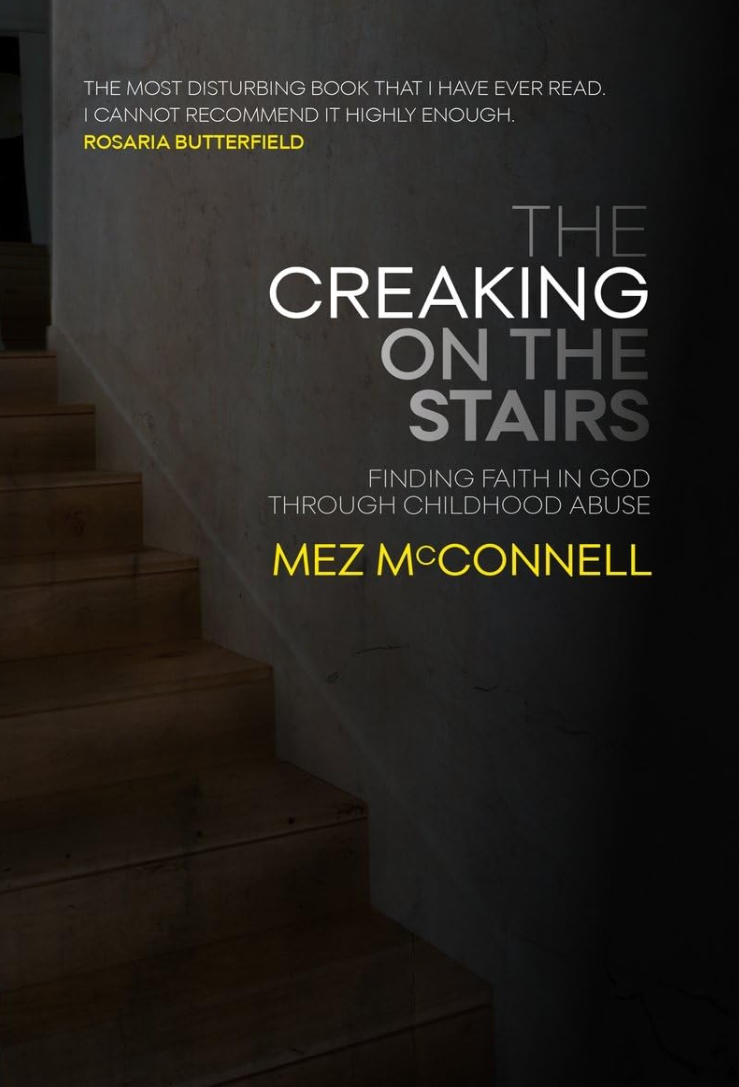
Just finished listening to this audiobook, The Creaking on the Stairs: Finding Faith in God Through Childhood Abuse. Very highly recommended. Rosaria Butterfield says in the forward, “The most disturbing book that I have ever read, and I cannot recommend it highly enough.” While I can’t say it is the most disturbing book I’ve ever read, the subject matter is beyond doubt extremely disturbing … and yet heavenly at the same time, which is why I heartily second Rosaria.
The author, Mez McConnell, was raised up in an extremely dysfunctional and highly abusive home. After coming of age, he fell into gross, reckless sin, became a criminal, and did hard time; but Christ had other plans. And so at the “time appointed,” Christ made a trophy of this sinner, plucking him as a brand from the burning and liberating his heart from anger, bitterness, and resentment.
The book is part narrative, part theology and spiritual reflection. It reminds me in many ways of Augustine’s great Confessions and Thomas Halyburton’s Memoirs, especially in its adult, post-conversion reflections on childhood, sin, and grace. (If you’ve never read those two classics, then tolle, lege! And for a taste, read Augustine’s thoughts on the ‘pear tree’ incident.) Further, Creaking is dramatic theodicy—if not directly inspired by the Book of Job, then at least resonating highly with it. If God is and is good, then why is there suffering?
This book is for those who have suffered abuse, Christian or not. It’s also for those who live with those who have or want to understand how better to love and support sufferers. Really, it’s for everyone. And I would be surprised if this doesn’t end up being something of a modern, Christian classic of autobiography, like Joni Eraekson Tada’s Joni and Rosaria Butterfield’s Secret Thoughts. Oh, and add those two to your list as well!
Posted in Audio Resources, Recent Reading (Book Recommendations), Sabbath/Religious Reading | Leave a Comment »
 West Port Experiment