Feeds:
Posts
Comments

Below are some extracts from a delightful volume by the Rev. Norman Macleod, Reminiscences of a Highland Parish (1867), providing some very romantic glimpses of the ‘auld parish way’ in the Highlands of Scotland.  One can find it on GoogleBooks – http://books.google.com/books?id=DCokAAAAMAAJ&printsec=frontcover&dq=Reminiscences+of+a+Highland+Parish.  Two chapters in particular are of interest, from which these quotes come – ‘The Manse’ and ‘The Minister and His Work.’ 


*   *   *   *


“The minister, like most of his brethren, soon took to himself a wife, the daughter of a neighboring ‘gentleman tacksman,’ and the granddaughter of a minister, well born and well bred; and never did man find a help more meet for him.  In that manse they lived for nearly fifty years, and there were born to them sixteen children; yet neither father nor mother could ever lay their hand on a child of theirs and say, ‘We wish this one had not been.’  They were all a source of unmingled joy” (27).


“The manse and glebe [acreage surrounding the manse] of that Highland parish were a colony which ever preached sermons, on week days as well as Sundays, of industry and frugality, of courteous hospitality and bountiful charity, and of the domestic peace, contentment, and cheerfulness of a holy Christian home” (28).


“Within the manse the large family of sons and daughters managed, somehow or other, to find accommodation not only for themselves, but also for a tutor and governess.  And such a thing as turning any one away for want of room was never dreamt of.  When hospitality demanded such a small sacrifice, the boys would all go to the barn, and the girls to the chairs and sofas of parlour and dining-room, with fun and laughter, joke and song, rather not make the friend or stranger welcome.  And seldom was the house without either.  The ‘kitchen-end,’ or lower house, with all its indoor crannies of closets and lofts, and outdoor additions of cottages, barns and stables, was a little world of its own, to which wandering pipers, parish fools, and beggars, with all sorts of odd-and-end characters came, and where the ate, drank, and rested” (30-31).


“The manse was the grand center to which all the inhabitants of the parish gravitated for help and comfort. . . . The poor, as a matter of course, visited the manse, not for an order on public charity, but for aid from private charity, and it was never refused in kind, such as meal, wool, or potatoes.  There being no lawyers in the parish, lawsuits were adjusted in the manse; and so were marriages not a few.  The distressed came there for comfort, and the perplexed for advice; and there was always something material as well as spiritual to share with them all.  No one went away empty in body or soul.  Yet the barrel of meal was never empty, nor the cruise of oil extinguished.  A ‘wise’ neighbor once remarked, ‘That minister with his large family will ruin himself, and if he dies they will be beggars.’  Yet there has never been a beggar among them to the fourth generation.  No saying was more common in the mouth of this servant than the saying of his Master, ‘It is more blessed to give than to receive.’


“A striking characteristic of the manse life was its constant cheerfulness.  One cottager could play the bagpipe, another the fiddle.  The minister was an excellent performer on the violin, and to have his children dancing in the evening was his delight.  If strangers were present, so much the better.  He had not an atom of that proud fanaticism which connects religion with suffering, as suffering, apart from its cause” [And then in a footnote, the author writes, “A minister in a remote island parish once informed me that, ‘on religious grounds,’ he had broken the only fiddle in the island!  His notion of religion, I fear, is not rare among his brethren in the far west and north.  We are informed by Mr Campbell, in his admirable volumes on the ‘Tales of the Highlands,’ that the old songs and tales are also being put under the clerical ban in some districts, as being too secular and profane for the pious inhabitants.  What next?  Are the signing-birds to be shot by the kirk-sessions?”] (33-35).


“The minister was too far removed from the big world of church politics, General Assembly debates, controversial meetings and pamphlets, to be a party man.  It satisfied him to be a part of the great Catholic Church, and of that small section of it in which he had been born.  The business of his Presbytery was chiefly local, and his work was confined mainly to his parish” (111).


“He ministered to 2000 souls, all of whom – with the exception of perhaps a dozen families of Episcopalians and Roman Catholics – acknowledged him as their pastor.  His charge was scattered over 130 square miles, with a sea-board of 100” (112)!


“[Arduous] land journeys were frequently undertaken, (with adventures more or less trying,) not merely to visit the sick, but for every kind of parochial duty – sometimes to baptize, and sometimes to marry.  These services were occasionally performed in most primitive fashion at one of those green spots among the hills.  Corrie Borrodale, among the old ‘shielings,’ ‘was a sort of half-way house between the opposite sides of the parish.  There, beside a clear well, children have been baptized; and there, among ‘the bonnie blooming heather,’ the Highland shepherd has been married to his bonnie blooming bride.  There were also in different districts preaching and ‘catechising,’ as it was called.  The catechizing consisted in examining on the Catechism and Scriptures every parishioner who was disposed to attend the meeting , and all did with few exceptions.  It constituted an important part of the minister’s regular work.  Every farm and hamlet was thus visited in rotation; notes were generally kept of the progress made by each individual in religious knowledge, and he who was sluggish and careless was put to shame before his neighbors.  Many presbyteries, at the time we speak of, took yearly account of the diligence of each member in the discharge of this branch of his pastoral office: a reckoning and a superintendence which, we humbly think, might, with mutual benefit to people and pastor, be revived in the present day.  This ‘exercise’ was generally followed by preaching, both of course in the open air, when weather permitted.  And no sight could be more beautiful than that of the venerable minister, seated on the side of a green and sheltered knoll, surrounded by the inhabitants of the neighboring hamlets, each, as his turn came, answering, or attempting to answer, the questions propounded with gravity and simplicity.  A simple discourse followed from the same rural pulpit, to the simple but thoughtful and intelligent congregation.  Most touching was it then to hear the Psalms rise from among the moorlands, disturbing ‘the sleep that is among the lonely hills;’ the pauses filled by the piping of the plover or some mountain bird, and by the echoes of the streams and water-falls from the rocky precipices.  It was a peasant’s choir, rude and uncultivated by art, but heard, I doubt not, with sympathy by the mighty angels who sung their own noblest song in the hearing of shepherds on the hills of Bethlehem.


“An essential, an important, and a very laborious part of the parish minister’s work was the providing for the wants of the poor and the needy.  He and his session were intrusted, under powers defined by law, with the administration of the very considerable funds contributed by charity at the church door every Sabbath.  The half-yearly, or quarterly apportionment of this fund, however, formed a small portion of the labours implied in providing for the poor.  They were carefully visited by minister and elders: their circumstances accurately ascertained; and in cases of sickness, or of any special trial, where the session allowance was insufficient, there was an ample supply provided by an appeal to the kindness of the more prosperous in the neighborhood; and whether food, or clothing, or cordials were needed, they were readily granted to an appeal thus made.


“Our minister’s work was thus devoted and unwearied for half a century.  And there is something peculiarly pleasing and cheering to think of him and of others of the same calling and character in every church, who from year to year pursue their quiet course of holy, self-denying labour, educating the ignorant; bringing life and blessing into the homes of disease and poverty; sharing the burden of sorrow with the afflicted, the widow, and the fatherless; reproving and admonishing, by life and word, the selfish and ungodly; and with a heart every open to all the fair humanities of nature; – a true ‘divine,’ yet every inch a man!  Such men, in one sense, have never been alone; for each could say with his Master, ‘I am not alone, for the Father is with me.’  Yet what knew or cared the great, bustling, religious world about them?  Where were their public meetings, with reports, speeches, addresses, ‘resolutions,’ or motions about their work?  Where their committees and associations of ardent philanthropists, rich supporters, and zealous followers?  Where their ‘religious’ papers, so called, to parade them before the world, and to crown them with the laurels of puffs and leading articles?  Alone, he, and thousands like him, laboured the very salt of the earth, the noblest of their race” (118-122).
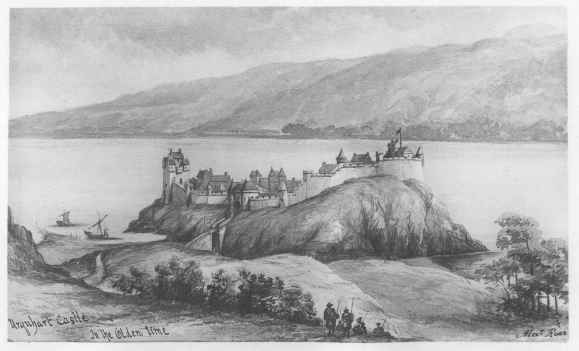
Urquhart Castle Prior to its Destruction

It does seem that parish ministry and itinerancy as models of Christianization are quite distinct from each other. The first emphasizes a ‘settled’ ministry with a pastor or pastors within a fixed geographic locale, drawing the unconverted within that charge to the sound of the Gospel call – and so into the regular worship services of the church – by a regular, habitual, and personal (often life-long) labor. Evangelization was by preaching, yes, but preaching that worked hand-in-hand with the methodical visitation of the unconverted in a defined territory, in coordination with other parochial ministers in their settled charges. This, as far as I understand it, was the norm in Reformation and Post-Reformation Scotland, for example. The second presumes an ‘unsettled’ ministry in a geographic area with a great spiritual need and sends men in circuits throughout that region to preach until such a time as regular, settled ministries can be established.

The two models have not always lived in peaceful coexistence. The First and Second Great Awakenings, as I’ve heard, introduced tensions on this subject. The itinerancy of great preachers such as Whitfield was warmly embraced by some, such as Jonathan Edwards, and even by many of the Scots Presbyterians (for a time). But there were many questions lingering as to whether the sensationalism of the comet-preachers with their big, spellbound crowds detracted from the value of the regular, settled ‘parish’ ministers. Did it all tend to remove the ancient boundary marks? Did it in any way contribute to a more market-oriented, consumerist Christianity, which figures such as Thomas Chalmers deplored? A brand of Christianity that focuses upon attracting those already religiously predisposed and fails to go after – habitually and methodically – the indifferent and careless? Perhaps.

But are parish ministry and itinerancy in and of themselves mutually exclusive models? Must we choose one over the other? Are Thomas Boston and Robert Murray M’Cheyne automatically good because they were arduous, settled parish ministers, given to systematic household visitation of all within their charge? Were Whitfield and the American frontier circuit riders automatically bad because they refused to settle down to the parson’s life? While I reject the idea that we should reimplement all the methods of the apostles in those formative days of the Gospel in the 1st century Mediterranean world, including ‘episcopal’ itinerancy and the deployment of apostolic deputies, yet isn’t there something to be said for the lawfulness of a kind of itinerancy during times of unusual need? When elders weren’t raised up in established congregations, Paul and his deputies visited – and appointed ‘settled’ elders. He left to Timothy a model for the continuation of the regular ministry, foreseeing a day when unsettled itinerants would no longer be necessary. Much like scaffolding to a finished building, the itinerant ministry was there for a time until the finished product could stand. Or, like parents to a child until he becomes mature enough to make it on his own.

The 16th century Church of Scotland in the First Book of Discipline made use of ‘superintendants’ to preach, establish new congregations, and ordain ministers throughout large geographical areas, during an extraordinary time when there was a shortage of ministers and the work of evangelizing the nation was a pressing need. And while the Lowlands had been effectively Christianized by the 17th century, yet the Highlands were still under the sway of Rome. The settled parish system of the south could not be easily managed in the north, where the vast, mountainous ‘parishes’ of the Highlands were too difficult to reduce to the order of a settled charge. Consequently the Established Church utilized itinerant ‘catechists’ in the Highlands through agencies such as the Scottish Society for the Propagation of Christian Knowledge (SPCK – incidentally, which also helped fund David Brainerd’s efforts to the Delaware Indians of North America).

Perhaps we may view itinerancy and parish ministry as complementary strategies, given different stages of an offensive. The first is a strategy for quick, broad dissemination of the Gospel of the Kingdom. It is the ‘first strike’ against the Kingdom of Darkness. It establishes the beachhead. Outposts are established in enemy territory. Then the second strategy is phased in. Theses outposts serve as bases to advance the frontline in their respective zones, and all in cooperation with each other. They do not interfere in the zone of another outpost, but fully expect the other to take possession of theirs, as they themselves are busy doing the same from their position. After all, they are fighting a common enemy.

One might think that in itinerancy geography factors less prominently than in parochialism. Itinerancy does not methodically focus on fixed households in a given district; parochialism does. Itinerancy relies mostly upon indiscriminate preaching sporadically in an area, sowing seed broadly; parochialism does not, since it concentrates regularly in one particular area.

But it is not as though geography is less of a concern in itinerancy. The Apostle Paul was an itinerant, it is true. “From Jerusalem, and round about unto [kuklo mechri, lit., ‘in a circuit’] Illyricum, I have fully preached the gospel of Christ” (Rom. 15:19). But note his great concern with localities, areas, regions, and even political territories – nations, along his routes. “As the truth of Christ is in me, no man shall stop me of this boasting in the regions [en tois klimasin] of Achaia” (2 Cor. 11:10). He was claiming lands for the Redeemer, and even had his eyes set on the frontiers – Spain (Rom. 15:24). Territories were divided up, and Corinth belonged to Paul. “But we will not boast of things without our measure, but according to the measure of the rule [to metron tou kanonos – ‘the boundary lines?’] which God hath distributed [emerisen] to us, a measure to reach even unto you. . . having hope, when your faith is increased, that we shall be enlarged by you according to our rule [ta kanona hemon] abundantly, to preach the gospel in the regions beyond you [ta hyperekeina]” (2 Cor. 10:13-16). Corinth then, to use much later Presbyterian jargon, was ‘within his bounds.’ (I cannot help but envision Paul with his deputies poring over a map of the Mediterranean as a general would with his officers!) So it is clear that itinerancy is not necessarily un-geographic in orientation.

One might also conclude that preaching is given a greater place in itinerancy and less in parochialism. It is always through the foolishness of preaching that God saves, whether in more or less settled phases of the Kingdom of God in a certain territory. But even itinerant ministry is not just about getting on a soapbox and preaching to anyone and everyone who might walk by. It also involves interpersonal, private interaction. The Apostle Paul both “taught publicly” in his Gospel labors in Ephesus as well as “from house to house” (Acts 20:20). Paul dealt intimately with the Philippian jailor and his household (Acts 16:32). And our Lord Himself, though an itinerant preacher, dealt privately with Nicodemus (John 3:1-13) and the Samaritan woman (John 4:1-30). Nor is parochial ministry all private visitation. Paul, writing to his deputy Timothy, was to focus on regular public ministry in Ephesus. “Till I come, give attendance to reading, to exhortation, to doctrine” (1 Tim. 4:13). “Preach the word; be instant in season, out of season; reprove, rebuke, exhort with all longsuffering and doctrine” (2 Tim. 4:2). And in addition to preaching, he was to train men who could settle into Timothy’s place, continuing the same, regular, public ministry of the Word (2 Tim. 2:2). The main difference here between the two models, it would seem, lies in the fact that the itinerant ministry is not settled, dealing regularly with the same number of people in a locality for a long period of time whereas the other is. And I also suppose that there is a certain fluidity between the itinerant and settled parochial ministry, especially since Paul stayed ministering in Ephesus for two years (Acts 19:9) and while under house arrest in Rome used his rented house to preach regularly there (Acts 28:30, 31).

But while there are differences and distinctions to be made between the two models or strategies, in one thing they are identical. Both are evangelistically oriented. There is no retreat into the insulated comfort of the congregation of the faithful, but both manifest an impetus beyond.


Shaw, Iain. High Calvinists in Action: Calvinism and the City, Manchester and London, c. 1810-1860. Oxford: Oxford University Press, 2002.


            Do the theological rigor, precision, and dogmatism of Calvinism inhibit evangelistic and benevolent efforts?  Perhaps individual cases here and there may be pointed out in defense of this caricature.  But in High Calvinists in Action, Shaw goes a long way to debunking the notion historically by turning to a period of great spiritual and social need, the Industrial Age in Britain, to two of her prominent cities, London and Manchester, and then to several ministers within them representing not only Calvinism but even ‘High Calvinism’ (a brand of Calvinism that one might distinguish as strongly emphasizing divine sovereignty in salvation, dismissing any idea of a free offer of the Gospel, advocating eternal justification, and a tendency to oppose progressive sanctification).  When examining a cross-section of Calvinist and High Calvinist preachers in the industrial centers of England, does one find a cold, clinical indifference to the spiritual and temporal well being of their neighbors?  And, consequently, are these chosen ‘frozen’ in inactivity, beyond the conventional routines of congregational life?  The data, indicates Shaw, leads to quite a different conclusion. 

            I will refrain from going into greater analysis; to read the book is to have the basic point reinforced repeatedly with many illustrations and concrete data.  If Shaw’s sampling is at all fair, which it seems that it is, then 19th century British Calvinists and even their more extreme representatives were decidedly not cultural retreatists.  Instead of analysis then, I’d like to turn to some interesting issues and questions that the book raised for me.

            First, I was ignorant of the fact that it was the general consensus of the times – and not just paternalistic figures like Thomas Chalmers – that poverty was to be seen perhaps more often as the fruit of vice and that the antidote was holding individuals accountable, stressing self-reliance and self-improvement, and giving aid only when absolutely necessary.  According to Shaw, “the self-help, anti-mendacity dogma was not only prevalent across sect and party, but that it also functioned as a cohesive force in much of the religious community” (102).  Consequently, the High Calvinist William Nunn of Manchester, when signing on to the newly created city Provident Society, was not unique in pursuing philanthropy by a strictly controlled process of personal visitation to avoid dispensing aid to the unworthy.  And James Wells, High Calvinist serving in South London, in a sermon he preached entitled ‘A Rod for the Lazy and the Crumb for the Hungry,’ pointed to his own history of self-help, raising himself up from poverty to self-sufficiency as an example for the poor to follow.  “And here I am now,” says Wells, “above fifty years old, and a better man than some of you that are hardly thirty; because you have been afraid of work and I have not” (quoted by Shaw, 267).

            Our own philanthropy in 21st century America – including that of the evangelical element in our society – could use a heavy helping of this kind of reasoning.  Is it not a biblical truism that “if a man will not work, neither let him eat?”  And is it truly merciful to rescue a man from the rod of God, brought upon his back for his own folly?  Will not God’s rod teach him better than our social programs?  If this is not true social concern by 21st century standards, then forward to the 19th century!

            But if this was a 19th century British consensus, and the High Calvinists of Shaw’s study were not particularly unique, what is to account for that consensus?  Was it an outgrowth of the ‘Protestant work ethic’ that generally characterized English culture at the time?  Or was it less of a religious and more of a cultural or political predisposition?  Or a mixture of both?

            It is also interesting to note in this connection that many Calvinists and High Calvinists recognized that not all poverty was to be chalked up to personal vice.  (“Master, who did sin, this man, or his parents?”)  Much poverty was the consequence of broader structural changes in economics and politics, and some men were more realistic and consequently more open-handed, according to Shaw.  William Gadsby, a High Calvinist Baptist in Manchester, responded to the “appalling poverty” of 19th century English cities in a different manner from those “evangelicals [who were] steeped in the tenets of political economy, who shunned indiscriminate personal acts of charity as lending only to pauperism and indigence” (147).  And therefore, “the poor in the district of his ministerial labours were ‘daily the objects of his commiseration and aid, and their temporal relief as well as their spiritual instruction was never lost sight of in his visits to their dwellings’” (quoted by Shaw, 147).  And even more discriminating philanthropists among the High Calvinists probed the claims of the poor only to ensure that funds were given to those who “suffered from the common accidents of life, evils which no human foresight can elude” (quoted by Shaw, 101).

            Which leads me to a further observation.  The ingredient of systematic visitation and examination of the poor by lay-agents, as in the case of the Manchester and Salford District Provident Society (100) founded in 1833, appears to have been a practice that predated Thomas Chalmers.  The description of their operations (101) struck me as remarkably close to what Chalmers presided over in his St. John’s parish in Glasgow, 1819-1823.  I had thought his was a novel idea.  But perhaps he was simply a popularizer of a practice already in place; or he was an efficient administrator… or both.  And in confirmation of this suspicion, it is intriguing to note that Shaw traces the philanthropic work of that Provident Society back to Charles Simeon, “who was involved in schemes in 1788 to sell bread to the poor cheaply and visitation schemes to administer relief to the poor of Cambridge” (99, emphasis mine).  Incidentally, I was just reading this morning in the Dictionary of Scottish Church History & Theology concerning Charles Simeon’s visits to Scotland and his warm reception among the Scots Presbyterians.  Is there a line of influence there?

            Another issue that this book raised for me – and didn’t necessarily resolve – is the matter of the church’s benevolent obligations to the surrounding society in which it is placed.  Some of the High Calvinists whom Shaw treats had an inclination to focus on the ‘Lord’s poor.’  That does make perfect biblical sense.  “Verily I say unto you, Inasmuch as ye have done it unto one of the least of these my brethren, ye have done it unto me” (Matt. 25:40).  We must “especially” do good to the “household of faith” (Gal. 6:10).  But on the other hand, we are to love all men, not only in word, but in deed.  Though there is to be special focus on the household of faith, Paul in his imperative does not exclude our doing good to those outside.  “As we have therefore opportunity, let us do good unto all men.  And though there was attention to the ‘Lord’s poor,’ Shaw demonstrates how that even the sternest of High Calvinists were men of true compassion and were moved by the scenes of wretchedness and squalor in the slums of the Industrial Age.  How could they simply say, “Depart in peace, be ye warmed and filled” (Jas. 2:16)? 

            So, provided that the emphasis remains on the household of faith, shouldn’t benevolent concern also extend to outsiders?  Obviously in the contemporary North American context, it cannot be done indiscriminately – of course, it never really can.  This is where I think the principles of visitation, inquiry, and accountability, embodied in these 19th century benevolent societies, come into play.  Money without strings is not necessarily true charity.  If 50 cents to every dollar you give goes to the local liquor store in the end, you are not helping anyone. 

Furthermore, this is where, again, I think having actual defined parishes can really come in handy.  The church phone, listed in the yellow pages, will always get a regular stream of calls for handouts.  But there is no face-to-face, regular interaction.  Consequently, accountability is nearly impossible.  But adopt a fixed geographic district for spiritual and benevolent care, and the efficiency of the benevolence is improved by face-to-face visitation and accountability.  And the phone solicitations can be answered with the official policy: congregation first, parish second. 

Obviously, however, many middle-class churches meet in the suburbs.  To adopt a parish in the suburbs is not a bad thing – but it will rarely bring us into contact with the poor, whether they are poor by their own vice or otherwise.  Perhaps the answer here is to adopt a district, maybe 3 or 4 square blocks, in the inner city, and start a visitation (‘door-to-door’) schedule. 

            Finally, the book also helped illustrate the very practical and experimental nature of 19th century British evangelicalism in its evangelistic and benevolent efforts.  I had thought that Chalmers was unique in the development, experimentation, promotion, and supervision of various ‘schemes’ and ‘societies.’  But he was apparently only representative; or again, a great popularizer and an efficient administrator.  I know that there is a fine line between principle and pragmatism.  It is not particularly easy to discern with confidence how well these men walked it.  But one with zeal for the promotion of the Redeemer’s cause and the well being of his fellow man can’t help but read such ventures and ask whether or not we could really learn from them.  And especially in conservative Reformed circles – because these doers, these activists, were anything but milk toast Arminians. 

Richard Baxter

Portrait of Richard Baxter.  King’s College London,

Foyle Special Collections Library

J. William Black, “From Martin Bucer to Richard Baxter: ‘Discipline’ and Reformation in Sixteenth- and Seventeenth Century England”


            Anyone with a basic familiarity of the history of Protestantism will no doubt be acquainted with its leading personalities.  Each of them had particular gifts, standing head and shoulders as Saul of Kish above their peers.   And each contributed uniquely to the Church of their own as well as of the present day.  Richard Baxter was certainly one of those figures, in whose shadow pastors of the present day still stand. 

            In this essay, Black renders a helpful service to us in the Reformation stream of pastoral theology.  He traces the historical background for, the development, and the impact of Richard Baxter’s parish-based discipline, calculated to achieve the two-fold goal of the reformation of discipline in the Church of England and, simultaneously, the propagation of the gospel in the land.  The program of Baxter’s involved, to put it concisely, “pastor-led and parish based … system of church discipline that would preserve the integrity of the sacraments and thus rob separatists of one of their primary excuses for abandoning the parochial system” (644). 

According to Black, this was not a new paradigm, but one inherited from Martin Bucer, who in the 16th century sought to help the young Church of England establish a program that would reform the Church and Christianize the land.  By refining discipline on the local level, the Church would be purified of its parish dross; by maintaining the parochial system of territorially defined ‘evangelistic’ (to use an anachronism) responsibility, the unconverted lump of the nation could effectively be leavened with the gospel.  In this model, there are two concentric circles – the smaller, the Church, within the larger, the nation.  By keeping these quite distinct and unblurred, the Church retains her spiritual integrity.  By keeping the smaller self-consciously within and in reference to the larger, she retains her missiological purpose and vision.  She must push the circumference of her circle increasingly towards the limits of the other in faithful obedience to the mandate of Christ. 

Baxter simply borrowed this program and diligently implemented it.  On the one hand, he set right to work removing the blur between congregation and parish by a faithful imposition of pastoral discipline.  On the other hand, he did not cherry-pick ‘the best sort’ out of parish churches to form ‘gathered churches’ as the separatists did, leaving the parish spiritually to fend for itself.  This would be to feed the sheep in the fold, yet leave Christ’s sheep as yet outside the fold without regular pastoral (evangelistic) concern.  The Baxterian – or the Bucerian paradigm – retained both emphases without sacrificing one for the sake of the other.  So Baxter was a nonconformist, one might say, in terms of church discipline and an establishment churchman in terms of national evangelistic responsibility and zeal. 

The course by which Baxter achieved these ideals simultaneously was one that in the first place simply fell back to defining publicly the proper procedure for full adult communicant membership and publicly enforcing it.  Black summarizes this policy, by which


the rights of adult church membership were made contingent upon a credible profession of faith and of consent to submit to pastoral oversight and discipline.  Those who found themselves unfit for such a step could undergo a period of preparation to acquaint themselves with the fundamentals of Christian faith without calling their baptismal rights into question.  The pastor could apply himself directly to helping them come to Christian faith and profession.  Discipline would be exercised only on those who had willingly consented to place themselves under it.  Thus the Lord’s Supper would be reserved for those in the parish who understood and professed the faith and who had willingly agreed to place themselves under the pastor’s oversight.  The ignorant or otherwise ungodly members of the parish were excluded from the Lord’s Supper, but given a clear procedure by which they might become full adult members (664-65).


In the second place, for those not members yet in the parish the minister was obliged to solicit their spiritual change by an aggressive parochial visitation ministry.

Key also to Baxter’s program was cooperation or associationalism.  This, we might say, would be a precondition for the twin ideals of local church discipline and parish evangelistic initiative.  The existence of spheres of responsibility presumes a self-conscious understanding of distinct boundaries separating the them and us in the broader ChurchWhat ethnically defined spheres of service were to Paul and Peter (Gal. 2:7-9), geographically defined ones were to English clergymen.  And yet fences were not so much to divide as to unite.  For by the division of labor geographically, the Church of England ministers would combine the aggregate of their mutual efforts to bear on the unsaved population.  Let each have a portion dedicated to himself (Neh. 3), and the wall will be raised; let each build on his own foundation (Rom. 15:20-21), and the City of God shall stand.   It was this conviction that led Baxter to found the Worcestershire Association and write extensively on church unity.

            But cooperation was not only a precondition, but also a result of the church discipline/parish reclamation plan.  By working in a non-competitive and cooperative way with other churchmen for the purging and the furtherance of the Church through the parish system, the case of Kidderminster was viewed as a replicable model for further similar ventures across the land.  Kidderminster was a successful experiment of sorts, and Baxter was all too happy to see it inspiring others to work cooperatively for the greater good.  He rejoiced to see that the Congregationalists and Baptists who


… had before conceited that Parish Churches were the great Obstruction of all true Church Order and Discipline … did quite change their Minds when they saw what was done at Kidderminster, and begin to think now, that it was much through the faultiness of the Parish Ministers, that Parishes are not in a better Case; and hat it is a better Work thus to reform the Parishes, than gather Churches out of them (670; quoted from Reliquiae Baxterianae 1:§136, 85-86).


            Having recently studied Thomas Chalmers’ theory and practice of church extension, I can’t help but observe many lines of connection between these two great promoters of the parish ideal.  Both were ardently concerned for ecclesiastical unity and cooperation, extensively collaborating with others beyond the bounds of their own denominational context.  Both were staunch establishmentarians, eager to retain the preexisting parish system and to Christianize not only their parishes, but, by furnishing encouraging models for others to replicate, the entire nation and beyond (Black does not mention Baxter’s keen interest in overseas missions, such as that of John Eliot to the American Indians; but it is another striking parallel).  Both were theorists as well as practitioners, arguing with the pen as much as with the hands and feet – Baxter gave us Kidderminster and Chalmers’ St. John’s and West Port.  And both have left a lasting impact on modern day pastors and churches keen to see the reign of Christ manifested in individual souls, families, and their aggregates – societies, economies, and nations. 

            The paper does stimulate many further questions in my mind, but I will confine myself only to one, the problem of separation.  This was a significant problem for Baxter (as well as Chalmers in the 19th century).  Baxter sympathized with separatists because he saw first hand how corrupt many parish churches in the Church of England had become.  The attraction of gathered churches was certainly strong among the truly godly.  And yet Baxter excoriated them on the other hand for their detrimental policies.  Black quotes Baxter:


Do not do as the lazy separatists, that gather a few of the best together, and take then [sic] only for their charge, leaving the rest to sink or swim. . . If any walk scandalously, and disorderly, deal with them for their recovery. . . . If they prove obstinate after all, then avoid them and cast them off; But do not so cruelly as to unchurch them by hundreds & by thousands, and separate from them as so many Pagans, and that before any such means hath been used for their recovery (The Saints Everlasting Rest, 509, emphasis mine).


So obviously Baxter was interested in a pure church: but not so pure that it cut off the world and buried its head ostrich-like in the sand before evangelistic duty.

But when does separation become necessary for Baxter?  I have not studied him in great depth as of yet.  But if I am correct, though a nonconformist liturgically, he was spared many of the hardships that others experienced who had sought first to reform the Church of England from within.  And if the spirits of the godly in the Church of England were grieved at the profanation of the Lord’s Supper by the ungodly, did they have no other option than to move to Kidderminster or a similar parish?  Is there not a point when, to use my earlier illustration, the integrity of the smaller circle is sacrificed for the well being of the larger?  Black in this connection observes that, “While concerned to cope with the notoriously ungodly in their parishes, the more accommodating puritans were still hopeful that the existing parish system itself could be reformed.  But even amongst these more patient puritans, there grew an increasing frustration with a structure and a hierarchy that seemed to fear more the implications of nonconformity and separatism than blatant hypocrisy and scandal at Communion” (652). 

I speculate that perhaps Baxter was grieved more at the rush to separation without having first attempted the measures he successfully employed in his own context.  Perhaps Baxter sniffed retreatism beneath surface claims of purism.  And I also wonder whether the separatists would have satisfied him more (like Chalmers later) if they had after their break retained an ecclesiastically cooperative and territorially evangelistic approach.  Whether they did or did not retain these ideals, or to what degree they did or did not, I cannot determine with my present knowledge.  I would welcome any light on the matter. 


David Nasmith, founder of the Glasgow City Mission 


Iain J. Shaw, “Thomas Chalmers, David Nasmith, and the Origins of the City Mission Movement”

Shaw, author of the recent work entitled High Calvinists in Action: Calvinism and the City in Manchester and London c. 1810-60 (Oxford University Press, 2003), in this essay turns to a related subject in the field of 19th century British Calvinism. He focuses here upon two other figures to portray Calvinist action, evangelistic and philanthropic, in the cities of the Industrial Age: one more widely known figure, Thomas Chalmers of the Church (and later Free Church) of Scotland, and one that has apparently fallen into greater obscurity, David Nasmith, founder of the British city mission movement.

According to Shaw, the parochial home and foreign mission philosophy that Chalmers advocated and applied in his St. John’s parish, Glasgow, was highly influential on Nasmith. Home visitation had long enjoyed popularity in evangelical Churches, and Chalmers was a firm proponent of the old policy Christianization by visitation. “Nature does not go forth in search of Christianity; but Christianity goes forth to knock at the door of nature and, if possible, awaken her out of her sluggishness. . . . It is the way of it in every missionary enterprise.” Consequently, every minister is duty-bound to keep up “an incessant locomotion among the families” (Chalmers, Christian Economy, I: 108-9, 117, quoted by Shaw, 33). Chalmers modified this old model into a territorial visitation scheme adapted to large, industrialized urban cities. And not content to remain an academic theorizer, Chalmers implemented this program in St. John’s (and later in the West Port, Edinburgh) with profound efficiency, mobilizing, regularly supervising and encouraging great numbers of energetic volunteers. Chalmers’ revised model then involved four indispensable components: (1) defined, localized responsibility, (2) habitual visitation of that locality, (3) lay mobilization, and (4) oversight and encouragement of that mobilized force. While Shaw questions the ultimate effectiveness of Chalmers’ charitable policies – paternalistic and anti-public assistance – in the urban slums of Scotland, yet he concedes that he enjoyed great success in popularizing regular territorial visitation in British evangelical home missions.

It was this modified urban parish outreach model that Nasmith basically took over in the Glasgow City Mission. Nasmith, his heart large for the spiritually and socio-economically degraded city of Glasgow, formed an interdenominational organization that sent agents out into the impoverished areas of the city on regular visitations for the spiritual and practical aid of the people. According to Shaw, “Nasmith set domestic visitation at the heart of the work of the agent. As Chalmers had urged, an acquaintance with every family in the district was to be made” (38). And just as Chalmers personally supervised his lay workers, Nasmith ensured that his agents were accountable in their territorial efforts. One is struck with the thoroughness of the program:

Although in Glasgow the post was formally part time, missionaries were to serve the society for up to five hours a day, with hours selected sometime between 11 am and 9 pm. Saturday was reserved for study. . . [The visiting agents] were required to produce a monthly journal of their visitation work which was inspected by the directors, and a report duly delivered to the committee. Directors of the mission accompanied the agents annually to assess their visitation work. Agents were often reprimanded for inefficient or inadequate performance of their duties: in such cases verdicts such as ‘very lifeless’, or ‘neglectful conduct’ were issued (38).

Now, it should be kept in mind that (many of?) these individuals were according to Shaw ‘on the payroll;’ but the accountability of spiritual workers, nonetheless, is here quite striking.

Further, just as with Chalmers’ program in St. John’s, so it was with the Glasgow City Mission – the lay workers visiting were personally able and obliged to deal with instances of poverty and to arrange assistance accordingly. Their duty was first spiritual, but physical concerns were not far behind.

Chalmers very naturally endorsed the Glasgow City Mission. He himself very well could have said what Nasmith himself urged, “Nothing can be of more importance than to Christianise the inhabitants of our large cities” (Letter of David Nasmith to Thomas Chalmers, 16 September 1827, Chalmers MSS, New College Library, Edinburgh, CHA 4. 82.5, quoted by Shaw, 37).

This essay introduces some questions for me in terms of the theory and practice of domestic mission. Chalmers and Nasmith seem to have made a great push towards the democratization of the Christian ministry. The professional ‘ministers’ were not to do it all; they should be leaders and equippers. The end of the ministry was, after all, “not to perform good works, but to multiply the workers” (T. Chalmers, Works, Vol. 18, 380; quoted by Shaw, 39). Chalmers, though an establishment churchman, clearly had a strong appreciation for voluntary ‘lay’ activity. If he was anything, he was an administrator, a delegator, a mobilizer, and a motivator. He both endorsed and formed many ‘societies’ aimed at spiritual and philanthropic improvement of his fellow man, and Nasmith was in some respects a carbon copy. The following extract well illustrates this paradigm: if laymen could exercise “all that competency which belongs to them of superintending and carrying through the whole work of our religious and other charities . . . how mighty an enlargement the field of Christian beneficence would instantly spread itself” (Hanna, Memoirs, Vol II: 505, quoted by Shaw, 40).

How much of this was (and is) good, and how much not so good? Was this a positive move away from that unhealthy, spiritually aristocratic view of the ministry that assigns all spiritual gifts to the ordained ministry and downplays the role of the gifts of the non-ordained? Or was this the opening of the floodgates of the modern day every-believer-has-a-ministry kind of mentality that denigrates the Ephesians 4 offices, gracious endowment of the ascended Christ? Does the centrality of preaching lose its proper place with the added emphasis on private, interpersonal visitation? Is the minister to be less preacher and more administrator and manager? I think the ideal lies somewhere in the middle of these two extremes; and whether Chalmers hit the golden mean is open to debate, I suppose.

I did find the discussion of the workforce of the Glasgow City Mission particularly interesting. Nasmith in the work of the Mission took over Chalmers’ strong emphasis on “lay agency in domestic visitation” (41). Those who were recruited for the work had to be men of blameless Christian character and capable to meet the spiritual and physical needs of those in the field of labor. What is of special note is that this role of the lay agent in the Glasgow City Mission frequently became a stepping stone for the Christian ministry. “Thomas Chalmers,” writes Shaw, “had enlisted ranks of elders, deacons, Sunday School and day school teachers as non-commissioned officers spearheading his assault on the urban parish. The Glasgow City Mission recruited a similar workforce, but they were NCO’s working towards a commission” (42). Whichever approach one takes, whether employing for the effort elders and deacons or lay persons training for the Christian ministry, it is clear both men viewed the parish as the field of labor for more than just the minister. For Chalmers, it was for the lay-officers; for Nasmith, the officers-in-preparation.

I am quite sympathetic with both variants of the model. In terms of Nasmith’s variant, an ecclesiastical office that is both congregational and parochial requires first a testing and an approving of men who are fit for this two-fold ministry. “And let these also first be proved; then let them use the office of a deacon, being found blameless” (1 Tim. 3:10). One who aspires to the office should demonstrate his capabilities, including his aptitude for teaching (1 Tim. 3:2) those within and those without. To that end, it is the Church’s responsibility to train thoroughly her future leaders. And so Nasmith pleads, “The Church must think of, nurse, and TRAIN her young men before she can answer the ends for which she exists” (quoted by Shaw, 42). Let the ‘probationers’ be busy not only in preaching, but also visiting the Lord’s people and those in the district that the church has adopted for its territorial, evangelistic expansion.

In terms of Chalmers’ variant, those who hold the office of elder and deacon should not be excluded from parochial ministry any more than from congregational ministry. So let them be deployed throughout ‘elder districts’ (which is historical point of interest for another time).

But I’m not sure I agree with the notion that the use of elders, as with Chalmers, is the utilization of the ‘laity.’ Doesn’t this suppose a view of the ministry that presumes teaching elders represent presbytery and ruling elders the congregation? That ‘elders’ are members not of presbytery, but of the congregation. If so, I am not in agreement. That the ‘laity’ should be used in evangelistic efforts I don’t deny. But the notion that mobilizing elders is mobilizing the laity strikes me as a manifestation of functional episcopacy. Since the age of the apostles has passed, I am leery of the deputation of elders from a presumed superior command.

And I wonder at the same time whether I can be perfectly at ease with Nasmith’s variant. The workforce of the Glasgow City Mission was strictly confined to the laity (43). It is as though the laity was viewed as consummate tool for territorial witness and not the ordained ministry. The ecclesiastical ministry never intersected with this model except, as Shaw notes, inasmuch as probationers and divinity students used it as a stepping-stone to clerical careers. What of the Church, though? What of the ordained gifts of the ascended Lord? Are not preachers ordained and sent especially for the work of conversion (Rom. 10:14, 15; Acts 13:1-5)? Are not “pastors and teachers” given “for the perfecting of the saints, for the work of the ministry, for the edifying of the body of Christ” (Eph. 4:11-12)? So why not graduate the efficient lay workers, who have first been trained, tested, and approved, to the ordained office? Why hold them in the sphere of followers if they have competently demonstrated themselves to be leaders? Or, why bid them adieu to the Church from the ‘society’ when they have shown themselves so faithful? Perhaps the fault lies in the ‘societal’ or para-ecclesiastical paradigm of Nasmith. The Mission worked in tandem with the Church, but was not itself a church. As sympathetic as I am with Nasmith’s large-hearted ecumenicity and evangelistic priority (again, following Chalmers), I think there was a better way, one that appreciates and involves the laity and yet does not at the same time seem to depreciate the Church and her ordained ministry.

Welcome to WordPress.com. This is your first post. Edit or delete it and start blogging!