This is a third installment of my review of the fascinating work, P. D. Thompson’s Parish & Parish Church. If you’re interested in the history of Christian missions and of the parish plan and are just joining us, click here to read the first.
* * * * *
In chapters 5 & 6, Thompson moves from Gaul to Britain. It is here that we are introduced to the parish systems most familiar to us in the English-speaking world.
Chapter 6, “The English Parish”
Six features marked the rise of the English parish system. First, it was patterned after previous work on the continent, and especially Gaul. The ‘Mother-Church’ models of Jerusalem and Antioch were thus transplanted indirectly. “When Augustine with his forty missionary monks landed in England in 596, effected their settlement around the Mother-Church at Canterbury and stared from that point to evangelize the whole land, he was of course familiar with the organization of the Church on the Continent, and set about shaping the Anglo-Saxon Church on the same lines” (56).
Second, the movement was from the greater to the smaller. Ecclesiastical units at first were more like ‘dioceses,’ broad unsubdued territories; yet with time, these territories were subdivided into smaller units as the Gospel prospered. They became more defined and emerged as parishes in the popular sense. In Venerable Bede’s time (c. 672–735), says Thompson, “the Church was organized only on the broadest and simplest lines, and nothing in the nature of parish or parish church had begun even tentatively to emerge” (63).
Third, as on the continent, management was carried on by hierarchical superintendence. Thompson writes:
The plan was that Augustine himself should be the primate of the whole country; that there should be two provinces, a southern and a northern; that he should ordain for his own province twelve bishops, with London as the metropolitan see; that he should consecrate another bishop and station him at York, who, when he had evangelized York and the surrounding territory, should thereupon ordain twelve bishops for this northern province with himself as metropolitan (56).
It is lamentable, I think, that the early Medieval Church did not distinguish the things that differ. The first Mother-Churches in Acts may have taken over patterns of civil organization for administration and witness, as we’ve seen in the first installment. The parish system, I contend, is a natural development of that. They also clearly furnished the early Church with directions for the selection of the orders of presbyter and deacon. But they left neither precedent nor precept for the selection of new apostles and sub-apostolic deputies. This is more than suggestive that the hierarchical model of the apostolic times was discontinued. Augustine surely couldn’t furnish the authenticating “signs of an apostle.”
That being said, I don’t think that there is anything wrong with a temporary superintendence in mission strategy. The Mother-Church model is a good one. But once the daughter churches become fully mature and self-sustaining, they should be raised to parity with the Mother-Church – her officers included. Really, the embassies sent from the Mother-Church should be fellow presbyters. If the missionaries begin collegially with the presbyters of the sending church, they will remain collegial.
Yet, there are two things in Augustine’s policy that I really like. First is his territorialism. England is the claim of the Heir of all things. Really, we’ve got to remember that the parish system is simply a version, or perhaps more properly, a later stage of territorialism. With Augustine, the broad lines were drawn; subdivisions would come with time. Second, one cannot help but admire his aggressiveness. Dividing is merely preparative for efficient conquering. And this faithful army of Christ left Canterbury with the sword of the Spirit, subduing unruly hearts by the preached Word. While I demur at his episcopacy, I praise his ferocity.
The fourth feature was itinerant preaching a key strategy. The matrices were the headquarters from which the preachers were deployed. Bede wrote to Egbert, the newly appointed Archbishop of York (735) and possibly a former student of his, suggesting
that he should follow the example of Paul and Barnabas, who, wherever they went, as soon as they entered cities or synagogues, preached the word of God. ‘This is the work, he went on, ‘to which you are called and for which you were consecrated. And this you will do if, wherever you go, you collect around you the inhabitants of the place and deliver to them the word of exhortation, and also, as a leader in the heavenly warfare, with all who come with you, set them an example of good living. And since the places which belong to the government of your diocese occupy too wide a space to enable you alone to go through them all and preach the Word of God in the smaller villages and hamlets, even in the course of the whole year, it is necessary that you should associate with yourself many helpers in this holy work, by appointing priests and teachers to go through all the villages, constantly preaching the Word of God and consecrating the heavenly mysteries, and especially administering the office of holy baptism, as opportunity may be found’ (61-62).
 Incidentally, I do think that while gathering the village for preaching is a standard approach in itinerant ministry, it is not inapplicable in the ‘settled’ phase. Gathering in a narrowly defined ‘parish’ in the standard sense is the continual obligation of the ministry. That is why there is visitation. Visitation is for gathering, and gathering is for preaching. Robert Murray M’Cheyne, a devout parish minister in the 19th century, would make his rounds in house-to-house visitation and call on the people to attend some preaching in the open air.
Fifth, just as in Gaul, godly kings and wealthy lay patrons facilitated the progress. Once Constantine adopted and patronized Christianity, the Mother-Church model in Europe was conjoined with establishmentarianism. Medieval England boasted of many large-hearted, royal patrons of the Church: Ethelbert, King of Kent (c. 560 – 616), Alcuin of York (c. 735 – 804), the friend of Charlemagne, Alfred (c. 849 – c. 899), Athelstan (c. 895 – 939), Edgar (959-75), and Cnut the Dane (1018-35). Among the many initiatives were – like Charlemagne in Gaul – the admonition and later the legal imposition of tithes for the maintenance of the ministry. Thompson comments on the last mentioned of these rulers:
Cnut in particular, who in his later years was a wise and devout ruler, and whose code of laws was even more elaborate than that of Alfred the Great, did much to strengthen and extend the Church both by legislation and by personal example. Among other enactments he restored the law of Edgar in favour of local churches with burial-grounds, and gave notice that if plough-alms, tithes, and other statutory dues payable to the Church were in arrears, the laws concerning them would be strictly enforced by him against defaulters (66).
Once again, we see kings greatly advancing the work of Christ. One is reminded of Rev. 12:16, a text that Thomas Chalmers quoted to defend establishments of Christianity, “And the earth helped the woman, and the earth opened her mouth, and swallowed up the flood which the dragon cast out of his mouth.” Praise God for those noble ones whom He calls to Himself and whose authority and resources are employed to Christ’s honor. And for those separation-of-church-and-staters out there, aren’t these men to be praised for their willing patronage of the Church? Won’t Christ honor their cup of cold water at the last day?
Further, since the very genesis of Christianity, God used wealthy landowners. So too in Medieval England:
The greater landowners in particular would feel it to be due to their position, as well as necessary for the religious welfare of their people, to have a church and resident chaplain of their own. The district assigned to such a church would naturally coincide with the boundaries of the estate whose people it was intended to serve. That many such districts, each with its church and chaplain, came into existence, is to be inferred from the fact that they were given a name of their own. This name was the ‘priestshire,’ to distinguish it from the ‘bishopshire’ or diocese of the bishop. ‘The priestshire’ was the Anglo-Saxon counterpart, at least in embryo, of the parish already widely established on the Continent (66).
In time, these wealthy landowners helped tip the scales away from Mother-Church dominance, so facilitating decentralization (the sixth feature, below). It is interesting in this connection to observe that the English parish system is at least in part a byproduct of the feudal structure of medieval society.
This also helps shed some light on the controversial issue patronage in the Church of Scotland from the Revolution Settlement on. The early and medieval Church grew in part because of wealthy, benevolent patrons, and this system remained in place through the Reformation. The controversy largely arose when the happy arrangement degenerated through corruption.
Last, hardships temporarily slowed the progress of the Gospel and consequently the development of the parish system. These were largely on account of the Norman invasions, beginning in 792. Alfred arose to stave off the invaders, becoming a national hero, and established a peace in which “the organization of the Church proceeded apace” (64). Yet before Alfred’s success, the hardships actually served to scatter the Gospel seed more broadly, and the blood of the martyrs enriched the soil. So really, these struggles actually hastened the establishment of the parish system. Its progress is, as we have seen previously, retarded when the Mother-Churches hold the reins too close. It is furthered when healthy decentralization occurs.
This, then, is the sixth feature of the rise of the English parish system – a decentralizing phase after the settlement of Christianity. Actually we might say, the parish system was not simply the result of decentralization, but of recentralization. Or, if you like, a movement from mono- to multi-centrism. A center of evangelism produces several centers of evangelism, and so on.
Two observations on this last point. I wonder if this fact may partially explain why modern society is not conducive to the parish system – in addition to Enlightenment freethinking and plain ol’ original sin, that is! During the Medieval time period, society was heavily agricultural. There were many more geographic centers in society, because you had feudal lords dotting the map of Christian Europe. The peasants became vassals to these lords, and so were geographically oriented to these many centers. They were near their benefactors. Because they could not finance the ministry, the wealthy lords would. And obviously, they viewed their sphere of responsibility delimited by the boundaries of their lands. The feudal system, however, began to break down as the medieval period shifted to the Modern. Cities grew. And of course the Industrial Revolution only accelerated that shift away from the field. Consequently, the wealthy patrons were disconnected geographically from the lower orders of society. We still see that geographical divide between the haves and the have-nots in our modern urban contexts. There is no geographic center of philanthropy, physical or spiritual. I’m sure the rise of the middle class also had something to do with this, in addition to a myriad of other factors. But I’m just (possibly) catching hold of this one!
It also seems that the Reformation perfected the parish system. By leaving the parish system intact, the Reformers merely recognized and confirmed the preexisting multi-central character of the catholic Church. What it threw off was the ghastly monocentrism of Rome.
Chapter 7, “The Scottish Parish”
While the rise of the parish system in Scotland bears analogies to its predecessors, it significantly differed from them in several ways.
First, though the introduction of the Gospel in Scotland was more or less coeval with that of England, yet the parish system emerged significantly later there than in England. A major factor is that the Celtic missionaries, Columba and his associates, were uninfluenced by Roman preeminence.
The Celtic Church instead had a somewhat different missionary plan. They did operate out of ‘Mother-Churches,’ Iona and Lindisfarne, but they were monastic. They also sent out itinerant missionaries, yet, “their missions were directed not along diocesan or parochial, but along tribal, lines, and resulted not in the formation of congregations or organized Christian communities but rather in ‘cells’ or ‘colonies,’ which were centers of evangelizing and educational influence within the tribal areas to which they ministered” (70-71).
Though it was profoundly successful, the Columban mission was “weak in organization, and did not always succeed in consolidating the ground it had so gallantly won” (75). The Anglo-Roman mission from Canterbury in time supplanted it, that model becoming ascendant in Scotland by the mid-12th century. It was really at that point that the emergence of a full-fledged parochial system began.
Another distinct feature in Scotland was its development towards a national Church. Under Kenneth McAlpin, who reigned from 844-860, the Church emerged as the Ecclesia Scoticana. It was “coterminous with the nation, and was intended to embody and express the national life on its religious side” (78). Further, it was free and independent. “Like its predecessor, the Columban Church, Ecclesia Scoticana was willing to be on friendly terms with Rome or Canterbury or any other Christian communion; but it acknowledged allegiance or subjection to none” (78).
Queen Margaret and her son King David in the 12th century furthered the process of Romanizing the Scottish Church. Margaret gave grants of land in Scotland to Norman and Saxon courtiers, moving the nation towards feudalism. Writing of these expatriates, Thompson indicates that
Among their other southern ideas and customs they brought with them, both from France and England, the parochial idea which had already taken root and become widespread in these two lands. It was an integral part of their feudal organization, and as such they set about planting it on Scottish soil. As feudal lords they recognized the obligation of providing religious ordinances for their retainers, and dedicated a portion of their lands for this purpose. Practically every such local religious foundation became in course of time a parish church, with its parish co-extensive with the boundaries of the estate, so that with the appearance of these pious donors parishes in embryo began to spring up all over the land (88).
Interestingly enough, the subsequent Scottish royalty that sought to complete the process of Romanization themselves slowed the development of the parish system. By their erecting and enriching a broad network of monasteries, “episcopal and parochial development” suffered (90). Bishops gradually lost immediate oversight in their “own sees,” and local endowments were handed over to enrich monastic orders, which proliferated throughout the land.
It is true that this centralizing, or ‘hoarding,’ tendency was offset by private activity. “Partly by private donations as in the case of Ednam, and partly by the energy of individual bishops, local churches were built and endowed with the usual ploughgate of land. In addition tithes of all produce (Scottice teinds) were enforced by successive kings; and tithes upon personal earning were also exacted and paid, not without resistance in either case” (91-92). Yet, during the 14th and 15th centuries, various factors contributed to the entire breakdown of the ecclesiastical system in Scotland, with the common people suffering the worst for it. Corruption and self-aggrandizement were the rule of the day. The ministry in rural areas was meager, only to be provided sporadically by itinerant friars. Yes, the parish structure just prior to the Reformation owes debt to the Anglo-Romanizing of the Scottish Church. Yet, paradoxically, its top-heavy self-interestedness trampled upon its vitality and potential for good. “The parish with its church was the Cinderella of the Scottish ecclesiastical household” (96). It was, says Thompson, left to the Reformers to “revive and develop the parochial idea, and to make the parish church a power in the land” (97).
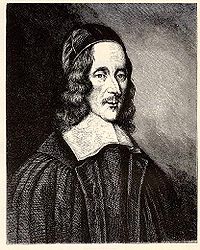 this to say of him, “Herbert speaks to God like one that really believeth a God, and whose business in the world is most with God. Heart-work and heaven-work make up his books.” High praise, coming from the ‘Reformed Pastor’ himself!
 Commitment to a locality is the product of this zeal. Yet, that very commitment can serve as the stimulant to our zeal. Let’s face it: few if any of us are always evangelizing with full wind in our sails. But to know that we are bound to our neighbors and are appointed for their deliverance draws us to our fulfill our duty, even when our hearts aren’t in it. And by following through in faith, God can reignite the passion once again.
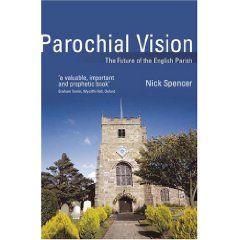 In Parochial Vision: The Future of the English Parish System (2004), Nick Spenser offers a very intriguing argument for the reimplementation of the ‘minster’ church model of England’s early medieval period. His main argument is that parish system of the Church of England is in major decline due to demographic shifts, the disappearing of traditional communities, and especially the spiritual declension of the British people. Spenser doesn’t reject the parish system, yet he contends that it needs recasting into a more flexible, regional, and collegial (cooperative) pattern. This pattern is the old ‘minster’ model.
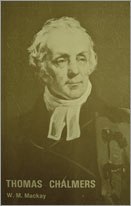 especially in the place of his spiritual birth – the Reformed community.
 West Port Experiment