Feeds:
Posts
Comments

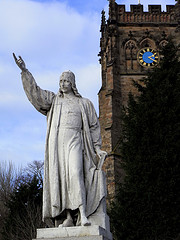
Richard Baxter of Kidderminster (from flickr.com)Baxter was an establishmentarian.  It is good that kings and queens should be nursing fathers and mothers to the Church.  He lamented in his Reformed Pastor that magistrates did not make adequate provision of Reformed pastors throughout the England of his day. 

Yet, he did not lay the main blame at the feet of civic leaders.  The fault was with the laziness of the ministry.  “It is we who are to blame, even we, the ministers of the gospel, whom they should thus maintain.  For those ministers that have small parishes, and might do all this private part of the work [pastoral care, mainly through catechizing], yet do it not, or at least few of them.  And those in great towns and cities, that might do somewhat, though they cannot do dall, will do just nothing but what accidentally falls in their way, or next to nothing; so that the magistrate is not awakened to the observance or consideration of the weight of our work” (Reformed Pastor, pp. 184-85, emphasis mine).  Like Chalmers some 150 years after him, his establishmentarianism was no fawning dependence of the Church on the State.  Rather, the Church ought to rise to the calling of its own Master, with or without the aid of the magistrate.  Yet, both Baxter and Chalmers believed that the diligence of the ministry could induce the State to its duty of patronizing the heavenly Kingdom.

“It is easy to separate from the multitude, and to gather distinct churches, and to let the rest sink or swim; and if they will not be saved by public preaching, to let them be damned: but whether this be the most charitable and Christian course, one would think should be no hard question” (Reformed Pastor, p. 184). 

In Chalmers’ terms, we must operate on the principle of aggression and not attraction.

The following is an excellent quote from Thomas Chalmers in his Christian and Economic Polity of a Nation (1821).  In it, he demonstrates one particular viture of the locality principle, on which the parish system is built – it facilitates the zeal and perseverance of the Christian missionary:

” He, with a select and appropriate vineyard thus lying before him, will feel himself far more powerfully urged, than when under the common arrangement, to go forth among its families. However subtle an exercise it may require from another, faithfully to analyse the effect upon his mind, he himself has only to try it, and he will soon become sensible of the strong additional interest that he acquires, in virtue of having a small and specific locality assigned to him. When the subject on which he is to operate, thus offers Thomas Chalmers and his family (from flicker.com)itself to his contemplation, in the shape of one unbroken field, or of one entire and continuous body, it acts as a more distinct and imperative call upon him, to go out upon the enterprise. He will feel a kind of property in the families; and the very circumstance of a material limit uround their habitations, serves to strengthen this impression, by furnishing to his mind a sort of association with the hedges and the landmarks of property. At all events, the very visibility of the limit, by constantly leading him to perceive the length and the breadth of his task, holds out an inducement to his energies, which, however difficult to explain, will be powerfully felt and proceeded on. There is a very great difference, in respect of its practical influence, between a task that is indefinite, and a task that is clearly seen to be overtakeable. The one has the effect to paralyze; the other, to quicken exertion. It serves most essential!v to spirit on his undertaking, when, by every new movement, one feels himself to be drawing sensibly nearer to the accomplishmviit of it—when, by every one house that he enters, he can count the lessening number before him, through which he has yet to pass with his proposals for the attendance of their children—and when, by the distinct and definite portion, which is still untravelled, he is constantly reminded of what he has to do, ere that district, which he feels to be his own, is thoroughly pervaded. He can go over his families too, with far less expense of locomotion, than under the common system of sabbath schools ; and, for the same reason, can he more fully and frequently reiterate his attentions; and it will charm him onwards, to find that he is sensibly translating himself into a stricter and kinder relationship with the people of his district; and, if he have a taste for cordial intercourse with the fellows of his own nature, he will be gladdened and encouraged by his growing familiarity with them all; and thus will he turn the vicinity which he has chosen, into a home- walk of many charities ; and recognized as its moral benefactor, will lug kindness, and his judgment, and his Christianity, be put forth, with a well- earned and well-established influence, in behalf of a grateful population.”

Today, I was reading an article comparing Adam Smith’s argument in favor (!) of establishments furnishing religious instruction with that of Thomas Chalmers.  The essay concluded that, in light of their views, contemporary tax policies are warranted in exempting religious organizations from such standard civil obligations and in allowing deductions for contributions made to them.  This statement reminded me of a recent post in which the author I was treating  contended that such tax policies were not just warranted, but that they placed distinct obligations upon churches actively to work for the common good.  They are, in a way, post-establishmentarian state subsidies of religious organizations to improve the social order.  If that is the case, then ought we as Church to consider our tax benefits as advance payments from Caesar to perform our Christian mandate (Mat. 28:18)?

I recently read an article entitled “Thomas Chalmers and the Communal Ideal in Victorian Scotland” (1992) by Stewart J. Brown, a recognized Chalmers scholar.  In it, he traces the development of the territorial mission program from Chalmers into the Free Church and, even somewhat surprisingly, back in the established Church in the late 1800s.

Brown makes an observation about the waning of the Free Church of Scotland’s vigor for the territorial ideal in the 1870s and on.  According to him, after a renaissance of Chalmersian territorial missions in the Free Church during the 1850s and 60s, the body slowly moved away from the ‘godly commonwealth’ ideal.  Writes Brown, “It began ceasing to perceive itself as a national Church, with responsibility for the spiritual and social welfare of the whole people of Scotland, and increasingly viewed itself as a gathered Church of believers.  In part, this was the result of the passing away of the older Free Church leadership, especially Robert Candlish and Thomas Guthrie (strong supporters of the territorial ideal)” (73).

Now, I’m no expert on the history to judge whether in fact this was the case.  But if it was, then I think it certainly reflects on a connection between ‘gathered church’ ecclesiology and the dangerous tendency to retreatism.  The territorial – or parochial – ideal envisioned the Church as at its core a society of the faithful, but ever reaching out to the perishing community beyond itself.  Its best expression did not confuse believing congregation and unbelieving community.  Yet it heartily embraced the unbelieving community under the obligation of its ‘cure of souls’ mandate (evangelism).  Sadly, when the Church loses that perspective, it will subtly morph into a mere asylum for escapists.  That is both unfaithfulness to Christ and a sure path to spiritual extinction.

When recently reading Iain Murray’s Scottish Christian Heritage, I caught an interesting aside about Chalmers’ regard for Charles Bridges, the author of the classic The Christian Ministry (1829). It should not be surprising, I suppose, not only because they were contemporaries, but also because they were establishmentarians who both believed in and practiced the territorial principle of home missions.

Here is a quote from Chalmers’ The Right Ecclesiastical Economy of a Large Town:

My excellent friend, the Rev. Charles Bridges, of Old Newton, Suffolk, finds, I am sure, most ample occupation among those six hundred people whom he may be said to have domesticated into one parochial family; and, were it not for his still more important services to the Christian church at large, would show, by his incessant labours, how possible it were to make out a most beneficial expenditure of all his strength and all his time amongst them.

I’d love to explore this connection further, as well as that of Chalmers and Charles Simeon.

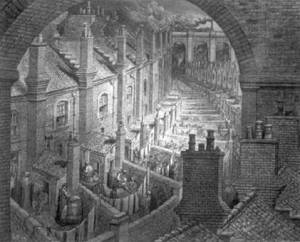
Victorian-era slums.  Image from http://mckaygardens.orgI recently came across a selection of a poem, originally written anonymously.  The poem, entitled Jonas Fisher, was thought to have been written by William Tasker, disciple of Thomas Chalmers and missionary to the slums of 19th century Edinburgh.  But apparently, later scholarship regarded it as the product of James Carnegie.

Whatever the origin, it is quite a stimulating read.  Quite illustrative of the dramas of evangelistic visitation among the underprivileged and useful as an example for similar work in the modern day.  Here’s a portion:

My mission day is Saturday,
For then at Two shop-work is o’er,
(On Sabbath, day of rest, I go
Three times to church, and prayers before),

And all the afternoon I give
To visiting the poor indeed;
Rich people scarce could even guess
The wretched life these creatures lead.

Each house is many stories high,
Each room a family contains;
And there they breed, and breathe foul air,
Like rats inhabiting the drains.

Though, when one comes to think of it,
The rats are far more clean and sweet;
These people neither comb nor wash,
Rats trim their fur and keep it neat.

O dear! O dear! the sights one sees!
In a close court the other day,
I saw some lean, large-stomached babes,
All busy at their childish play:

They dabbled in the thick black slime,
Stuck fish-heads in and drew them out,
Made pies of stuff much worse than mud,
While fat blue-bottles buzzed about. . .

I prayed an earnest prayer for them,
Then turned and climbed a winding stair
That smelt of cats, knocked at a door,
Half opened it, and looked in there.

Notions do differ. Some good folk
Are to the poor quite rough behaved:
Push into rooms, hat on, and cry-
“Well, how’s your soul? Friend, are you saved?”

Attention thus they hope to draw
By sudden pain or startling noise;
As pedlars shout to puff their wares,
Or teaches lash their careless boys.

But I have always liked to act
On ‘Do as you’d be done by’ rule,
And show the manners that I learned
At my dear native Berkshire school.

Well, as the opening door I paused,
Stood still and just put in my chin,
Took off my hat, half bowed, and said –
“Good afternoon. May I come in?”

An inner porch I then perceived;
The door that moment open burst,
Out rushed two angry Irish wives,
And shook their fists, and raged and cursed.

“Off with you, dirty Protestant!
You beast! you devil! get away.”
(I cannot write their curious brogue,
But tell the things they meant to say.)

On hearing this I breathed a prayer –
Which helps one much, and much protects –
“Don’t call me Protestant,” I said,
“All Christians don’t belong to sects.”

“You’re not a Christian, sure, at all;
You’re one that mocks God’s mother mild.”
“Blest above women she,” – says I.
I smiled, and then the woman smiled.

“This kind of wide-mouthed Irish folk,
Change like a swallow in its flight;
One, two, – they want to shed your blood,
Three, four, – they’re friendly and polite.

“Come in, Sir, come,” the women said,
And wiping clean their only chair,
They moved it tow’rds me; suddenly,
I heard a growl as from a bear,

And off his bed there leaped a man,
A huge, half-drunken, savage beast;
He seized a knife, and ran at me;
I stood, and did not budge the least….”

As for the rest, take up and read!

D. A. Carson has a great message recently placed on the Gospel Coalition’s website, entitled Is the Culture Shaping Us or are We Shaping the Culture?

Among other useful things he says, he gives a good caution to evangelical men concerned about balancing Word-ministry and Deed-ministry.  He simply says, makes sure that it is the Gospel that excites you.  If the Gospel becomes our ‘given,’ with social consciousness what excites us, then there is reason to be concerned.   As usual, Carson puts things quite well.

This blog is largely devoted to the theory and applicability of the ‘locality principle’ in missions.  Thomas Chalmers advocated the principle as a practical means of Christianizing cities.  But while I agree that locality should factor prominently in mission strategy, what place does place itself hold in Scripture?

So in recent days, I’ve been reading through the passages of the Old Testament (for starters) that contain the Hebrew word for ‘place,’ maqom. I realize that this is not a study in the heavy-weights of biblical concepts.  Place cannot be set next to propitiation, atonement, justification, etc.  And yet, as I read through these passages, it strikes me that the idea is rich with meaning.  Genesis 22, the great narrative of Abraham’s call to sacrifice Isaac, illustrates this.

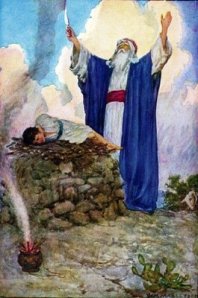
In four instances, ‘place’ (maqom) is mentioned, vv. 3, 4, 9, & 14.  As Abraham and Isaac on Mount Moriahone reads these verses in their context, not only is attention called to place, but place is given special significance.

Place in this passage is the destination of Abraham.  He is called from a place of blessing, rejoicing in Issac, to a place of trial.  There and not elsewhere, he will be put to the test.

Place then passes from the agonies of the trial to the triumph of faith.  Instead of being a site of tragedy with the promise going up in flame, it becomes the place of renewed celebration.  Faith overcomes.

But faith rests on a higher plane.  It reaches out for God.  Yet, it reaches out to God at the very place where He gracious comes down.  There, at Mount Moriah, they converge.  There, God gloriously reveals that His promise stands.  There, in the thicket, God has provided a substitute.

On that spot, the sacrifice assumes the place of Isaac.  And so the ground receives a name. “And Abraham called the name of that place Jehovah-jireh: as it said to this day, In the mount of the LORD it shall be seen” (v. 14).

Someday, that place would be hallowed with a greater Sacrifice.  There, He would suffer in our place that we might be released.  From that place all the families of the earth would be blessed.

“A Plea and Plan for a Coöperative Church Parish System in Cities,” by Walter Laidlaw

In this essay, published in the American Journal of Sociology (1898), Walter Laidlaw advocates among the Protestant church a voluntary ‘cooperative parish system’ in the large cities of the United States for the spiritual, moral, and socio-economic benefit of the people. His argument is threefold. First, it is the mandate of Christ to seek the entire well-being of men, both body as well as soul. Secondly, Laidlaw contends that the Church owes it to the taxpayers to seek the ‘moral uplift’ of the working classes. They ought not receive tax exemption for nothing in return. Quite an interesting take on the role of the Church in relation to a non-establishmentarian state! Last, the particular plan he advocates is the surest way to satisfy the mandates both of heaven and of earth.

Map of Lower Manhattan, 1847Positively, I think the article reproduces both the zeal of Thomas Chalmers on the need of Church to evangelize (and that wholistically) the burgeoning modern cities and his level-headed practicality in how the work ought to be done. Energetic, cooperative territorialism is the answer. While Chalmers is not mentioned, his fingerprints are all over it.

Further, Laidlaw certainly continued this legacy by endorsing the elevated philanthrophy that gives intelligently.

My only qualm is the faint note of evangelicalism throughout. It is there, but it is too subdued for my comfort. Presently, I’ve not found out much about Laidlaw’s theology (if anyone can shed some light, I would welcome it). I’m not sure whether he was an advocate of the Social Gospel or whether he retained a distinctive evangelical stance. But the essay is almost altogether devoted to the cooperative parish plan for the relief of outward human misery. I would say ‘Amen and Amen’ to Laidlaw if he unequivocally made the efficient dissemination of the apostolic Gospel the ultimate justification of the system. But right now, I’m at just one ‘Amen.’

Below are some great quotes, with a few comments interspersed.

* * * * * * *

“Originated by the Holy One from one of the largest cities of Judah, commissioned in Palestine’s largest city, her literature christened with the names of the ancient world’s greatest cities and city, her social ideal a city let down from heaven, the church has the opportunity to take the primacy, beyond all question, in altruistic movements, by the institution of a coöperative parish system in cities” (796).

Lamenting over the relative failure of Protestant over Roman Catholic churches to retain their adherents in the large cities, Laidlaw writes,

“Protestantism’s families are not in Protestantism’s church because Protestantism’s church representatives, attending to the people on their communion and pew rolls, scattered all over the 13,000 acres of Manhattan island, have not time or plan to discover and recover the families found on no communion or pew roll.

“It should be a humiliation to Protestantism in New York that three Roman Catholic churches get at more families in the district than do ninety-five Protestant churches, among which are three resident churches. It is idle to ascribe the difference of efficiency in the district to denominational tendency, or national characteristics. It is rather due to the difference between regimentation and somnambulism [sleepwalking]. “Except the Lord keep the city, the watchmen waketh but in vain,’ says Protestantism; and she does on underestimating human wide-awakeness and gumption through her admirable reverence for divine grace. She walketh in a dumb show of saving the city for herself or her Lord” (799-800).

Appreciating the work of the Evangelical Alliance (itself a brainchild of Chalmers) before him in seeking to bring the Gospel wholistically to the cities, Laidlaw critiques the over-idealism of a previous plan that had doomed it to failure. That plan failed in part precisely because of an overemphasis on cooperation:

“It is too ideal … in intermingling denominational visitors. The first step to be taken would [rather] seem to be to induce the churches to regard a geographical area as a special responsibility, and many a church would undertake this if, as a church, it were held responsible for the area, when it might not be willing to share the responsibility with workers from other churches. Spiritual life is systole and diastole indeed, both organization and individual discharging both organic functions at time, but if the church is a divine organization, we must concede her arterialism and assume that individuals are venous” (801).

“Christianity’s warm heart will say to her cool head, when she sees that her alms and uplift must be with both left hand and right hand: ‘Had, you must direct this business for me, or I shall fail in meeting this need. The Master himself did not feed the multitude by Galilee as a mob. He divided the five thousand into companies, and gave each of the twelve his sections to care for. And they did all eat and were filled, no one was overlooked. And they gathered up twelve baskets of fragments, a basket for each disciple, more food than they started with. Head, this need is so great that some hungry one is sure to be underfed, and some greedy one is sure to be overfed, unless there is method.’ And when Christianity talks in this strain, it will not indicate a cooling heart, but a glowing one, one that responds to the Redeemer’s desire, and ‘mind and soul, according well, / will make one music as before’” (803).

Last, Laidlaw gives a number of guidelines for such a cooperative parish system. Cooperation is more than inter-church – it also involves cooperation with civic officials for the ultimate blessing of the community. He gives one interesting instance of such cooperation in New York City during his time:

“For instance, the committee on parks recently circulated a petition, signed by everyone of the pastors in the area, asking the city authorities to locate a small park in the region. When the park is actually opened, it cannot but advertise throughout the whole neighborhood the fact that the church is interested in the people’s well-being” (806-7).