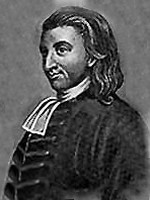
 If you’re Reformed, passionate about evangelism, and not such a ‘frozen chosen’ that you can indulge in a good laugh, then you really need to read about Aeneas Sage. Sage was a Presbyterian minister in the 18th century Scottish Highlands, then a very rough and Roman Catholic region. Sage was a Samsonesque figure, somewhat larger than life. The following is a delightful vignette from his heroic ministry, taken from The Scot of the eighteenth century: his religion and his life, by John Watson (1907). I’m not sure if it is apocryphal – but it sure is enjoyable!
Posted in Catechesis, Diets of Catechizing, Evangelistic Catechesis, Experimental Religion & the Cure of Souls, Gospel Tactics, Highlands & Islands, Vignettes from the Old Parish Way | 1 Comment »
The following is Calvin’s dedication of the Geneva Catechism to the ministry of East Friesland. The entire Geneva Catechism can be seen here. But first, a few observations.
 I notice that Calvin takes a middle way approach to particular catechisms. On the one hand, a variety of catechisms written and employed is not necessarily a bad thing. But on the other, it should never be an inlet for novelties that would nullify the very purpose of catehcizing. By design, it must inculcate and preserve the unity of the faith. Consequently, there is wisdom in seeking uniformity of catechetical usage.
Also in this connection, catechism is for Calvin a highly traditional practice. This is not “Calvinism,” but “the faith once delivered,” the “received Gospel.” To introduce curious tangents is at variance with catechism.
Calvin also explains his reasons for using the Latin tongue in the formation of his catechism. This also shows that his reason for catechesis is to promote and fortify a catholic spirit throughout a divided Christendom. As Latin was the lingua franca of the day, this edition would held bind the Diaspora together in that oneness of the Spirit.
Then there is Calvin’s trans-generational interest. Catechesis is traditional and traditionary – we receive it with our hands to pass on uncompromised to the next, that it may remain faithful to the Lord. Doesn’t this make catechism a covenantal exercise? “I will open my mouth in a parable: I will utter dark sayings of old: which we have heard and known, and our fathers have told us. We will not hide them from their children, shewing to the generation to come the praises of the LORD, and his strength, and his wonderful works that he hath done” (Psa. 78:2-4).
* * * *
JOHN CALVIN TO THE FAITHFUL MINISTERS OF CHRIST THROUGHOUT EAST FRIESLAND, WHO PREACH THE PURE DOCTRINE OF THE GOSPEL.
Seeing it becomes us to endeavor by all means that unity of faith, which is so highly commended by Paul, shine forth among as, to this end chiefly ought the formal profession of faith which accompanies our common baptism to have reference. Hence it were to be wished, not only that a perpetual consent in the doctrine of piety should appear among all, but also that one Catechsim were common to all the Churches. But as, from many causes, it will scarcely ever obtain otherwise than that each Church shall have its own Catechism, we should not strive too keenly to prevent this; provided, however, that the variety in the mode of teaching is such, that we are all directed to one Christ, in whose truth being united together, we may grow up into one body and one spirit, and with the same mouth also proclaim whatever belongs to the sum of faith. Catechists not intent on this end, besides fatally injuring the Church, by sowing the materials of dissension in religion, also introduce an impious profanation of baptism. For where can any longer be the utility of baptism unless this remain as its foundation — that we all agree in one faith?
Wherefore, those who publish Catechisms ought to be the more carefully on their guard, by producing anything rashly, they may not for the present only, but in regard to posterity also, do grievous harm to piety, and inflict a deadly wound on the Church.
This much I wished to premise, as a declaration to my readers, that I myself too, as became me, have made it my anxious care not to deliver any thing in this Catechism of mine that is not agreeable to the doctrine received among all the pious. This declaration will not be found vain by those who will read with candor and sound judgment. I trust I have succeeded at least so far that my labor, though it should not satisfy, will be acceptable to all good men, as being in their opinion useful.
In writing it in Latin, though some perhaps will not approve of the design, have been influenced by many reasons, all of which it is of no use to detail at present. I shall only select such as seem to me sufficient to obviate censure.
First, in this confused and divided state of Christendom, I judge it useful that there should be public testimonies, whereby churches which, though widely separated by space, agree in the doctrine of Christ, may mutually recognize each other. For besides that this tends not a little to mutual confirmation, what is more to be desired than that mutual congratulations should pass between them, and that they should devoutly commend each other to the Lord? With this view, bishops were wont in old time, when as yet consent in faith existed and flourished among all, to send Synodal Epistles beyond sea, by which, as a kind of badges, they might maintain sacred communion among the churches. How much more necessary is it now, in this fearful devastation of the Christian world, that the few churches which duly worship God, and they too scattered and hedged round on all sides by the profane synagogues of Antichrist, should mutually give and receive this token of holy union, that they may thereby be incited to that fraternal embrace of which I have spoken?
But if this is so necessary in the present day, what shall our feelings be concerning posterity, about which I am so anxious, that I scarcely dare to think? Unless God miraculously send help from heaven, I cannot avoid seeing that the world is threatened with the extremity of barbarism. I wish our children may not shortly feel, that this has been rather a true prophecy than a conjecture. The more, therefore, must we labor to gather together, by our writings, whatever remains of the Church shall continue, or even emerge, after our death. Writings of a different class will show what were our views on all subjects in religion, but the agreement which our churches had in doctrine cannot be seen with clearer evidence than from catechisms. For therein will appear, not only what one man or other once taught, but with what rudiments learned and unlearned alike amongst us, were constantly imbued from childhood, all the faithful holding them as their formal symbol of Christian communion. This was indeed my principal reason for publishing this Catechism.
A second reason, which had no little weight with me, was, because I heard that it was desired by very many who hoped it would not be unworthy of perusal. Whether they are right or wrong in so judging is not mine to decide, but it became me to yield to their wish. Nay, necessity was almost laid upon me, and I could not with impunity decline it. For having seven years before published a brief summary of religion, under the name of a Catechism, I feared that if I did not bring forward this one, I should cause (a thing I wished not) that the former should on the other hand be excluded. Therefore if I wished to consult the public good, it behooved me to take care that this one which I preferred should occupy the ground.
Besides, I deem it of good example to testify to the world, that we who aim at the restitution of the Church, are everywhere faithfully exerting ourselves, in order that, at least, the use of the Catechism which was abolished some centuries ago under the Papacy, may now resume its lost rights. For neither can this holy custom be sufficiently commended for its utility, nor can the Papists be sufficiently condemned for the flagrant corruption, by which they not only set it aside, by converting it into puerile trifles, but also basely abuse it to purposes of impure and impious superstition. That spurious Confirmation, which they have substituted in its stead, they deck out like a harlot, with great splendor of ceremonies, and gorgeous shows without number; nay, in their wish to adorn it, they speak of it in terms of execrable blasphemy, when they give out that it is a sacrament of greater dignity than baptism, and call those only half Christians who have not been besmeared with their oil. Meanwhile, the whole proceeding consists of nothing but theatrical gesticulations, or rather the wanton sporting of apes, without any skill in imitation.
To you, my very dear brethren in the Lord, I have chosen to inscribe this work, because some of your body, besides informing me that you love me, and that the most of you take delight in my writings, also expressly requested me by letter to undertake this labor for their sake. Independently of this, it would have been reason sufficient, that what I learned of you long ago, from the statement of grave and pious men, had bound me to you with my whole soul. I now ask what I am confident you will of your own accord do — have the goodness to consult for the utility of this token of my goodwill towards you! Farewell. May the Lord increase you more and more in the spirit of wisdom, prudence, zeal, and fortitude, to the edification of his Church.
Geneva, 2nd December, 1545
Posted in Catechesis | Leave a Comment »
Here’s an interesting piece on the advantages of the parish system from an evangelical in the Church of England. As Chalmers articulated it, the Church should be a Church for all people and consequently should not be subjected to the laws of the marketplace. “I am debtor both to the Greeks and to the barbarians, both to the wise and to the unwise.” The author of this piece argues that principle well.
Posted in Experimental Religion & the Cure of Souls, Parish Theory & Practice | Leave a Comment »
Here’s a great little piece on the contemporary applicability of the parish system, from a friend in the Anglican communion of Australia. Maybe they can help bring us Presbyterians back to our own parochial inheritance!
Posted in Contemporary Parochialism, Parish Theory & Practice | Leave a Comment »
The following is extracted from Thomas Cochrane’s Home Mission Work (1878). The chapter, “The Territorial System,” is a nice overview of the urban mission strategy advocated by Thomas Chalmers.
* * * *
In the later years of his eventful life, with all the experience and mellow ripeness of a mind that had given very much of the best of its powers to the advocacy and outworking of the grand old parochial system of Scotland, the illustrious Dr Chalmers, while carrying on with undimmed and  undiminished lustre the labours of his distinguished professoriate, worked out, alongside of this theoretical training for the students of theology, the grand practical work of Territorialism. He thus devised and carried out, in a most singularly successful way, a scheme which, because it sought to cope with all the difficulties, and to grapple with all the obstructions that might be encountered, and set itself to the prosecution of true mission work, in a certain selected locality or territory, and to cultivate regularly and thoroughly that district so assumed, has been most fitly termed— “The Territorial System.”
In the great metropolis of the West, among her merchant princes, in St John’s parish there, Dr Chalmers had previously developed, and very successfully worked out, under the wing of the State, the system, as strictly parochial; now he was to unfold and develop the same system, minus State support and State influence in any way.
The chosen field in Edinburgh, “The West Port,“ was the most unlikely, and, seemingly, unpropitious that could have been selected.
The hall opened for public worship was an “old Tan Loft,” near to the spot which had earned an unenviable notoriety, because of revolting murders that had been perpetrated—more revolting than any that had either before or since disgraced the fair escutcheon of that noble city—a locality where purity and outward decency alike blushed for very shame!
Nothing daunted, however, that truly great man, surrounded by a staff of devoted volunteers, went forth into the thick of the conflict, to do battle with the sin and crime that met them, at every corner of the district, and to soothe the sorrows and assuage the trials of human misery and woe.
It was indeed a noble scheme, a grand enterprise; and let that interesting chapter, “The West Port,” in the classic and eloquent biography of Dr Chalmers, written by his son-in-law, the late Dr Hanna, tell in his inimitable style, how, under more than wizard wand, of that Great Moral Conjuror, the wilderness became a fruitful field, and the desert rejoiced and blossomed as the rose, becoming “A Garden of the Lord.“
All around now in Edinburgh, from the west to the extreme east, ‘neath the shadow of hoar Holyrood, there have been erected churches and schools upon this territorial system, so that, in addition to “The West Port,” there are more than seven other churches with as many ministers, and fully equipped agencies and congregations, carrying on with greater or less success the operations of the Territorial system.
Glasgow, too, has had her full share of the benefits of this scheme. The development of this system, however, is not confined to Edinburgh or Glasgow. Many other large towns in Scotland, such as Aberdeen, Dundee, Perth, &c, have reaped golden harvests from the seed sown, through the carrying out of this important work; while England, too, in measure, has caught the infection and influence, from the spell of the mighty charmer, who though “being dead, yet speaketh,” while his works, all around, follow him; and far hence, away across the broad Atlantic, the winds have wafted on and o’er the story, and there, too, in several instances, the system is being tested and tried.
In the prelude to his lecture on “Transcendentalism,“ Dr Joseph Cook of Boston, rehearses the story of “The West Port,” and presses upon his readers the importance and moral grandeur of the scheme; while, as Dr Cook himself informed us, when on a visit to this country, the system has been found in America to be the only true system for elevating the community, civilly, socially, and morally.
It may here be stated that the system, both scholastically and ecclesiastically, can be worked out in such a manner as to be self-sustaining; so that the big thoughts, and large desires of the illustrious founder, have not only been proved not to be Utopian, but fruitfully workable; and that too, not only during his distinguished life, under his own eye, and by the cunning of his own right hand; but now, also, a full generation after he has been gathered to his fathers, the work progresses and advances still more and more, and we believe will continue to do so, after its present promoters have gone the way of all the earth.
It may be argued, however, that if so much has been done,—if such harvests have been, or are being ripened and reaped all round, in the town and country districts of Scotland, and elsewhere, is there still need for the advocacy and extension of the practical outworking of this scheme? There is “much land yet to be possessed.“ When we are reminded that in Edinburgh alone, there are perhaps not less than forty thousand, in Glasgow a much larger number, while over broad Scotland, there are about five hundred thousand living in entire neglect of the means of grace; living “without God,” if not dying “without hope,” we cannot fail to perceive that this scheme is of prime importance, and that the necessity for the thorough outworking of it is as great as ever.
THE DISTRICT SELECTED.
The idea of the great founder of the scheme, in regard to the chosen district, was very decided. His firm and unwavering conviction was, that the field selected should be very carefully and deliberately chosen, and that it should be of adequate proportions,—not too large, lest it should not be fully and thoroughly cultivated; not too small, lest there should not be a population sufficiently large to yield material for a good, self-supporting congregation.
Holding these views strongly, Dr Chalmers was in the habit of affirming that a population of about 2000 was quite large enough, in ordinary circumstances, for the purpose in view, and that a district less populous was not adequate for the formation of a Territorial Congregation. Hence a district of about 400 families, or 2000 of a population, according to the system under review, would require about forty visitors in order to cultivate it thoroughl, giving manageable sub-divisions of about ten families to each agent.
THE VISITOR’S DUTIES.
The duties of visitors may be regarded in many aspects (see pages 57-60), but the great, the chief duty is to visit their districts, with a view of promoting the highest good of the families in the district allocated to them. Assuming the visitor to be truly Christian, and devoted to the work, how very much will depend upon the judiciousness manifested in the discharge of duty. What care will be required, lest their visits should hinder, rather than help on the work to be accomplished. How important, all-important, to make the families visited feel that we are really and truly their friend; that we visit, not with a prying over-curious eye to spy into their household affairs, far less in a censorious spirit, ever insinuating our fancied superiority, and finding fault with what, we imagine, may be their little delinquencies; but that, placing ourselves upon the same platform on which they stand, we thus make it clear that we have their highest good at heart, and have love in our heart for them, as well as expressed sympathy upon our lip with them. Hence our aim should be to influence the heart for good.
“They build too low who build beneath the skies.” They aim too low who aim not at the heart. The effect of mere gossip in visiting, is always fruitless, if not of evil tendency. By all means let us be happy, with a gleam of sunshine ever lighting up our countenances. By all means let our words he happy words, and happy social words. If time permit there may be talk about the common affairs of life, and the current events of the day; but we should never let our conversation degenerate into flippant talk, idle talk, or jesting which is not convenient; and, if possible, we should never leave any house, without making it clear that our object in visiting was with respect to the highest good of the family.
Even in the distribution of tracts let us have a care of the manner we manifest in so doing. Let us keep in view that, while we are as messengers of mercy bearing the silent message in the tract we give, we are to make it plain that we need the message we bear, as well as those to whom we bear it, as Mr M’Cheyne would have said, in his own tender, touching way, “I need it, my brother, as well as you.” Or, as we have it from an inspired pen, “We, that we say not you.”
The importance of house-to-house visitation can never be over-estimated. There may be—there are —some who weary in this seemingly slow process, and who would fain “rush into print,” in placards large, fancying that by sleight-of-hand, or speed of foot, or by monster meetings in large halls, and other general schemes, they may speedily evangelise the outlying population in our vast moral wastes. All success to these, and every good scheme! It is not so, generally, however, that this work is to be done. The race is not to the swift, nor the battle to the strong. The patient, laborious, conscientious worker, who realizes what is implied in faithful labour for the Great Master, is the labourer that will here prevail. If it be true that the time shall come when they shall no more teach every man his neighbour, and every man his brother, saying, “Know the Lord,” does not this imply that, until that time shall have come, this system should be carried on? And here, again, the conscientious worker must be content to be hidden from the world’s eye, but work ever under the eye of His Lord and Master. He must be willing to be unknown, perhaps unheard of. Down in the damp, dark cellar; high, in the lone garret room; concealed in some back court where the sun scarce shines; or in the loathsome land, where fever holds its perpetual sway, and revels, in the luxury of human misery, all prodigal of life,—there must the visitor be prepared to labour, there the missionary be contented to toil, from day to day.
” Go labour on, ’tis not for nought:
Thy earthly loss is heavenly gain;
Men heed thee, love thee, praise thee not;
The Master praises; what are men?”
“Prevention is better than cure.“—There are congregations whose membership may not be able to supply agents for carrying out the scheme we have been commending, and where it would be of immense advantage, to such a congregation, to have the scheme thoroughly and earnestly worked out, in connection with their own work, and into their own congregation. In such a case why should not some healthy and vigorous, if not wealthy and numerous, congregation, come with all its flow of life and love, and work for, at least, if not in connection with the work of such a congregation? Would not many a struggling congregation thus take heart and begin anew? Would not many a downcast and cheerless minister obtain encouragement, and gird on with fresh ardour the armour of the Gospel of Peace? Nay, would not this be a true exhibition of the members of the church, looking “not every man on his own things, but every man also on the things of others;” and of manifesting in the clearest sense, how the strong could help the weak, thus showing to the world and the Church alike that “it is more blessed to give than to receive”?
Having, throughout the volume, touched upon the main features of the Territorial system, and having had the privilege, for very many years, of being a humble labourer in the Territorial field, in closing our remarks we may be permitted to say that the longer we have laboured in the outworking of the system, the more thoroughly have we been convinced of the value and effectiveness of it.
One of our greatest and sincerest regrets is, that we should have been so little able to do anything like justice to it. We feel this all the more, that we are not now so agile, as heretofore, in buckling on our armour, and sallying forth at the trumpet’s sound against the common foe. We must soon retire from the field of action, but, when retiring, we hope to do so by handing down the banner, unfurled and untarnished, with the device thereon, as ever, full, perfect, and undimmed—
For THE LORD
and
Territorialism.
Posted in Parish Theory & Practice, Thomas Chalmers, Vignettes from 19th Century District Visitation, Visitation Evangelism | Leave a Comment »
Being an armchair philologist, words fascinate me. I am often allured by the suggestive hints from other cognate languages. “Hmm. Could this word be related to that? And if so, how?” Soon I’m at the dictionary, probing unknown etymologies and discovering family relationships. New shades of significance of even the most familiar of words give me an inward satisfaction.
But I really sit up and take notice when they are words that tap into domains of personal interest. So after several years of nursing a respect for Reformed parochial mission theory a la Thomas Chalmers, I’ve become really interested in expanding my grasp of related terminology and its significance.
One of the new words under personal review is ward. I owe this one to Dr. Francis Wayland (1796-1865), the fourth President of Brown University and a strong American admirer of Thomas Chalmers. In his biographical tribute to the great Scotsman, he mentions the word to explain Chalmers’ advocacy of the parish as a unit of evangelism. “So far as I understand, the city of Glasgow is divided into parishes, as our cities are divided into wards” (p. 88). Really, it was just an incidental statement in a larger explanation. But this attempt to translate a somewhat foreign state of affairs for an American audience made me pause. “Now if the British parish is analogous to the American ward (or district, precinct, borough), then what is its precise meaning? And how could it be appropriated ecclesiastically?”
Well, the word as a noun basically means “the act or condition of guarding” or “being in a state of custody.” Germanic in origin, the word developed through Old and Middle English to the current ward and related variants. In the same family are beware, wary, guard, and warden.
The following seems to be central to its essence. The ward is an authoritatively fixed responsibility assigned to some person or persons to regard, protect, and otherwise care for certain ones under their charge. Usually a ward is not alone, but several wards are distributed throughout a general area, combining for the overall protection and provision of a larger body. So, then, the ward is an organizational expedient for a broad charge. In light of all this, we get a clearer insight into the significance both of city and hospital wards.
Turning to the ecclesiastical application, the Lord Jesus Christ has been invested with “all authority in heaven and on earth.” He, however, chooses to send the Twelve throughout the nations with the keys of the kingdom. Whatever they “bind on earth shall be bound in heaven,” while “whatever they loose on earth shall be loosed in heaven.” He that hears them hears the Son, and whoever hears Him hears the Father.
The entirety of the nations are to be taught, baptized, and consequently further taught “in all things whatsoever [Jesus has] commanded them.” The nations, then, are under the Church’s custody. No doubt “the heathen rage” and attempt to throw off these “bands” and “cords.” Yet, none of their mad fury alters in the slightest the dominion of God’s Christ or the authority entrusted to the Church as steward. The world is Christ’s ward.
Yet the Church under Christ can only fulfill its charge by (in the words of Thomas Chalmers) an intelligent economy. Only by division can the whole be conquered. So the Church, seeing herself as Christ’s city steward or the spiritual hospital’s administrator, divides and subdivides its sacred charge. We may call these units any number things. But given the ancient and contemporary significance of the ward, this offers itself as a great word for the Church’s missionary vocabulary. And for that matter, it ought to be more than idea – but an abiding mandate. The Church ought not so much to create wards as to realize and begin to take charge of them!
Perhaps these ideas seem Roman Catholic. I would contend, however, that the Reformation Church – wearing the mantle of the true catholicism – affirmed them wholeheartedly. It threw out the vain traditions of men, but not this theology of the Church’s spiritual stewardship over the nations. And that is why the Reformation Churches kept establishments and the parochial system. They were viewed as wise expedients to fulfill its sacred responsibility.
Nevermind the blight of secularism, with its contempt of all churchly restraints. Let us not be browbeaten by the re-paganizing of the West. It remains, as well as the East – and for that matter, the North and South too! – the territory of the Lord Christ. It is His domain, as the rightful Heir of all things. That means the nations are His, the states are His, the cities are His – with all its wards. Let the Church assume its responsibility over them. And in so doing, it will one day receive that cheering commendation, “Well done, thou good and faithful servant.”
Posted in Experimental Religion & the Cure of Souls, Parish in American Context, Parish Theory & Practice | Leave a Comment »
Here are selections from Boston’s personal journal in which he recounts his catechizing efforts throughout his regular, parish ministry. This installment takes us from Boston’s first labor in the parish of Simprin to his second and last at Ettrick. Observe the diverse settings and audiences of his catechizing, its bearing on church membership and the sacraments, as well as Boston’s pastoral sensitivity and adaptability to the needs of the people. Note also how Boston deplored ignorance of Gospel ‘fundamentals’ and so regarded catechizing as a sine qua non in making authentic Christians (that is, in evangelization).
* * * *
1699
“12th December.—I have had a desire to set up week-day sermons this long time. And since the synod (at which time I had great apprehensions of evil days, which pressed me to be busy in my time) I resolved to try what encouragement I might meet with in prosecuting it. This night I proposed it to two of the members of the meeting for Christian fellowship; who received the motion with all gladness; and I wa3 desired to begin it next Thursday’s night. Upon which immediately I found a great averseness in my own mind to it; thinking withal, that I should have tabled it particularly before the Lord ere I had proposed it. Thus I saw the dreadful deceit of my heart. I pressed my heart with that word, 2 Tim. iv. 2, ” Preach the word, be instant in season, out of season:” but it would not do. As I was going out of doors, it was suggested to me, that the Lord had thus punished me for not seeking light as to that particular expressly. While I wrote this, I thought it indeed a temptation of Satan to divert me from this work. (Nota, It seems both were true.) I was helped earnestly to seek light from the Lord in it. On the morrow I went to God again with this business ; yet could I not be fully satisfied to undertake that work, so long and so much before desired by me; neither had I anything material to object against it. Wherefore I renewed my suit; and thinking about it, got my heart more satisfied and inclined thereto, urging myself with the Lord’s kindness to me in His work, and the necessity of the people’s souls. I went to God again with it; and, in fine, the assiduity of faithful ministers, the apostles, and others, preaching both by day and by night, and no doubt sometimes to a small handful, did overcome me : so that I determine to go on, desiring heartily to comply with it. On Thursday the 14th, at night, I began this exercise, having spent the afternoon in catechising. I went about the examination under a sense of my own emptiness and insufficiency; and was well helped while my heart kept right; but in turning to some one or other of its biasses, my help decayed. In the evening-exercise the Lord’s presence was such, that I was made to say, ” It is good for us to be here.” When alone, the mismanaging of the examination, yea and the sermon too, lay heavy on me; and therefore I went to God for pardon of my weakness. And that exercise I kept up all along after, during my continuance in Simprin ; and had many a sweet and refreshing hour of it. In the winter-season, our meetings for it were in my house, and in the night; in the summer, they were in the kirk, at the time of the day wherein the men rested from their labour: for the people were servants to Langton. And I believe that, for the same reason, it was only the women whom I catechised at any other time of the day ; being solicitous that the master’s business might not suffer by me, nor my good be evil spoken of on that account. On the morrow after, having visited the sick, and found how the Lord had laid His rod on my handful, I was thereby convinced, that, had I slighted the motion for the Thursday’s sermon, I would have had no peace in so doing. Having come home from this visitation, I reflected on it, and saw what secret averseness was in my heart to it, and how poorly I had managed it. I got a clear sight of the freedom and riches of grace, went by myself, and lamented my emptiness and unworthiness; which when I saw, it gave me a check for an inward itching after more work, whereby I might have a little more stipend. That work was, I think, to have been a catechist in Dunse, the encouragement £100 Scots. I had such an offer, and refused it; yet since that time I had such an itch after it. Last night in reading the latter part of John vi. the Lord held His candle before me, helping me to understand it. This night having consulted some books, and my own heart, on the sinfulness of man’s natural state, to see what further of that subject remained to be handled, there occurred only man’s death in sin, to which I was determined accordingly. On the Saturday I studied it, but not with my former assistance: but, after having prayed, and found it to be owing to that I was not so much emptied of myself as before, reckoning the subject more easy, I recovered the divine aid, in meditating afterward on what I had prepared” (109-110).
“17th December. . . That night I began the catechising of the servant; the which part of family duty I continued in my family on the Sabbath nights, till of late years my strength decaying, I almost confined it to the time of the year wherein we have but one sermon.
On the morrow I visited the sick, and spent the afternoon in catechising, and found great ignorance prevailing. On the Tuesday, visiting a sick woman grossly ignorant, after I had laid out before her her wretched state by nature, she told me she had believed all her days. I thereupon sat as astonished for a while, lifted up my eyes to the Lord, and addressed myself to her again for her conviction; howbeit nothing but stupidity appeared. Therefore I saw I had enough ado among my handful. I had another diet of catechising on Wednesday afternoon; and looking to the Lord for help, I got it: and I had some more comfort in them than before. Having inculcated almost on each of them their wretched state by nature, and they frequently attending the means of instruction, there were but few examined that day who did not shew some knowledge of that point. But the discovery I had made of their ignorance of God and of themselves, made me the more satisfied with the smallness of the charge”(111-114).
“Saturday the 23rd… On the morrow, being the Lord’s day, after prayer in the morning I had given way to some worldly thoughts, which were indeed occasioned by something that concerned my conscience; yet my heart soon went without bounds: so that though a desire to be near Christ remained in me, yet I found an averseness to duty even in the very time of duty. Entering on the public work, my prayer was according to my frame, complaining of a body of death, and an ugly heart, and admiring heaven as a place of rest from sin. I preached that day man’s ignorance of his wretched state by nature; and was sure that God called me to preach it, by the voice of the people’s necessity, two of whom had told me expressly that week, they had believed all their days. That night I altered the evening-exercise, from explaining a question sermon-wise, to catechising, as more fit to profit the people: and to this I had been determined after seeking a discovery of the Lord’s mind therein” (114).
1700
“[15th January] I endeavoured on the Monday, not without some success, to keep my heart in a heavenly disposition; spent the morning in my chamber, the forenoon in catechising, the afternoon in business, and visiting a sick man at night, with help from the Lord. Thereafter earnestly plying my books, I found my heart much bettered, my confidence in the Lord more strengthened, the world less valuable in my eyes, and my soul free of the temptations that otherwise I was liable to” (120).
1704
“As for the subject of baptism; after I was settled among the people of Simprin, and had entered closely on my work, finding some of them grossly ignorant, and hardly teachable in the ordinary way, and casting in my mind what course to take with such, I drew up in writing a little form of catechising in the fundamentals, in short questions and answers, on design to teach it them privately in my house. I do not well remember the progress of that affair; nor do I well know where these questions are; but afterward I used the same, in the case of my little children, in the first place, when they became capable of instruction. Among other such grossly ignorant, there was one, who desiring his child to be baptized, I could not have freedom to grant his desire for some time: neither am I clear, whether, when the child was baptized, it was baptized on a satisfying account of the fundamental principles from him or his wife. Whatever had laid the foundation of such scrupling, I was, by means of such straitening in practice, brought closely to consider that point. And having purposely studied the question, Who have right to baptism, and are to be baptized? I wrote my thoughts thereon also. And being one day in conversation on that head with Mr. William Bird, dissenting minister in Barmoor in England, he presented to me Fulwood’s Discourse of the Visible Church, for clearing me. Bringing home the said book with me, I considered it, and wrote also some animadversions on a part of it. From that time I had little fondness for national churches strictly and properly so called, as of equal latitude with the nations, and wished for an amendment of the constitution of our own church, as to the membership thereof” (171-172).
Posted in Catechesis, Parish Theory & Practice, Thomas Boston, Vignettes from the Old Parish Way | 1 Comment »
“In order that the Christian youth may be diligently instructed in the principles of religion, and be trained in piety, three modes of catechizing should be employed. 1. In the houses, by parents. 2. In the schools, by schoolmasters. 3. In the churches, by ministers, elders, and catechists especially appointed for the purpose. That these may diligently employ their trust, the Christian magistrates shall be requested to promote by their authority so sacred and necessary a work; and all who have the oversight of churches and schools shall be required to pay  special attention to this matter.
“1. The office of parents is diligently to instruct their children, and their whole household, in the principles of the Christian religion, in a manner adapted to their respective capacities; earnestly and carefully to admonish them to the cultivation of true piety; to engage their punctual attendance on family worship, and take them with them to the hearing of the Word of God. They should require their children to give an account of the sermons they hear, especially those on the Catechism, assign them some chapters of Scripture to read, and certain passages to commit to memory, and then impress and illustrate the truths contained in them, in a familiar manner, adapted to the tenderness of youth. Thus they are to prepare them for being catechized in the schools, and by attendance on these to encourage them, and to promote their edification. Parents are to be exhorted to the faithful discharge of this duty, not only by the public preaching of the word, but specially at the ordinary period of family visitation, previous to the administration of the Lord’s Supper: and also at other proper times, by the minister, elders, etc. Parents who profess religion and are negligent in this work, shall be faithfully admonished by the ministers, and if the case requires it, shall be censured by the consistory, that they may be brought to the discharge of their duty.
“2. Schools, in which the young shall be properly instructed in the principles of Christian doctrine, shall be instituted not only in cities, but also in towns and country places, where heretofore none have existed. The Christian magistracy shall be requested, that wellqualified persons may be employed, and enabled to devote themselves to the service, and especially that the children of the poor may be gratuitously instructed, and not be excluded from the benefit of the schools. In this office none shall be employed but such as are members of the Reformed Church, having certificates of an upright faith and pious life, and of being well versed in the truths of the Catechism. They are to sign a document professing their belief in the confession of faith, and the Heidelberg Catechism, and promising that they will give catechetical instruction to the young in the principles of Christian truth according to the same. The schoolmasters shall instruct their scholars, according to their age and capacity, at least two days in the week, not only by causing them to commit to memory, but also by instilling into their minds an acquaintance with the truths of the Catechism. For this end three forms of the Catechism adapted to the threefold circumstances and ages of the young, shall be used. The first shall be for the young children, comprising the Articles of Faith, or Creed, the Ten Commandments, the Lord’s Prayer, the Institution of the Sacraments, and Church discipline, with some short prayers, and plain questions adapted to the three parts of the Catechism. The second shall be a short compendium of the Catechism of the Palatinate (or Heidelberg), used in our churches, in which those who are somewhat more advanced than the former, shall be instructed. The third shall be the Catechism of the Palatinate (or Heidelberg), adopted by our churches for the youth still more advanced in years and knowledge. The Walloon churches of the Netherlands, who have long been accustomed to the use of the Genevan Catechisms, may still continue them in their schools and churches, but the schoolmasters shall not employ any other formularies than these in their schools. The magistrates shall be requested to exclude from the schools all Popish Catechisms, and all other books, which contain errors and impurities. The schoolmasters shall take care, not only that the scholars commit these Catechisms to memory, but that they suitably understand the doctrines contained in them. For this purpose they shall suitably explain the topics to every one in a manner adapted to his capacity, and frequently inquire, if they are understood. The schoolmasters shall bring every one of the pupils committed to their charge, to the hearing of the preached word, and particularly the preaching on the Catechism, and require from them an account of the same.
“3. In order that due knowledge may be obtained of the diligence of the schoolmasters and the improvement of the youth, it shall be the duty of the ministers, together with an elder, and if necessary with a magistrate, to visit all the schools, private as well as public, frequently, in order to excite the teachers to earnest diligence, to encourage and counsel them in the duty of catechising, and to furnish an example by questioning them, addressing them in a friendly and affectionate manner, and exciting them to early piety and diligence. If any of the schoolmasters should be found neglectful or perverse, they shall be earnestly admonished by the ministers, and if necessary by the Consistory, in relation to their office. If these exhortations produce no effect, the magistrates shall be requested to exercise their authority in leading them to the discharge of their duty, or to appoint others more qualified and faithful in their places. The ministers, in the discharge of their public duty in the Church, shall preach on the Catechism. These sermons shall be comparatively short, and accommodated, as far as practicable, to the comprehension of children as well as adults. The labors of those ministers will be praiseworthy who diligently search out the wants of country places, and see that catechetical instruction be supplied and faithfully preserved. Experience teaches that the ordinary instruction in the Church, catechetical and other, is not sufficient for many to instill that knowledge of the Christian religion which should, among the people of God, be well grounded; and also testifies that the living voice has very great influence, and that familiar and suitable questions and answers adapted to the comprehension of each individual, is the best mode of catechizing, in order to impress the principles of religion upon the heart. It shall be the duty of the ministers to go with an elder to all capable of instruction, and collect them either in their houses, the consistory chamber, or some other suitable place (a number, particularly of those more advanced in years), and explain familiarly to them the articles of the Christian faith, and catechize them according to the circumstances of their different capacities, progress and knowledge. They shall question them on the matter of the public sermons on the Catechism. Those who desire to unite with the Church shall, three or four weeks before the administration of the Lord’s Supper, be frequently and more carefully instructed, that they may be better qualified and be more free to give a satisfactory account of their faith. The ministers shall employ diligent care to ascertain those who give any hopeful evidence of serious concern for the salvation of their souls, and invite them to them, assembling together those who have like impressions, and encouraging them to friendly intercourse and free conversation with each other. These meetings shall commence with appropriate prayer and exhortation. If all this shall be done by the ministers with that cordiality, faithfulness, zeal and discretion that become those who must give an account of the flock committed to their charge, it is not to be doubted that in a short time abundant fruit of their labors shall be found in growth in religious knowledge, and holiness of life to the glory of God, and the prosperity of the Church of Christ.”
Posted in Catechesis | 2 Comments »
I cannot say as I always agree with C. S. Lewis. He was, after all, not a theologian by profession. Yet his Screwtape Letters are worthily a spiritual classic and well worth the read. I am truly amazed by Lewis’ spiritual acuity throughout.
As I was making my way through the Letters recently, one in particular- no. 16 – offered some keen insight into territorialism. Screwtape favors the gathered church over the parish church – because of the ‘advantages’ of the former and the ‘dangers’ of the latter! Here is an excerpt.
* * * *
MY DEAR WORMWOOD,
You mentioned casually in your last letter that the patient has continued to attend one church, and one only, since he was converted, and that he is not wholly pleased with it. May I ask what you are about? Why have I no report on the causes of his fidelity to the parish church? Do you realise that unless it is due to indifference it is a very bad thing? Surely you know that if a man can’t be cured of churchgoing, the next best thing is to send him all over the neighbourhood looking for the church that “suits” him until he becomes a taster or connoisseur of churches.
 The reasons are obvious. In the first place the parochial organisation should always be attacked, because, being a unity of place and not of likings, it brings people of different classes and psychology together in the kind of unity the Enemy desires. The congregational principle, on the other hand, makes each church into a kind of club, and finally, if all goes well, into a coterie or faction. In the second place, the search for a “suitable” church makes the man a critic where the Enemy wants him to be a pupil. What He wants of the layman in church is an attitude which may, indeed, be critical in the sense of rejecting what is false or unhelpful, but which is wholly uncritical in the sense that it does not appraise—does not waste time in thinking about what it rejects, but lays itself open in uncommenting, humble receptivity to any nourishment that is going. (You see how grovelling, how unspiritual, how irredeemably vulgar He is!) This attitude, especially during sermons, creates the condition (most hostile to our whole policy) in which platitudes can become really audible to a human soul. There is hardly any sermon, or any book, which may not be dangerous to us if it is received in this temper. So pray bestir yourself and send this fool the round of the neighbouring churches as soon as possible. Your record up to date has not given us much satisfaction. . . .
Your affectionate uncle
SCREWTAPE
Posted in Gathered Church Ecclesiology, Parish Theory & Practice | 1 Comment »
“To appropriate his little vicinity—to lay it down in the length and the breadth of it—to measure it off as the manageable field within 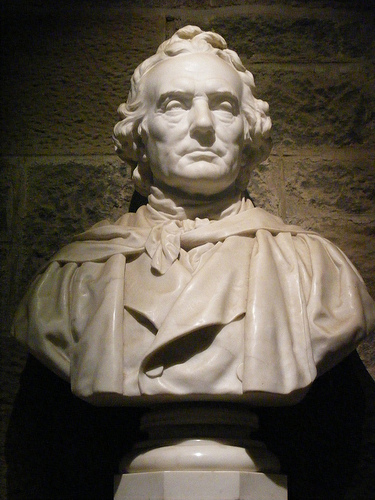 which he can render an entire and a lasting benefit to all its families—to know and be known amongst them, and thus have his liberality sweetened by the charm of aquaintanceship with those who are the objects of it—instead of dropping as heretofore of his abundance, into an ocean where it was instantly absorbed and became invisible, to pour a deep, and a sensible, and an abiding infusion into his own separate and selected portion of that impracticable mass which has hitherto withstood all the efforts of philanthropy—instead of grasping in vain at the whole territory, to make upon it his own little settlement, and thus to narrow at least the unbroken field which he could not overtake—to beautify one humble spot, and there raise an enduring monument, by which an example is lifted up, and a voice is sent forth to all the spaces which are yet unentered on—this is benevolence reaping a reward at the very outset of its labours; and such a reward, too, as will not only insure the accomplishment of its own task, but as must, from the ease, and the certainty, and the distinct and definite good which are attendant upon its doings, serve both to allure and to guarantee a whole host of imitations.”
-Thomas Chalmers, The Christian & Economic Polity of a Nation, p. 101.
Posted in Parish Theory & Practice, Thomas Chalmers | Leave a Comment »
 West Port Experiment