Feeds:
Posts
Comments

I’m certainly not well-versed in the current Reformed debates on the two kingdoms.  But what I have read in some quarters has given me the impression that the two kingdoms, church and state, ought to be as two ships passing in the night.  Each are on their own charted courses and should steer quite (quite!) clear of each other.

Now, this may be a position held in modern confessionally Reformed circles.  And it may have a pedigree going back to early 18th century American Presbyterianism.  But if my impression approximates to reality, then the position of some can hardly be advanced as classically reformed.  It may employ Melville’s famous terminology of the two kingdoms, but not the substance.

In my recent reading of the First and Second Books of Discipline (1560 and 1578 respectively) drafted by the architects of Presbyterianism, it is clear that the two kingdoms were to be distinct.  They ought not intrude on each other’s territory.  But note how they envisaged the ideal relationship, as recorded in the opening sections of the Second Book of Discipline:

10. The civil power should command the spiritual to exercise and do their office according to the word of God. The spiritual rulers should require the Christian magistrate to minister justice and punish vice, and to maintain the liberty and quietness of the kirk within their bounds.

11. The magistrate commands external things for external peace and quietness amongst the subjects; the minister handles external things only for conscience cause.

12. The magistrate handles external things only, and actions done before men; but the spiritual ruler judges both inward affections and external actions, in respect of conscience, by the word of God.

13. The civil magistrate craves and gets obedience by the sword and other external means, but the ministry by the spiritual sword and spiritual means.

14. The magistrate neither ought to preach, minister the sacraments, nor execute the censures of the kirk, nor yet prescribe any rule how it should be done, but command the ministers to observe the rule commanded in the word, and punish the transgressors by civil means. The ministers exercise not the civil jurisdiction, but teach the magistrate how it should be exercised according to the word.

15. The magistrate ought to assist, maintain, and fortify the jurisdiction of the kirk. The ministers should assist their princes in all things agreeable to the word, provided they neglect not their own charge by involving themselves in civil affairs.

Hardly did the Scottish Reformers admit the “Am I my brother’s keeper?” principle in their concept of the two kingdoms.  No, Cain ought not intermeddle in Abel’s affairs.  But neither should he ignore him as though he had relationship whatsoever.  The civil magistrate was to have a concern and exert his influence in the Kirk circa sacris.  So likewise the Kirk had a prophetic mantle to tell the civil magistrate how he ought to rule the people!
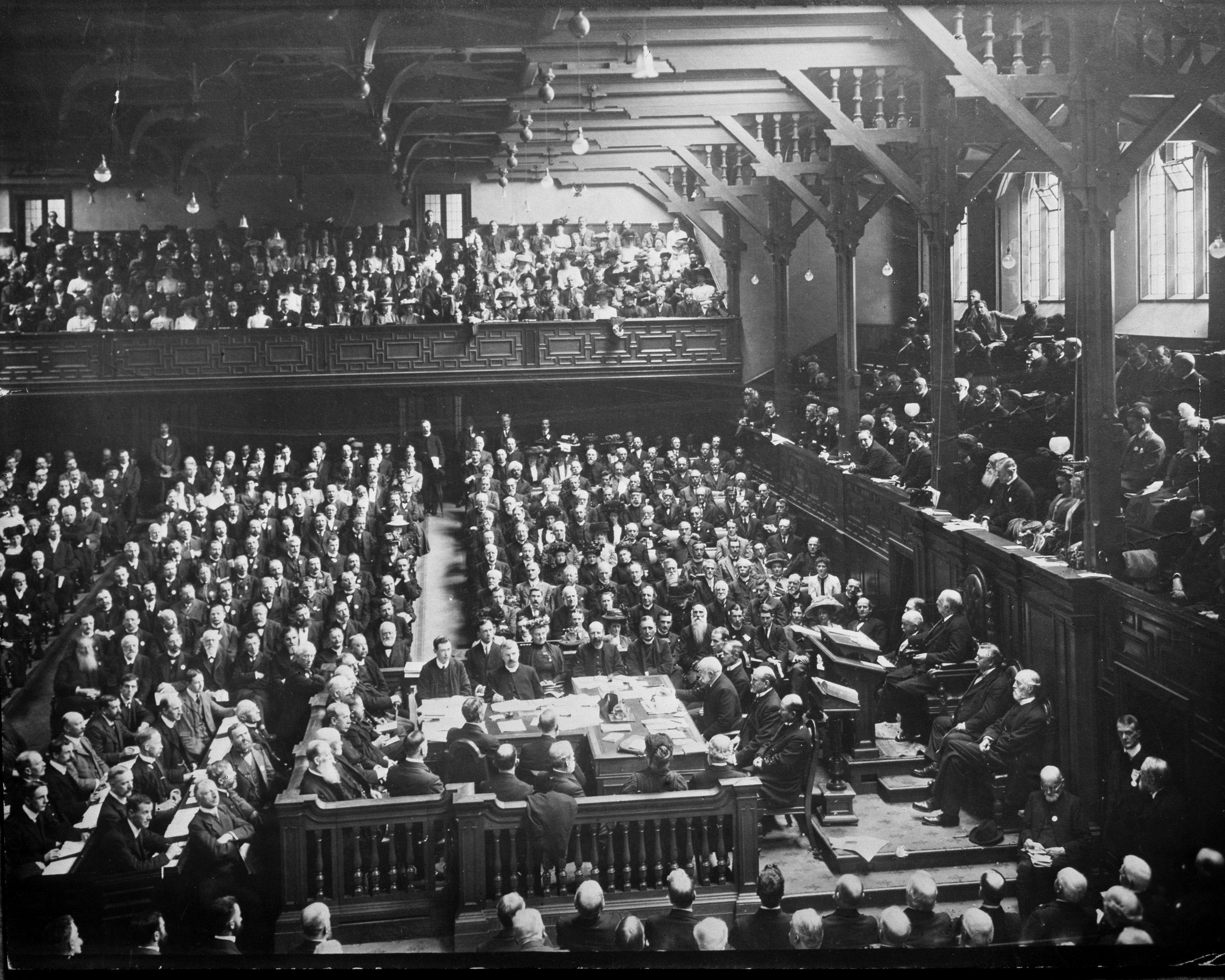

More often than not, we identify Presbyterianism as a form of church government.  But recently, it occurred to me that a preacher’s exercise of looking at good commentaries after he has done his own firsthand exegesis is also an exercise in Presbyterianism.  It is a golden mean between exegetical Independency and Episcopacy.  Exegetical Independency says ‘no’ to the fruits of other men’s labors and an unequivocal ‘yes’ to one’s own.  It is idosyncratic, and in too many instances just plain idiotic.  On the other extreme, there is exegetical Episcopacy.  It makes too much of the gifts of some, becoming slavishly subservient to them.  The preacher who rushes to the commentaries before digesting God’s Word himself buries his talent in a napkin and exalts others to a lordly status – even over Scripture.  As in church government, so in exegesis.  Presbyterianism is the golden mean.

“What a union is that which exists between two believers, who have in common the same hope, the same desire, the same mode of living, the same service of the Lord; like brother and sister, united both in spirit and in flesh, they kneel down together; they pray and fast together; they teach, exhort, and support each other with gentleness; they go together to the house of God, to the table of the Lord; they share one another’s troubles, persecutions, and pleasures; they conceal nothing from each other; they do not avoid one another; they visit the sick and succour the needy; the singing of psalms and hymns is heard among them; they rival each other in singing with the heart to their God. Christ is pleased to see and hear these things; he sends down his peace upon them. Where two or three are thus met he is with them; and where he is the Evil One can not come.”

Tertullian (c. 160 – c. 220 A.D.)

I just read a great piece by Carl Trueman on the virtue of self-restraint when engaging in theological controversy.  He essentially argues that we ought to be much more modest about our usefulness beyond the sphere God has placed us.  Most of us ought simply to retire our capes, roll up our sleeves, and channel our energies our own small, local plot.  While Trueman’s piece is by no means a formal endorsement of parochialism, my parochial mind can’t help thinking about Chalmers’ celebration of the “power of littles” and his famous dictum, “Locality, in truth, is the secret principle wherein our great strength lieth.”  Chalmers also repeatedly burst the bubbles of the pretentious who thought they could and should assume larger fields of work.  They ought rather be “sober minded” about their gifts and celebrate the giftings of others.  And work.  Locally.

Our hyper-individualized society possesses a very low sense of corporate solidarity. Every man does that which is right in his own eyes. Every man isolates himself, tears apart what God has joined together, challenging, “and who is my neighbor?” Or, “am I my brother’s keeper?” Tragically, this thinking bleeds over into the mentality of the Church. We have become conformed to this individualistic world, not transformed by the renewing of our mind. Shame on us!

When, however, we begin thinking corporately – and for that matter, inter-generationally (should I say, consistently covenantal?) – we will find ourselves doing much more than confessing our own individual sins. For starters, we will confess the sin of individualism. But what is more, we will sense the guilt that we bear as members of families, states, and nations. We will sense a shared guilt by our association with the compromised Visible Church. And we will certainly feel, in addition to our own sins, the shared sins of our forbears.

Observe this principle in Leviticus 26:40, 42, “If they shall confess their iniquity, and the iniquity of their fathers, with their trespass which they trespassed against me . . . then will I remember my covenant with Jacob, and also my covenant with Isaac, and also my covenant with Abraham will I remember; and I will remember the land.” When exiled as a punishment for their sins and the sins of their fathers, Israel ought to repent and confess both. And they should do so with the assurance that the God who shows mercy from generation to generation will do precisely that!

See this also with Daniel in his great confession. This holy man, far from isolating himself from the larger body to which he belonged, rather owned it and identified with it. Even if the nation would not confess its sin, he would do it for them. Or, more to the point, as a part of them. “We have sinned, and have committed iniquity, and have done wickedly, and have rebelled, even by departing from thy precepts and from thy judgments: neither have we hearkened unto thy servants the prophets, which spake in thy name to our kings, our princes, and our fathers, and to all the people of the land” (Dan. 9:6; see the reference to “our fathers” also in vv. 8 & 16).

Now we may not like this. We may complain, charging God with injustice. “The fathers have eaten sour grapes and the children’s teeth are set on edge” (Ezek. 18:2). But the Potter has power over the clay. And it has pleased Him to make us not bare, atomized individuals – but much more. We are also members of corporate bodies. We are waves in a larger generational stream, branches in a much bigger tree. This is biblical. This is covenantal. This is reality! Let us acknowledge it and confess our sins. Including those we share with our ancestors. And if we do, should we not expect the God of the thousand generations to remember his mercies towards us – and our children (Acts 2:39)?

Let’s face it.  Those of us who practice family worship frequently don’t feel like it, often fall into formalism, and end off hopping down way too many bunny trails.  How many times, too, is the whole business interrupted because the little one has a runny nose (or worse, smelly drawers)?  The boy isn’t sitting up?  Or older sis is annoying the younger for the umpteenth time?   And after a long day of homeschooling, errands, cleaning, and damage controlling, mom is frazzled – and dad is just plain socked.   At its best, family worship is usually nondescript; at its worst, it approaches something like a three-ring circus.

And yet, when we look back on it more impartially, we find that there has been glory there all along.   After the drill is done – and done with some habit – we see in faith that the very rhythm itself has been wonderful.  All the children know their places.  The catechumens say their lines.  The old songs of Zion are taken up and singing fills the room; and those who can’t read croon right along.  The humble family Bible is taken out, and father reads a portion.  And then the approach to the throne of grace.

Yes, it’s flawed.  Messy even.  And we must confess that it is fraught with sin.  But it is covered in the blood and accepted by the Father.  Let’s open our eyes – there is glory here.  Things into which the very angels desire to look.

The following quote from the First Book of Discipline (1560) illustrates how perceptive the Reformers were in the machinations of Satan – and human vulnerability.  Time and again, he has sought to draw the Church aside to the extremes of hyper-visibility (idolatry) and hyper-invisibility (profanity):

As Satan hath never ceased from the beginning to draw mankind into one of two extremities, to wit, that men should either be so ravished with gazing upon the risible creatures, that forgetting the cause wherefore they are ordained, they attribute unto them a virtue and power which God hath not granted unto them; or else that men should so contemn and despise God’s blessed ordinances and holy institutions, as if that neither in the right use of them there were any profit, neither yet in their profanation there were any danger: as this way, we say, Satan hath blinded the most part of mankind from the beginning; so doubt we not, but that he will strive to continue in his malice even to the end.

The Reformers sought to hold to a biblical via media in these matters.  There is a Visible Church.  Knox wished to alter the Creed from “I believe an holy kirk” to “I see (video) an holy kirk.”  Thus, the Reformers weren’t hyper-invisibilists like so many Anabaptist radicals.  But on the other hand, they were not hyper-visibilists calling believers to walk by sight and not by faith. 

We absolutely must retain this vital balance in the present climate of evangelical low-churchism.  And let us also be aware of the law of extremes.  Like the pendulum, one overreaction begets its opposite.  I’m sure Rome could become appealing to mystified followers of an eccentric old man who has to revise his end-time decrees every few years.

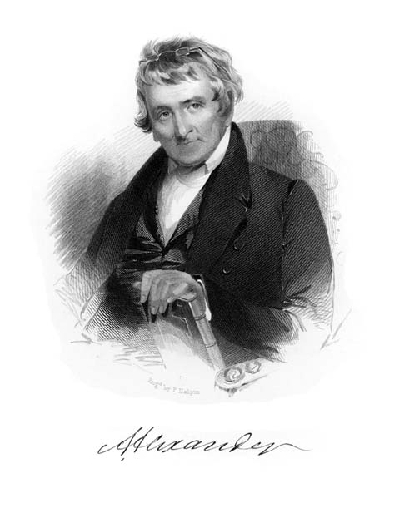
The following is a review of Ashbel Green’s Lectures on the Shorter Catechism by Archibald Alexander in 1830.  Alexander (1772-1851) was the  first President of Princeton Seminary and a venerable patriarch of American Presbyterianism.  The following presents the bulk of this review, which treats the warrant and nature of the good old plan of Presbyterian catechizing.

* * * * *

[If] we do not entirely misinterpret the temper and taste of the times in which we live, doctrinal catechisms, and lectures explanatory of such catechisms, are not the books which will be sought after and read with avidity. The religious taste of most readers is, we fear, greatly vitiated by works of fiction and other kinds of light reading. Nothing will now please, unless it be characterized by novelty and variety; and while many new means of instruction have been afforded to our youth, in which we sincerely rejoice, we are so old fashioned in our notions, as to feel regret that in our own church those excellent little summaries of Christian doctrine, the Westminster Catechisms, are falling with many into disuse. Our numerous Continue Reading »

“More knowledge is ordinarily diffused, especially among the young and ignorant, by one hour’s catechetical exercise, than by many hours’ continued discourse.”

– John Owen (1616-1683)

“Some persons preach only doctrine; that makes people all head, which is a monster. Some preach only experience; that makes the people all heart, which is a monster too. Others preach only practice; that makes people all hands and feet, which is likewise a monster. But if you preach doctrine and experience and practice, by the blessing of God, you will have head, heart, and hands, and feet – a perfect man in Christ Jesus.”  

– John “Rabbi” Duncan (1796-1870)