Feeds:
Posts
Comments

“If a poor child be capable of being thus transformed, how it should move the heart of a city philanthropist, when he thinks of the amazing extent of raw material, for this moral and spiritual manufacture that is on every side of him—when he thinks, that in going forth on some Christian enterprise among a population, he is, in truth, walking among the rudiments of a state that is to be everlasting—that out of the most loathsome and unseemly abodes, a glory can be extracted, which will weather all the storms, and all the vicissitudes of this world’s history—that in the filth and raggedness of a hovel, that is to be found, on which all the worth of heaven, as well as all the endurance of heaven, can be imprinted—that he is, in a word, dealing in embryo with the elements of a great and future empire, which is to rise, indestructible and eternal, on the ruins of all that is earthly, and every member of which shall be a king and a priest for evermore.”

– Thomas Chalmers (1780-1847)

J. W. Alexander (1804-1859) gives the following powerful observation in Thoughts on Preaching.   If we would learn how to preach, we must not start with Homiletics.  We must return ever and again “to the one thing needful.”  He writes,

The great reason why we have so little good preaching is that we have so little piety. To be eloquent one must be in earnest; he must not only act as if he were in earnest, or try to be in earnest, but be in earnest, or he cannot be effective.

We have loud and vehement, we have smooth and graceful, we have splendid and elaborate preaching, but very little that is earnest. One man who so feels for the souls of his hearers as to be ready to weep over them—will assuredly make himself
felt. . .  We must aim therefore at high degrees of warmth in our religious exercises, if we would produce an impression upon the public mind. . .

Without any increase of our numbers, the very men we now have, if actuated with burning zeal for God, might work a mighty reformation in our country.

I recently read a very troubling, yet extremely revealing quote in John Macleod’s Scottish Theology.  In the context, Macleod is  speaking of  the theological decline of the 19th century Free Church of Scotland and the erosion of confessional subscription in her ranks.  To illustrate the Zeitgeist of the time, he quotes a famous anti-confessionalist by the name of James Martineau, who apparently was an influential Unitarian.  It shows the essential grudge he and others had about the time-honored practice of ecclesiastical subscription to subordinate standards:

My protest is against a Church fixing its creed, i.e., against a prior generation of life tenants prejudging the convictions of a posterior and using their own rights to the restriction of their posterity’s.  I know well that to believe a thing true is to believe it immutable; that earnest conviction naturally excludes all suspicion of possible change and carries in it a confidence of spreading to other minds and attaining to universal recognition.  Within the limits of his proper rights I would have every man surrender himself freely to these impressions, utter them and act upon them.  But limits there certainly are to his proper rights in this respect; arising partly from the presence around him of his fellows within precisely similar feeling attached to different beliefs; partly from the certainty of successors whose faculties and opportunities are not his to mortgage.

Macleod then judiciously observes, “That is to say, men may think  for themselves that they have found the truth, but the Church must be ever learning and never able to come to the knowledge of it” (Scottish Theology, pp. 316-17).

As if the quote were not damning enough, it bears a disturbing resemblance to the words of a famous Deist, Thomas Jefferson.  Writing to James Madison in 1789, Jefferson wrote:

I set out on this ground, which I suppose to be self evident, ‘that the earth belongs in usufruct to the living’: that the dead have neither powers nor rights over it. The portion occupied by an individual ceases to be his when himself ceases to be, and reverts to the society. . . . [thus] it may be proved that no society can make a perpetual constitution, or even a perpetual law. The earth belongs always to the living generation. They may manage it then, and what proceeds from it, as they please, during their usufruct. They are masters too of their own persons, and consequently may govern them as they please.

by B. B. Warfield

The Shorter Catechism is, perhaps, not very easy to learn. And very certainly it will not teach itself. Its framers were less careful to make it easy than to make it good.  As one of them, Lazarus Seaman, explained, they sought to set down in it not the knowledge the child has, but the knowledge the child ought to have.  And they did not dream that anyone could expect it to teach itself.  They committed it rather to faithful men who were zealous teachers of the truth, “to be,” as the Scottish General Assembly puts it in the Act approving it, “a Directory for catechizing such as are of a weaker capacity,” as they sent out the Larger Catechism “to be a Directory for catechizing such as have made some proficiency in the knowledge of the grounds of religion.”

No doubt it requires some effort whether to teach or to learn the Shorter Catechism. It requires some effort whether to teach or to learn the grounds of any department of knowledge.  Our children – some of them at least – groan over even the primary arithmetic and find sentence-analysis a burden.  Even the conquest of the art of reading has proved such a task that “reading without tears” is deemed an achievement. We think, nevertheless, that the acquisition of arithmetic, grammar and reading is worth the pains it costs the teacher to teach, and the pain it costs the learner to learn them.  Do we not think the acquisition of the grounds of religion worth some effort, and even, if need be, some tears? Continue Reading »

In the previous post on building multi-generational churches, I focused mainly on the duties of parents and especially fathers.  On their shoulders, in large part, rests the future of the Church.  But of course, as we observed, the church ‘fathers’ must cultivate them, and so really it does come back to the teaching and ruling ministry of the Church at the end of the day.

The following extract from Samuel Miller (1769-1850) comes from his masterly work, The Christian Education of Children and Youth. In this passage, he urges one particular duty of church officers in raising up and retaining a godly seed for the Church.  It is the time-honored Reformed practice of pastoral catechizing of the youth:

It follows, of course, that the pastor who does not diligently attend to the religious instruction of the young people of his charge, is blind to the comfort, the acceptance, and the popularity of his own ministry. Why is it that so many ministers, before reaching an infirm old age, grow out of date with their people, and lose their influence with them? Especially, why is it that the younger part of their flocks feel so little attraction to them, dislike their preaching, and sigh for a change of pastors? There is reason to believe that this has seldom occurred, except in cases in which pastors have been eminently negligent of the religious training of their young people; in which, however respectable they may have been for their talents, their learning, and their worth, in other respects, they have utterly failed to bind the affections of the children to their persons; to make every one of them revere and love them as affectionate fathers; and, by faithful attentions, to inspire them with the strongest sentiments of veneration and filial attachment. Those whose range of observation has been considerable, have, no doubt, seen examples of ministers, whose preaching was by no means very striking or attractive, yet retaining to the latest period of their lives, the affections of all committed to their care, and especially being the favourites of the young people, who have rallied round them in their old age, and contributed not a little to render their last days both useful and happy. It may be doubted whether such a case ever occurred excepting where the pastor had bestowed much attention on the young people of his charge.

Such are some of the evils which flow from neglect on the part of the Church to train up her children in the knowledge of her doctrines and order. She may expect to see a majority of those children—even children of professors of religion—growing up in ignorance and profligacy; of course forsaking the church of their fathers; leaving her either to sink, or to be filled up by converts from without; turning away from those pastors who neglected them; and causing such pastors to experience in their old age, the merited reward of unfaithful servants (22-23).

Here is one big reason why churches, even Reformed ones, lose their youth.  The ministry has neglected catechizing.  Church catechizing, that is.  Much of the evangelical ministry today, sadly, has farmed out its duty here to ‘youth pastors’ – most of whom are often little better than glorified baby-sitters.  At best, it has delegated church education to pious, but unordained lay people.  But as Miller shrewdly observes, this passing on duty is also passing on a major opportunity.  An opportunity for the ministry to win young people’s minds to the principles of the church of their baptism, as well as an opportunity to win their hearts by sustained care and attention.  A profound insight indeed.

My mind here is taken to a beautiful mental image I have of the good Dr. Luther.   I can’t recall if it was a painting or something I read at some point – but forever irretrievable, I fear.  The master has gathered his pupils around him, and he is imparting a sacred lesson.  The little peasant catechumens are listening with rapt attention, and on occasion one is put on the spot to give an answer.   Here we see the embodiment of duty, of love, and of shrewd church policy, aimed at winning and at retaining the young.

We in the Reformed ministry must imitate our Saviour.  “Suffer the little children to come unto me, and forbid them not: for of such is the Kingdom of heaven.”  And when we are done baptizing them, let us yet hold on to them.  Let us retain them in our hearts, in our prayers, in our attentions – and in our devoted, focused instruction of them.  And combining this discipline with godly parenting in the home, by the blessing of the Spirit, shouldn’t we hope to mend the breaches in Zion’s walls?

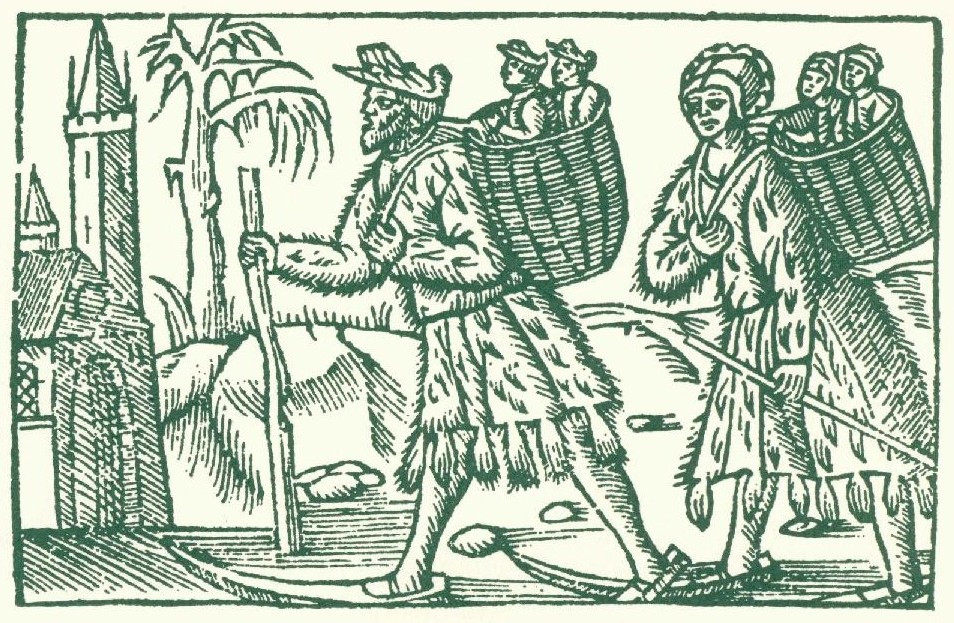
olaus-magnus-jpeg1I serve in a Presbyterian denomination with congregations generally consisting of first-generation converts to the Reformed faith and their children.  We don’t have swarms of young people, and many of them either leave for ‘greener’ Christian pastures or, sadly, go prodigal.  So retention is a problem, and ‘sustainability’ (to use an overused term) is a regular worry.  Sometimes, it is easy to feel like we’re on the high seas in a leaky rowboat, and the winds are kicking up.

I must confess that I look wistfully at some of those Presbyterian and Reformed congregations that are large, established, and multi-generational.  Without having sold out.  They are not many, of course.  Usually in the present day large equals compromised.  But God has been faithful to some communions.  The ones I know are Dutch Reformed.  They don’t just have Christian but Reformed schools.  That is, teachers have to subscribe to the subordinate standards.  Many of the children usually profess the faith in the congregations where they were baptized.  They then find mates, marry, settle down, bear children and further populate their ranks.  If not in their original congregation, then not far off.  Often in the same denomination. Continue Reading »

Thomas Chalmers (1780-1847) was an early voice opposing the compulsory, state-managed poor relief, what would later evolve into the present monster of the welfare state.  He argued that a compulsory, bureaucratized system tended to stop up four natural fountains of charity within society, fountains that had long adequately refreshed the poor in rural Scottish society for ages.  In order, these fountains were (1) personal industry, (2) the kindness of personal relatives, (3) the sympathy of the wealthy, and (4) the sympathy of the poor for each other.  Unstop these by eliminating the compulsory system, and in general, poverty is naturally relieved.  A few words from Chalmers himself on each, from his Collected Works, Vol. 14:

(1) Natural fountain # 1: personal industry.

“We know not a more urgent principle of our constitution than self-preservation; and it is a principle which not only shrinks from present suffering, but which looks onward to futurity, and holds up a defence against the apprehended wants and difficulties of the years that are to come.  Were the great reservoir of public charity, for the town at large, to be shut, there would soon be struck out many family reservoirs, fed by the thrift and sobriety, whichnecessity would then stimulate, but which now the system of pauperism so long has superseded;—and from these there would emanate a more copious supply than is at present ministered out of poor rates, to aliment the evening of plebeian life, and to equalise all the vicissitudes of its history” (402).

(2) Natural fountain # 2: the kindness of personal relatives.

“One of the most palpable, and at the same time most grievous effects of this artificial system, is the dissolution which it has made of the ties and feelings of relationship. It is this which gives rise to the melancholy list of runaway parents, wherewith whole columns of the provincial newspapers of England are oftentimes filled. And then, as if in retaliation, there is the cruel abandonment of parents, by their own offspring, to the cold and reluctant hand of public charity. In some cases, there may not be the requisite ability; but the actual expense on the part of labourers, for luxuries that might be dispensed with, demonstrates that, in most cases, there is that ability. But it is altogether the effeet of pauperism to deaden the inclination. It has poisoned the strongest affections of nature; and turned inwardly, towards the indulgences of an absorhent selfishness, that stream which else would have flowed out on the needy of our own blood and our own kindred. It has shut those many avenues of domestic kindliness by which, but for its deadening and disturbing influence, a far better and more copious circulation of needful supplies would have been kept up throughout the mass of society” (402-403).

(3) Natural fountain # 3: the sympathy of the wealthy.

By the state-managed system, the result is that the wealthy and the poor “stand to each other in a grim array of hostility—the one thankless and dissatisfied, and stoutly challenging as its due, what the other reluctantly yields, and that as sparingly as possible. . . Were this economy simply broken up, and the fountain of human sympathy again left free to be operated upon by its wonted excitements, and to send out its wonted streams throughout those manifold subordinations by which the various classes of society and bound and amalgamated together – we doubt not that from this alone a more abundant, or, at least, a far more efficient and better-spread tide of charity would be diffused throughout the habitations of indigence” (404-405)

(4) Natural fountain # 4: the sympathy of the poor for each other.

“In the veriest depths of unmixed and extended plebeianism, and where, for many streets together, not one house is to be seen which indicates more than the rank of a common labourer, are there feelings of mutual kindness, and capabilities of mutual aid, that greatly outstrip the conceptions of a hurried and superficial observer: And, but for pauperism, which has released immediate neighbours from the feeling they would otherwise have had, that in truth the most important benefactors of the poor are the poor themselves— there has been a busy internal operation of charity in these crowded lanes, and densely peopled recesses, that would have proved a more effectual guarantee against the starvation of any individual, than ever can be reared by any of the artifices of human policy” (405).
“And because we are all too fond of ourselves, we are not able to recognize or judge our own deeds properly. Therefore, if we do not have a good and high opinion of those whom the Lord has placed over us, and who are to instruct, exhort, admonish and correct us on his behalf, and do not immediately receive their words and teaching with all fear and trembling as the Lord’s own words and teaching, then we will get nowhere and will not progress in the pursuit of godliness, as is our current and daily practice.”

Martin Bucer (1491-1551)

“Though the foundations of the world should be ripped up, and the heavens clatter together, and the whole fabric of them be unpinned and fall to pieces, the firmest parte of it dissolved; yet the church [shall] continue in its stability, because it stands not upon the changeableness of creatures, but is built upon the immutable rock of the truth of God, which is as little subject to change, as his essence.”

-Stephen Charnock (1628-1680)

“And therefore I feared not to affirm, that of necessity it is, that such as hope for life everlasting avoid all superstition, vain religion, and idolatry. Vain religion and idolatry I call whatsoever is done in God’s service or honour, without the express commandment of his own Word.”

– John Knox (c. 1514-1572)