Feeds:
Posts
Comments

1629_seal_Massachusetts_Bay_Colony_MassachusettsArchivesThe following is an excerpt from The Charter of Massachusetts Bay, 1629.  The royal charter, in the name of “CHARLES, BY THE, GRACE, OF GOD, Kinge of England, Scotland, Fraunce, and Ireland, Defendor of the Fayth, &c.” was drafted with the view that the “said People, Inhabitants there, may be soe religiously, peaceablie, and civilly governed, as their good Life and orderlie Conversacon, maie wynn and incite the Natives of Country, to the KnowIedg and Obedience of the onlie true God and Sauior of Mankinde, and the Christian Fayth, which in our Royall Intencon, and the Adventurers free Profession, is the principall Ende of this Plantacion.”

Alas, “from the daughter of Zion all her beauty is departed” (Lam. 1:6).

Below, Chalmers makes a compelling case against the notion that a Christian ruler must leave his religion at the door of public office.  Men are men, privately and publicly.  And Christian men must be Christian men wherever they go, advocating good and resisting evil according to their place and calling:

“A righteous and religious monarch, or righteous and religious senators, must impress their character on their acts; nor can we understand the distinction, or rather the disjunction, which is spoken of in these days, between Christian governors and a Christian government. We have no such notion of the moral that we have of the physical chemistry, in the compounds of which, the properties of the ingredients may be changed or disappear. The corporation of a state cannot be thus denaturalised, or reduced to a sort of caput mortuum, discharged of all soul and all sentiment—as if by a process of constitution-making in the crucibles of a laboratory. The cold metaphysical abstraction that is thereby engendered, may exist in the region of the ideal; but it does not exist in the region of the actual, nor even in the region of the possible; for men, though convened within the hall of a legislative assembly, will not, therefore, forget that they are men; or think that they must renounce all care for the highest well-being of families, when called to deliberate on the well-being of a nation.”

Hardly rocket science.

Glasgow_map_1878“Now the specific business which we would like to put into the hands of a Christian minister is, not that he should fill his church any how – that he may do by the superior attractiveness of his preaching, at the expense of previous congregations, and without any movement in advance on the practical heathenism of the community: But what we want is, to place his church in the middle of such a territory as we have now specified and to lay upon him a task, for the accomplishment of which we should allow him to the labour and preference of a whole lifetime; not to fill his church any how, but to fill this church out of that district. We should give him the charge over head, of one and all of its families; and tell him, that, instead of seeking hearers from without, he should so shape and regulate his movements, that, as far as possible, his church-room might all be taken up by hearers from within. It is this peculiar relation between his church, and its contiguous households, all placed within certain geographical limits, that distinguishes him from the others as a territorial minister.”

– Thomas Chalmers

In the following, we hear Thomas Chalmers echoing the sentiment of the inspired apostle, “I am debtor both to the Greek, and to the barbarian, to the wise and to the unwise . . . to preach the Gospel.” This is a timeless reminder to be a minister who is truly all things to all men, and not slavishly ‘relevant’ (beholden?) to a narrow slice of the demographic pie.

* * *

“There is no doubt the vanity of popular applause; but there is also the vanity of an ambitious eloquence, which throws the common people at a distance from our instructions altogether; which, in laying itself out for the admiration of the tasteful and enlightened few, locks up the bread of life from the multitude; which destroys this essential attribute of the gospel, that it is a message of glad tidings to OLYMPUS DIGITAL CAMERAthe poor; and wretchedly atones by the wisdom of words, for the want of those plain and intelligible realities which all may apprehend and by which all may be edified. Now the great aim of our ministry is to win souls; and the soul of a poor man consists of precisely the same elements with the soul of a rich. They both labour under the same disease, and they both stand in need of the same treatment. The physician who administers to their bodies brings forward the same application to the same malady; and the physician who is singly intent on the cure of their souls will hold up to both the same peace-speaking blood, and the same sanctifying Spirit, and will preach to both in the same name, because the only name given under heaven whereby men can be saved. . . . We hear of the orator of fashion, the orator of the learned, the orator of the mob. A minister of the gospel of Jesus Christ should be none of these; and, if an orator at all, it should be his distinction that he is an orator of the species. He should look beyond the accidental and temporary varieties of our condition; and recognise in every one who comes within his reach, the same affecting spectacle of a soul forfeited by sin, and that can only be restored by one Lord, one faith, one baptism.”

Thomas Chalmers (1780-1847) in his 1829 sermon, On Religious Establishments, addresses a long-standing objection to establishments.  They necessarily corrupt the Church, and history demonstrates it.  The Church only declined after the Edict of Milan.  But, Chalmers counters, the Voluntaries fallaciously mistake the cause.  The source of the secularization was not the state – it was the Church itself.  There is no fault in the contract of these two independent parties, each laboring in its own separate sphere, yet supporting each other mutually.  The fault rests with the party who abuses the contract.  And before the Reformation, it was not the Church that got the raw end of the deal:

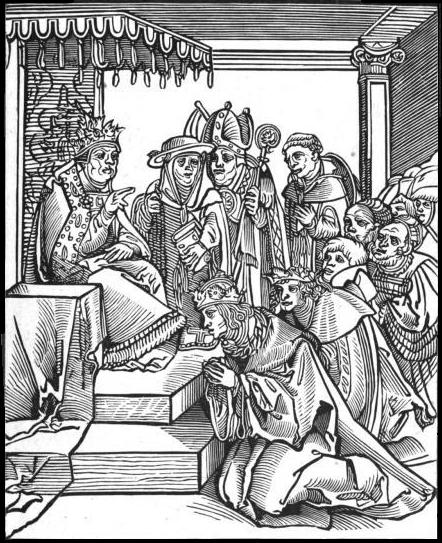
“There is a kind of vague and general imagination, as if corruption were the invariable accompaniment of such an alliance between the civil and the ecclesiastical; and this has been greatly fostered, by the tremendously corrupt Popery, which followed in historical succession after the establishment of Christianity in the days PopeKissing_Feetof Constantine, and which certainly holds out, in vivid contrast, the difference between this religion in the period of its suffering, and this religion in the period of its security and triumph. But it were well to discriminate the precise origin of this frightful degeneracy. It arose not from without; it arose from within. It was not because of any ascendency by the state over the church whom it now paid, and thereby trenched upon its independence in things spiritual. It was because of an ascendency by the church over the state, the effect of that superstitious terror which it wielded over the imaginations of men, and which it most unworthily prostituted to the usurpation of power in things temporal. The fear that many have of an establishment, is, lest through it, the state should obtain too great power over the church, and so be able to graft its own secularity, or its own spirit of worldliness, on the pure system of the gospel,—whereas the actual mischief of Popery, Continue Reading »

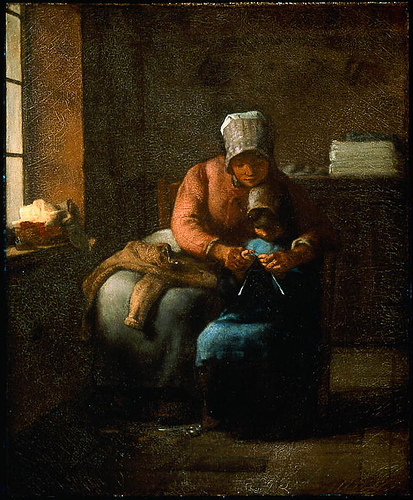
http://www.flickr.com/photos/sharkseason/1419160463/in/photostream/lightbox/“Keep your children as long as you can in your own house. Domestic feeling is a sacred tie which should be preserved fresh and strong—as long as possible. Often, mothers lose all their influence over sons by their being sent abroad to school. Have as much of your children’s education, therefore, conducted at home, as is practicable. Be assured that no place is so favorable to the good feelings and morals of the young as the family circle, unless the family be destitute of religion and virtue; and for such I do not now write.

“Boarding schools for girls may be useful—but I would advise you to keep your daughters at home, under your own eye, and when they go to school in the day, let them come home by night. You may possibly find a better school by sending them abroad—but the sacrifice is too great, and the risk of evil habits and evil sentiments is not small. And as to your sons, if they must go abroad, place them in the family of some pious man, and under the maternal care of some pious woman, where they may find a substitute for parental attention. While absent, let them return home as frequently as they can, that what I have called the ‘domestic’ feeling may be preserved. If your sons must be put to a trade, or become clerks in a store or counting-house, be very particular as to the character and conscientious fidelity of their master. It is lamentable to see how youth in these circumstances are neglected; and how they are exposed to temptations from which it is hardly possible they can escape without guilt and contamination.”

– Archibald Alexander (1772-1851)

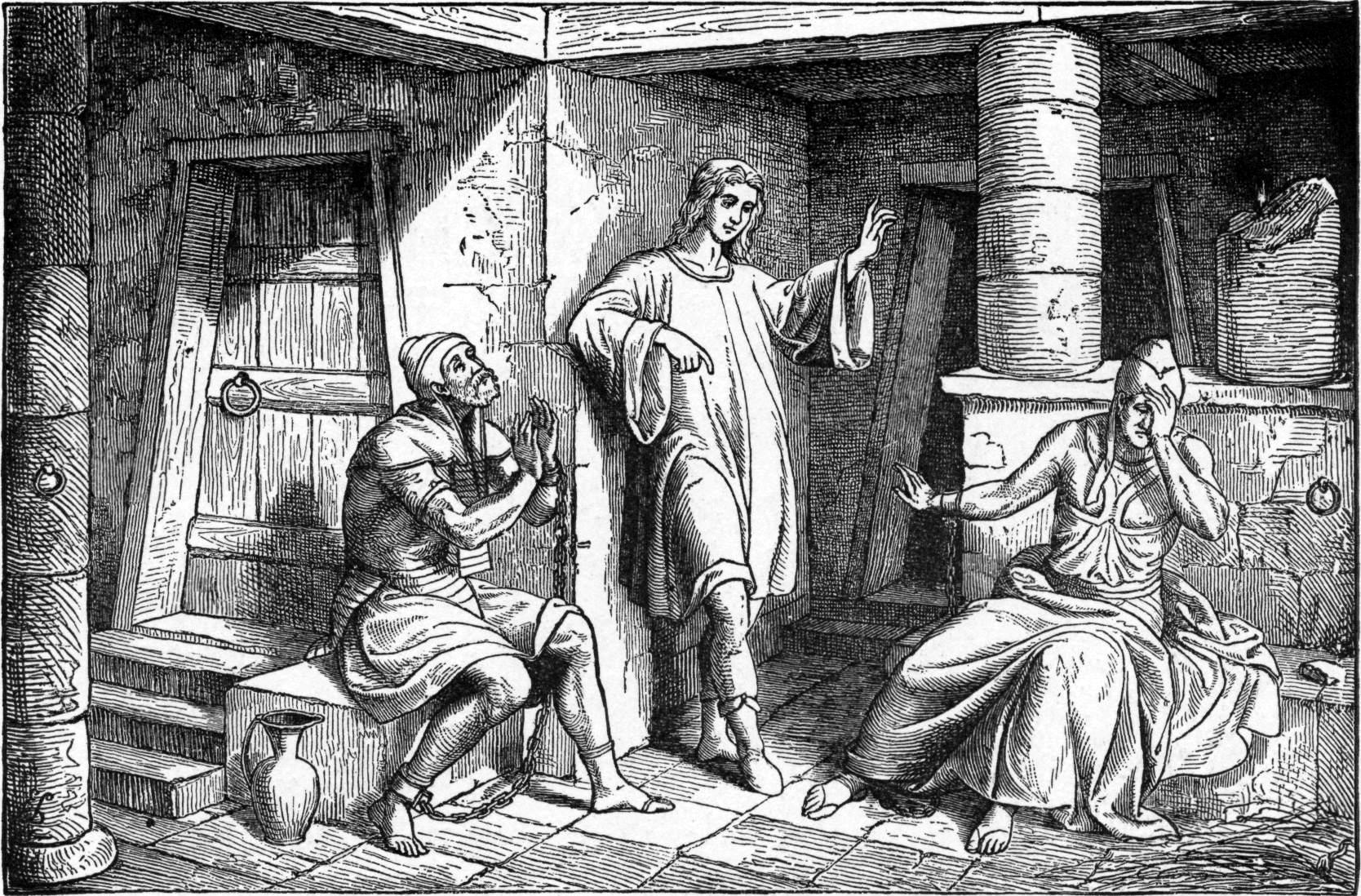
Foster_Bible_Pictures_0051-1_Joseph_Interprets_the_Prisoners'_Dreams“There is sometimes a very great similitude between true and false experiences, in their appearance, and in what is expressed and related by the subjects of them: and the difference between them is much like the difference between the dreams of Pharaoh’s chief butler and baker; they seemed to be much alike; insomuch that when Joseph interpreted the chief butler’s dream, that he should be delivered from his imprisonment, and restored to the king’s favor, and his honorable office in the palace, the chief baker had raised hopes and expectations, and told his dream also; but he was woefully disappointed; and though his dream was so much like the happy and well-boding dream of his companion, yet it was quite contrary in its issue.”

-Jonathan Edwards

William Hanna, son-in-law and biographer of Thomas Chalmers, here reflects on the bearing of Chalmers’ inner, spiritual history on his outer history in the public light.  Inner histories are certainly more inaccessible and uncertain to others.  “For what man knoweth the things of a man, save the spirit of man which is in him?”  Even self-knowledge is murky at best.  Yet with the infallible light of Scripture, we may shed light on what is left us of the inner-histories of great men, shaping the parts they played on the stage of divine providence.

* * *

“The events in which Dr. Chalmers mingled, and which ho helped so much to mould, were far from engrossing his thoughts. The part he took in them was in fact the product of those deeper convictions which rested upon the unseen and enduring objects of faith. Behind the outer history of his life there lay that inner spiritual history which made the other what it was. His correspondence, his speeches, his published writings, and his public acts, which furnish such ample materials for unfolding the one history, are absolutely barren as to the other. We know of no other iImagendividual of the same force and breadth of Christian character, who, in all his converse, public and private, with his fellow-men, spoke so little of himself, or afforded such slender means of information as to his own spiritual condition and progress, and yet it would be difficult to name another of whose deeper religious experience we have so full and so trustworthy a record. We owe this to the openness and perfect truthfulness of his private Journal. The strict reserve which he observed in his communications with others he entirely laid aside when communing with his own heart, the fullness of the one disclosure more than atoning for the stintedness of the other. The very breaks and gaps, the compressed or the expanded condition of his private Journal, when studied in connection with his external occupations during different periods, are themselves instructive. Judged of in this way, the year 1840 formed a marked epoch in his spiritual life, as exhibiting the commencement of that softening, refining, elevating process which, ripening to perfection, threw such a pure and mellow light of piety around his closing years—a light whose chastened lustre was perceived and felt even by those who saw not into the place of its birth.”

 

rainy_day_wallpaper_series_5_out_of_7_by_moggget-d5ddcjf“I find that principle and reflection afford a feeble support against the visitations of melancholy. It is a physical distemper, and must be counteracted by physical means. It is not the direct application of reason that will school it down, any more that it can cure the discomfort of your physical sensations when placed in an overheated room, for example. But it is our duty to apply whatever experience tells us is a corrective against those unpleasant feelings which agitate, and enfeeble, and render unfit for any useful exertion. It is not my duty to feel cool and comfortable when placed in a confined room; but it is my duty to rise and open the window if this can restore me to my wonted capacity of exertion. It is perhaps not my duty to summon up a cheerfulness of mind in the hour of unaccountable despondency, for perhaps this is an affair as completely beyond the control of reason as any other of our physical sensations; but it is my duty to study, and, if possible, to devise expedients for restoring me from this useless and melancholy state. Now, all experience assures me that regular occupation is that expedient; and it is my duty, if I find myself unequal to the severity of my usual exercises, to devise slighter subjects of employment which can be resorted to in the time of necessity. This I esteem to be an important part of moral discipline. Writing a fair copy of an old production which you wish to preserve, setting your books and papers into a state of greater arrangement, writing letters, looking over your accounts, and making slight but interesting calculations about your future gains and future expenditure,—these, and a number of other subjects of occupation, should occur to be ever ready to offer themselves as correctives to melancholy. Let me cultivate, then, that habit of exertion which will not shrink from a remedy which I find so effectual.”

-Thomas Chalmers (1780-1847)

From "A Christmas Story" (1983)It’s Christmas Eve, and we’re among the very precious few nowadays who aren’t doing anything special. Though we are committed Christians, we don’t observe this holiday – though we love and embrace all sincere Christians who celebrate the God who entered our world of sin and misery through a virgin’s womb. Yet, unlike the masses both of saints and seculars, for us this is just another Monday. And tomorrow is just another Tuesday. Continue Reading »