Feeds:
Posts
Comments

IMG_4156“I will come by you into Spain.” (Rom. 15:28)

Ever since I turned my sights to South Providence, there was no looking back. While conversions have been slow in coming (O come, Holy Spirit!), yet there has been a striking openness, especially among the Hispanic community there. I have been invited into the homes of many families and sweet, little old ladies, proclaiming the timeless truth of Jesus with my rather flawed, Gringo-Spanish. I have many an open door to read Scripture, expound, exhort, and pray. And of course, I’m keen to introduce the richness of the Reformed faith where there is quite a range of sub-par ‘Christianities.’

The struggle, of course, has been that our regular services have only been in English. With our slender resources, we’ve done various things to bridge the gap. We’ve had special midweek meetings with translation. And we’ve attempted on and off to have our services translated into Spanish. But because I can’t predict when someone will take up the offer to worship with us, it has really put a damper on that project.

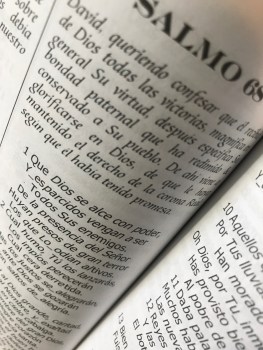
Well, in recent weeks, things have changed. One Hispanic family – we’ll give them the surname here, “Ortega” – has started coming. Last Lord’s day was the second time in three weeks, and they seem rather interested. A brother in our church and I had met them doing door to door a couple of years back, and they were quite receptive. Finally, something clicked. They came to our uber-Presbyterian, psalm-singing, KJV-reading church … and they weren’t scared away. They seem to track with and appreciate the preaching. It is a young unmarried couple with a little boy and a grandmother. The couple is evidently unconverted, whatever their opinions of their state might be. The grandmother seems to be a devout Bible reader, judging from her very used copy.

The couple is bilingual, but the grandmother is not. So we’re working on some kind of translation of my sermons, which is not straightforward. If you are bilingual, Reformed, and willing to help from a distance, please drop us a note!

And please keep these folks in prayer. They could easily lose interest and drift away. I’m quite prepared for that, as I’ve seen in my day many promising starts fizzling out. Please pray ultimately for a regenerating baptism of the Spirit of God, clothing the Word with power.

We were also struck that a Liberian sister who joined our church from the outreach saw the young lady and realized that they were good friends from high school. Perhaps I shouldn’t read too much into that. But a coincidence? I think not.
More about RPM.

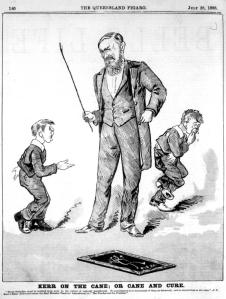
StateLibQld_1_113036_Cartoon_of_students_receiving_the_cane,_1888Thomas Chalmers (1780-1847) sharing about how the Tron church Sabbath school leadership worked through disciplinary issues with their sometimes rowdy students. Insightful and amusing!

“Although we had no set forms of teaching, yet we conversed over all the modes that we might find out the best. On one point we had much discussion, namely, whether or not punishment should be resorted to in a Sabbath-school. Mr. Stow was very strenuous in condemning its introduction—I was rather inclined the other way. Among other strong cases, Mr. Stow told us of a boy who had been so restless, idle, and mischievous, that he was afraid he would have to put him away, when the thought occurred to him to give the boy an office. He put, accordingly, all the candles of the school under his care. From that hour he was an altered boy, and became a diligent scholar. An opportunity soon occurred of trying my way of it also. A school composed of twenty or thirty boys, situated in the east end of the parish, had become so unruly and unmanageable, that it had beaten off every teacher who had gone to it. The Society did not know what to do with it, and the Doctor asked me if I would go out and try to reduce it to order. I was not very fond of the task, but consented. I went out the next Sabbath, and told the boys, whom I found all assembled, that I had heard a very bad account of them, that I had come out for the purpose of doing them good, that I must have peace and attention, that I would submit to no disturbance, and that, in the first place, we must begin with prayer. They all stood up, and I commenced, and certainly did not forget the injunction,—Watch and pray. I had not proceeded two sentences, when one little fellow gave his neighbour a tremendous dig in the side; I instantly stepped forward and gave him a sound cuff on the side of his head. I never spoke a word, but stepped back, concluded the prayer, taught for a month, and never had a more orderly school. The case was reported at one of our own meetings. The Doctor enjoyed it exceedingly, and taking up my instance and comparing it with Mr. Stow’s, he concluded that the question of punishment or non-punishment stood just where it was, inasmuch as it had been found that the judicious appointment of a candle-snuffer-general and a good cuff on the lug had been about equally efficacious.”

These images accompany the post, “A handheld Ebenezer.”


A few years back, our family traveled to the U.K. by way of Holland. One of my daughters became entranced by all things Dutch while aboard a KLM flight, with tall, blonde and brunette stewardesses speaking freely in their mother tongue. While she had little firsthand experience of modern Dutch culture, she already had some exposure to the richness of Dutch Christianity, having read Brother Andrew’s God’s Smuggler (re-read chapter 1!) and Corrie ten Boom’s The Hiding Place. And it wasn’t long before she started trying to learn Dutch online. So when I found myself back in Grand Rapids, I had my antennae up, on the lookout for a trinket for my Lowlands-smitten girl.

I was staying for a week at my hosts, the Kamps, the dearest Christian seniors you will ever meet. When my daughter came up in conversation, they really rose to the occasion. Mrs. Kamp right then and there hopped up, and busily rifled through her very tidy house (are there any messy Hollanders?). I would have been quite content with a cheap curio, something easily parted with and forgotten. While she did hand me a few inexpensive momentos, I was profoundly humbled that she offered the old book above without so much as a blink.

The volume is a late 19th century Dutch New Testament, a metrical Psalter set to the grand old Geneva tunes, and at the end, the Three Forms of Unity. The book exudes the “beauty of holiness” from the best of their heritage and serves as a handheld Ebenezer of God’s covenant faithfulness. As I hold it in my latecomer, ‘Gentile’ hands, I glory in a rich tradition I now own. In it, I hear the voice of generations past, confessing the true, Reformed religion, their “only comfort in life and in death.” I hear the august psalmody of the venerable dead, the spirits of just men made perfect who have gone to their reward. I hear their roaring thunder as they, the great cloud of witnesses, cheer us on while we yet run the race that is set before us.

I have been grafted into the good olive tree, as the Dutch, the Scots, the English, and many others before me. And my children, by covenant, are now holy to the Lord. May they too own “their father’s God.” May they never reject what they have received, selling their birthright for a full stomach. And may they cherish this volume and all that is stands for in an age that is fast losing its way.

For more images, visit here.

In this 1816 charge to Thomas Chalmers’ newly elected elders, he winsomely appeals to them to ‘repair the breaches’ of the old system of spiritual, district visitation. Let the elders together with the ministers be once again the friends and spiritual patrons of all men, especially the poor. Ad urbem!

* * *

“I am well aware how widely the practice of our generation has diverged from the practice of our ancestors—how, within the limits of our Establishment, the lay office-bearers of the Church are fast renouncing the whole work of ministering from house to house in prayer and in exhortation and in the dispensation of spiritual comfort and advice among the sick or the disconsolate or the dying. On this subject I urge nothing upon you. I am aware that a reformation in this department can only be brought about by an influence of a more gentle and moral, and withal more effectual kind than that of authority; and I shall therefore only say that I know of almost nothing which would give me greater satisfaction than to see a connexion of this kind established between my elders and the population of those districts which are respectively assigned to them—that I know of nothing which would tell more effectually in the way of humanizing our families, than if so pure an intercourse were going on as an intercourse of piety between our men of reputable station on the one hand, and our men of labour and of poverty on the other,—I know of nothing which would serve more powerfully to bring and to harmonize into one firm system of social order the various classes of our community; I know not a finer exhibition, on the one hand, than the man of wealth acting the man of piety, and throwing the goodly adornment of Christian benevolence over the splendour of those civil distinctions which give a weight and a lustre to his name in society; I know not a more wholesome influence, on the other, than that which such a man must carry around him when he enters the habitations of the peasantry, and dignifies by his visits the people who occupy them, and talks with them as the heirs of one hope and of one immortality, and cheers by the united power of religion and of sympathy the very humblest of misfortune’s generation, and convinces them of a real and longing affection after their best interests, and leaves them with the impression that here at least is one man who is our friend, that here at least is one proof that we are not altogether destitute of consideration amongst our fellows, that here at least is one quarter on which our confidence may rest—ay, and amidst all the insignificance in which we lie buried from the observation of society, we are sure at least of one who, in the most exalted sense of the term, is ever ready to befriend us, and to look after us, and to care for us.”

“We would appeal, in this connection – progressiveness – specially to the practical and practicable character of Old-Testament legislation. And thus we are led to assert that those very passages concerning polygamy and kindred themes (which have been made an occasion of gibe against the Scriptures) are themselves a most cogent argument for their divine origin. We Americans ought to know by this time that the best way to secure polygamy unharmed and enshrine it unconquerably under the protection of a nation is to write on the statute-books inoperative laws against it. The Bible was framed by too wise a statesman to fall into that error, and we who enjoy Christian homes to-day have to thank God for it. The unspeakable wisdom of dealing at that age, and under those circumstances, with polygamy, divorce, slavery by regulative laws, which in regulating discouraged, and in discouraging destroyed them, makes strongly for a superhuman origin of the legislation.”

– B. B. Warfield

And O what a hard matter it is to deal with people that are ready to leave the world, and step in upon eternity! when their souls do, as it were, hang on their lips, and they have one foot (as we use to say) already in the grave! The minister is seldom sent for till the physician has given the patient over, and then they beg him to dress their souls for heaven, when their winding-sheet is preparing, and their friends are almost ready to dress the body for the funeral. Now, though some of these have lived well, and, like the wise virgins, have, oil in their lamps, yet it is a great matter to calm them, and to dispose their souls for that great change they are presently to undergo. But alas! it fares otherwise with the greatest part: they are yet strangers to the ways of religion; the work of their salvation is yet to begin, and their lusts to be mortified, their corruptions subdued, the whole frame of their souls to be changed: and though they have scarce so much strength as to turn them on their beds, yet their warfare against principalities, powers, and spiritual wickedness, is but newly commenced: their work is great, their disadvantages many, and the time very short that is before them. Perhaps they are dull and insensible, and we shall hardly persuade them of their danger: they will acknowledge they are sinners, and so are all others as well as they: they trust in the mercies of Christ, and have confidence enough of their salvation, and cannot be persuaded they want any thing that is necessary for the same. Others of these, again, are seized with fear, and call for the minister to comfort them: what shall he do? Shall he tell them that all their terrors are just, and it is now too late to repent? I know some divines are peremptory in this case, and think they should be left in despair: but sure it were a sad employment for a minister to go to visit a dying man, only to tell him he is damned: and withal, it is too great boldness in us to limit the grace and mercy of God. True and sincere repentance will never come too late, but certainly a death-bed repentance is seldom sincere; and it is hard either for the minister or the man himself to tell, whether it be only the fear of hell, or a true and godly sorrow that he feeleth in his soul. All that a minister can do, is to press him to all possible seriousness, and to resign himself to God for the event; or to lay before him in general, the terms and conditions of the gospel covenant: the application will be hard and uncertain. These, and many more, are the difficulties of the ministerial function.

-Henry Scougal (1650-1678)

Secondly, propitiation is not a turning of the wrath of God into love. The propitiation of the divine wrath, effected in the expiatory work of Christ, is the provision of God’s eternal and unchangeable love, so that through the propitiation of his own wrath that love may realize its purpose in a way that is consonant with and to the glory of the dictates of his holiness. It is one thing to say that the wrathful God is made loving. That would be entirely false. It is another thing to say the wrathful God is loving. That is profoundly true. But it is also true that the wrath by which he is wrathful is propitiated through the cross. This propitiation is the fruit of the divine love that provided it. “Herein is love, not that we loved God, but that he loved us and sent his Son to be the propitiation for our sins” (I John 4:10). The propitiation is the ground upon which the divine love operates and the channel through which it flows in achieving its end.”

-John Murray, Redemption Accomplished & Applied

IMG_1621“The Assembly, considering that the long-waited-for fruits of the Gospel, so mercifully planted and preserved in this land, and the reformation of ourselves and families, so solemnly vowed to God of late in our Covenant, cannot take effect except the knowledge and worship of God be caried from the pulpit to every family within each parish, hath, therefore, appointed that every minister, besides his paines on the Lord’s day, shall have weekly catechising of some part of the paroch, and not altogether cast over the examination of the people till a little before the communion. Also, that in every familie the worship of God be erected where it is not both morning and evening, and that the children and servants be catechised at home by the masters of the families, whereof account shall be taken by the minister and elders assisting him in the visitation of every family; and, lest they fail, that visitation of the severall kirks be seriously followed by every Presbyterie, for this end among others. The execution and successe whereof, being tried by the Synods, let it be represented to the next Generall Assembly.
-Acts of the General Assembly of the Church of Scotland, 1639

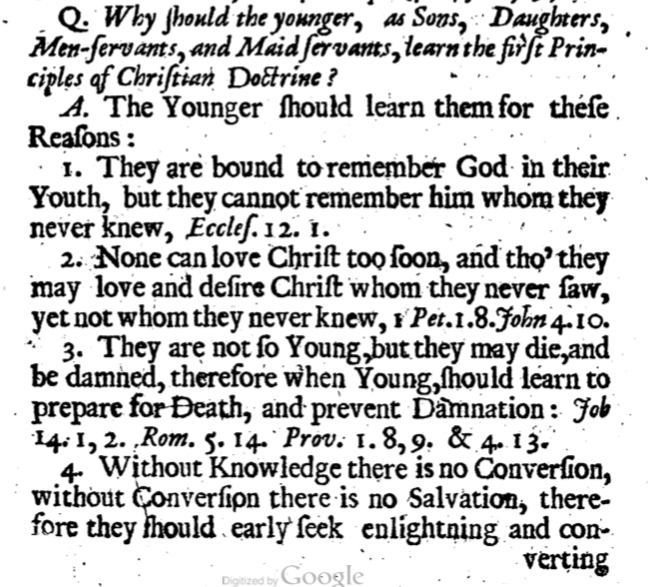
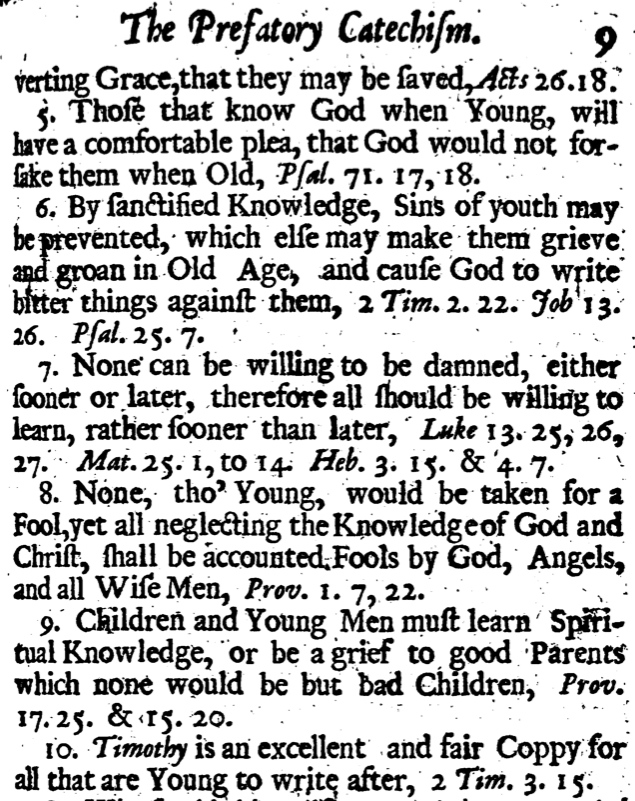
This late 17th century treatise on ministerial catechesis by Robert Doolittle is simply masterful. A few highlights are worth mentioning. He argues that catechesis should not just be a discipline for the young, but also for the old. One is also struck by the great importance he places on stocking the mind with the furniture of foundational, biblical doctrine. And it is hardly an academic exercise – eternity hangs in the balance. No knowledge, no salvation!

Below is a sample. I’ve simply inserted images from the document. Yes, it’s in an old script. But give it a go, and it will come before long. Note that some s’s look like f’s.