Feeds:
Posts
Comments

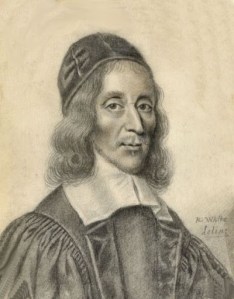
The following chapter entitled, “The Parson Catechizing,” is taken from George Herbert’s (1593-1633) classic of pastoral theology, A Priest to the Temple, or, The Country Parson his Character and Rule of Holy Life. Herbert, a celebrated English poet, was a minister in the Church of England. Though a conformist, his work surely merits serious attention by the heirs of nonconformity – a definitely pre-Baxter Baxterian. May the lost duty & art of pastoral catechizing be revived and stimulated by this rich contribution! [Recorded in audio here.]

* * * *
unnamed

The Country Parson values catechizing highly: for there being three points of his duty; the one, to infuse a competent knowledge of salvation in every one of his flock; the other, to multiply, and build up this knowledge to a spiritual temple; the third, to inflame this knowledge, to press, and drive it to practice, turning it to reformation of life, by pithy and lively exhortations; catechizing is the first point, and but by catechizing, the other cannot be attained. Besides, whereas in sermons there is a kind of state, in catechizing there is an humbleness very suitable to Christian regeneration; which exceedingly delights him as by way of exercise upon himself, and by way of preaching to himself, for the advancing of his own mortification; for in preaching to others, he forgets not himself, but is first a sermon to himself, and then to others; growing with the growth of his parish.

He useth, and preferreth the ordinary church catechism, partly for obedience to authority, partly for uniformity sake, that the same common truths may be every where professed, especially since many remove from parish to parish, who like Christian soldiers are to give the word, and to satisfy the congregation by their catholic answers.

Continue Reading »

IMG_9458So a young lady, “Leah,” has come within our church’s orbit from our S. Providence outreach. Her story is shared here and here.
Leah doesn’t have a credible profession of faith, though she considers herself a Christian. In many ways, she is as the Ninevites of old, who did not know their “left hand from their right” in spiritual matters. But she has been encouraging in many ways. Since November, she has been faithfully coming to church with her precious little baby boy and eagerly participating in a Bible study. So far, we’ve tackled the first fourteen chapters of Genesis.

Continue Reading »

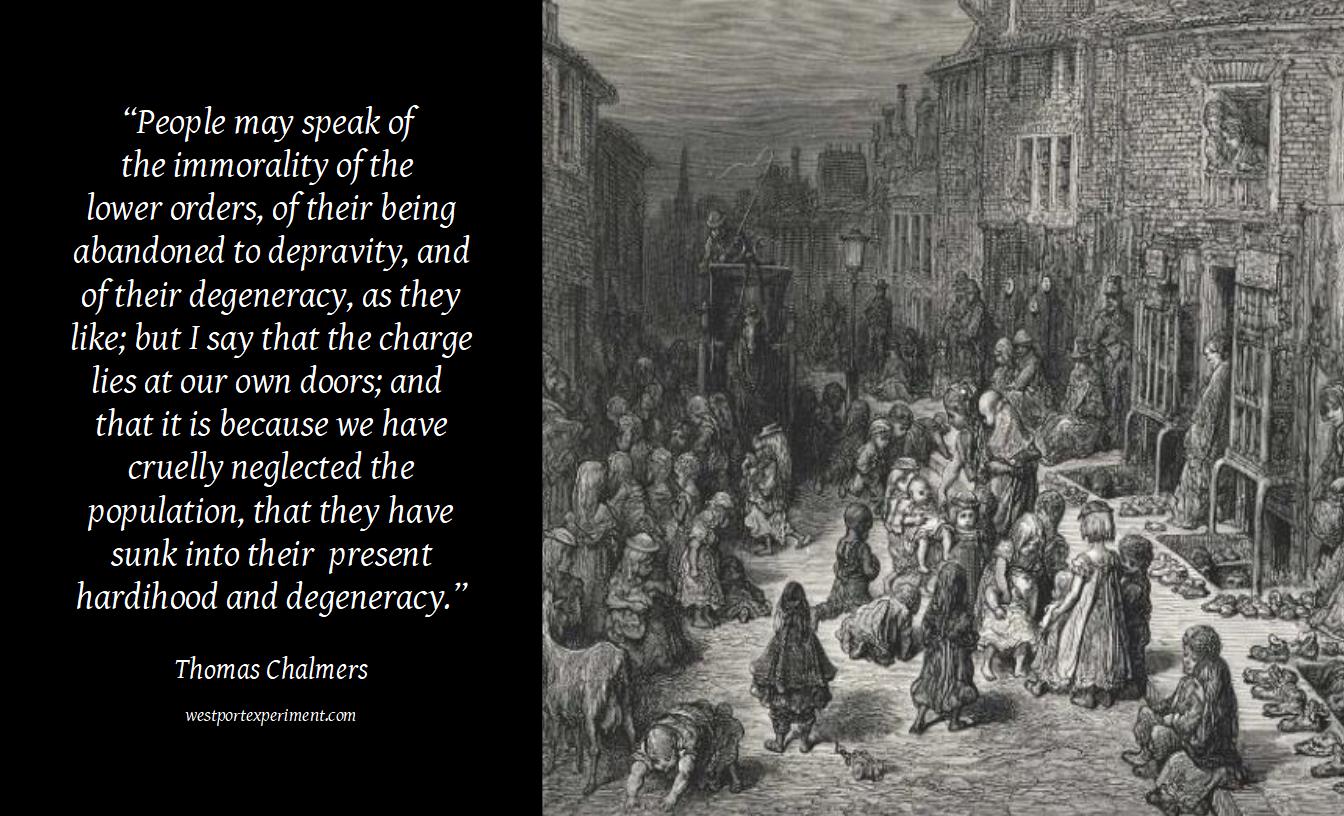
Chalmers, A Neglected Population

The rest of the quote runs, “And I say, farther, that there is a smouldering flame gathering at the bottom of the social edifice, which, if it be not speedily met and extinguished, will upheave the social edifice from its base, and overthrow all the institutions of the country.”

From “Dr. Chalmers’ Lecture,” Witness, June 19th, 1844

Image (6)Image (7)

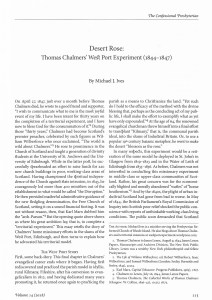
My 2018 journal article, “Desert Rose: Thomas Chalmers’ West Port Experiment (1844-1847),” published in the 2018 edition of The Confessional Presbyterian. Images used by permission. To purchase a copy, click here.

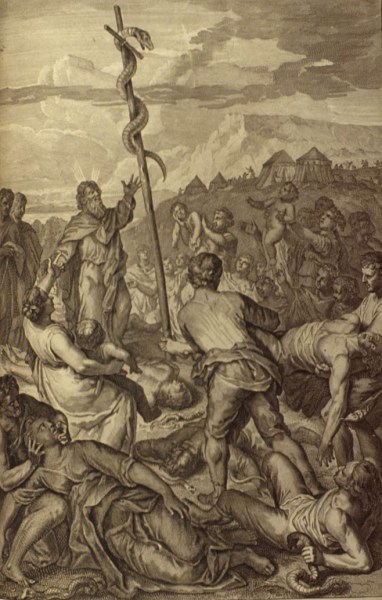
Figures_Moses_fixes_the_brazen_Serpent_on_a_pole

“As to the attendance of the people on the Sabbath ministrations of the missionary, you will doubtless find that they will give you very fair promises. They may all say they will go to church; but by many of them the promises will not be kept. In such circumstances, a very good plan, which I would recommend to you, would be this, — Let either the agent of the district, or some person on whom he can depend, after the hour at which the various churches go in, go to the district where the defaulters, — reside, and entering one of their houses, beg to be allowed to conduct a family exercise, to which the neighbours may be called in. Depend upon it, they will take it very well. They will of course feel themselves caught . . . but still they will tolerate you, and make their escape next Sabbath, by going to the place of worship. That’s one of a variety of doing the thing. It will bring them in contact with the gospel at any rate. The great matter is to get them into the habit of church-going.”

-Thomas Chalmers, 1844 lecture on the eve of the West Port Experiment

[image]

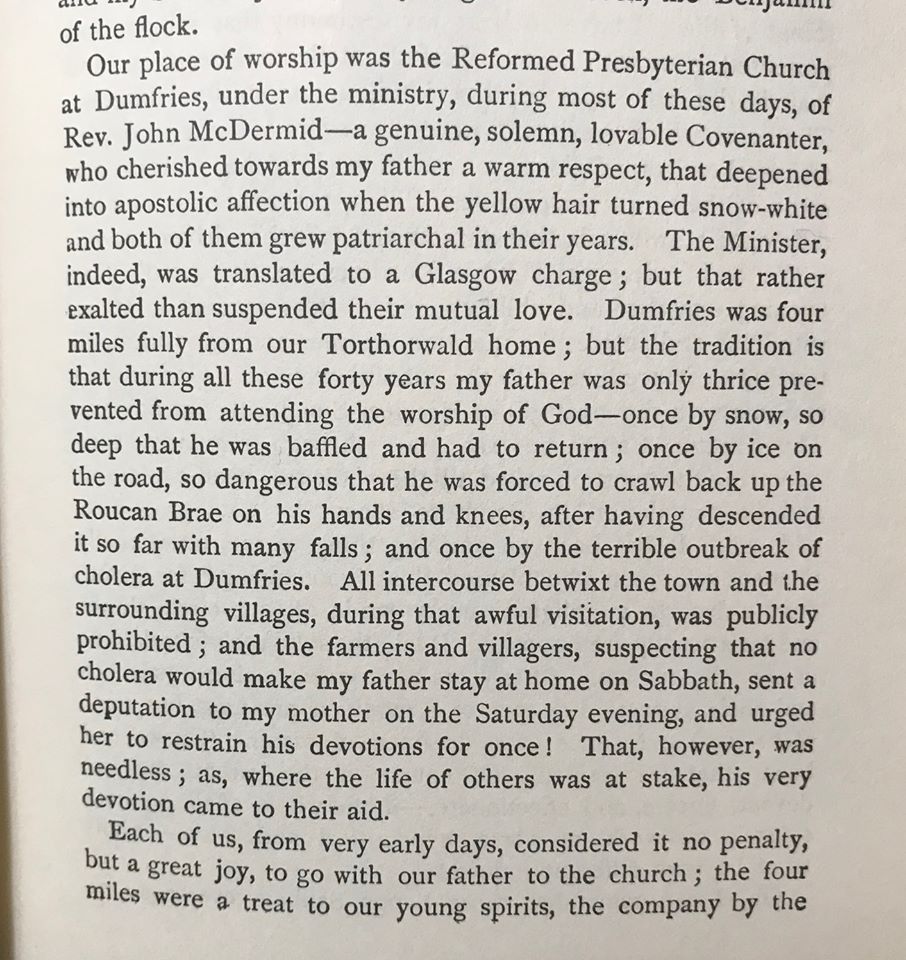
A few striking observations from a favorite anecdote in John G. Paton’s autobiography, below. If I’m not mistaken, this would be referring to a cholera outbreak in 1832 in the U.K.

1. Healthy believers long for the courts of the Lord and don’t let lesser things get in their way. 2. However, it appears that godly Scottish Presbyterians in the early 19th century believed that public health crises could warrant church closures (or at least effectively cause them by population controls). 3. And apparently, the same believed that the state could mandate such closures (or at least effectively, etc.) in the interests of public health.

Not an argument that any of our churches must necessarily close under the present circumstances; just an observation to help put some strong opinions out there in context.

90471480_211006586771078_538897256095416320_o

00019767The following is a list, though not exhaustive, of Reformed & Presbyterian bodies who either have observed a day of fasting & prayer during the COVID-19 crisis or who have appointed and/or commended one. If we cannot coordinate our days, perhaps we may be encouraged that we are not alone when we take our part “on the wall.”
“Therefore also now, saith the LORD, turn ye even to me with all your heart, and with fasting, and with weeping, and with mourning: and rend your heart, and not your garments, and turn unto the LORD your God: for he is gracious and merciful, slow to anger, and of great kindness, and repenteth him of the evil. Who knoweth if he will return and repent, and leave a blessing behind him; even a meat offering and a drink offering unto the LORD your God” (Joel 2:12-14)?


[Updated 4/18 @ 5:49 p.m. EDT]

Wednesday, March 25. ARP Canadian Presbytery.

Wednesday, March 25. RPCNA Pacific Coast Presbytery.

Lord’s day, March 29. Free Church of Scotland (Cont.). [Statement from the Public Questions, Religion and Morals Committee.]

Wednesday, April 1. Various Heritage Reformed Congregations (HRC) & Free Reformed Congregations (FRC). [Prayer and Fasting Outline, with help from Th. Boston.]

Saturday, April 4. The Midwest Presbytery (RPCNA). [Full communication & helpful suggestions.]

Thursday, April 2 or 9. RPCNA Synod.

Wednesday, April 8. OPC Presbytery of the Southeast.

Monday, April 6. Calvary Presbytery (PCA). [Days of Fastings RPCNA]

Saturday, Ajpril 18. Several congregations in the Presbyterian Reformed Church (PRC).

I’ve also heard from / about some individual OPC congregations who have observed fasts.

* * * *

[Image above, “Nineveh Repents“]

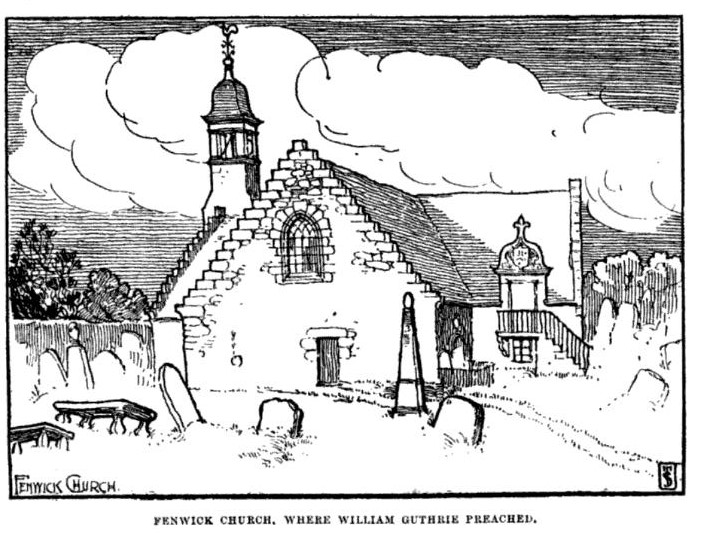
Smellie, Thomas. “Fenwick Church.” 1905

During the recent COVID-19 crisis, many Christian churches have closed their doors, cancelling regular public worships services, though often utilizing telecommunications to facilitate God’s worship in private home contexts. What principles do confessionally Reformed and Presbyterian elders consider when making their decision? These are the ones that factored in to my mind.

1. Worship is priority number one. God’s honor comes before man’s honor, His being before ours. “Thy love is better than life.” We should sooner join the three Hebrew children and lay down our lives than surrender an inch of God’s worship. The First Table comes before the Second, and if there is an apparent conflict, the general rule is to surrender our own interests.

Continue Reading »

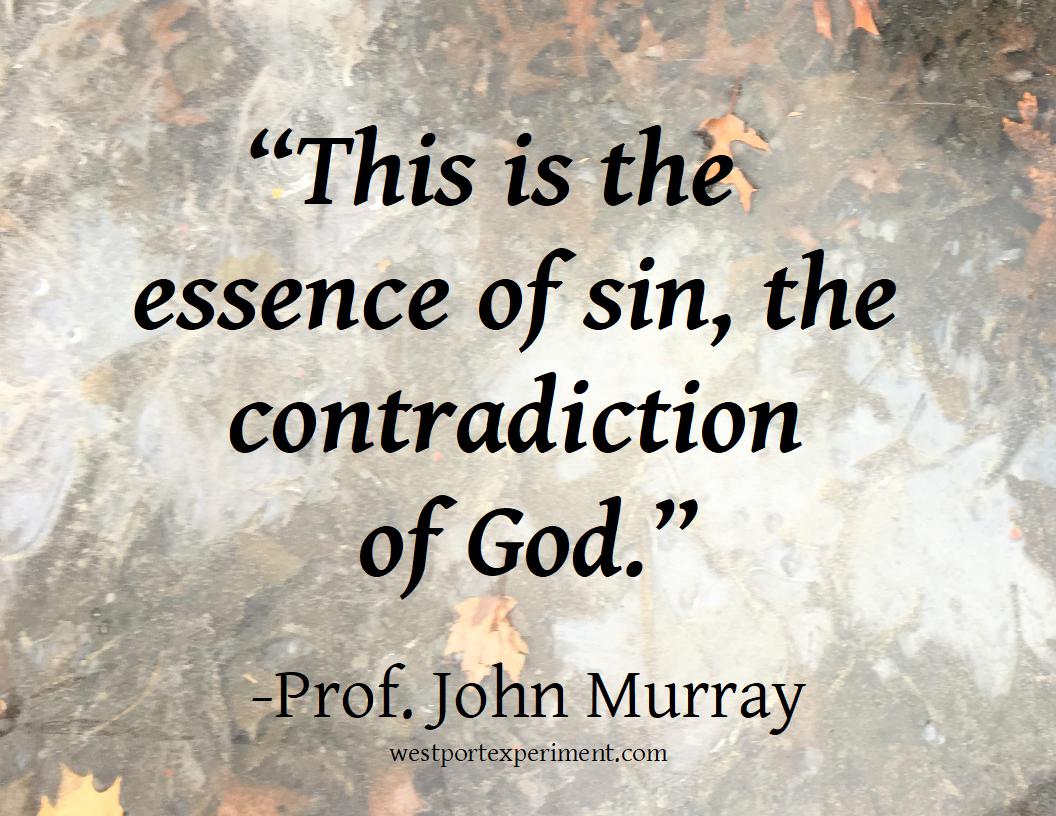
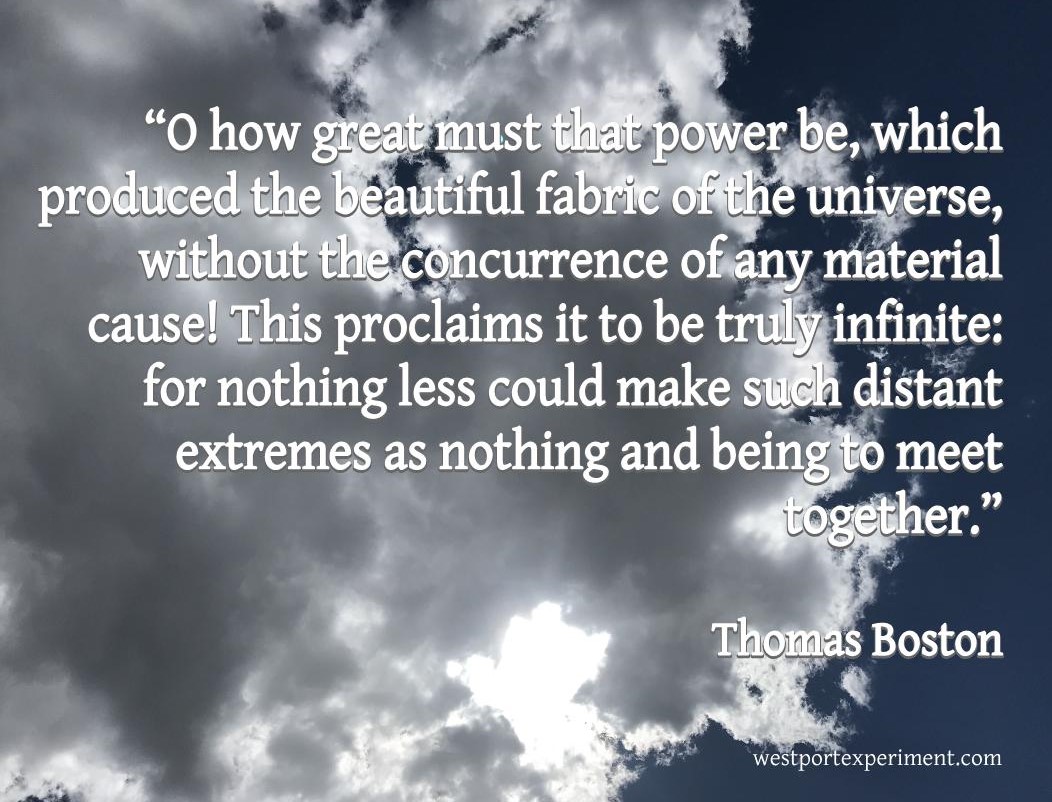
To reduce cluttering your inboxes, I’m posting several memes I’ve finished recently:

Murray, Essence of Sin

Boston, Beautiful Fabric

Willison, Wit's End

Here is the latest edition to the “Chalmers Audio Library,” a work composed in 1835 entitled “The Cause of Church Extension, and the Question Shortly Stated, Between Churchmen and Dissenters in Regard to It.”

In this essay, Chalmers clarifies the true goals of the Church Extension movement in Scotland in the 1830s, indicating that it is much more than an effort to build more churches for the establishment. It is a means to Christianize the entire home population of the nation, including the poor. The essay is rather encumbered with historical details that will seem remote to the modern Christian. However, if one perseveres, he will find that this contributes significantly to the body of Reformed missiology and offers much of enduring value for the Church’s contemporary witness.

For more about the Church Extension movement, see The Dictionary of Scottish Church History & Theology, p. 182.