“A Griegos y á bárbaros, á sabios y á no sabios soy deudor” (Rom. 1:14) —
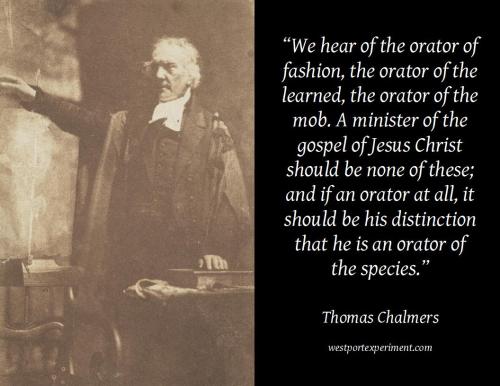
![Chalmers, Orator of the Species [Esp]](https://westportexperiment.com/wp-content/uploads/2020/06/chalmers-orator-of-the-species-esp.jpg?w=500)
More quotes, sans image …
Communion of the Saints
“The speech of one hearty friend cannot but revive the spirits of another. Sympathy hath a strange force, as we see in the strings of an instrument, which being played upon, as they say, the strings of another instrument are also moved with it. After love hath once kindled love, then the heart, being melted, is fit to receive any impression. Unless both pieces of the iron be red hot, they will not join together. Two spirits warmed with the same heat will easily solder together.”
-Richard Sibbes
Faith & the Promise
“The faith of the promises is the door at which the accomplishment of the promises doth enter in: according to the word, Luke 1:45, Blessed are they that believe, for there shall be a performance of those things that are spoken of the Lord unto them. If we were more in waiting for the accomplishment of the promises, the vision should speak, and should not tarry: and no doubt, a mercy coming to us, as the fruit and performance of a promise, will make it an exceeding refreshful thing, when a Christian getteth leave to sing that song, which is in Isa 25:9, Lo, this is our God; we have waited for him, and he will come and save us. And when a mercy is the fruit and accomplishment of the promise, there is a beautiful lustre and dye upon that mercy, which no art could set on, but only the finger of the love of God.”
-Andrew Gray
Regeneration of Children
“The education of children should proceed on the principle that they are in an unregenerate state, until evidences of piety clearly appear, in which case they should be sedulously cherished and nurtured. . . . Although the grace of God may be communicated to a human soul, at any period of its existence, in this world, yet the fact manifestly is, that very few are renewed before the exercise of reason commences; and not many in early childhood.”
-Archibald Alexander, Thoughts on Religious Experience
Honesty in Confessional Subscription
“Honesty is as important in theology as in trade and commerce, in a religious denomination as in a political party. Denominational honesty consists, first, in a clear, unambiguous statement by a Church of its doctrinal belief, and, second, in an unequivocal and sincere adoption of it by its members. Both are requisite. If a particular denomination makes a loose statement of its belief, which is capable of being construed in more than one sense, it is so far dishonest. If the creed of the denomination is well drawn and plain, but the membership subscribe to it with mental reservation and uncertainty, the denomination is dishonest. Honesty and sincerity are founded in clear conviction, and clear conviction is founded in the knowledge and acknowledgement of the truth. Heresy is a sin, and is classed by St. Paul among’the works of the flesh,’ along with ‘adultery, idolatry, murder, envy and hatred,’ which exclude from the kingdom of God. (Gal. v. 19-21). But heresy is not so great a sin as dishonesty. There may be honest heresy, but not honest dishonesty. A heretic who acknowledges that he is such, is a better man than he who pretends to be orthodox while subscribing to a creed which he dislikes, and which he saps under pretence of improving it and adapting it to the times. The honest heretic leaves the Church with which he no longer agrees; but the insincere subscriber remains within it in order to carry out his plan of demoralization.”
– W. G. T. Shedd, Calvinism: Pure and Mixed, 152
Trials in the Womb of the Covenant of Redemption
“Whatever trials you have, whatever troubles you have, whatever difficulties you have, they come from the same covenant as Christ came for your salvation. They come from the same covenant as your regeneration came. They come from the same covenant as your hope of heaven comes. And they come with the same love, and they come for the same purpose, and that is that you might be to the glory of his grace throughout eternity.”
-Hugh M. Cartwright (1943-2011)
The Virgin Mary’s “Low Estate”
“In the following words she teaches us how worthless she felt of herself and that she received by the heavenly grace that was lavished on her every sort of good merit that she had. She says, “For he has considered the humility of his handmaid. For behold from this time on all generations will call me blessed.” She demonstrates that in her own judgment she was indeed Christ’s humble handmaid, but with respect to heavenly grace she pronounces herself all at once lifted up and glorified to such a degree that rightly her preeminent blessedness would be marveled at by the voices of all nations.”
-Venerable Bede
The Right Veneration of the Virgin
“But that she was eminently a saint; that her faith, and resignation, and absolute devotion to God, on the message of the angel, were most extraordinary and exemplary; that her relation to our common Saviour should render her name dear and venerable to us all; and that we should fulfil our part of her own prediction, that “henceforth all generations shall call me blessed,” [Luke 1:48]—all this is not only to be admitted, but remembered and regarded. . . Yet in counteracting this error, the veneration and affection due to her true character, has, I think, been sometimes refused, or impaired. Let us avoid both extremes. Let us worship God alone; but let us love and venerate all his saints, and the mother of our Lord among the chief.”
-Ashbel Green
A Penitent Marveling at Common Grace
“Her self-conceited heart is self-convict’d,
With barbed arrows of compunction prick’d;
Wonders how justice spares her vital breath,
How patient heav’n adjourns the day of wrath;
How pliant earth does not with open jaws
Devour her, Korah-like, for equal cause;
How yawning hell, that gapes for such a prey,
Is frustrate with a further hour’s delay.”-Ralph Erskine
“Social” Christianity & the Individual
“Nevertheless, the attempts to apply Christianity socially have profoundly affected the meaning which the Christian faith has for the average man and ordinary churchgoer. The emphasis on the social has largely stifled the spiritual nature of the faith. It has obscured the revealed fact that the Christian message was primarily to and for individuals. . . For the business of the Church in its God-given mission is to the individual and through the individual to society. Moreover, the Christian revelation holds out no hope for society except in so far as the men and women who form it are Christian, which for the secular State is a futile and unattainable ideal. It is therefore all the more essential that the truth should be understood that a Christian society can only be fashioned out of and by Christian men and women. . .”
“Evangelical ministers, holding their high commission as ambassadors of Christ, must ever plead with men to be reconciled to God. When people are reconciled to God they are in fact at peace with one another. From this peace, conditioned by faith in Jesus Christ, can alone arise a state of mutual peace among peoples of nations and a fellowship in peace of the states constituted of these reconciled peoples. . .”
“To-day, therefore, as at all times, the primary privilege and service of this ministry must be the regeneration of men who will become creators of a better and more really Christian civilisation.”
-Donald Maclean (1869–1943), Principal of the Free Church of Scotland and co-founder of the Evangelical Quarterly. From “An Evangelical Ministry.”-

 District, door-to-door evangelism done right is distinctly Reformed, being a distinctly household-oriented approach to Gospel outreach.
 In the present debate over Aimee Byrd (et al.) and her book Recovering From Biblical Manhood and Womanhood, I have been forced to re-evaluate how and when naming names is appropriate in the Christian ‘public square.’ While it saddens me that rancor has developed among those with serious if not grave concerns over Byrd and company, it has at least helped me sharpen in my own mind a distinction that is vital.
 “I am quite aware that the situation of some of the largest of our city churches in those central districts from which the better class of the population is rapidly receding towards the suburbs, and leaving their neighbourhoods to be occupied chiefly either by enormous warehouses, or by crowded masses of the very poorest people, renders it exceedingly difficult to use them in strict accordance with the territorial principle. I have a strong opinion that such districts will never be made what they ought to be in reference to church attendance and religion till this difficulty is boldly faced and completely overcome, and till the districts are worked and superintended as regular parishes, with their own ministers and kirk-sessions, responsible to the Church at large, and particularly to the presbytery of their bounds, for their faithful management. In some instances, however, transitional expedients might for a time be resorted to with advantage. A church confessedly too large for one parish of manageable extent might, for example, be used as the church not only of the district specially designated as its proper parish, but also of several other districts annexed to it for the nonce. Each of these should have its own minister from the first, and eventually would have its own church; but till things were made ripe for this latter consummation, the ministers of all the districts would work together from a common centre and have different services in the same church. Possibly in this way, by combined endeavours of a systematic kind, and by a variety of agencies and services, good might be done for all the districts in question, which could not be done for any one of them apart by itself. Nevertheless the expedient at best is of doubtful issue, and should only be tried in extreme cases ; and the thorough-going remedy of separate churches and of independent territorial work, wherever practicable, is to be preferred.”
 So a young lady, “Leah,” has come within our church’s orbit from our S. Providence outreach. Her story is shared
  West Port Experiment
