Ever read this classic of pastoral theology? Perhaps you should. But if you could use it in audio format, I’m making progress in recording it into mp3. Access it here (and more to follow).
Consider these contemporary endorsements from the Banner edition, then I challenge you not to ‘take up and read.’ Or, now listen, if you prefer!
“This book has been my companion for almost fifty years. First published in 1830, it is arguably more needed now than then. It is a classic, serving as a guide to all who are aware of the perils and privileges of pastoral ministry.” — Alistair Begg
“People ask me, “What’s the very best book for Ministers?” Overall for the ministry, and for passionate preaching, and how to preach to different kinds of people – there’s nothing like The Christian Ministry.” — Joel Beeke
For more titles, see my growing amateur audio library. [And if any links fail, kindly drop me a note: mjves dot refparish at gmail dot com. Thanks!]
Here is a truly momentous and historic sermon by John Cotton. Richly theological, eminently practical, and tenderly pastoral. On the occasion of the embarking of John Winthrop and company to the Massachusetts Bay in 1630.
The sermon is especially valuable for its contribution to a “theology of place” and the Christian ethics of travel, relocation, and lawful acquiring of land. Have a listen!
One precious gem: “Ruth dwelt well for outward respects while shee dwelt in Moab, but when shee cometh to dwell in Israel, shee is said to come under the wings of God: Ruth 2. 12 . When God wrappes us in with his Ordinances, and warmes us with the life and power of them as with wings, there is a land of promise.”
And check out my growing audio library, including the Puritan fathers of New England.
”The rise of sectarianism that has accompanied the Protestant movement is a dark and negative phenomenon. It manifested itself already at the beginning of the Reformation, but it has never flourished as it has in our age. New church after new church is established. In England there are already more than two hundred sects. In America they are innumerable. The differences have become so many and so insignificant that one cannot keep track of them. There are even voices arguing for a new discipline in theology itself devoted to the comparative history of church confessions. What is even more serious is that this sectarianism leads to the erosion and disappearance of church consciousness. There is no longer an awareness of the difference between the church and a voluntary association. The sense that separation from the church is a sin has all but disappeared. One leaves a church or joins it rather casually. When something or other in a church no longer satisfies us, we look for another without any pangs of conscience. The decisive factor turns out to be our taste. Exercise of discipline thus becomes virtually impossible; it loses its very character. What preacher is left who dares, in good conscience, except perhaps in extremely rare instances, to use the form for excommunication? The worst result of all this is that by breaking the unity of doctrine and the church, Christians do violence to the communion of saints, deprive themselves of the Spirit’s gifts of grace, by which other believers labor to build up the saints, shut themselves up in their own circle, promote spiritual pride, strengthen Rome, and give the world occasion for scorn and mockery.”
-Herman Bavinck, “The Catholicity of Christianity and the Church”
This message was delivered at the Presbytery Conference of the Presbyterian Reformed Church on June 16, 2022. The audio is available here. Special thanks to Susan Abel for her selfless efforts in transcription!
* * * * *
Isaiah 35:7-10, “And the parched ground shall become a pool, and the thirsty land springs of water: in the habitation of dragons, where each lay, shall be grass with reeds and rushes. And an highway shall be there, and a way, and it shall be called The way of holiness; the unclean shall not pass over it; but it shall be for those: the wayfaring men, though fools, shall not err therein. No lion shall be there, nor any ravenous beast shall go up thereon, it shall not be found there; but the redeemed shall walk there. And the ransomed of the LORD shall return, and come to Zion with songs and everlasting joy upon their heads: they shall obtain joy and gladness, and sorrow and sighing shall flee away.”
Revelation 21:1-3, “And I saw a new heaven and a new earth: for the first heaven and the first earth were passed away; and there was no more sea. And I John saw the holy city, new Jerusalem, coming down from God out of heaven, prepared as a bride adorned for her husband. And I heard a great voice out of heaven saying, Behold, the tabernacle of God is with men, and he will dwell with them, and they shall be his people, and God himself shall be with them, and be their God. Amen, this is the Word of the living God.”
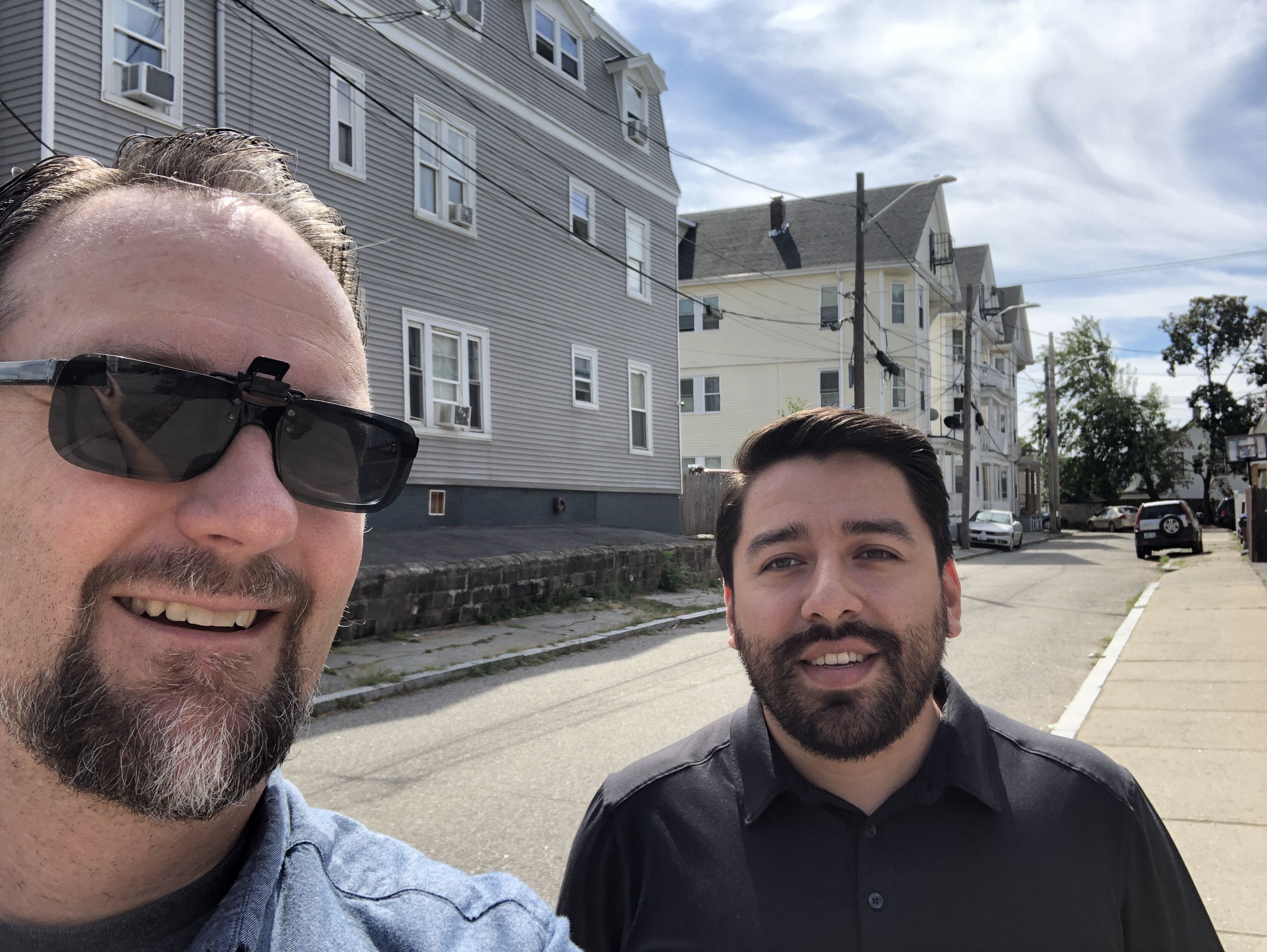
Last month I had the personal privilege of going back to my old stomping grounds—at least, one of them— as a boy. I had not been to Homestead, Florida, just south of Miami, since I was about fourteen years old, not long after my father went to glory. It was a place, notwithstanding the bitterness of the memories of the loss of my father, [that] was overall a time of great delight: many good memories, especially on this particular street. And I am sure my children can tell you, that I would mention the many late nights when we would play a pick-up game of baseball, and take some charcoal and make some bases, and have an awful lot of fun. Well, as we drove up and came into the neighborhood, memories started flooding back—a lot of good memories. And finally I came with my wife to this home, and there it was, largely as I remembered it, although it had a new coat of paint. And much was the same, and much was so very sweet and so very special. I even got to meet the next-door neighbor whom I did remember as a boy (and I got to have a selfie with them!). So it was quite special.
It is very common for professing Christians to draw a distinction between essentials and non-essentials in religion, and to infer that, if any fact or doctrine rightly belongs to the latter class, it must be a matter of very little importance, and may in practice be safely set at naught. The great bulk of men take their opinions on trust; they will not undergo the toil of thinking, searching, and reasoning about anything, and one of the most usual expedients adopted to save them the trouble of inquiry, and to turn aside the force of any disagreeable fact, is to meet it by saying, ”The matter is not essential to salvation; therefore we need give ourselves little concern on the subject.”
If the distinction here specified is safe, the inference drawn from it is certainly dangerous. To say that, because a fact of Divine revelation is not essential to salvation, it must of necessity be unimportant, and may or may not be received by us, is to assert a principle, the application of which would make havoc of our Christianity. For, what are the truths essential to salvation? Are they not these: That there is a God; that all men are sinners; that the Son of God died upon the cross to make atonement for the guilty; and that whosoever believes on the Lord Jesus Christ shall be saved? There is good reason for believing that not a few souls arc now in happiness, who in life knew little more than these—the first principles of the oracles of God—the very alphabet of the Christian system; and if so, no other Divine truths can be counted absolutely essential to salvation. But if all the other truths of revelation are unimportant, because they happen to be non-essentials, it follows that the Word of God itself is in the main unimportant; for by far the greatest portion of it is occupied with matters, the knowledge of which, in the case supposed, is not absolutely indispensable to the everlasting happiness of men. Nor does it alter the case, if we regard the number of fundamental truths to be much greater. Let a man once persuade himself that importance attaches only to what he is pleased to call essentials, whatever their number, and he will, no doubt, shorten his creed and cut away the foundation of many controversies; but he will practically set aside all except a very small part of the Scriptures. If such a principle does not mutilate the Bible, it stigmatizes much of it as trivial. Revelation is all gold for preciousness and purity, but the very touch of such a principle would transmute the most of it into dross.
Read the entire treatise, Which is the Apostolic Church?, by Thomas Witherow, below. Or, listen to an audio version here.
¿Eres bilingue? ¿Reformado? ¿Está buscando el ministerio o está interesado en la formación teológica? ¿Le gustaría participar en un ministerio urbano?
¡Me vendría bien tu ayuda! Conozca más sobre nuestro trabajo aquí. Si las circunstancias son las correctas, hay fondos disponibles para pagarle por venir y explorar estas oportunidades. “La cosecha es mucha, pero los trabajadores son pocos”. Envíeme una nota a mjives punto refparish en gmail punto com. O llámame/envíame un mensaje de texto al 515-783-5637.
Además, si puede mejorar esta traducción con GoogleTranslate, comparta sus sugerencias. ¡Todavía estoy trabajando en mi propio español!
* * * *
Are you bilingual? Reformed? Are you pursuing the ministry, or are you interested in theological training? Would you like to be involved in an urban ministry?
I could use your help! Learn more about our work here. If the circumstances are right, funds are available to pay for you to come and explore these opporunities. “The harvest is plentiful, but the laborers are few.” Drop me a note at mjives dot refparish at gmail dot com. Or call/text me at 515-783-5637.
Also, if you can improve this translation by GoogleTranslate, please share your suggestions. I am still working on my own Spanish!
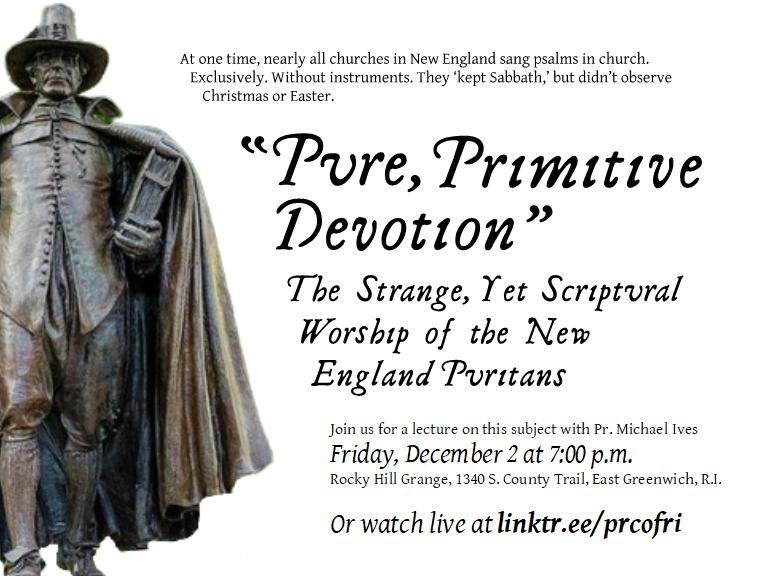
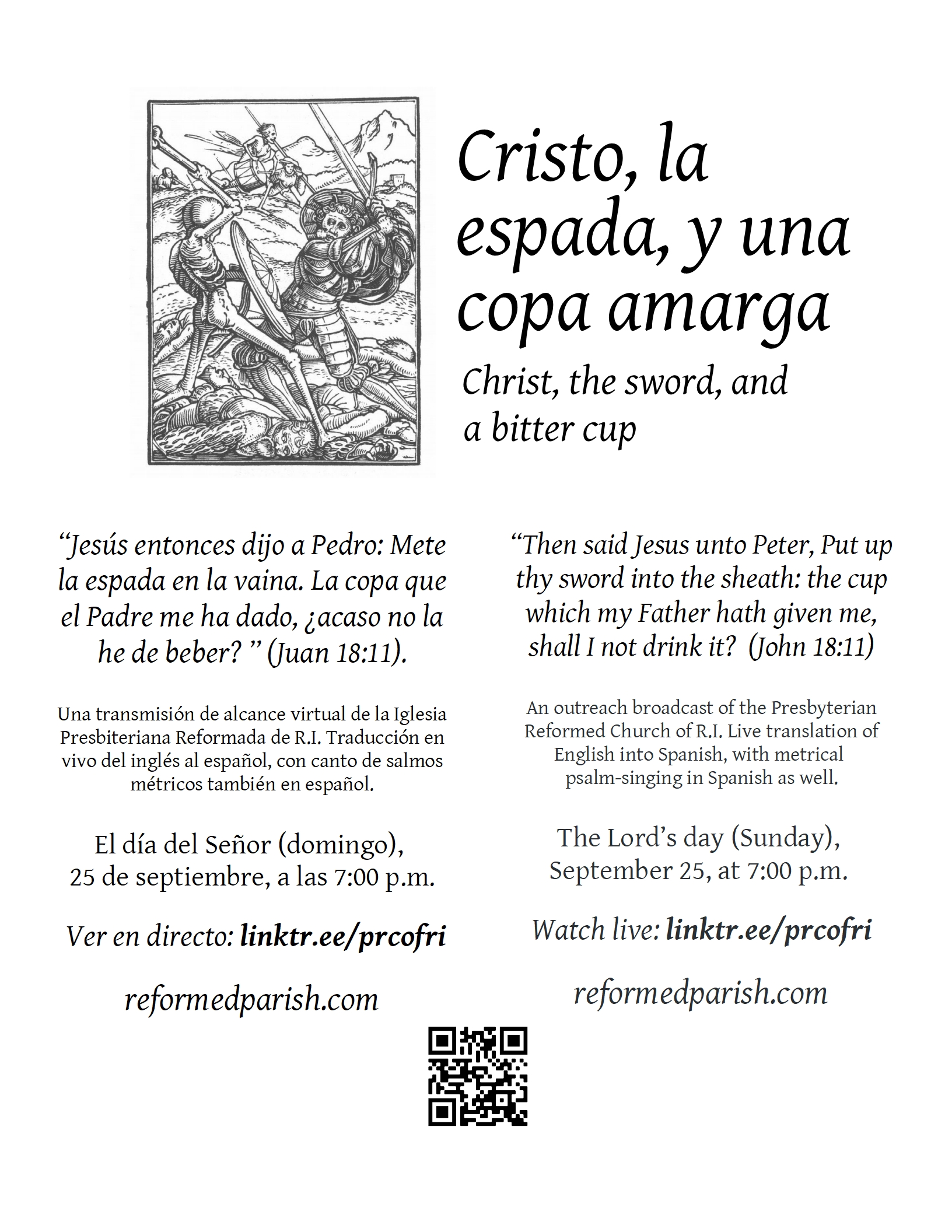
Here is the video of our last monthly Spanish outreach effort. Puritan Reformed Th. Sem. student Daniel Navarro preached, with our selfless helper, Richard Santos, translating. The advert below is for our next effort this Lord’s day evening. If you would like to join in, go here this Lord’s day evening, September 25, at 7:00 p.m. Eastern.
Would you pray for us? We hope to invite two families in my two respective parishes. Both have turned up for previous meetings, but neither show clear evidence of saving grace.
Since our last post sharing Fatima’s housing problems, we had quite the roller-coaster trying to help her find a place to land. We found one seemingly ideal opportunity, but it fell through. My son, Gabriel, and a friend of his helped her move out of her old place on the day of her eviction, with nowhere definite for her to go. Her things went into one of our elder’s garages for the time being. The clock ticked.
A few generous options were offered from folks after I sent this appeal to pastor friends in Rhode Island, but both of those had serious downsides. Eventually, some veterans in our congregation opened their home for her to stay and have been helping her also with getting a better job. She is qualified to practice phlebotomy, but for several reasons has been stuck in a dead-end, low-paying security job. We’ve seen her in church and hope to see her even more. Please continue to pray for her, as this family blesses her with hands-on love in Jesus’ name.
Then, I had another seminary intern for a short, intensive mission weekend. Mr. Daniel Navarro, a Presbyterian student from Mexico City, Mexico, and a student at Puritan Reformed Theological Seminary came along side me in my ‘territorial vineyard.’
We had a number of good visits with folks in the S. Providence parish. One of them was “Mahim,” a Muslim from Somalia. A rather polite, friendly fellow, though he tells me he’s a rather devout attender of the mosque. I’ve actually visited with him a couple of times before in recent years, while on my rounds. He’s a Computer Science student at URI, which immediately gave me a point of connection, given my son Gabriel’s studies. From my notes, I see that my last two little ‘Gospel homilies’ with Mahim involved Joseph as a type of Christ, saving his brothers through their cruel betrayal, followed the next year by our Lord’s words about eating His flesh and drinking His blood. This time around, after a little friendly exchange, I shared about Daniel’s upcoming message that weekend from Genesis 2 on the Bible’s teaching on marriage. I told him how much our culture has degraded this holy institution, from God’s original “one flesh” design.
“This arrangement ought, as far as possible, to be commonly observed, that every one, content with his own limits, may not encroach on another’s province. Nor is this a human invention. It is an ordinance of God. For we read that Paul and Barnabas appointed presbyters over each of the churches of Lystra, Antioch, and Iconium (Acts 14:23); and Paul himself enjoins Titus to ordain presbyters in every town (Titus 1:5). In like manner, he mentions the bishops of the Philippians, and Archippus, the bishop of the Colossians (Phil 1:1; Col 4:17). And in the Acts we have his celebrated address to the presbyters of the Church of Ephesus (Acts 20:28). Let every one, then, who undertakes the government and care of one church, know that he is bound by this law of divine vocation, not that he is astricted to the soil (as lawyers speak), that is, enslaved, and, as it were, fixed, as to be unable to move a foot if public utility so require, and the thing is done duly and in order; but he who has been called to one place ought not to think of removing, nor seek to be set free when he deems it for his own advantage. Again, if it is expedient for any one to be transferred to another place, he ought not to attempt it of his own private motive, but to wait for public authority.”
John Calvin, Institutes of the Christian Religion, Vol. II, pp. 321


 West Port Experiment