Feeds:
Posts
Comments

Just added a recording in two parts of John Witherspoon’s farewell sermon to his congregation in Paisley, Scotland before sailing over to the American colonies to take up the presidency of the College of New Jersey in 1768. It is a profoundly moving and historic sermon, and especially one that ministers of the Gospel would do well to read. I began recording it soon before my transition to a pastorate in New Jersey, which added to its personal significance for me. Here are the opening words of the sermon. And to access more titles from my growing audio library, go here.

“My brethren, these words [Acts 20:26-27] are a part of the apostle Paul’s discourse to the elders of Ephesus, when taking leave of them, under a firm persuasion, or rather a certain knowledge, that he would never again see them in the body. My present situation, of which none of you is ignorant, has determined me to the choice of this passage, as a very proper subject from which I may conclude the exercise of my ministry among you. I had once occasion, on leaving another charge, to have taken a formal farewell of a very affectionate people, but had not courage to attempt it. The circumstances attending the removal, which, if Providence prevent not, seems now to be at hand, are such as do not lessen, but greatly increase the difficulty of speaking from such a subject. And yet, in another view, they seemed to urge it so strongly, and to present such an opportunity of being useful, as I durst not wholly decline. Every Christian ought to be an observer of providence. Nothing will more effectually promote his holiness and comfort. And both a minister and his people ought to improve the aspect of providence, when it hath any thing peculiar in it, to their mutual benefit.

“Let me therefore intreat you to attend to the following discourse, with patience and composure. This request I the rather hope you will comply with, as there is nothing intended that is personal, further than must necessarily arise from the subject itself, or be unavoidably suggested by your own thoughts. I bless God that I have no complaint to make of want of duty or affection upon your side; neither is it any part of my purpose to justify my own conduct, during the time that I have had the honour and happiness of being entrusted with the ministry of the gospel in this place. I shall therefore only fay, that whether I have been able to deliver my own foul by fidelity in duty, and by purity of principle, I am certain, that very much has been laid to the charge of many of yours. Least of all do I intend to endeavour to satisfy you of the motives which have induced me to accept of a call to a distant part of the world, and, in some degree, a different employment in the Church of Christ. For this, I know that an account must be given, in due time, to a much greater Judge, with whose approbation either the applause or censure of men are not worthy to be laid in the balance. The single purpose, therefore, of the following discourse, shall be to give you such a comprehensive view of the truths of the everlasting gospel, of the importance and difficulty of a minister’s work; as may direct you in the choice of another pastor, increase your esteem of such as are faithful, and excite you to guard against every thing that may either discourage them in their work, or prevent their success.”


The following two quotes are taken from George Gillespie’s An Assertion of the Government of the Church of Scotland (1641). They seem to me to have a bearing on the question of the ‘indigenous principle’ that our denomination, the Presbyterian Reformed Church, has advocated since its inception in 1965. That is, presbyterian churches ought ideally to develop their own nationally autonomous bodies distinct from others outside their borders; or, trans-national denominations, especially when ‘centered’ in one particular nation, should be avoided or superseded as impractical, and liable to hierarchicalism or a kind of church-imperialism. These quotes in particular demonstrate that historic presbyterianism, while holding out a gradation of church courts, nevertheless accepts as valid smaller and even the smallest church units when circumstances on the ground prevent more.

“Add unto these a distinction betwixt a congregation lying alone in an island, province or nation, and a congregation bordering with sister churches. If either there be but one congregation in a kingdom or province, or if there be many far distant one from another, so that their pastors and elders cannot ordinarily meet together, then may a particular congregation do many things by itself alone, which it ought not to do where there are adjacent neighbouring congregations, together with which it may and should have a common presbytery” (43).

Continue Reading »

“Mission efforts have often been led by notable individuals. When it comes to examples, we may first think of the missionary journeys of the Apostle Paul, the preaching of George Whitfield, or the exploratory work of Hudson Taylor. These individuals, their characters, and their stories loom large in our minds, and to a degree, they ought to. Their biographies are helpful, their tenacity was admirable, and most important, the Lord’s care for them and blessing on their work encourages the church to continue in missions. A careful survey of scripture, as well as Reformed practices and precedents, however, reveals that while the Lord often uses individuals prominently, it ought not to be ordinary to send individuals alone into a mission field.”

Read the rest of this helpful, thought-provoking paper by Rev. Rob VanDoodewaard of the Free Reformed Churches of North America:

If you would truly profit by ordinances, after you have a fixed pastor, I think it is of moment to forget, as much as possible, the persons of men, and consider them as no more than instruments in the hand of God, for your daily instruction and comfort. The more you remember the appointment of God, and wait upon his ordinances, in the faith of his presence, and the expectation of his blessing, the more you are likely to receive both sensible and lasting benefit. I must therefore take the liberty to observe, that we have amongst us a set of wandering unsettled hearers, who run about from one congregation to another, and even from one profession to another, and are scarcely ever to be seen a whole day in one place. If they be but deliberating where to fix, we may fay of them, that they are ever learning, and never come to the knowledge of the truth. But the probability is, that they have itching and curious ears, and go about not to serve God but to hear men. If I am able at all to judge, either by reflection or observation, those are most likely to profit, who having deliberately made their choice, sit habitually and regularly under one minister. By this means they enter into his views; and as he will naturally endeavour, if any thing was wanting at one time, to complete his scheme by supplying it at another, they will thereby have a more comprehensive view of the whole counsel of God. At the fame time, not having the charm of novelty to enchant them, they will have nothing to do but to reap instruction. On the other hand, by hearing separate, detached, and independent discourses, men may please their fancy more, but they will improve their understanding less. It is also plain, that as every minister will endeavour, not only to follow an order in his discourses on one subject, but to have a respect to the connection, and relation of the subjects themselves, the more accurate and exact he is, in suiting one part to the, illustration of another, the less he will be understood by these desultory hearers, who take only a single branch, without being able to perceive its subserviency to the general design. I have many times known exceptions taken at ministers, for some parts of a discourse by such persons, when, if they had heard the whole upon the same or corresponding subjects, they would have perceived there was no place for their objections. The great purpose, my brethren, of a serious and judicious people, in attending on ordinances, should neither be to please themselves, nor to criticise their teachers; but to hear the word of God, that they may do it. On this account it is, that humble and regular Christians are getting real advantage to their souls, while some are only watching the opinions, or others only passing judgment on the ability, perhaps no more than the style and outward manner of the speaker.

Listen to the entire sermon here.

“10.  He may and ought to remove all false worships, and endure no corrupt preaching, or writing, or meetings for that end, or administrating of corrupted sacraments, or any ordinance other than what is allowed; for, Josiah did cause the people stand to the Covenant that was made, and having removed all idolatrous worship, he made Israel to serve the Lord, that is, he made them abandon corrupt worship, and wait on pure ordinances, as keeping of the sabbaths, offering of sacrifices, etc. and that according to the manner prescribed by the Lord.

“Neither was it a wronging of their liberty, to do so, because:

1.  It was the preservation of their liberty, to keep them from the abominable bondage of these evils.

2.  It was their duty to abstain from these, and to follow the ordinances purely, and the magistrate may well put people to that.

Continue Reading »

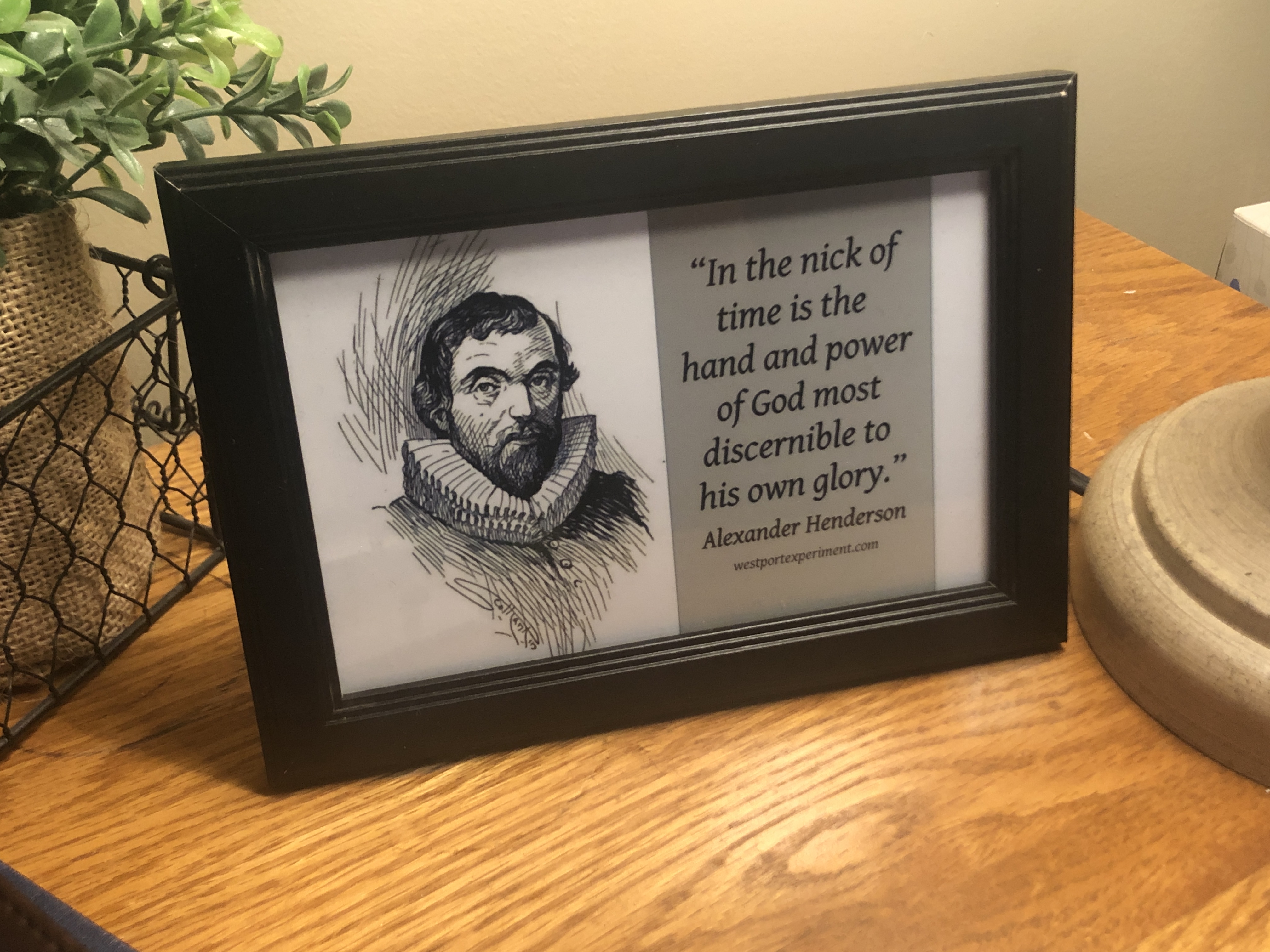
As I’m raising funds to support myself with Reformed Parish Mission (RPM), I’m putting some of my artistic aptitudes to use here. For a gift of any amount to RPM, I will be happy to ship you a framed (4×6) Bible verse or quote from our Reformed forbears. Or, for multiples, you could make a suggested donation of $7.00 per framed picture. I am also open to special requests. Drop me a note to let me know which one you’d like — michael@reformedparish.com.

These could be welcome house-warming gifts or encouragements to a Christian friend in need. Several new Scripture photos have been added below (6/12/24).

Continue Reading »

Establishments got some good press last week, at least on a respectable Reformed podcast. Kudos to Christ the Center for welcoming on Timon Cline to a panel discussion last Friday. While I’ve never heard of Timon before, I am sure going to read and listen to more of him. And I’m sure I’m not alone!

The panel discussion focused on Dr. Alan Strange’s newly published book, Empowered Witness: A Panel Discussion on Politics, Culture, and the Spiritual Mission of the Church. Giving feedback and critiques were D. G. Hart, Nick Wilborn, and Timon Cline. I’ve not read Strange’s book, so I’m only commenting on the video. The discussion up to Timon and related rejoinders was interesting enough. But Timon sure rocked the boat pretty hard when he brought up the obvious (at least from a historical Reformed perspective and not an American echo-chamber), that is, what about the spiritual nature in the church in light of the classic, confessionally Reformed and Presbyterian endorsements of religious establishments?

It’s clear that Dr. Strange was a bit flustered, though keeping a gracious demeanor. Sadly, though a respectable and accomplished Reformed scholar whom I otherwise appreciate, Strange’s response to Timon was more or less a rigmarole of informal fallacies and non-answers. Hart, however, just became flummoxed and unhinged. In contrast to Cline’s calm, measured demeanor, and even more importantly, to his much more careful, close, and logical reasoning (they guy’s a practicing lawyer, and it shines), Hart just full-on melted down, notwithstanding a clever little jab about Timon’s alleged tap-dancing like James Cagney. But even that was more amusing than apropos, as it only thinly veiled his chagrin. The young no-namer clearly bested his betters.

Continue Reading »

I. WHAT IS CATECHISATION?

The Greek word katechesis is derived from kataecheo, as kataecismos is from kataechizo. Both words, according to their common signification, mean to sound, to resound, to instruct by word of mouth, and to repeat the sayings of another. Kataecheo more properly, however, means to teach the first principles and rudiments of some particular doctrine. As applied to the doctrine of the church and as understood when thus used, it means to teach the first principles of the Christian religion, in which sense it occurs in Luke 1. 4, Acts 18. 25, Gal. 6. 6, etc. Hence, catechisation in its most general and comprehensive sense, means the first brief and elementary instruction which is given by word of mouth in relation to the rudiments of any particular doctrine; but, as used by the church, it signifies a system of instruction relating to the first principles of the Christian religion, designed for the ignorant and unlearned.

The system of catechising, therefore, includes a short, simple, and plain exposition and rehearsal of the Christian doctrine, deduced from the writings of the prophets and apostles, and arranged in the form of questions and answers, adapted to the capacity and comprehension of the ignorant and unlearned; or it is a brief summary of the doctrine of the prophets and apostles, communicated orally to such as are unlearned, which they again are required to repeat.

Continue Reading »

Nathan Eshelman recently penned this very helpful review article of a newly published book on spiritual abuse in the church. This is a must read. While there are certainly autocratic bullies in the Church, there are also dangerous, manipulative abusers in the pew who–if not held to simple, biblical and presbyterian standards for conflict resolution–can create tremendous harm.

* * * *

If you stumbled into a rabbit hole you may find several things that intrigue you. There may be keys and playing cards or caterpillars—and maybe even a rabbit. But just because you find keys, playing cards, and caterpillars does not mean that you’ve entered the world of the Red Queen and the hookah-smoking caterpillar. Sometimes it takes more. Jefferson Airplane said it like this: 

“One pill makes you larger
And one pill makes you small
And the ones that mother gives you
Don’t do anything at all
Go ask Alice
When she’s ten feet tall…”

I am working on a writing project that has taken me into various books on church relationships and communication. In the midst of that project, a beloved former professor of mine and churchmen has resigned from the ministry, in part, because of what is currently being called “spiritual abuse.” The idea of spiritual abuse is everywhere right now.

Read the rest here.

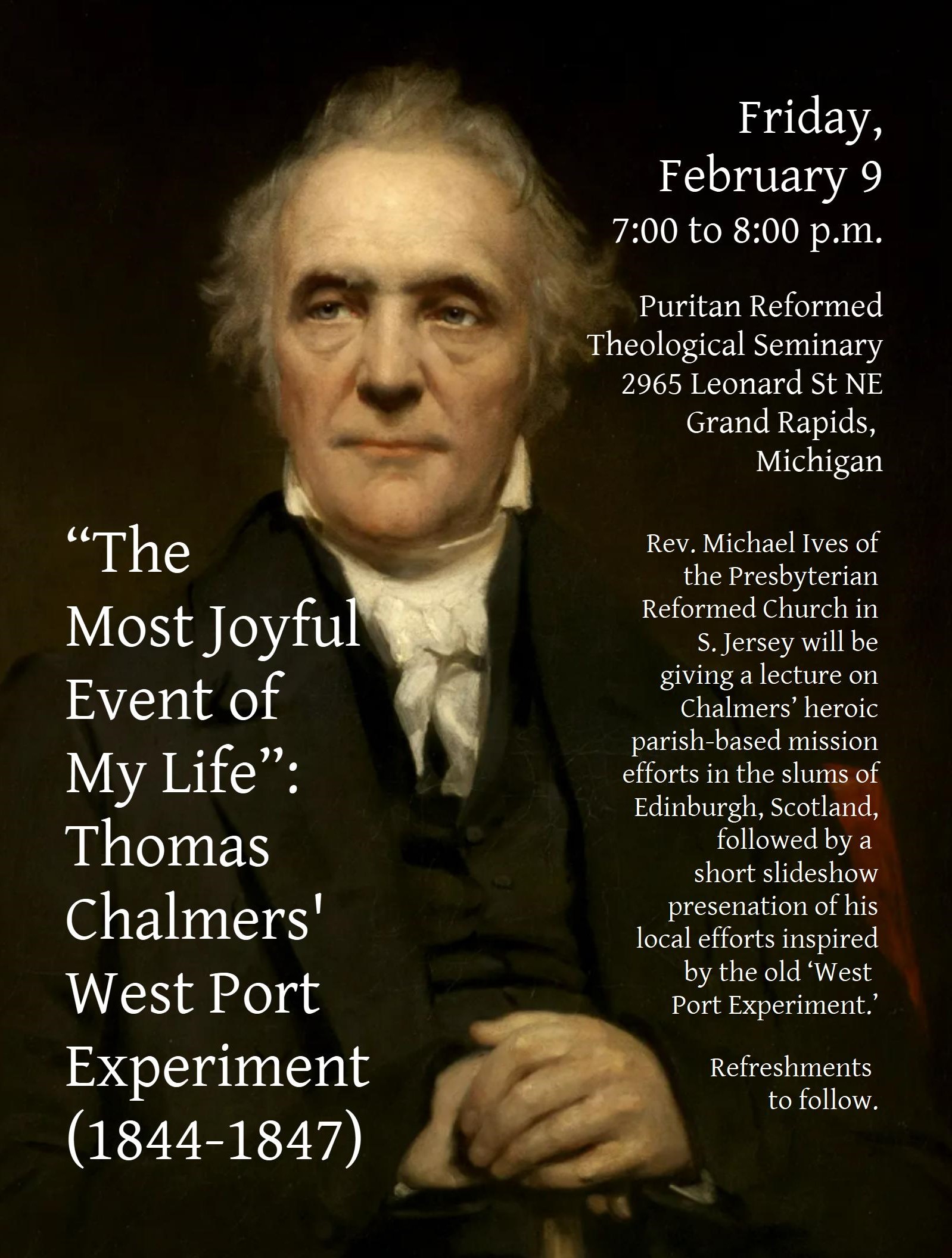
In Grand Rapids? Join us! Or sign up and/or watch it this Friday, February 9 by Facebook Live.

Note: this is a distinct, public event after the earlier PRTS Student Society lecture below. Both, however, are livestreamed (yet not including the short RPM slideshow as these include unedited photos of personal mission contacts).