Feeds:
Posts
Comments

Over the last few weeks, I’ve made more progress door-to-door in Woodbine. It’s got some character to be sure. There are some nice, even stately old homes alternating with run-down and abandoned shells. The one below had the front door completely knocked in to the ground. With poorer judgment, I could have just walked throughout the place.

I’ve encountered and visited with a number of Spanish speakers here in Woodbine. One had me inside. And not long into this first round I’ve discovered just how many African Americans there are. And their relatively openness to talk and comparative friendliness from past experience elsewhere has been mildly surprising–and definitely encouraging.

One of my most recent encounters was with “Dequan.” As I walked up to his house, he stood there, music blaring from his car. He looked late 20s, dressed in typical urban street-wear. As I introduced himself and handed him a leaflet, he very quickly got exercised and said that there was ‘no forgiveness for him–he killed a man!’ I noticed beer on his breath. Hard to say whether he was serious or not; but I had little reason to doubt him as the conversation progressed. I spoke to him of the infinite love of God in Christ who willingly died for wicked sinners like him and like me. I told him, as for his despair of pardon, that there was a great believer in the Bible who killed a man, and yet God forgave him. “Moses!” he replied. I was thinking David. (This fellow probably had a Christian upbringing, maybe even a godly mother or grandmother still praying for him. O, let us never despair of our prodigals!) So now Dequan had two witnesses of divinely pardoned murderers, and “in the mouth of two or three witnesses every word shall be established.” I was grateful that he did not brush me off for who I was, and I certainly treated him with the dignity he deserved as a human being. But, I explained to him, he and I were both in the same boat. We are helpless sinners in desperate need of mercy! I got his phone number. Then I asked if I could pray with him? He had quite calmed down by now. As I prayed for Dequan, he volunteered an arm around me. So touching, and I responded in kind as I led our poor souls to the throne of grace.

Continue Reading »

Thomas Shepard (1605-1649), on civil magistrates promoting the true religion. “Thesis 20. And if superiors in families are to see their gates preserved unspotted from such provoking evils, can any think but that the same bond lies upon superiors in commonwealths, who are the fathers of those great families, whose subjects also are within their gates, and the power of their jurisdictions? The civil magistrate, though he hath no power to impose new laws upon the consciences of his subjects, yet he is bound to see that the laws of God be kept by all his subjects; provided always, that herein he walk according to the law and rule of God, viz., that, 1, ignorant consciences in clear and momentous matters be first instructed; 2, doubting consciences have sufficient means of being resolved; 3, bold and audacious consciences be first forewarned. Hence it is, that though he hath no power to make holy days, and to impose the observation of them upon the consciences of his subjects, (because these are his own laws,) yet he may and should see that the Sabbath day, (the Lord’s holy day,) that this be observed, because he doth but see to the execution of God’s commandment herein.”

Theodore Beza: “The blindness of the Jews is neither so universal that the Lord has no elect in that nation, neither will it be continual: for there will be a time in which they also (as the prophets have foretold) will effectually embrace that which they now so stubbornly for the most part reject and refuse.”

John Owen: “It is granted that there shall be a time and season, during the continuance of the kingdom of the Messiah in this world, wherein the generality of the nation of the Jews, all the world over, shall be called and effectually brought unto the knowledge of the Messiah, our Lord Jesus Christ; with which mercy they shall also receive deliverance from their captivity, restoration unto their own land, with a blessed, flourishing, and happy condition therein.”

Jonathan Edwards: “The Jews in all their dispersions shall cast away their old infidelity, and shall wonderfully have their hearts changed, and abhor themselves for their past unbelief and obstinacy; and shall flow together to the blessed Jesus, penitently, humbly, and joyfully owning him as their glorious king and only saviour, and shall with all their hearts as with one heart and voice declare his praises unto other nations [Isaiah 66:20; Jeremiah 50:4]. Nothing is more certainly foretold than this national conversion of the Jews in the eleventh chapter of Romans.”

Principal John Macleod (1872-1948) writes with a freshness and a force of thought that sadly is all too uncommon today. Listen to my latest recording of his sermon, “The Sure Mercies of David.” (View entire library here.) Here are a couple of worthy passages:

Nay, as Victor our Lord has overcome and is set down with the Father on His Throne. There as the Exalted Servant He is seated on the Throne of His Heavenly Father and on the throne of His father David. It is as David’s throne was the throne of the Lord over Israel that his Exalted Son sits upon it now. Having died death outright He lives with a life over which the shadow of death shall never fall. He dieth no more for He has borne and exhausted the curse. So as Lord of life and death He is the Resurrection and the Life. His rising from the dead was the step that went before His Ascension; and it was a step that brought with it in full detail every succeeding step of His glory as the Lord’s Exalted Servant.

With our Lord’s Resurrection and Ascension the Kingdom of God has come. Until He arose and went up it was a kingdom or order of things that was yet to come. This is the case no more. The fullness of the glory of the kingdom is in the course , of being unveiled. The fullness itself reaches unto the eternal ages.

Also, a delightful passage on the conversion of the Jews:

Israel shall return to the Lord their God and to David their King. When the set time comes the David of the New Testament will subdue them and bring them in. Then the natural branches shall come to their place in the old olive tree and it will be as it were life from the dead. Not only will it be life from the dead : to them it will be such life from the dead as a pining Church and perishing world need. It is for ~ur Lord Himself to bring about this glorious return. He will then make Jerusalem a praise in the earth; for He will pour on the house of David and on the inhabitants of Jerusalem His own Spirit, the token of His good will, as the Spirit of prayer, and they shall call on Him. They shall look on Him whom they pierced, and the world shall know the mourning of the brethren of the New Testament Joseph when He makes Himself known to them and gives them the kiss of peace. This thing will not be done in a corner. All the world shall hear of it.

Here is the original copy:

Hugh Martin, great 19th century Free Church of Scotland preacher and churchman, is well-known for his masterful preaching as exhibited in his The Shadow of Calvary. But he clearly had a polemic side in his advocacy of a strict adherence to the Confession of Faith as constitution of the Church, together with its commitment to the due obedience of nations to King Jesus. This speech of his in 1871 was printed in the Watchword is a worthy contribution to ongoing discussions of confessional subscription among Presbyterians. I have recorded it here, and the PDF is available below. See more audio titles from the old Free Church and Church of Scotland legacies.

I am grateful to Rev. Rob McCurley for introducing me to this speech in a lecture of his, as well as to Rev. John Keddie for so helpfully treating it and the larger Constitutionalist cause in his Preserving a Reformed Heritage: The Free Church of Scotland in the 20th Century.

* * * *

“The extreme seriousness of the conflict going forward in the Free Church of Scotland arises from this, that the question now raise is that of the preservation or destruction of our Constitution.

“We brush aside at the outset the assertion (and the question grounded on it), that the Church of Scotland changed her Confession in the middle of the 17th century, — and why not do the same again? An utterance like this, in the present discussion, is characterized by such thoughtlessness, if not indeed such moral levity, as to deprive it of all right to serious answer. The Church of Scotland, in adopting the Westminster Confession, declared it to be ‘in no respect contrary to the doctrine of this Church.’ And in amending the formula in 1846, she did so with the avowed purpose not of changing but of expressing, re-affirming, and conserving the principles of the Church. And how men can allege a parallel between that and a proposal to make ‘allowance’ for the principles of another Church, exactly wherein they contradict our own, ought to surpass all powers of honourable imagination. It is not by moral trifling of this description that we are to be turned aside from our argument. . . .”

Read the rest here:

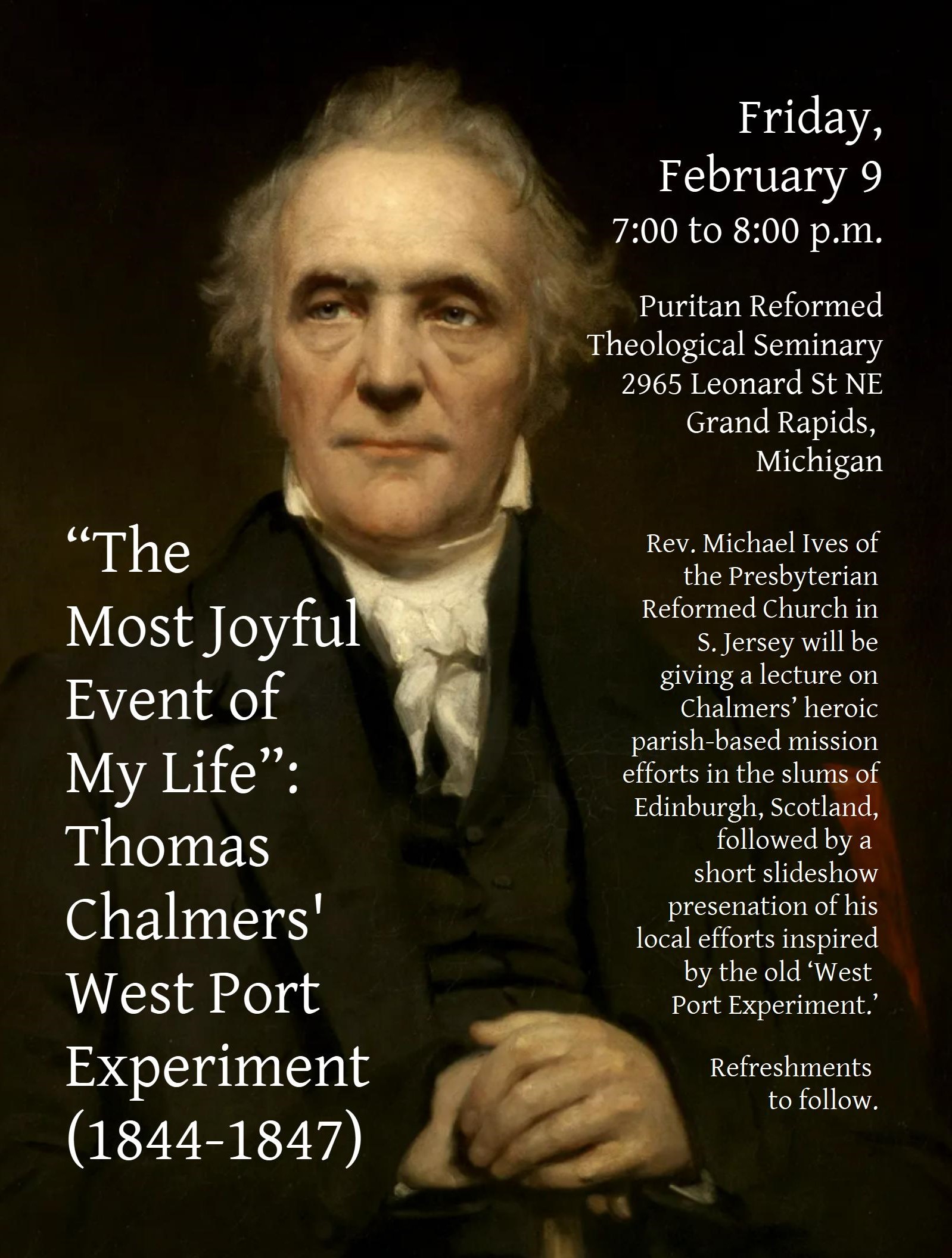
Just published another article on Thomas Chalmers. This is also a fantastic journal, and well worth the low cost to purchase. Get your copy here. For past articles I’ve written on Chalmers, visit the ‘About’ page and scroll to the bottom.

Years back, Prof. John Murray’s letter to a friend on the question of ladies wearing head-coverings in public worship was very helpful to me. In particular, he helped me see that 1 Corinthians 11:6 in particular will make no sense at all on the thesis that Paul wanted women simply to wear long hair in church. But if the long-hair “covering” of v. 15 is all that Paul meant for women being “covered” in vv. 5-6, then what does verse 6 even mean?

To help make this as clear as possible for others, I decided to make a little chart here below. Also feel free to read a transcript of a sermon I gave on the subject here.

* * * * * * *

Interested in receiving occasional notifications of new West Port Experiment posts? Sign up at the top right, under “Email Subscription.”

Just completed recording Thomas Halyburton’s “A Christian’s Belief Under Troubles: Two Sermons After the Death of a Friend.” Access this three-part series and other titles here. View my full audio library here. (And please drop me a note if any link fails: michael at reformedparish dot com).

The following introduction is taken from the James Begg Society.

* * * *

THOMAS Halyburton (1674-1712) was born into a family of Scottish Covenanters. His Father, Rev. George Halyburton, was a minister in the Reformed Church of Scotland until his ejection in 1662. Twenty years later George was denounced by the Privy Council of Scotland for holding “conventicles” (church services in the open air, unauthorised by the established church and outlawed by the government in those days). After his father’s death, young Thomas’s family (mother and sister) fled to Rotterdam in order to avoid the fierce persecution which was carried on against the Covenanters, where Thomas had his early education in the school of Erasmus. Following the Revolution, he returned to Scotland and continued his education.

After a period of inner struggle with the philosophy of Deism, God sovereignly and graciously enlighened Thomas’s soul, and gave him saving faith in the Lord Jesus Christ. He became committed to the same Reformed Christian religion as his father, and followed in his footsteps as a minister of the gospel. On completing theological training, Thomas was licenced to preach in the Church of Scotland by Queen Anne, and ordained to the ministry of the church in Ceres, Fife. The church was part of the presbytery of Kirkcaldy.

After faithfully pastoring the church in Ceres for ten years, Rev. Dr. Halyburton became Professor of Theology at St. Leonard’s College in St. Andrews.

He died two years later at the age of 38, following an illness. At his request, his body was buried in St. Andrews next to his favourite Christian minister, Rev. Dr. Samuel Rutherford.

Thomas Halyburton’s theological and apologetic writings are marked by a distinctive thoroughness. The surviving scripts of his sermons show him to have been richly theological, deeply experimental (i.e. dealing with the experiences of the soul) and very practical — a master of the classic Puritan style of preaching.

* * * *

Have you been blessed by these recordings? Could you possibly help with a one-time gift, or perhaps a monthly recurring donation of $2, $3, or $5? Donations can be made here. Please earmark your contribution in the notes “WPE Audio,” as it will be processed through the Reformed Parish Mission. Donations will offset the monthly SermonAudio expenses; and any excess will go towards supporting my efforts to bring the Reformed faith to the working class, immigrant, and Hispanic populations here in the U.S.

This content is password-protected. To view it, please enter the password below.

Friends, this next update is a major one for me. In addition to taking a new call in South Jersey and so expanding the urban mission efforts of our presbytery, I’m making a major appeal for regular support so that I can increasingly dedicate myself to this cause full-time.

Could you please help with a monthly recurring donation of any amount, however small? Even a $10/month commitment would be a blessing. Or a one-time gift of any amount. But above all, please pray for the Lord’s blessings in our transition and the expansion of the work in the urban Northeast.

Finally, a special ‘thank you’ to those who are already supporting. Your part is so vital; may the Lord bless you for it!