Feeds:
Posts
Comments

The following comes from the pen of Abraham Kuyper (1837-1920), pastor, theologian, and prime minister of the Netherlands. It’s a devotional work entitled To Be Near Unto God. And you don’t have to be a card-carrying Neo-Calvinist to appreciate it!

“NIGHT is a mystery in our life, and remains a mystery. For years together, sleep to most people is a provisional going out from life, in order after some seven or eight hours to come back to it. When they fall asleep, which most people do immediately after their head touches the pillow, they are gone, and when the hand on the dial of the clock has moved on a given number of hours, they rise and resume their part in life. At most they have an occasional remembrance of a dream that entered into their sleep, but for the rest it is all a blank. The seven hours during which they were lost in unconsciousness passed by unobserved, and as far as their remembrance of them goes they amounted to no more than two or at most three hours.

“Thus a third of life is taken out of their existence. When they are thirty years of age, they have actually lived but twenty, and the other ten years are wrapped in the haziness of sleep.

“This sleep, however, was not devoid of purpose. He who was weary on retiring, rises girded with new strength, though as far as his consciousness goes, he was idle. His thinking, feeling, willing, working, have all been at a stand-still. This absolute surcease of life is the normal state of things, for as long as man is well, in the fullness of his strength and not oppressed by cares, he sleeps as long as nothing disturbs him from without.

“Why this was so ordained, remains a riddle. For though it is true that after hours of work our strength becomes exhausted and demands rest to recuperate, this does not solve the problem. For at once the question arises: “Why this exhaustion of strength?” God, our Maker, after Whose Image weare created fainteth not, neither is He weary. The heavenly hosts of angels do not sleep. Of the New Jerusalem we read: “And there shall be no night there” (Rev. 22: 5). Thus, a being who does not continually exhaust his strength, and hence is in no need of sleep, is conceivable. Why God, our Maker, appointed a life for us with continual exhaustion of its power to be restored by sleep, remains a mystery. This ordinance of the Lord has not been promulgated without a purpose and a wise design, though no one understands it.”

Read the rest of the chapter here.

[Image source.]

This was a really helpful biographical sketch of the great Presbyterian preacher of the Scottish Highlands, Lachlan Mackenzie (1754-1819). Below that are a collection of his sermons. Listen to some of his material I’ve recorded in audio here. And visit my entire audio library here.

XX. Sixthly. We may reckon among the benefits of the New Testament the restoration of the Israelites, who were formerly rejected, and the bringing them back to the communion of God in Christ. Paul has unfolded this mystery to the Gentiles, Rom. 11:25–27: “For, I would not, brethren, that ye should be ignorant of this mystery (lest ye should be wise in your own conceits), that blindness in part is happened to Israel, until the fulness of the Gentiles be come in. And so all Israel shall be saved; at it is written, There shall come out of Sion the deliverer, and shall turn away ungodliness from Jacob. For this is my covenant unto them, when I shall take away their sins.”

XXI. On this place observe, 1st. That the apostle here explains some mystery; that is, a secret thing, not known but by revelation, and taken notice of by few, and happening beyond the expectation and judgment of reason; in fine, the whole method and manner of executing which, lies in a great measure concealed; see 1 Cor. 2:7, 15:51, and Eph. 3:3. 2dly. That it is the interest of the Gentiles to be acquainted with this mystery, to prevent their entertaining higher thoughts concerning themselves, and lower concerning the Israelites: we are therefore to take care to enquire diligently, and with attention, into what the prophets have foretold concerning this matter. 3dly. The apostle here speaks of the people of Israel, not figuratively but properly so called; who were at this time blind, obdurate, stupid, and hardened, of which ver. 7. Isaiah foretold this judgment of God against Israel at large, chap. 6:9, 10, compared with Acts 28:26, Isa. 29:10, 11. To this also seems applicable, that whirlwind of the Lord, that fury, and continuing whirlwind, which shall abide on the head of the wicked, of which Jer. 30:23. In short, this is that forlorn condition of the blinded nation of Jews, which taking its rise in the apostles’ time, continues to this our day. 4thly. That this blindness is in part happened to Israel. The whole nation, from its first origin even to the end of the world, is considered as one whole; a certain part of which are those, who either have, or now do, or hereafter shall live in the days of the wrath and indignation of God: blindness has seized that part only. 5thly. That blindness is to continue upon them no longer, than till the fulness of the Gentiles be come in; that is, till the Gospel is preached among all nations of the world whatever. Which, indeed, began to be done by the apostles and their fellow-labourers; but could not be done perfectly, both on account of the extent of the world, and the shortness of human life, and likewise because many nations (as all the American) were at that time unknown. This therefore still remains to be done successively; God, in his admirable providence, paving the way for his word. The offer of grace was first made to the Israelites. When they refused it, it was sent to the Gentiles; but when the fulness of them shall be brought in, it will be again given to the Israelites, “that the last may be first, and the first last,” Luke 13:30; see Luke 21:24. 6thly. That when the fulness of the Gentiles is brought in, all Israel shall be saved; that is, as our Dutch commentators well observe, not a few, but a very great number, and in a manner the whole Jewish nation, in a full body. Peter Martyr has judiciously explained the fulness of the Gentiles, and the whole body of Israel, in the following words: “But we are to understand a limited fulness, and a fixed or determined collection; which is therefore called fulness, because there will be an exact and a very great number of believers, so that the church shall be publicly owned, and had in great esteem among the Gentiles, just as all Israel is to be taken for a great number of Jews, among whom Christ should be publicly acknowledged; not that some, as well of the Gentiles as Jews, shall not be lost.”

Continue Reading »

Before reading of him in Principal John Macleod’s Scottish Theology in Relation to Church History, I had never heard of John Maclaurin. A contemporary of Jonathan Edwards and Thomas Boston, he stood within the old Evangelical wing of the Church of Scotland during the long, wintry reign of Moderatism. Impressed with the high praise for his sermon “Glorifying in the Cross of Christ,” I recorded it here. Here is a rich sample from Maclaurin as he waxes eloquent on the “fabric of nature” visibly responding to the horror of the death of the Prince of life:

“The frame of nature solemnized the death of its Author; heaven and earth were mourners; the sun was clad in black; and if the inhabitants of the earth were unmoved, the earth itself trembled under the awful load. There were few to pay the Jewish compliment of rending their garments; but the rocks were not so insensible, they rent their bowels. He had not a grave of his own; but other men’s graves opened to him. Death and the grave might be proud of such a tenant in their territories; but he came not there as a subject, but as an invader, a conqueror. It was then the king of terrors lost his sting; and on the third day the Prince of life triumphed over him, spoiling death and the grave. But this last particular belongs to Christ’s exaltation: the other instances show a part of the glory of his humiliation, but it is a small part of it.”

You can read more about Maclaurin in the PDF below, taken from Macleod’s work and the DSCH&T. And be sure to check out other audio titles from the Old Church of Scotland and the entire West Port Audio library.

[image source]

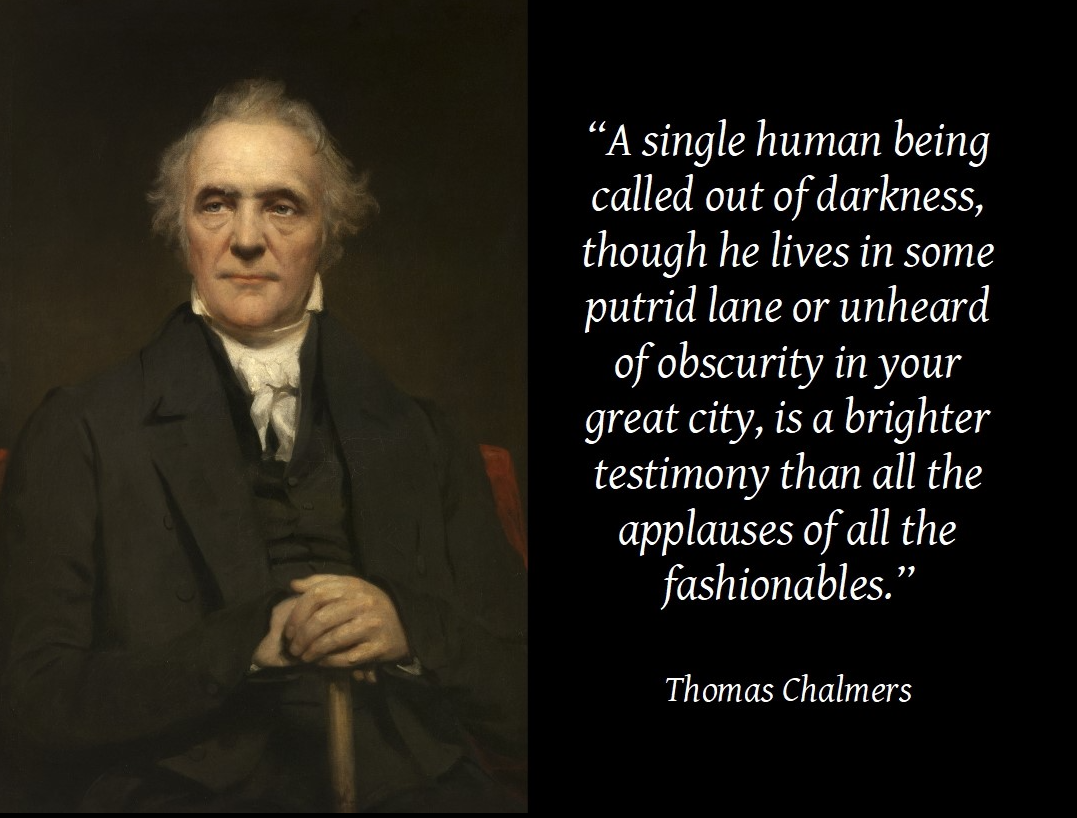
“For the accomplishment of this, there must not only be a going forth on the vast and untrodden spaces that are without; there must be a filling up of the numerous and peopled vacancies that are within—a busy, internal locomotion, that might circulate, and disperse, and branch off to the right and to the left, among the many thousand families which are at hand: and thoroughly to pervade these families; to make good a lodgment in the midst of them, for the nearer or the more frequent ministrations of Christianity than before; to have gained welcome for the Gospel testimony into their houses, and, in return, to have drawn any of them forth to attendance on the place of Sabbath and of solemn services—this, also, is to act upon our text, this is to do the part, and to render one of the best achievements of a missionary.”

-Thomas Chalmers, Works, 6:270.

[image source]

Birth rates are plummeting in the United States and globally, forecasting a political and financial crisis. The most recent estimate predicts the average American woman will have 1.6 children in her lifetime, far below the rate of 2.1 required to maintain a steady population and even further below the 2.5 rate observed in the United States as recently as 1970.

Many cultural and technological factors have contributed to this dramatic decline, and public policies play a role in shaping people’s decisions about whether to have children and how many. Finding the right policy levers for influencing fertility rates, however, has proven very difficult.

Read the rest of this article at The Federalist here.

“Did believers in the Lord Jesus more frequently meet in council, in service, in communion, how soon and entirely would the coldness, the party spirit; the jealousies, the erroneous impressions vanish which now, alas! divide the body of Christ, all whose members are ‘members one of another.’ Knowing each other better, they would love each other more; and loving each other more, there would be more ready concession made to the freedom of judgment and the claims of conscience. The clergy of the various sections of the Christian Church stand too wide apart from each other simply because they do not know each other. And if the shepherds are thus sundered, it is no marvel that the sheep are divided! The Church of Christ is essentially one, why should she not be visibly one? Inseparable from Christ, why should we be separated from each other? With an essential unity of faith, why should we not all unite in excluding uncharitableness? Oh! If the Lord’s people—losing sight of every badge but Christian, and of every name but Christ—were to mingle more frequently, confidingly, and prayerfully together, how much more would they find of assimilation, of sympathy, and affection—how much less to sunder, separate, and censure, and how much more to admire, love, and imitate in each other than they had any conception of.”

–Octavius Winslow

A single soul!