“Why, the circle, whose centre is his meeting-house, and whose radius passes at its further extremity through the tenement of his most distant hearer—such a circle would comprehend, in Edinburgh, a population of fifty thousand, and in London, a population of half a million. There is no other way of addressing ourselves with effect to the moral cultivation of this stupendous domain, but by breaking it up into parishes, and each of its ministers going forth on the territorial principle, charged with the care and the cognizance of all its families—keeping up, by his varied attentions, the spiritual appetite where it exists, and reviving it when it has fallen into dormancy—sustaining, by the external appliance of his household visits and week-day ministrations, that will for religion, and for its services, which, when left to itself, is so miserably apt to wither into extinction—doing, on the large scale of a parish, all that a city missionary does on the smaller scale of a district” (Chalmers, Works 18:90).
Here is the latest quarterly update. If you missed the last one from November, you can read it here. And visit Reformed Parish Mission to learn more about history and principles of this effort.
Patrick Fairbairn (1805–1874), Free Church of Scotland theologian and author of The Typology of Scripture, on his understanding of the papacy as the antichrist and “man of sin.”
* * * *
“On the whole, then, the conclusion which forces itself upon our minds from a full and impartial consideration of the apostolic testimony, is that the antichristian apostacy cannot be identified cither with the heathenism ofancient Rome, or with any conceivable form of infidelity or atheism yet to be developed. The conditions of the prophetical enigma are not satisfied by either of these views. So much for the negative side of the question. And in regard to the positive, if we may not say (as, indeed, we by no means think it can in truth be said) that in Romanism and the papacy the anticipated evil has found its only realization; yet we cannot for a moment doubt, that it is there we are to look for the most complete, systematic, and palpable embodiment of its grand characteristics. There, we perceive, as nowhere else, either to the same extent, or with the same firm determination of purpose, a mass of errors and abuses “grafted on the Christian faith, in opposition to, and in outrage of, its genius and its commands, and taking a bold possession of the Christian church.” We see “the doctrines of celibacy, and of a ritual abstinence from meats, against the whole spirit of the gospel, set up in the church by an authority claiming to have universal obedience; a man of sin exalting himself in the temple of God, and openly challenging rights of faith and honour due to God; advancing himself by signs and lying wonders, and turning his pretended miracles to the disproof and discredit of some of the chief doctrines or precepts of Christianity; and this system of ambition and falsehood succeeding, established with the deluded conviction of men still holding the profession of Christianity.” All this meets so remarkably the conditions of St Paul’s prophecy, and in its history and growth also from the apostolic age so strikingly accords with the warnings given of its gradual and stealthy approach, that, wherever else the antichrist may exist, they must be strangely biased, who do not discern its likeness in the Romish apostacy. We may the rather rest in the certainty of this conclusion, as it is matter of historical certainty, that ages before the Reformation, and, indeed, all through the long conflict that was ever renewing itself on the part of kings and men of faith against Rome, the Pope was often denounced as the antichrist, and man of sin. But it is one thing to find a great and palpable realization of the idea there, and another thing to hold, that it is the only realization to be found in the past or the future. And if Romanists have made void the testimony of Scripture in rejecting the one application, we fear Protestants have too often grievously narrowed it by excluding every other. Of this, however, we shall have a fitter occasion to speak, when we have examined that remaining portion of New Testament Scripture, which treats of the same subject, and in a way peculiarly its own. We refer, of course, to the Apocalypse.”
It is a joyful time when new members are added to a congregation, formally identifying themselves as believers in Jesus and committing to live as one of His disciples. All churches have some kind of admission process which allows them to decide whether somebody can be accepted as a new member. However, what criteria should a church use? Robert Baillie (1602–1662) served as a minister in Kilwinning, an army chaplain, and Professor of Divinity (later Principal) at Glasgow University. He was also one of the Scottish commissioners to the Westminster Assembly. In his writings he interacted with some who believed that people were obliged to provide evidence that they were truly regenerate before they could be accepted as church members. Robert Baillie argues in the following extract that this sets the bar for church membership too high. We cannot see into each other’s hearts, so how can we know whether someone is genuinely saved or not? Also, the Lord Himself has organised His church in the world in such a way that it will never be composed entirely of the truly regenerate. Baillie’s position strives for the highest standards for church members to live up to, while relieving us of the burden of deciding whether each individual church member is genuinely born again.
“It is no personal disparagement to the dissenting minister, when we simply say of him that he is less favourably placed. He may officiate through the week among his own hearers, who often lie scattered in isolated families over a wide extent of country, or through all the streets, and to the distant outskirts of a populous town. We have no doubt that he would greatly augment his influence, by assuming a local district in either of these two situations, and, in the way of Christian experiment, charging himself with the duty of religious attention to all the families within its limits whom he shall find willing to receive him. We should look for a far wider and more welcome respondency, and therefore a better result than is generally anticipated. But, in point of fact, this is seldom if ever done by dissenters. They are incredulous of its success—and are even themselves discouraged by a certain haunting sense of inferiority, which in as far as it is well founded, is itself a strong demonstration in favour of a religious establishment. They do apprehend a certain defect of reception and recognition among the families; and that, on the ground too, that they are not the regular or established functionaries of the land. They hang back under a sort of consciousness, that theirs is not so valid a right of entry as that of the parish minister. They cannot help the feeling of a certain defect in their warrant, in virtue of which they are not so authorized to go into every house, and there overture the services of Christianity. They themselves, in short, would have a greater sense of comfort and confidence in the prosecution of such a round, if translated into the place of regular clergymen, or similarly backed by the institutions of the land. For ourselves, we should like if our dissenting ministers could in the spirit of enlightened zeal, or of active religious philanthropy, overleap all these delicacies, and actually make the attempt of carrying their household ministrations into the bosom of every family that would open the door to them. The fact that this is so little done by them, is pregnant with inference. To our mind, it speaks powerfully for a religious establishment; that under the cover of its sanctions, there is on the one side, a greater boldness of access felt by its ministers; and, on the other side, a readier acquiescence by the people, in their offered services. The propriety of a universal movement among the houses of his allotted territory on any Christian errand, or with any Christian proposal, is far more promptly recognized by all, when performed by the parish clergyman, than would be a similar movement, if gratuitously attempted by a sectarian minister. And this would be the feeling not of the upper classes of society alone—but, in truth, the feeling even of workmen and cottagers. It is one of those aptitudes of our nature, of which it were most legitimate to avail ourselves—and which is turned to its best account by the device of an establishment. Without this machinery, the population will fall away in large masses, beyond the scope of any ecclesiastical cognizance. With it a wide door of access is opened to all the families. It is just the access which it is most desirable that a man of principle and prayer should be provided with that as it is a great, so also it may be an effectual door” (Thomas Chalmers, Collected Works 17:123-124).
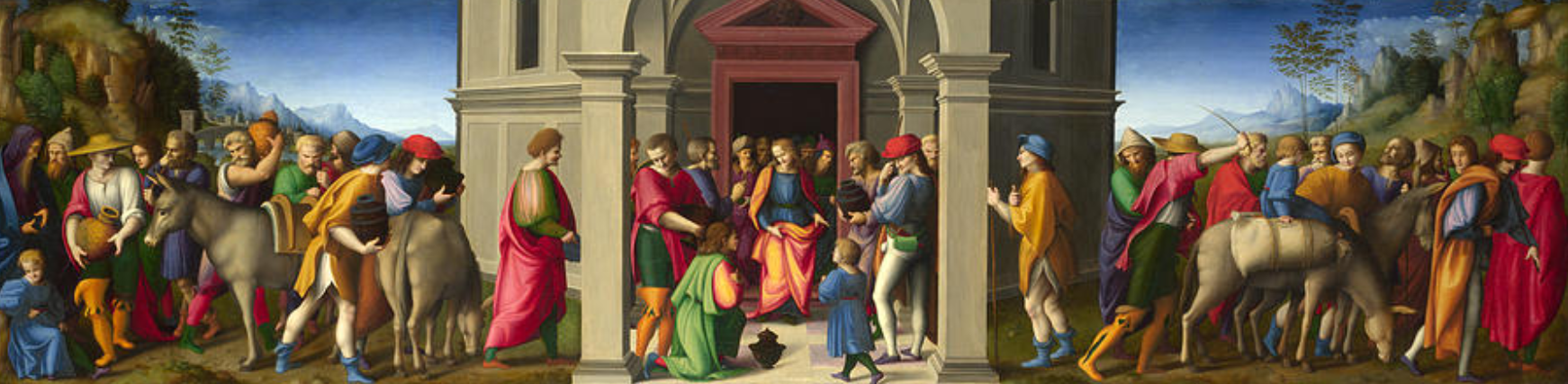
Joseph Receives His Brothers on their Second Visit to Egypt, a painting by Bacchiacca, ca. 1515.
The following are some passages from Scottish Presbyterian fathers on the Christological theme of our Lord’s mediatorial “stewardship.” Sublime:
“And if there be varieties of temperature of saints, some rough and stiff, some mild, some old men, and some babes, 1 John 2:13. And as there be some lambs, some fainting, weak and swooning tender things, that Christ feeds like kings’ sons, with wine of heaven: so there be others that are under the care of the steward Christ, who are heifers and young bullocks, like Ephraim not well broken yet, Jer.31:18, 19 and there be hoping and waiting saints, that must bear the yoke in their youth, Lam. 3:26, 27 and sundry kinds and sizes of children; every one must have their own portion and diet, 2 Tim.2:15; Mat. 24:45. One man’s meat is another’s poison, and yet they are both the sons of one Father.”
-Samuel Rutherford, Christ’s Dying and Drawing Sinners to Himself
“You have cause to hold up your heart in remembrance and hope of that fair long summer day, for in this night of your life, wherein you are in the body absent from the Lord, Christ’s fair moon-light in his word and sacraments, in prayer, feeling, and holy conference, hath shined upon you to let you see the way to the city. I confess our diet here is but sparing; we get but tastings of our Lord’s comforts; but the cause of that is not because our steward Jesus is a niggard, and narrow-hearted, but because our stomachs are weak, and we are narrow-hearted. But the great feast is coming, and the chambers of them made fair and wide to take in the great Lord Jesus . Come in, then, Lord Jesus to hungry souls gaping for thee!”
“Chrysostom soon gained by his eloquent sermons the admiration of the people, of the weak Emperor Arcadius, and, at first, even of his wife Eudoxia, with whom he afterwards waged a deadly war. He extended his pastoral care to the Goths who were becoming numerous in Constantinople, had a part of the Bible translated for them, often preached to them himself through an interpreter, and sent missionaries to the Gothic and Scythian tribes on the Danube. He continued to direct by correspondence those missionary operations even during his exile. For a short time he enjoyed the height of power and popularity” (Schaff, The Life and Work of St. John Chrysostom, Nicene and Post-Nicene Fathers 1.9).
“It was perceived by John [Chrysostom] that the Scythians were involved in the Arian net; he therefore devised counter contrivances and discovered a means of winning them over. Appointing presbyters and deacons and readers of the divine oracles who spoke the Scythian tongue, he assigned a church to them, and by their means won many from their error. He used frequently himself to visit it and preach there, using an interpreter who was skilled in both languages, and he got other good speakers to do the same. This was his constant practice in the city, and many of those who had been deceived he rescued by pointing out to them the truth of the apostolic preaching. On learning that some of the Nomads encamped along the Danube were thirsty for salvation, but had none to bring them the stream, John sought out men who were filled with a love of labor like that which had distinguished the apostles, and gave them charge of the work. I have myself seen a letter written by him to Leontius, bishop of Ancyra, in which he described the conversion of the Scythians, and begged that fit men for their instruction might be sent” (Theodoret, Historia Ecclesiastica 5.30–31).
A really good podcast episode from King’s Hall. They basically said what I had already been thinking (for what that’s worth!). In short, one size does not fit all educationally; and we really ought to rethink adding more vo-tech courses into the standard Christian school/homeschool curriculum.


 West Port Experiment