Feeds:
Posts
Comments

Archive for the ‘Worship, True & False’ Category

Eusebius of Ceasarea (ca. 260-339). And thus note, not a 2CV.

“You also wrote me concerning some supposed image of Christ, which image you wished me to send you. Now what kind of thing is this that you call the image of Christ? I do not know what impelled you to request that an image of Our Saviour should be delineated. What sort of image of Christ are you seeking? Is it the true and unalterable one which bears His essential characteristics, or the one which He took up for our sake when He assumed the form of a servant?  . . . Granted, He has two forms, even I do not think that your request has to do with His divine form. . . . Surely then, you are seeking His image as a servant, that of the flesh which He put on for our sake. But that, too, we have been taught, was mingled with the glory of His divinity so that the mortal part was swallowed up by Life. Indeed, it is not surprising that after His ascent to heaven He should have appeared as such, when, while He—the God, Logos—was yet living among men, He changed the form of the servant, and indicating in advance to a chosen band of His disciples the aspect of His Kingdom, He showed on the mount that nature which surpasses the human one—when His face shone like the sun and His garments like light. Who, then, would be able to represent by means of dead colors and inanimate delineations (skiagraphiai) the glistening, flashing radiance of such dignity and glory, when even His superhuman disciples could not bear to behold Him in this guise and fell on their faces, thus admitting that they could not withstand the sight? If, therefore, His incarnate form possessed such power at the time, altered as it was by the divinity dwelling within Him, what need I say of the time when He put off mortality and washed off corruption, when He changed the form of the servant into the glory of the Lord God. . . ? … How can one paint an image of so wondrous and unattainable a form—if the term ‘form’ is at all applicable to the divine and spiritual essence—unless, like the unbelieving pagans, one is to represent things that bear no possible resemblance to anything. . . ? For they, too, make such idols when they wish to mould the likeness of what they consider to be a god or, as they might say, one of the heroes or anything else of the kind, yet are unable even to approach a resemblance, and so delineate and represent some strange human shapes. Surely, even you will agree that such practices are not lawful for us.

“But if you mean to ask of me the image, not of His form transformed into that of God, but that of the mortal flesh before its transformation, can it be that you have forgotten that passage in which God lays down the law that no likeness should be made either of what is in heaven or what is in the earth beneath? Have you ever heard anything of the kind either yourself in church or from another person? Are not such things banished and excluded from churches all over the world, and is it not common knowledge that such practices are not permitted to us alone?

(more…)
Read Full Post »

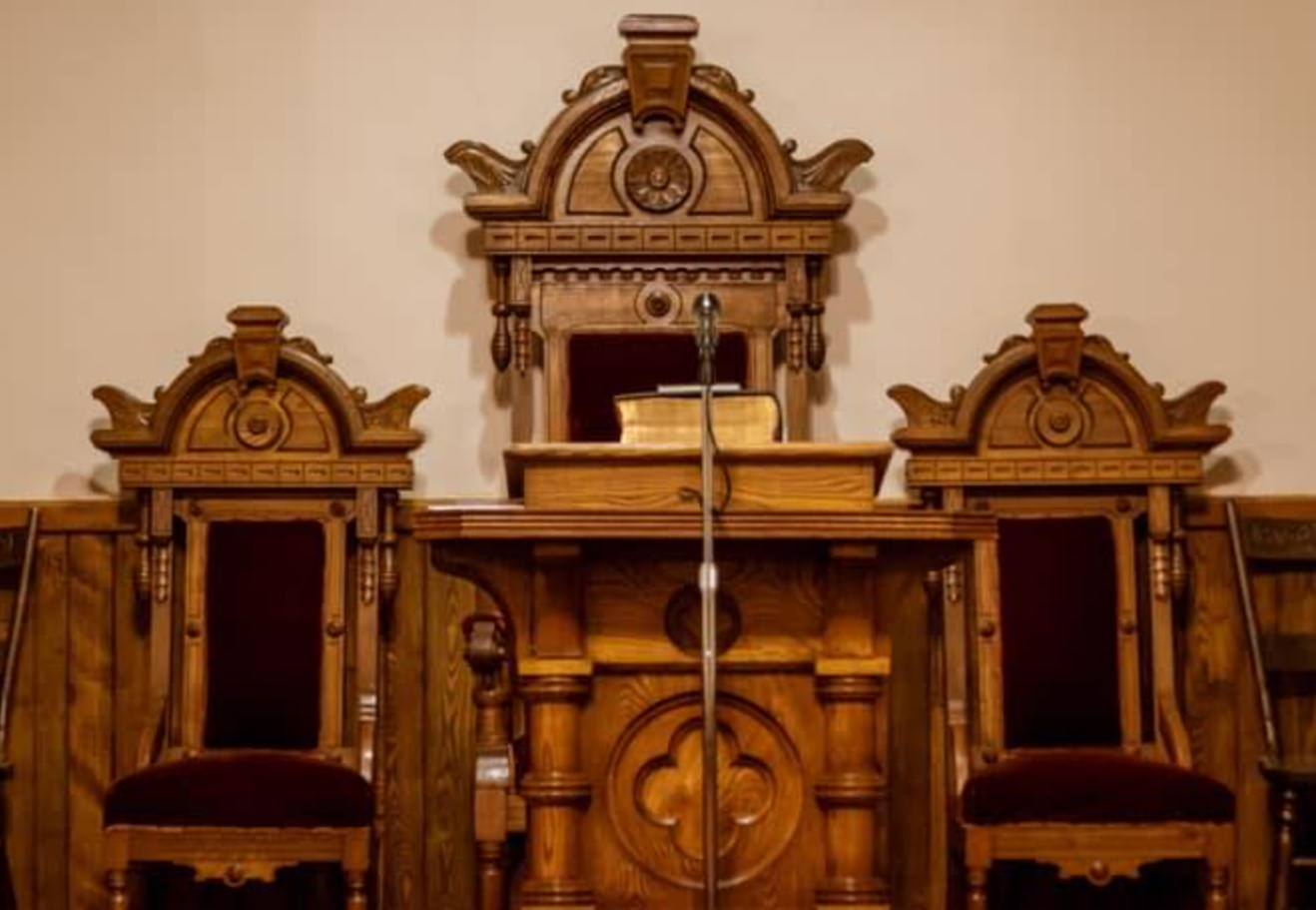
WHEN the congregation is to meet for publick worship, the people (having before prepared their hearts thereunto) ought all to come and join therein; not absenting themselves from the publick ordinance through negligence, or upon pretence of private meetings.

Let all enter the assembly, not irreverently, but in a grave and seemly manner, taking their seats or places without adoration, or bowing themselves towards one place or other.

The congregation being assembled, the minister, after solemn calling on them to the worshipping of the great name of God, is to begin with prayer.

“In all reverence and humility acknowledging the incomprehensible greatness and majesty of the Lord, (in whose presence they do then in a special manner appear,) and their own vileness and unworthiness to approach so near him, with their utter inability of themselves to so great a work; and humbly beseeching him for pardon, assistance, and acceptance, in the whole service then to be performed; and for a blessing on that particular portion of his word then to be read: And all in the name and mediation of the Lord Jesus Christ.”

The publick worship being begun, the people are wholly to attend upon it, forbearing to read any thing, except what the minister is then reading or citing; and abstaining much more from all private whisperings, conferences, salutations, or doing reverence to any person present, or coming in; as also from all gazing, sleeping, and other indecent behaviour, which may disturb the minister or people, or hinder themselves or others in the service of God.

If any, through necessity, be hindered from being present at the beginning, they ought not, when they come into the congregation, to betake themselves to their private devotions, but reverently to compose themselves to join with the assembly in that ordinance of God which is then in hand.

Read the rest of the Directory for the Public Worship of God (1645)

Read Full Post »

The following post was written by my friend, Rev. Jerrold Lewis, of the Free Reformed Churches.

* * * *

“They sacrifice upon the tops of the mountains, and burn incense upon the hills, under oaks and poplars and elms, because the shadow thereof is good…” (Hosea 4:13).

What was found in the Qumran caves was nothing new to Israel. In Hosea’s day, heart religion had long become a relic. Over generations, the fire of first love had all but gone out. Historically, slipping happens in stages. Typically, the first generation is passionate, the second grows complacent, and the third rebels. It’s a story as old as time. When the heart of religious man turns from the living God, it will fill that heart with other things. Oh, how each generation needs a fresh outpouring of the Holy Spirit! By the time we meet Israel in Hosea, the covenant people are in the third stage, rebellion.

Yet, this rebellion was not easily spotted. They still brought their sacrifices to the altar. They still offered their tithes and observed the holy days. The priests still performed their duties, just like past generations. To the casual eye, things appeared status quo. Outwardly, at least, Israel’s calendar was full, their altars were hot, the priesthood was sacrificing.

Read the rest here.

Read Full Post »

I could not bring myself to watch all of this, it’s just so idolatrous. But the observation is, if modern pagans take Halloween as their own, should it not raise some serious second thoughts among Christians who participate? “Have no fellowship with the unfruitful works of darkness, but rather reprove them.”

Read Full Post »

This is a helpful article by Jerrold Lewis on exclusive psalmody, vis-a-vis an argument for the setting of other portions of Scripture to verse and music for inclusion in public worship. While of course all Scripture is inspired and authoritative, Lewis makes a convincing case that the genre of the Psalms alone meet the unambiguous criterion required by the Regulative Principle of Worship. “Contrast the genre of the Psalms with Paul’s epistles, the visions of Daniel, or the narratives of Exodus. These are inspired, infallible, and rich in doctrine, but they were never songs. Nowhere in Scripture are we instructed to versify and sing Paul’s letters. No command tells us to render Isaiah into meter and melody for the congregation. To treat all Scripture as equally singable is to erase the clear distinction and intent the Holy Spirit Himself has drawn.”

Read Full Post »

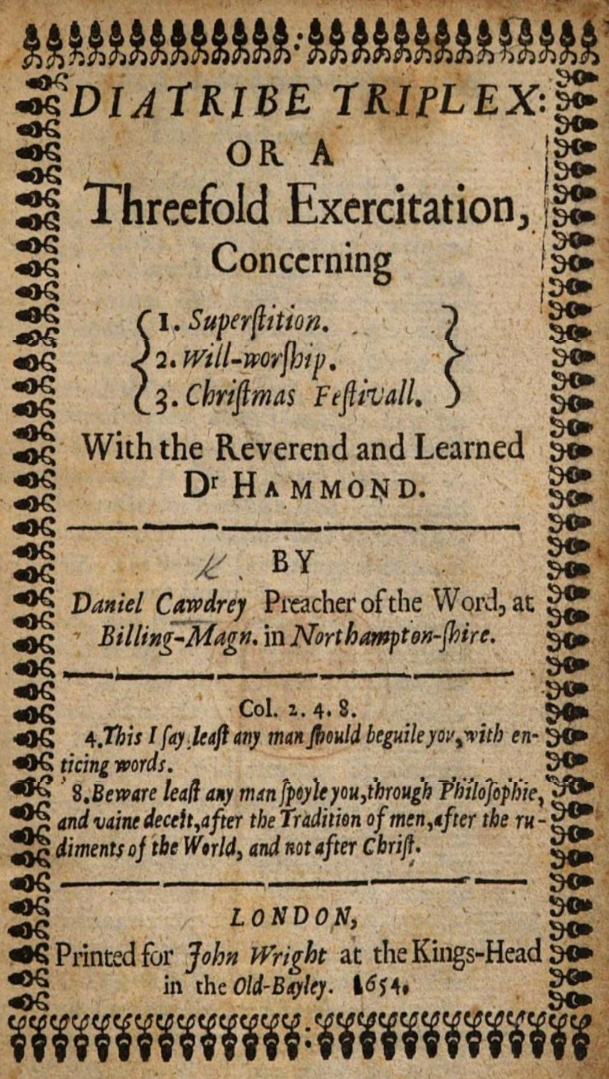
Just finished recording part 2 of 2 of Daniel Cawdrey’s “Of the Festivals of the Church, and Especially Christmas.” Listen to the audio here. This is the third part of a larger work, attached below. The University of Michigan has digitized the text here.

Visit the complete WPE Audio library.

Cawdrey (1588–1664) was a member of the Westminster Assembly, which produced the Westminster Confession of Faith, as well as the Larger and Shorter Catechisms. Like the rest of the Puritans of England and New England, as well as the Presbyterians of Scotland, these godly men rejected all holy days of men’s devising based on what has become called the ‘regulative principle of worship,’ which requires us to have clear and undoubted certainty about the divine, scriptural origin of any worship practice, and that any worship falling short of this standard must be set aside.

The Puritans were not kill-joys or men of bigoted, narrow minds. Anyone who reads their sermons and devotional writings will find them to be the warmest lovers of God, of Christ, and of their fellow men. They were also as a rule generous, catholic-minded men who embraced all those who called upon the Lord in sincerity, even among those who might disagree with them. And above all, they were men who passionately wanted to please God, even if that went against the flow of the opinions of men. I offer these recordings in that spirit.

The following is a sample from Cawdrey, in particular on his contention that the observation of Christmas is ultimately hostile to the proper, apostolic practice of Lord’s day observance:

“[It is said that] The Birth of Christ, is a mercy of such excellent quality, that it can never be overvalued, &c. This is granted; ​But to Institute a day as Holy, without command of Christ, for an Annual commemoration of this, is above the power of any Church, and a Superstitious presumption: and [altogether] needless; considering that the Lord’s day, (which includes the commemoration, not only of his Birth, but his Resurrection, and the whole works of our Redemption by him) was instituted by himself, or his Apostles, by him authorized and inspired, for this very end; & comes [around] once in every week. To limit it therefore to one day in a year, to remember that Mercy, is not an exaltation, but a derogation from it. If this were done, on his own design[ated] Day, wee need not fixe another day.”

Friend, let appeal to you not to brush off this position. You may in the end disagree with it; by all means, search the Scriptures, and be a Berean. But none of us “have attained,” and we should always be willing to bring any of our views or practices to the touchstone of Scripture. Embracing this position would naturally involve sacrifices, hurt feelings, and misunderstandings. But I can assure you from close to 30 years of experience after becoming convinced, and after raising four children in these principles, it is well worth it. “Them that honor me, I will honor.” And you don’t have to be a Grinch! I’m not—and I keep up many, many friendships with dear brothers who aren’t persuaded.

But of course, they’ll understand sooner or later (1 Cor. 13:12)!

Read Full Post »

Standard caveats, Rom. 12:9.

Read Full Post »

Found this quite insightful. Disturbing, to be sure; but also enriching to see the manifold grace of God’s Son who came “to destroy the works of the Devil.”

Read Full Post »

The Presbyterian Reformed Church (PRC) is an indigenous North American denomination whose roots are in the Scottish Reformation. We endeavour, by God’s grace, to keep to the Old Paths in the New World.

The church was formed in 1965 by the union of the Free Presbyterian Church of Ontario and the Bloor Street Presbyterian Church. The Free Presbyterian Church of Ontario was made up of the descendants of the Scottish settlers who had remained out of the unions which brought into being the Presbyterian Church in Canada (PCC) and who met in various communities throughout Southwestern Ontario. The origins of the Bloor Street Church were Scots-Irish immigrants from Ulster who settled in Toronto and were unhappy with the introduction of new worship practices in the PCC. By the 1960s, subsequent immigration from Scotland and family connections had united the congregations in doctrine and worship. It was time to unite them in government. That union was facilitated by Prof. John Murray of Westminster Theological Seminary.

Read more of this article by Rev. D. Douglas Gebbie at Presbyterian Picante.

Read Full Post »

The following is a transcription, graciously provided by Paul Barth, of my sermon some years back on head coverings for women during public worship. You can listen to the original audio here, which was an installment in a series on the distinctives of the Presbyterian Reformed Church.

Part of the practice that our presbytery has adopted is that in the public worship of God, women have their heads covered. The passage, naturally, that we go to is one that is not exactly easy to understand. I myself for many years read it and struggled with it. But I do think that the position that we have come to as a presbytery is the right one, as far as we think God has given us light. And we would like to set that before you humbly, for your prayerful consideration. We are not holding it forth as a “term of communion” that is a requirement to be a member in good standing of the church. We have not seen fit to go that far, as we also recognize that it is a challenging passage. And many other godly believers in the Lord Jesus Christ have seen things differently than we have. Nevertheless we set forth this position.

Now, the way we are going to go about things is, first, simply to read through the passage in 1 Corinthians 11 with comment, noticing the structure of the argument that the Apostle outlines, and then we will close with answers to several objections. The thesis here is that in the public worship of God women ought to worship God with their heads covered.

* * * * *

Read the rest here. See also an illustrative chart on 1 Cor. 11:6.

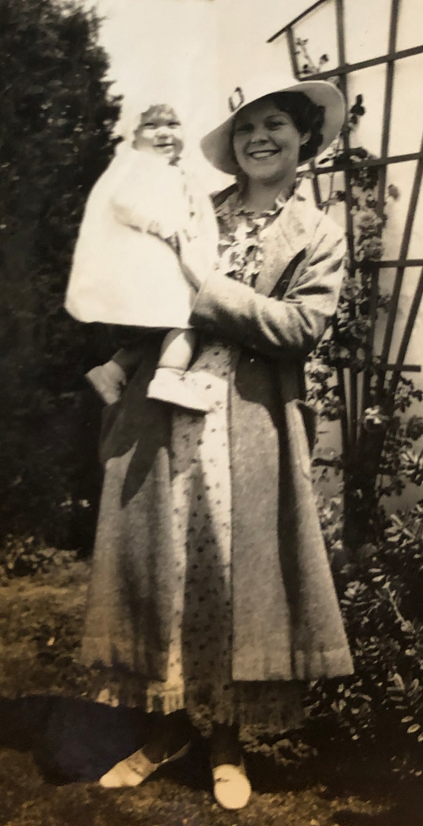
Incidentally, the photo above is my mother as a baby, being held by her mother. Looking lovely in their Sunday best!

Read Full Post »

Older Posts »