Feeds:
Posts
Comments

Archive for the ‘Vignettes from the Old Parish Way’ Category

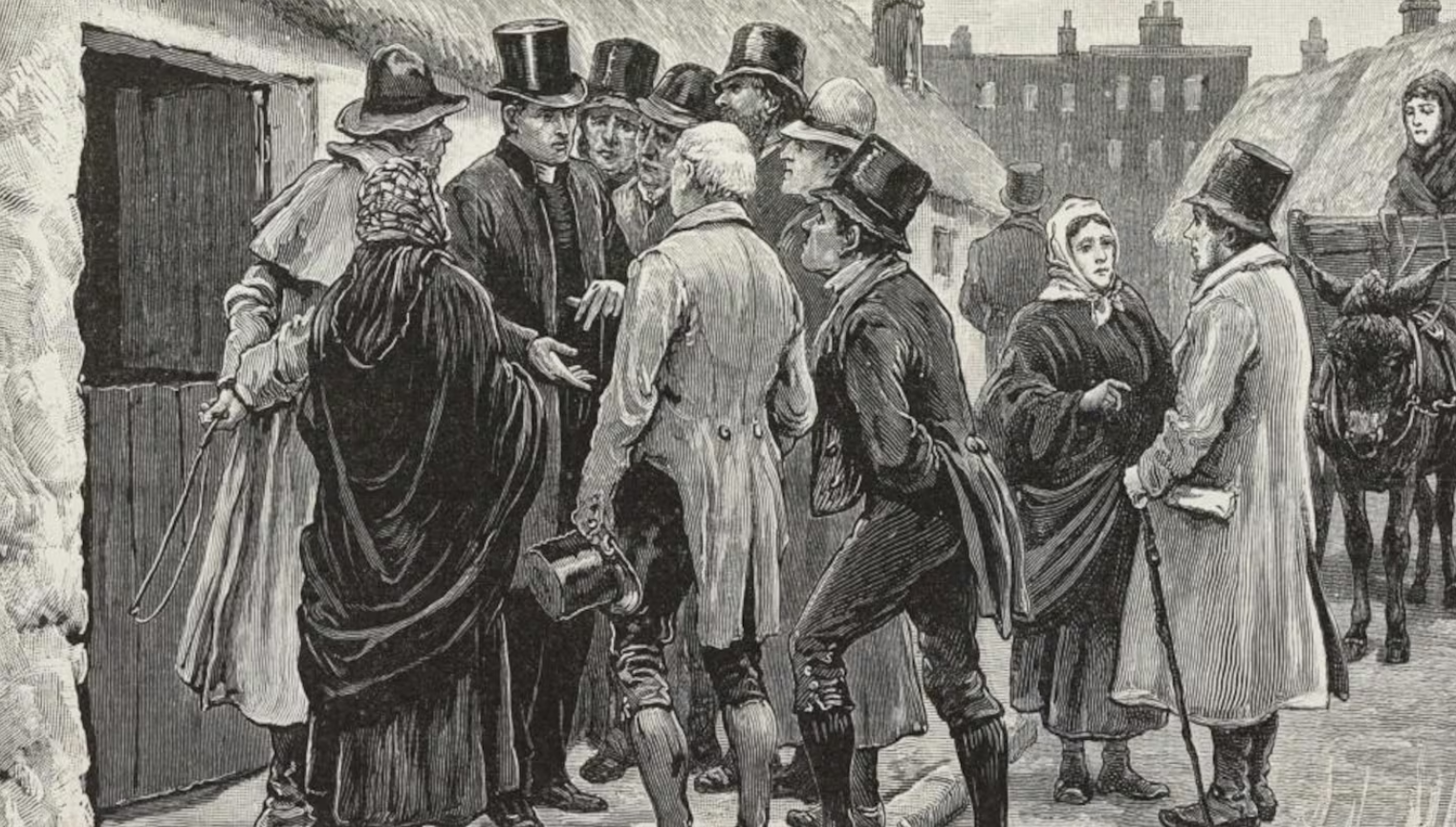
The following extract comes from Thomas Cochrane’s, Home Mission-work; Or, Twenty-five Years in a Mission Field (1873; pp. 51-52). Chalmers earlier advocated these exact same tactics years before. In my parish mission efforts, I’m already seeing the profound wisdom and insight of this policy. If they don’t yet come to church, then (assuming they let you in the door) bring church to them!

“In all Territorial districts there will be found many not only living in entire neglect of the sanctuary, but many of that number who will scarcely be persuaded by prayer and pains to avail themselves of the privilege To meet such cases, the devoted missionary will often be found to try and bridge over the difficulty by taking the church to them; sometimes, perhaps, even taking possession of the home of the neglectful, and making a church in their house. The effect of such little gatherings is often very blessed indeed. By these meetings there is not only opened a way for bringing the Gospel to the very homesteads of the careless and prayerless, but it is also, under GOD, a very fruitful source of augmenting the central gatherings.

“One of the most useful members of the Mission relates, as his own experience, how by this agency especially he was won to the public ordinances of the church. He was ill to gain over. Many months of prayerful effort were spent, but “by keeping at it,” with God’s blessing on the means, he was at last enlisted in the good cause ; and how useful he has been since in gaining others, the future only can reveal. How devoted he has been cannot be told.

“The services at these fireside gatherings should not, as a general rule, be lengthened above an hour, for many reasons. Mothers cannot conveniently give longer time from household duties. Short telling addresses at such meetings will ordinarily be most useful and acceptable. The grand object being to deal chiefly and closely with those who have not been accustomed to much serious thinking about religious subjects, anything fitted to weary and repel should be carefully avoided. How all-important to leave a good impression, and, by this short pithy service, to beget a thirst for the more extended, if not more formal, services of the house of God! It would not be an easy thing to say how many members of the church first found their footing towards the sanctuary through the influence of these district meetings. They will not only prove useful-almost essential-in the forming of a Territorial congregation, but will be of immense benefit after it has been formed, both as a means of dealing with the neglectful members of the congregation, and of reaching those beyond the pale of the church.”
[photo source]

Read Full Post »

“Yet I must say I liked the Irish part of my parishioners. They received me always with the utmost cordiality, and very often attended my household ministrations, although Catholics” (Works 16:243).

This and the following are selections from Thomas Chalmers on his attitude and outlook on reaching the poor Irish “papists” of his day, both domestically through aggressive, Protestant territorial missions, as well as on the Emerald Isle itself. Much here that is relevant, especially when so many Western nations have swarms of un-Christianized immigrants on our very doorstep.

* * * * *

Chalmers here refutes the notion that the Protestant establishment in Ireland ought to respect parochial bounds of Romanists. No! Parish lines are only relevant for the sake of the Gospel, and ought valiantly to be transgressed when the strong man’s house must be plundered: “We do not say that the maxim has been universally acted on, but it has been greatly too general, that to attempt the conversion of a Papist was to enter another man’s field; and that, in kind at least, if not in degree, there was somewhat of the same sort of irregularity or even of delinquency in this, as in making invasion on another man’s property. In virtue of this false principle, or false delicacy, the cause of truth suffered, even in the hands of conscientious ministers; and when to this we add the number of ministers corrupt, or incompetent, or utterly negligent of their charges, we need not wonder at the stationary Protestantism, or the yet almost entire and unbroken Popery of Ireland. We now inherit the consequences of the misgovernment and the profligacy of former generations. They may be traced to the want of principle and public virtue in the men of a bygone age. Those reckless statesmen who made the patronage of the Irish Church a mere instrument of subservience to the low game of politics—those regardless clergymen who held the parishes as sinecures, and lived in lordly indifference to the state and interests of the people—these are the parties who, even after making full allowance for the share which belongs to the demagogues and agitators of the day, are still the most deeply responsible for the miseries and the crimes of that unhappy land (Chalmers T 1838m; Works 17:304).

(more…)

Read Full Post »

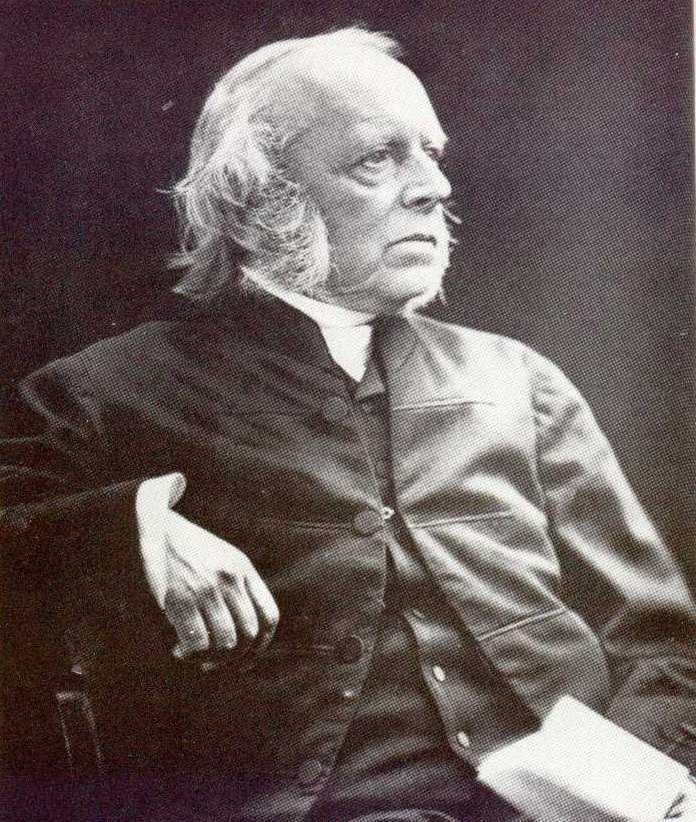
The article below on Andrew Bonar at Finnieston, Glasgow, was written by my friend Matthew Vogan and published in the Bulwark Magazine of the Scottish Reformation Society. The author relates the compelling story of Bonar’s evangelistic labor on the parish principle as taught and modeled by Thomas Chalmers.

Here are some sample extracts from the article:

Every afternoon from one o’clock till nearly five he would be found walking about his parish, visiting his people. He was well known on the streets of the district. He became a well-known figure in the area, and his friendly way of speaking and behaving endeared him to all, including children. Little children would run up to him as he walked and put their hand in his and receive a smile and gentle hand laid on the heard. One child called him “the minister with the laughing face.” Soon after arriving in the city, he spoke to a little girl in the street, addressing her by name. The child ran home to her mother with the delighted cry, “Mither, mither, he kens me.” [“Mother, mother, he knows me!”]

(more…)

Read Full Post »

Unless otherwise noted here prior to the event, the lecture will be livestreamed here:

https://linktr.ee/prcofri

Read Full Post »

Untitled 1

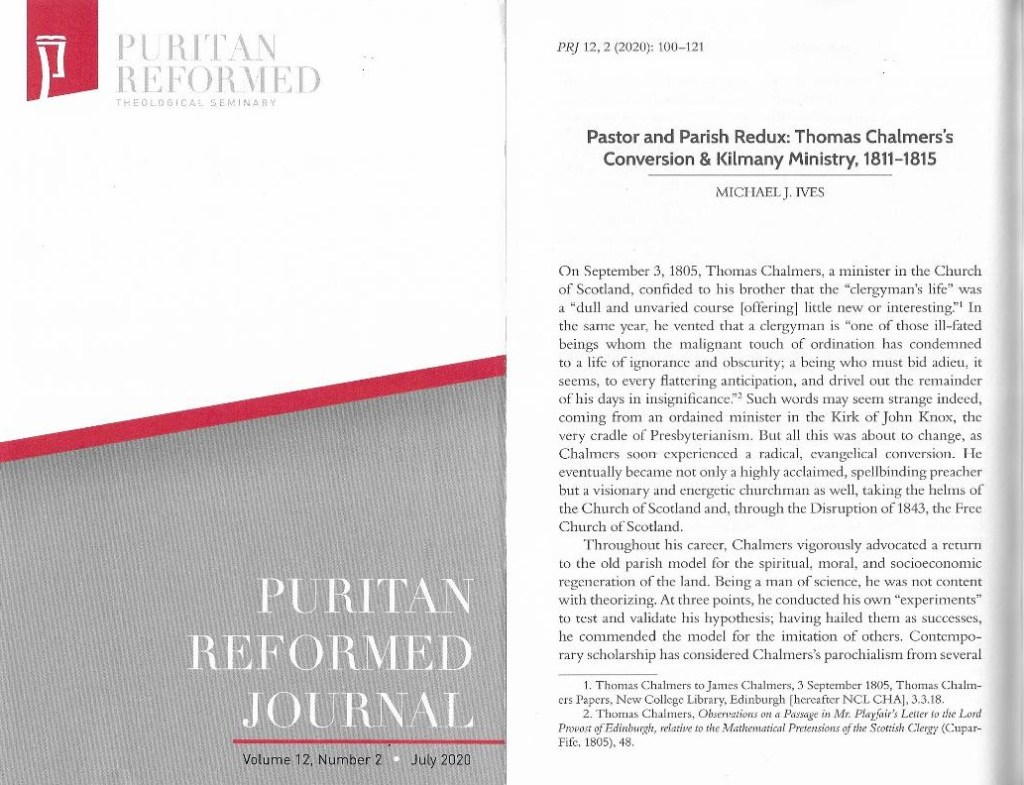
My recent journal article, “Pastor and Parish Redux: Thomas Chalmers’s Conversion & Kilmany Ministry, 1811-1815” (submitted copy), published in the July 2020 edition of the Puritan Reformed JournalImages used by permission. To purchase a copy, click here.

Read Full Post »

Read Full Post »

“Some Highland Evangelicals (in the 18th century) resorted to coercive tactics to compel people to hear their message. A mild example was Walter Ross’ confiscation of the cooking utensils in a fishing village that repeatedly emptied of its suspicious inhabitants when he approached. He returned the pots and pans after entertaining the villagers at a meal two days later. At that time they promised to receive his visits and to attend church.”

-Stephen A. Woodruff, The Pastoral Ministry in the Church of Scotland, p. 242

Read Full Post »

X. Sess. 13 et ult., April 27, 1708.—Act and Recommendation concerning Ministerial Visitation of Families.

“. . . Seeing, for the faithful discharge of ministers’ work, they ought, besides what is incumbent to them in the public congregation, to take special care and inspection of the particular persons and families under their oversight and charge, in order to which, it hath been the laudable custom of this Church, at least once a year, if the largeness of the parish, bodily inability in the minister, or other such like causes, do not hinder, for ministers to visit all the families in their parish, and oftener, if the parish be small, and they be able to set about it.

“For the more uniform and successful management of which work, although in regard of the different circumstances of some parishes, families, and persons, much of this work, and the management thereof, must be left to the discretion and prudence of ministers in their respective oversights, yet these following advices are offered and overtured as helps in the management thereof, that it may not be done in a slight and overly manner.

(more…)

Read Full Post »

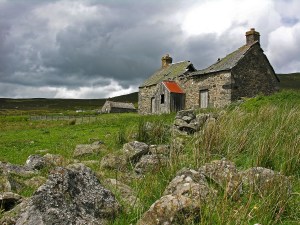
The following passage comes from the Memoirs of James Fraser of Brea (1639-1698). In it, we hear the heartbeat of a true fisher of men, a pastor-evangelist that all pastors should strive to be. Also, note that he urged the duty of the minister going beyond the four walls of the church into the “highways and hedges” to speak to the lost.  This is the good old parish way—ministerial house to house evangelistic labor in a fixed, geographical district. Would to God it may be recovered! (Italics below mine.)

* * * *

God did not send me to baptise, but to preach. But that which I was called to was, to testify for God, to hold forth his name and ways to the dark world, and to deliver poor captives of Satan, and bring them to the glorious liberty of the sons of God: this was I to make: my only employment, to give myself to, and therein to be diligent, taking all occasions; and to be plain, full and free in this charge. I was called to enter in hot war with the world and sinners, to fight by my testimony against them for God. . .

He is [in addition to public preaching] to execute his commission by exhortation, private and occasional instruction, whether for reproof, comfort, or in formation and direction. And this is it which I suppose I was most called unto, viz. to take all occasions with all persons in private discourse, to make the name of Christ known, and to do them good, and to do this as my only work; and to do it boldly, and faithfully and fully: and this to do is very hard in a right and effectual manner; to do this is harder than to preach publickly; and, to be strengthened, directed and encouraged in this, is that for which I ought to live near in a dependence on Christ, without whom we can do nothing, and of whom is all our sufficiency. In preaching there are a great many whom we can not reach, and there are many to whom we have no occasion to preach publickly; we may thus preach always, and speak more succesfully than in publick, where the greatest part of hearers do not understand the minister tho’ he speak never so plainly. This likewise we are called unto this day, seeing we are by force incapacitate: but oh how is this neglected! were ministers faithful in this, we should quickly see a change in affairs; but, alas, with grief of heart I speak it, it is in this thing that I challenge myself most of any, it is in this that I have most come short, and I suppose it may be so with others too. The Apostles went from house to house.

Read Full Post »

Here is a delightful vignette of old parish ‘missions,’ if you will, in 17th century Presbyterian Scotland.  The minister, William Guthrie (1620-1665), labored to be all things to all men, that he might gain some.

* * *

“After William Guthrie came to Fenwick, many of the people were so rude and barbarous, that they never attended upon divine worship, and knew not so much as the face of their pastor. To such, everything that respected religion was disagreeable; many refused to be visited or catechised by him; they would not even admit him into their houses. To such he sometimes went in the evening disguised in the character of a traveller, and sought lodging, which he could not even obtain without much entreaty, but, having obtained it, he would engage in some general amusing conversation at first, and then ask them how they liked their minister. When they told him that they did not go to church, he engaged them to go and take a trial; others he hired with money to go. When the time of family worship came, he desired to know if they made any, and if not, what reasons they had for it.

(more…)

Read Full Post »

Older Posts »