The Church, in its worldwide missionary enterprise, must be funded. Yet, according to Chalmers, the Church must ultimately fail if it makes its services dependent upon a pre-existing demand. Adam Smith was right to promote free trade in the marketplace, but not in religion. Why? Because the natural man won’t pay for the Gospel. He has no demand for such a supply. Therefore, missionaries must be financed by those who are already Christian, whose hearts have been enlarged by the Gospel that they may patronize its cause. This is what Chalmers calls voluntaryism ab extra. And it is a major part of his argument for the necessity of Church establishments.
In the quote below, Chalmers demonstrates that this has always been the case, from the coming of the Savior to the age of the apostles and beyond.
* * *
“Now let us consider whether this is the footing on which the world ever is; or ever can be, supplied with its Christianity, or rather with its Christian instruction, in the way that is best for the moral interests of our species. It was not so at the first introduction of Christianity, in virtue, not of a movement from earth to heaven, but of a movement from heaven to earth; and the expenses of which, throughout the infancy and boyhood of the Saviour, were certainly not defrayed by those for whose welfare the mission was undertaken. It was not so during the time of His public ministry, when three or four women ministered to Him of their substance, as He travelled from place to place over the land of Judea; and so He was maintained at the cost of the few for the benefit of the many. It was not so in the journeyings of His disciples, two by two among their countrymen—who, when they entered a city, fixed their residence in some particular house, and were supported by the hospitality of one individual for the good of the general population. It was not so when the apostles went forth after the resurrection; and received their maintenance from such as Simon the tanner, or Lydia the seller of purple, or Stephanus and Fortunatus, and Achaicus, and others of those Scripture worthies who harboured and entertained the men of God, while they held out the bread of life, without money and without price, to the multitude at large. It was not so when the last, but not 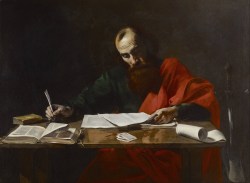 the least of the apostles, provided with his own hand for his own necessities; and the wages of Paul the tentmaker, enabled Paul the apostle, to labour in his sacred vocation without wages. It was not so when he received from other and distinct churches, that, in the church of Corinth, the gospel might not be chargeable to any; and he would suffer no man to strip him of this boasting in the regions of Achaia. And, to come down from the age of the New Testament, it generally could not have been so, that the extension of Christianity was carried forward during the three first centuries. The men who were not yet Christians did not, in those days, send to the apostolic college for men who might give them the lessons of the gospel; but, by a reverse process, teachers went forth among the yet benighted countries of the earth; and their expenses, at least in the first instance, behoved to be borne, not in the shape of a price by those who received the benefit, but in the shape of a bounty by those who dispensed it. In all these instances, contrary to every law or character of pure trade, the expense was borne either totally or partially by one party, and that for the good of another party. It was not as in the ordinary exchanges of commerce. The receivers were not the purchasers; and what they did receive was not a thing by them bought, but a thing to them given. It is an utter misconception that when Constantine set up in his dominions a national establishment of Christianity, he made the first infringement on that system of free trade by which the prosperity of this religion had been heretofore upholden; for, from its very outset, Christianity stood indebted, for almost every footstep of its progress, to a system and a policy directly the opposite of this. When he came forth with his great imperial bounty or benefaction, he only did on the large scale, what thousands of benefactors had previously, and for hundreds of years, done on a small scale before him. When he became the friend and nursing father of the church, he did for the whole territory of which he was the sovereign, what, times and ways without number, the friends of the church had already done, each for the little district in which he himself resided, or for the introduction and the maintenance of Christian worship in some chosen locality of his own. With his great national endowment, he but followed in the tract of those private and particular endowments which, sometimes temporary, and sometimes perpetual, had multiplied beyond all reckoning, during the preceding ages of Christianity; and in virtue of which it was, that churches innumerable were raised, and congregations were formed; but chiefly in the large and flourishing cities of the Roman empire. The peasants, or they who lived in the country and villages, inhabitants of the pagi, and hence called Pagans, were, in the great bulk of them, still unconverted—insomuch that Paganism in those days became synonymous with heathenism; or, in other words, the great majority of the rustics or countrymen of that period, notwithstanding the strenuous and apostolic exertion of many thousands of Christian missionaries for about three centuries together, were still adherents to the old superstition and idolatry of their forefathers. The universal endowment, by which a ministry was provided for every little section of the territory or the whole was broken into parishes, opened a way to the moral fastnesses that were still held and occupied by the countless millions whom all the efforts of by-gone generations had not reached; and so brought a whole host of gospel labourers into contact with the wide and plenteous harvest of the general population.
Read Full Post »

 West Port Experiment