Feeds:
Posts
Comments

Archive for the ‘Thomas Chalmers’ Category

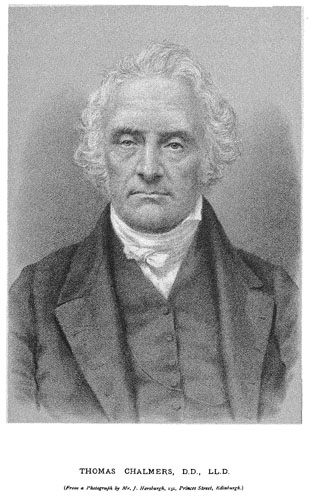
The following is extracted from Thomas Cochrane’s Home Mission Work (1878).  The chapter, “The Territorial System,” is a nice overview of the urban mission strategy advocated by Thomas Chalmers.

* * * *

In the later years of his eventful life, with all the experience and mellow ripeness of a mind that had given very much of the best of its powers to the advocacy and outworking of the grand old parochial system of Scotland, the illustrious Dr Chalmers, while carrying on with undimmed and undiminished lustre the labours of his distinguished professoriate, worked out, alongside of this theoretical training for the students of theology, the grand practical work of Territorialism. He thus devised and carried out, in a most singularly successful way, a scheme which, because it sought to cope with all the difficulties, and to grapple with all the obstructions that might be encountered, and set itself to the prosecution of true mission work, in a certain selected locality or territory, and to cultivate regularly and thoroughly that district so assumed, has been most fitly termed— “The Territorial System.

In the great metropolis of the West, among her merchant princes, in St John’s parish there, Dr Chalmers had previously developed, and very successfully worked out, under the wing of the State, the system, as strictly parochial; now he was to unfold and develop the same system, minus State support and State influence in any way.

The chosen field in Edinburgh, “The West Port, was the most unlikely, and, seemingly, unpropitious that could have been selected.

The hall opened for public worship was an “old Tan Loft,” near to the spot which had earned an unenviable notoriety, because of revolting murders that had been perpetrated—more revolting than any that had either before or since disgraced the fair escutcheon of that noble city—a locality where purity and outward decency alike blushed for very shame!

Nothing daunted, however, that truly great man, surrounded by a staff of devoted volunteers, went forth into the thick of the conflict, to do battle with the sin and crime that met them, at every corner of the district, and to soothe the sorrows and assuage the trials of human misery and woe.

It was indeed a noble scheme, a grand enterprise; and let that interesting chapter, “The West Port,” in the classic and eloquent biography of Dr Chalmers, written by his son-in-law, the late Dr Hanna, tell in his inimitable style, how, under more than wizard wand, of that Great Moral Conjuror, the wilderness became a fruitful field, and the desert rejoiced and blossomed as the rose, becoming “A Garden of the Lord.

All around now in Edinburgh, from the west to the extreme east, ‘neath the shadow of hoar Holyrood, there have been erected churches and schools upon this territorial system, so that, in addition to “The West Port,” there are more than seven other churches with as many ministers, and fully equipped agencies and congregations, carrying on with greater or less success the operations of the Territorial system.

Glasgow, too, has had her full share of the benefits of this scheme. The development of this system, however, is not confined to Edinburgh or Glasgow. Many other large towns in Scotland, such as Aberdeen, Dundee, Perth, &c, have reaped golden harvests from the seed sown, through the carrying out of this important work; while England, too, in measure, has caught the infection and influence, from the spell of the mighty charmer, who though “being dead, yet speaketh,” while his works, all around, follow him; and far hence, away across the broad Atlantic, the winds have wafted on and o’er the story, and there, too, in several instances, the system is being tested and tried.

In the prelude to his lecture on “Transcendentalism, Dr Joseph Cook of Boston, rehearses the story of “The West Port,” and presses upon his readers the importance and moral grandeur of the scheme; while, as Dr Cook himself informed us, when on a visit to this country, the system has been found in America to be the only true system for elevating the community, civilly, socially, and morally.

It may here be stated that the system, both scholastically and ecclesiastically, can be worked out in such a manner as to be self-sustaining; so that the big thoughts, and large desires of the illustrious founder, have not only been proved not to be Utopian, but fruitfully workable; and that too, not only during his distinguished life, under his own eye, and by the cunning of his own right hand; but now, also, a full generation after he has been gathered to his fathers, the work progresses and advances still more and more, and we believe will continue to do so, after its present promoters have gone the way of all the earth.

It may be argued, however, that if so much has been done,—if such harvests have been, or are being ripened and reaped all round, in the town and country districts of Scotland, and elsewhere, is there still need for the advocacy and extension of the practical outworking of this scheme? There is much land yet to be possessed. When we are reminded that in Edinburgh alone, there are perhaps not less than forty thousand, in Glasgow a much larger number, while over broad Scotland, there are about five hundred thousand living in entire neglect of the means of grace; living “without God,” if not dying “without hope,” we cannot fail to perceive that this scheme is of prime importance, and that the necessity for the thorough outworking of it is as great as ever.

THE DISTRICT SELECTED.

The idea of the great founder of the scheme, in regard to the chosen district, was very decided. His firm and unwavering conviction was, that the field selected should be very carefully and deliberately chosen, and that it should be of adequate proportions,—not too large, lest it should not be fully and thoroughly cultivated; not too small, lest there should not be a population sufficiently large to yield material for a good, self-supporting congregation.

Holding these views strongly, Dr Chalmers was in the habit of affirming that a population of about 2000 was quite large enough, in ordinary circumstances, for the purpose in view, and that a district less populous was not adequate for the formation of a Territorial Congregation. Hence a district of about 400 families, or 2000 of a population, according to the system under review, would require about forty visitors in order to cultivate it thoroughl, giving manageable sub-divisions of about ten families to each agent.

THE VISITOR’S DUTIES.

The duties of visitors may be regarded in many aspects (see pages 57-60), but the great, the chief duty is to visit their districts, with a view of promoting the highest good of the families in the district allocated to them. Assuming the visitor to be truly Christian, and devoted to the work, how very much will depend upon the judiciousness manifested in the discharge of duty. What care will be required, lest their visits should hinder, rather than help on the work to be accomplished. How important, all-important, to make the families visited feel that we are really and truly their friend; that we visit, not with a prying over-curious eye to spy into their household affairs, far less in a censorious spirit, ever insinuating our fancied superiority, and finding fault with what, we imagine, may be their little delinquencies; but that, placing ourselves upon the same platform on which they stand, we thus make it clear that we have their highest good at heart, and have love in our heart for them, as well as expressed sympathy upon our lip with them. Hence our aim should be to influence the heart for good.

“They build too low who build beneath the skies.”  They aim too low who aim not at the heart.  The effect of mere gossip in visiting, is always fruitless, if not of evil tendency.  By all means let us be happy, with a gleam of sunshine ever lighting up our countenances.  By all means let our words he happy words, and happy social words.  If time permit there may be talk about the common affairs of life, and the current events of the day; but we should never let our conversation degenerate into flippant talk, idle talk, or jesting which is not convenient; and, if possible, we should never leave any house, without making it clear that our object in visiting was with respect to the highest good of the family.

Even in the distribution of tracts let us have a care of the manner we manifest in so doing. Let us keep in view that, while we are as messengers of mercy bearing the silent message in the tract we give, we are to make it plain that we need the message we bear, as well as those to whom we bear it, as Mr M’Cheyne would have said, in his own tender, touching way, “I need it, my brother, as well as you.”  Or, as we have it from an inspired pen, “We, that we say not you.”

The importance of house-to-house visitation can never be over-estimated. There may be—there are —some who weary in this seemingly slow process, and who would fain “rush into print,” in placards large, fancying that by sleight-of-hand, or speed of foot, or by monster meetings in large halls, and other general schemes, they may speedily evangelise the outlying population in our vast moral wastes.  All success to these, and every good scheme!  It is not so, generally, however, that this work is to be done. The race is not to the swift, nor the battle to the strong.  The patient, laborious, conscientious worker, who realizes what is implied in faithful labour for the Great Master, is the labourer that will here prevail.  If it be true that the time shall come when they shall no more teach every man his neighbour, and every man his brother, saying, “Know the Lord,” does not this imply that, until that time shall have come, this system should be carried on?  And here, again, the conscientious worker must be content to be hidden from the world’s eye, but work ever under the eye of His Lord and Master. He must be willing to be unknown, perhaps unheard of.  Down in the damp, dark cellar;  high, in the lone garret room; concealed in some back court where the sun scarce shines; or in the loathsome land, where fever holds its perpetual sway, and revels, in the luxury of human misery, all prodigal of life,—there must the visitor be prepared to labour, there the missionary be contented to toil, from day to day.

” Go labour on, ’tis not for nought:
Thy earthly loss is heavenly gain;
Men heed thee, love thee, praise thee not;
The Master praises; what are men?”

Prevention is better than cure.“—There are congregations whose membership may not be able to supply agents for carrying out the scheme we have been commending, and where it would be of immense advantage, to such a congregation, to have the scheme thoroughly and earnestly worked out, in connection with their own work, and into their own congregation.  In such a case why should not some healthy and vigorous, if not wealthy and numerous, congregation, come with all its flow of life and love, and work for, at least, if not in connection with the work of such a congregation?   Would not many a struggling congregation thus take heart and begin anew? Would not many a downcast and cheerless minister obtain encouragement, and gird on with fresh ardour the armour of the Gospel of Peace?  Nay, would not this be a true exhibition of the members of the church, looking “not every man on his own things, but every man also on the things of others;” and of manifesting in the clearest sense, how the strong could help the weak, thus showing to the world and the Church alike that “it is more blessed to give than to receive”?

Having, throughout the volume, touched upon the main features of the Territorial system, and having had the privilege, for very many years, of being a humble labourer in the Territorial field, in closing our remarks we may be permitted to say that the longer we have laboured in the outworking of the system, the more thoroughly have we been convinced of the value and effectiveness of it.

One of our greatest and sincerest regrets is, that we should have been so little able to do anything like justice to it. We feel this all the more, that we are not now so agile, as heretofore, in buckling on our armour, and sallying forth at the trumpet’s sound against the common foe.  We must soon retire from the field of action, but, when retiring, we hope to do so by handing down the banner, unfurled and untarnished, with the device thereon, as ever, full, perfect, and undimmed—

For THE LORD

and

Territorialism.


Read Full Post »

“To appropriate his little vicinity—to lay it down in the length and the breadth of it—to measure it off as the manageable field within which he can render an entire and a lasting benefit to all its families—to know and be known amongst them, and thus have his liberality sweetened by the charm of aquaintanceship with those who are the objects of it—instead of dropping as heretofore of his abundance, into an ocean where it was instantly absorbed and became invisible, to pour a deep, and a sensible, and an abiding infusion into his own separate and selected portion of that impracticable mass which has hitherto withstood all the efforts of philanthropy—instead of grasping in vain at the whole territory, to make upon it his own little settlement, and thus to narrow at least the unbroken field which he could not overtake—to beautify one humble spot, and there raise an enduring monument, by which an example is lifted up, and a voice is sent forth to all the spaces which are yet unentered on—this is benevolence reaping a reward at the very outset of its labours; and such a reward, too, as will not only insure the accomplishment of its own task, but as must, from the ease, and the certainty, and the distinct and definite good which are attendant upon its doings, serve both to allure and to guarantee a whole host of imitations.”

-Thomas Chalmers, The Christian & Economic Polity of a Nation, p. 101.

Read Full Post »

Here’s a link to another great introductory lecture on Thomas Chalmers.  We’ll add that one to our library.  Enjoy!

Read Full Post »

Key to understanding Thomas Chalmers’ advocacy of the locality (or parish) principle for urban missions is what he called ‘the gregarious principle.’  Man by God’s design was made a social creature.  And as a part of God’s moral government, there are certain social laws that men disregard only to their detriment.  The locality principle does not disregard, but presumes the gregarious principle and harnesses its potential.  As a minister adopts a territory for its spiritual cultivation, he removes not only the geographic, but the social distance between himself, his church, and the people he is seeking to reach.  And in the end, heart joins with heart. 

The following quote illustrates Chalmers’ view of the social advantages in a minister doing outreach on the locality principle.  Notice his concern with social ideas such as acquaintance, intimacy, friendliness, welcome, and fellow feeling:

In the first place, then, it is not so likely that a minister will go forth on his share of the population, when spread at random over the whole city, as when they lie within the limits of a space that is overtakable. He feels an incitement to move in the latter way of it, which he does not feel when his attentions are dispersed over a wide and bewildering generality. He, under the one arrangement, may have rare, and rapid, and transient intercourse with the individuals of a diffused multitude; but this can never ripen into solid acquaintanceship with more than a very few.  Under the other arrangement, he may, at a greatly less expense, attain to terms of intimacy with some, and of civility with many. And it would add prodigiously to this operation, were his hearers, on the Sabbath, also his parochial acquaintances through the week. By this simple expedient alone, he would attain such an establishment of himself in his parish, in a single month, as he will not otherwise reach, but by the labour and assiduity of years. The very consciousness that, in a certain quarter of the city, lay the great body of his congregation, would be enough to assure him of a welcome there, and a friendship there, that would ever be inclining his footsteps to his parish, as the fittest scene of promise and of preparation for all his enterprises. And he would find, that the business of the Sabbath and the business of the week, had a most wholesome reciprocal influence the one upon the other. The former business would immediately open a wide and effectual door of intercourse with the people; and the latter business would not only retain the people in attendance upon their minister, but would rapidly extend their demand of attendance upon him, whenever there was room for it. . . .

But the second influence of locality in this matter, is perhaps of greater efficacy still. The first is that by which the minister obtains a more intense feeling of his relationship to his people. The second is that by which the people obtain a more intense feeling of their relationship to their minister. It is incalculable how much this last is promoted by the mere juxtaposition of the people to one another. There is a great deal more than perhaps can be brought out by a mere verbal demonstration, in a number of contiguous families, all related by one tie to the same place of worship, and the same minister. It would go to revive a feeling, which is now nearly obliterated in towns, whereby the house which a man occupies, should be connected, in his mind, with the parish in which it is situated, and an ecclesiastical relationship be recognised with the clergyman of the parish. In these circumstances, where there was no interference of principle, and no personal disapprobation of the clergyman, attendance upon the parish church would at length pass into one of the habitual and established proprieties of every little vicinage. Old families would keep it up, and new families would fall into it; and the demand for seats, instead of slackening under such an arrangement, would become more intense every year, so as to form a distinct call for more churches, whenever they were called for by the exigencies of a growing population (The Christian & Economic Polity of a Nation, pp. 67-68).

Read Full Post »

“However thoroughly we may he convinced of the benefit that would result from the influence of locality, we feel that it is not in easy task didactically to set forth this influence, by any process of argument or explanation. The conviction is far more readily arrived at by the tact of real and living experience, than by the lessons of any expounder. There is a charm in locality, most powerfully felt by every man who tries it; but which, at the same time, it is most difficult so to seize upon as to embody it in language, or to bring it forth in satisfying demonstration to the public eye. We do not know an individual who has personally attached himself to a manageable portion of the civic territory, and has entered with taste and spirit upon its cultivation-and who does not perceive, with something like the force and the clearness of intuition, that, if this way of it were spread over an assembled million of human beings, it would quickly throw a new moral complexion over the teeming expanse that is on every side of him. But what he feels, it is not easy to make others see. For, however substantial the influence of locality is, there is a certain shadowy fineness about it, in virtue of which it eludes the efforts of an observer to lay hold of it, and to analyze it. It is no bad evidence, however, of the experimental soundness of this operation, that the incredulity about it, is all on the side of those who stand without the field of local management; and the confidence about it, on the side of those who stand within-and that, while the former regard it as a mystic and undefinable fancy, the latter find in it as much of sureness and solidity, as if their eyes saw it, and their hands handled it.”

-Thomas Chalmers, The Christian and Economic Polity of a Nation, p. 43.

Read Full Post »

The following is a delightful quote in the preface of the 1840 edition of Thomas Chalmers’ Christian and Economic Polity of a Nation:

We confess no small gratification in finding, at the end of twenty years, that our promulgations, held at the time to be altogether Utopian, of the great charm and efficiency which lie in the household ministrations of clergymen, are now repeated in the most popular, and at the same time, the most able and authoritative of our daily journals. The Times newspaper of a few days back recommends with great force and eloquence, and in the following terms, “the still further prosecution of an earnest and indefatigable system of parochial domiciliary visiting throughout all the parishes of the land. This, depend upon it, is the only patent and talismanic key to English hearts, whether of Churchmen, Papists, or Dissenters. Disinterested and persevering kindness, brought habitually to a man’s home under all sorts of discouragement, is what no human being can long or rudely resist. With that elevated determination and singleheartedness, which, in the absence of all impertinent intrusions or officious curiosity, manifestly seeks to engage mankind in a devout concern for their immortal interests, let every family in every city, town, or hamlet, be regularly and affectionately visited, no matter what denomination they may belong to. The established clergy, accredited, commissioned, and upheld by the law of this realm, are the clergy of the whole nation. Every fireside in their parish is a part of their allotted charge. They have an official as well as a moral right, subject, of course, to discreet limitations, to seek admittance into every door, ‘ whether men will hear or whether they will forbear.’  Painful repulses will occasionally, though not often, occur; but these, compensated by a consciousness of dutiful exertion and by cordial welcomes in other cases, will sooner or later be overcome hy meek and patient endurance. Only let all the families of England be regularly invited to the dispensation of a free gospel in a free church ; and eventually the very universality of this hahit of parochial visiting will establish it as a part of our social system; and cause it to work with the uniform beneficence of nature’s general laws.”

Read Full Post »

One of the reasons Chalmers advocated territorial city missions was to reunite the classes, particularly by the clergy’s concentrated evangelistic efforts in the slums.  It was ultimately a missionary policy, yet it had distinct advantages for the social fabric.  Here’s an interesting quote that helps illumine Chalmers’ rationale for the parish plan in urban context:

In a provincial capital, the great mass of the population are retained in kindly and immediate dependence on the wealthy residenters of the place. . . [which] brings the two extreme orders of society into that sort of relationship, which is highly favourable to the general blandness and tranquillity of the whole population. In a manufacturing town, on the other hand, the poor and the wealthy stand more disjoined from each other.  It is true they often meet, but they meet more on an arena of contest, than on a field where the patronage and custom of the one party are met by the gratitude and goodwill of the other (Thomas Chalmers, Christian and Civic Economy of Large Towns, Glasgow, 1821, p. 51).

As the clergy and benevolent Christian volunteers adopt mission districts in the cities and thoroughly work them, the net effect should be a re-harmonization of the upper- and middle-classes with the working class.

Read Full Post »

Richard Baxter of Kidderminster (from flickr.com)Baxter was an establishmentarian.  It is good that kings and queens should be nursing fathers and mothers to the Church.  He lamented in his Reformed Pastor that magistrates did not make adequate provision of Reformed pastors throughout the England of his day. 

Yet, he did not lay the main blame at the feet of civic leaders.  The fault was with the laziness of the ministry.  “It is we who are to blame, even we, the ministers of the gospel, whom they should thus maintain.  For those ministers that have small parishes, and might do all this private part of the work [pastoral care, mainly through catechizing], yet do it not, or at least few of them.  And those in great towns and cities, that might do somewhat, though they cannot do dall, will do just nothing but what accidentally falls in their way, or next to nothing; so that the magistrate is not awakened to the observance or consideration of the weight of our work” (Reformed Pastor, pp. 184-85, emphasis mine).  Like Chalmers some 150 years after him, his establishmentarianism was no fawning dependence of the Church on the State.  Rather, the Church ought to rise to the calling of its own Master, with or without the aid of the magistrate.  Yet, both Baxter and Chalmers believed that the diligence of the ministry could induce the State to its duty of patronizing the heavenly Kingdom.

Read Full Post »

“It is easy to separate from the multitude, and to gather distinct churches, and to let the rest sink or swim; and if they will not be saved by public preaching, to let them be damned: but whether this be the most charitable and Christian course, one would think should be no hard question” (Reformed Pastor, p. 184). 

In Chalmers’ terms, we must operate on the principle of aggression and not attraction.

Read Full Post »

The following is an excellent quote from Thomas Chalmers in his Christian and Economic Polity of a Nation (1821).  In it, he demonstrates one particular viture of the locality principle, on which the parish system is built – it facilitates the zeal and perseverance of the Christian missionary:

” He, with a select and appropriate vineyard thus lying before him, will feel himself far more powerfully urged, than when under the common arrangement, to go forth among its families. However subtle an exercise it may require from another, faithfully to analyse the effect upon his mind, he himself has only to try it, and he will soon become sensible of the strong additional interest that he acquires, in virtue of having a small and specific locality assigned to him. When the subject on which he is to operate, thus offers Thomas Chalmers and his family (from flicker.com)itself to his contemplation, in the shape of one unbroken field, or of one entire and continuous body, it acts as a more distinct and imperative call upon him, to go out upon the enterprise. He will feel a kind of property in the families; and the very circumstance of a material limit uround their habitations, serves to strengthen this impression, by furnishing to his mind a sort of association with the hedges and the landmarks of property. At all events, the very visibility of the limit, by constantly leading him to perceive the length and the breadth of his task, holds out an inducement to his energies, which, however difficult to explain, will be powerfully felt and proceeded on. There is a very great difference, in respect of its practical influence, between a task that is indefinite, and a task that is clearly seen to be overtakeable. The one has the effect to paralyze; the other, to quicken exertion. It serves most essential!v to spirit on his undertaking, when, by every new movement, one feels himself to be drawing sensibly nearer to the accomplishmviit of it—when, by every one house that he enters, he can count the lessening number before him, through which he has yet to pass with his proposals for the attendance of their children—and when, by the distinct and definite portion, which is still untravelled, he is constantly reminded of what he has to do, ere that district, which he feels to be his own, is thoroughly pervaded. He can go over his families too, with far less expense of locomotion, than under the common system of sabbath schools ; and, for the same reason, can he more fully and frequently reiterate his attentions; and it will charm him onwards, to find that he is sensibly translating himself into a stricter and kinder relationship with the people of his district; and, if he have a taste for cordial intercourse with the fellows of his own nature, he will be gladdened and encouraged by his growing familiarity with them all; and thus will he turn the vicinity which he has chosen, into a home- walk of many charities ; and recognized as its moral benefactor, will lug kindness, and his judgment, and his Christianity, be put forth, with a well- earned and well-established influence, in behalf of a grateful population.”

Read Full Post »

« Newer Posts - Older Posts »