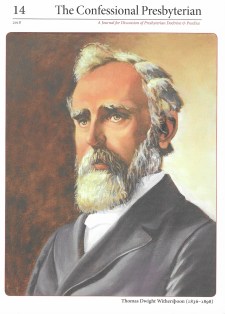
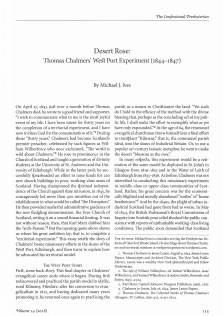
My 2018 journal article, “Desert Rose: Thomas Chalmers’ West Port Experiment (1844-1847),” published in the 2018 edition of The Confessional Presbyterian. Images used by permission. To purchase a copy, click here.
Posted in Articles, Free Church of Scotland, Locality & the Law of Residence, Missiology, Moral Suasion, Parish Theory & Practice, Parochial Strategy, The Romance of Locality, Theology of Community, Theology of Place, Thomas Chalmers, Vignettes from 19th Century District Visitation, Visitation Evangelism, West Port experiment, WPE Editor on April 14, 2020| Leave a Comment »
My 2018 journal article, “Desert Rose: Thomas Chalmers’ West Port Experiment (1844-1847),” published in the 2018 edition of The Confessional Presbyterian. Images used by permission. To purchase a copy, click here.
Posted in Missiology, Parish Theory & Practice, Parochial Strategy, Pastoral Theology, The Romance of Locality, Theology of Place, Thomas Chalmers on January 3, 2020| Leave a Comment »
Just finished a new addition to the Chalmers Audio Library, “The Right Ecclesiastical Economy of a Large Town.” (Original here.) While it is somewhat ponderous in its Victorian style and treats some antiquated matters, the core of this piece is a profoundly relevant contribution to historic, Reformed missiology. If only every Reformed and Presbyterian office-bearer would read it and process it!
Here is a little extract to give an idea of his parochial approach:
“If he go much among them through the week, the unfailing result in time will be, that they shall come much about him on the Sabbath. This is the ligament, and we know not a more important one in the whole mechanism of human society, by which to elevate a degenerate population, and again to place them on that higher moral platform from which they have descended. There is no romance, there is a sober and home-bred reality in all the steps of this operation. On the very first movements of the clergyman, he will meet with the smiles of encouragement and welcome from every quarter of his parish, with a thousand promises of attendance on his church, many of which in the first instance will not be realized; but, with every month of perseverance in the assiduities of his office, he will find a lessening reluctance on the part of his people, and that even the obstinacy of their practical heathenism is not unconquerable. It will at length give way under the power of his sustained and duteous attentions. Providence will open a door for him, even to the most ruthless of the families; and, implicating his presence with the sicknesses, and the deaths, and the funerals of every household, he will, on the sheer efficacy of his Christian worth, and with no other engine by which to make his way than Christian kindness, obtain an ascendant over the hearts of his people, only to be won by the omnipotence of charity” (Chalmers, Works 18:73-74).
For any who wants a simpler, more accessible introduction to Chalmers’ thought, you can listen to this lecture.
Posted in Locality & the Law of Residence, Missiology, Parish Theory & Practice, The Gospel & the Poor, Theology of Place, Visitation Evangelism on February 5, 2019| 1 Comment »
A fine quote by Charles Spurgeon. Chalmers could not have said it better! –
“Brethren, let us hunt up destitute localities, and see that no district is left without the means of grace. This applies not only to London, but also to villages, hamlets, and little groups of cottages. Heathenism hides away among the lone places, as well as in the crowded slums of our mammoth cities. May every piece of ground be rained upon by gospel influences!”
Posted in Articles, Benevolence & the Diaconate, Contemporary Parochialism, Parish in American Context, Parish in Perspective (Qualifications), Parish Theory & Practice, Parochial Strategy, The Romance of Locality, Theology of Place, Visitation Evangelism, WPE Editor on December 11, 2018| Leave a Comment »
 “Behold, I have set before thee an open door, and no man can shut it” (Rev. 3:8).
I do door-to-door evangelism and actually believe in it – in 2018. In making that admission, I suppose I should feel like Sarah Sanders trying to tap-dance around a newly minted presidential tweet. But I simply don’t.
I’m not a JW or a Mormon. Nor am I a Fundamentalist Baptist. I’m a confessional Presbyterian, relatively well educated, and (somewhat) comfortably middle-class. So why embrace what many Reformed and evangelicals consider pointless at best and counterproductive at worst?
Since I was converted back in the early 90s, I’ve practiced a number of methods of evangelism. I do not consider any one of them ‘the’ silver-bullet, nor do I think that door-to-door is always and in every case the most ideal method. But for the last thirteen years, I’ve engaged in regular, door-to-door evangelism as key part of my overall outreach effort. I do not presume to have the final answer on all questions, nor can I boast impressive success. Do I do this perfectly? Not at all. I’m always going to be on a learning curve. And consequently, I’m open to other suggestions and critiques. But after these many years and after many, many discouragements, I still keep coming back. I still plod and hope.
Here are a number of reasons why I believe it’s worth a serious re-think.
(more…)
Posted in Gregarious (Social) Principle, Locality & the Law of Residence, Parish in American Context, Parish Theory & Practice, Pastoral Theology, The Church in America, The Romance of Locality, Theology of Community, Theology of Place on October 22, 2018| 1 Comment »
Over the years, I’ve heard about different pastors in America, from various evangelical traditions, more or less acting like old parish ministers. That is, they didn’t just look at their faithful congregations as the limits of their pastoral responsibility. Their ‘cure of souls’ reached to the communities where they were placed.
Not long ago, a friend of mine told me about an Assembly of God pastor he knew who fit this description. The following is used with permission from David Shedlock.
And if you know of a similar story, would you kindly forward it to me? Feel free to drop me a note at mjives dot refparish at gmail dot com.
* * *
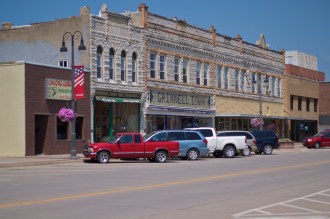 When I first met Pastor Reaves, he had just finished mowing. I didn’t know this, because he came into the house wearing a tie. He shared with me later that he did this so that he would be ready in case he got a call to the hospital. I would also learn soon that a visit to the hospital with him, in this town of about 9,000, could turn into an all-day event. That is not because he overstayed his welcome. On the contrary, he seemed to know just how long to stay, usually less than 15 minutes. No, it was because he visited so many patients.
Back then, a minister could freely visit anybody in the hospital, whether or not they were members of his denomination. Pastor Reaves, of course, did not force his way into people’s rooms, but kindly asked if he might pray for them. Hardly anyone turned him down. You see, he believed the whole town was his church. And many in the town, who never darkened the door of the small, Assembly of God Church he pastored, would think of Sam Reaves as their pastor, and as their friend.
One of the family’s favorite stories was this: If one of the members in the congregation was being rushed to the hospital in Des Moines, he would often beat the ambulance there. A time or two, he got pulled over by the police. But, he would nicely tell them, not ask, that he was headed to the hospital, and they would be better off tagging along, and use their lights to help him get there, not to slow him down. You would have to have known him to know that his look was serious and no policeman ever held him up after his little speech.
Here are thoughts about that, from his daughter, Debi:
“Yes, this is correct. If he could, he would try to get behind the Ambulance rolling out of town and the police knew dad’s car. Then they would radio ahead. Many times he would have family members with him because they were too upset to drive. He was basically the chaplain for the community back in the day. Today I think every pastor should try to be a police chaplain to have the same effect that dad did in Grinnell. I never realized the impact he had till the day of his funeral. They had been away from Grinnell for over 12 years at the time of his death and the place was packed!”
Posted in Articles, Locality & the Law of Residence, Parish Theory & Practice, Parochial Strategy, Theology of Place, Thomas Chalmers on June 18, 2011| Leave a Comment »
 I just read a great piece by Carl Trueman on the virtue of self-restraint when engaging in theological controversy. He essentially argues that we ought to be much more modest about our usefulness beyond the sphere God has placed us. Most of us ought simply to retire our capes, roll up our sleeves, and channel our energies our own small, local plot. While Trueman’s piece is by no means a formal endorsement of parochialism, my parochial mind can’t help thinking about Chalmers’ celebration of the “power of littles” and his famous dictum, “Locality, in truth, is the secret principle wherein our great strength lieth.” Chalmers also repeatedly burst the bubbles of the pretentious who thought they could and should assume larger fields of work. They ought rather be “sober minded” about their gifts and celebrate the giftings of others. And work. Locally.
Posted in Theology of Place on March 25, 2009| Leave a Comment »
This blog is largely devoted to the theory and applicability of the ‘locality principle’ in missions. Thomas Chalmers advocated the principle as a practical means of Christianizing cities. But while I agree that locality should factor prominently in mission strategy, what place does place itself hold in Scripture?
So in recent days, I’ve been reading through the passages of the Old Testament (for starters) that contain the Hebrew word for ‘place,’ maqom. I realize that this is not a study in the heavy-weights of biblical concepts. Place cannot be set next to propitiation, atonement, justification, etc. And yet, as I read through these passages, it strikes me that the idea is rich with meaning. Genesis 22, the great narrative of Abraham’s call to sacrifice Isaac, illustrates this.
In four instances, ‘place’ (maqom) is mentioned, vv. 3, 4, 9, & 14. As 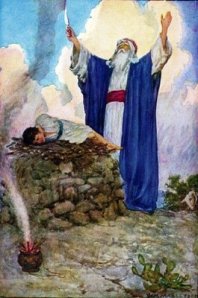 one reads these verses in their context, not only is attention called to place, but place is given special significance.
Place in this passage is the destination of Abraham. He is called from a place of blessing, rejoicing in Issac, to a place of trial. There and not elsewhere, he will be put to the test.
Place then passes from the agonies of the trial to the triumph of faith. Instead of being a site of tragedy with the promise going up in flame, it becomes the place of renewed celebration. Faith overcomes.
But faith rests on a higher plane. It reaches out for God. Yet, it reaches out to God at the very place where He gracious comes down. There, at Mount Moriah, they converge. There, God gloriously reveals that His promise stands. There, in the thicket, God has provided a substitute.
On that spot, the sacrifice assumes the place of Isaac. And so the ground receives a name. “And Abraham called the name of that place Jehovah-jireh: as it said to this day, In the mount of the LORD it shall be seen” (v. 14).
Someday, that place would be hallowed with a greater Sacrifice. There, He would suffer in our place that we might be released. From that place all the families of the earth would be blessed.
 West Port Experiment