 The Church frequently gets its axiology – its theory of value – dead wrong. To value is fundamentally human. It is instinctive and inescapable, a testament to the fact that man is the offspring of God. But when the Church fails to discern between the values of “the present evil world” and her Lord, it has just plain sold the farm. A Church that doesn’t defend its axiological borders (God’s rather) has in effect seceded to the enemy. And so she comes under Christ’s condemnation, “Ye are they which justify yourselves before men; but God knoweth your hearts: for that which is highly esteemed among men is abomination in the sight of God” (Luke 16:15).
Archive for the ‘The Sacred Ministry’ Category
“Who is on the Lord’s side?” An appeal for anti-partisanship in ministry
Posted in The Sacred Ministry, Thomas Chalmers, Two Kingdoms Theology on July 12, 2011| Leave a Comment »
 Thomas Chalmers (1780-1847) may have been in favor of religious establishments. (Bravo!) But he was hardly for a sycophant ministry beholden to the state, much less a political party:
“It appears to us that a Christian minister cannot keep himself in the true path of consistency at all, without refusing to each of the parties all right of appropriation. . . He who cares for neither [of two rivaling political parties] is the only independent man; and to him only belongs the privilege of crossing and re-crossing their factious line of demarcation, just as he feels himself impelled by the high, paramount, and subordinating principles of the Christianity which he professes. . . But turning away from the beggarly elements of such a competition as this, let us remark, that on the one hand, a religious administration will never take offence at a minister who renders a pertinent reproof to any set of men, even though they should happen to be their own agents or their own underlings; and that, on the other hand, a minister who is actuated by the true spirit of his office, will never so pervert or so prostitute his functions, as to descend to the humble arena of partisanship. He is the faithful steward of such things as are profitable for reproof and for doctrine, and for correction, and for instruction in righteousness” (Collected Works 11:34-36).
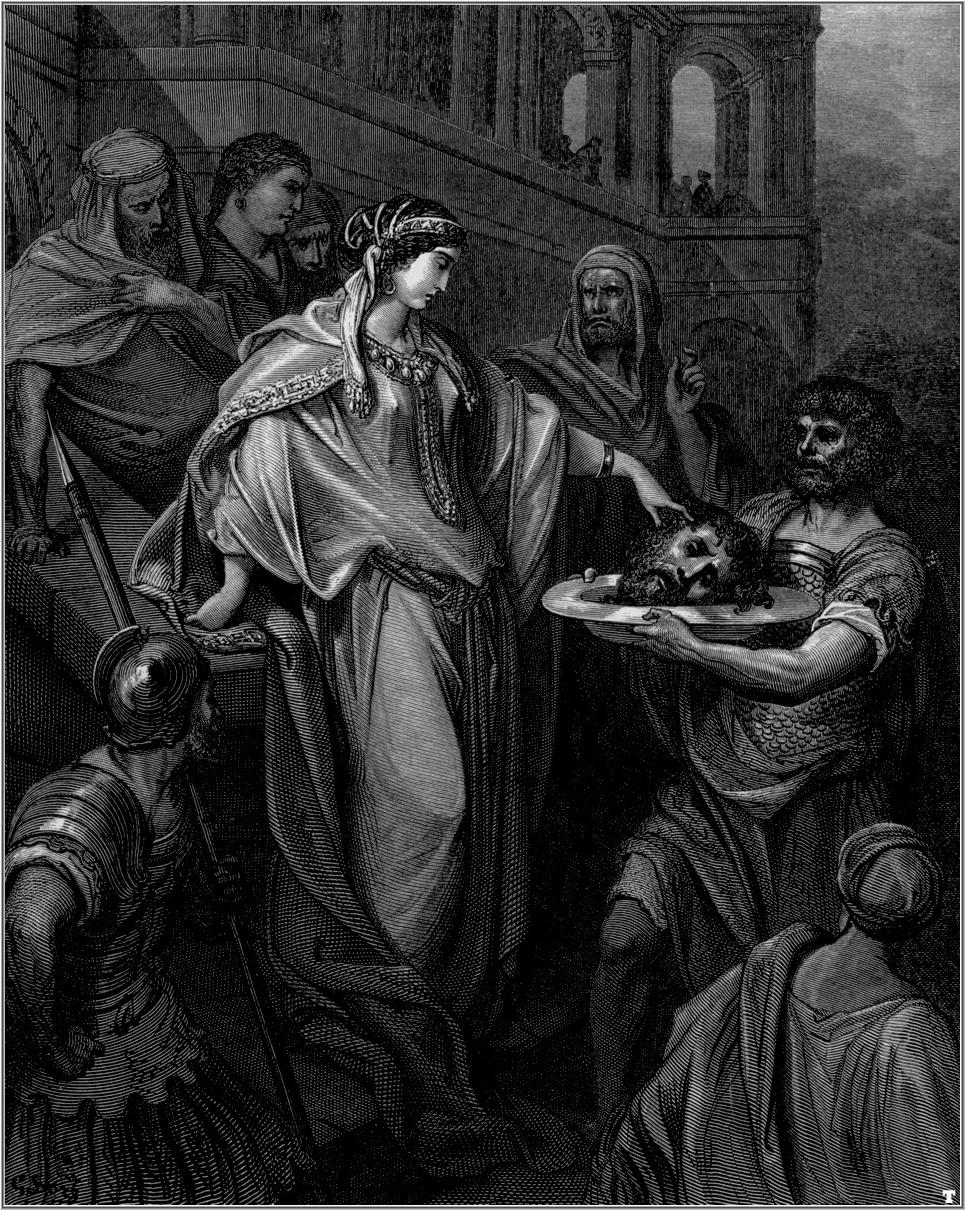
Now, this is anything but a call for the clergy remain aloof from all things political. Instead, it holds out the high principle of ministerial allegiance to heaven, which may make the man of God unpopular or put him on a collision course with the powers that be – whoever they be. This was the legacy of Knox, the bold gadfly of Queen Mary. This was the costly legacy of the John the Baptist and of so many of the prophets who preceded him. May God grant us a double portion of their spirit. And so let us stay out of anyone’s pocket – except God’s.
Balaam’s preacher
Posted in The Sacred Ministry on January 18, 2011| Leave a Comment »
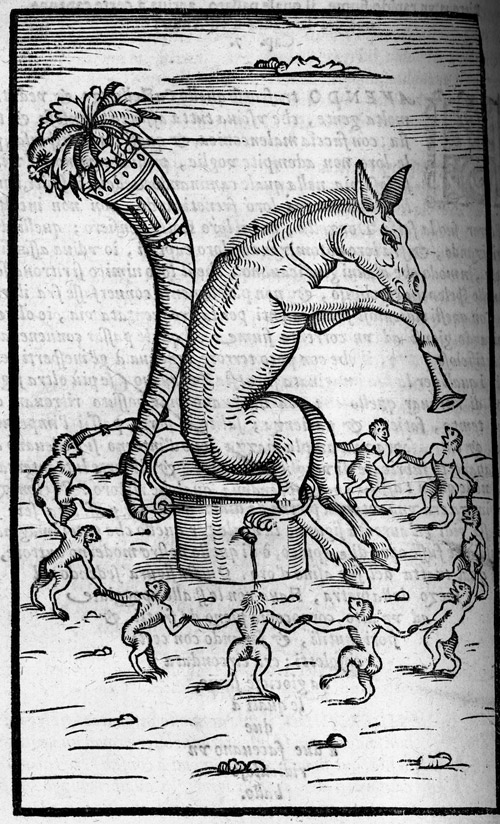 Here’s a wonderful tonic from Dr. Luther for young preachers. “Let the righteous smite me; it shall be a kindness” (Psa. 141:5)!
If, however, you feel and are inclined to think you have made it, flattering yourself with your own little books, teaching, or writing, because you have done it beautifully and preached excellently; if you are highly pleased when someone praises you in the presence of others; if you perhaps look for praise, and would sulk or quit what you are doing if you did not get it-if you are of that stripe, dear friend, then take yourself by the ears, and if you do this in the right way you will find a beautiful pair of big, long, shaggy donkey ears. Then do not spare any expense! Decorate them with golden bells, so that people will be able to hear you wherever you go, point their fingers at you, and say, “See, See! There goes that clever beast, who can write such exquisite books and preach so remarkably well.” That very moment you will be blessed and blessed beyond measure in the kingdom of heaven. Yes, in that heaven where hellfire is ready for the devil and his angels.
Entertainment in ministry – “ineffably disgusting”
Posted in Ministerial Fidelity, The Sacred Ministry, Thomas Chalmers on December 22, 2010| Leave a Comment »
Thomas Chalmers (1780-1847) records the following about an invitation he had accepted to preach. In the passage, he relates his growing revulsion as he learned of the details planned for the event. It’s amusing, yet sobering – especially since it’s so contemporary!
* * * * *
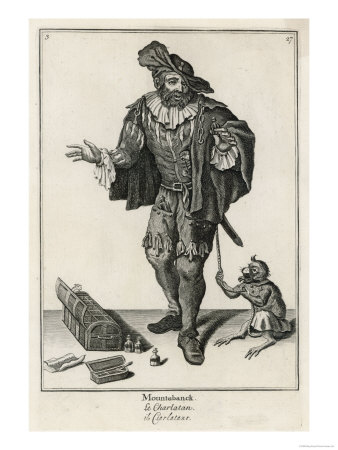 “They have got the sermon into the newspaper, and on reading the advertisement I was well-nigh overset by the style of it. They are going to have a grand musical concert along with the sermon, to which the best amateurs and performers of the neighborhood are to lend their services. This is all put down in their gaudy manifesto, and to me it is most ineffably disgusting. You know that I am to be very guarded; but I could not perfectly disguise my antipathies to this part of the arrangement. I asked Mr. Grant if I might take the paper with me for the amusement of my Scottish friends. He asked if I disliked music. I said that I liked music, but disliked all charlatanry. Thus far I went; and it was perhaps too far, but this is really making it a theatrical performance, and me one of the performers. But let me be patient; I am jaded and overdone, and reserve my further writing till Monday. . .
When I went to the great preaching hall, I found that there was just this practicing before an immense assemblage, on which I called out, in the distinct hearing of those about me, that there was an air of charlatanry about the whole affair, and that I did not like it at all. I would stay no longer in that place, and went along with them to the committee-room, where there were about twenty managers and others. I said that I had come from a great distance on their account, and had therefore purchased the privilege of telling them plain things; that they should have consulted me ere they had made their arrangements—that I was quite revolted by the quackery of their advertisement—that they had made me feel myself to be one of the performers in a theatrical exhibition—that what they had done stood in the same relation to what they ought to have done, that an advertisement of Dr. Solomon’s did to the respectable doings of the regular faculty, &c., &c. I was firm and mild withal—they confused, and awkward, and in difficulties. I said, that still I would preach, but that I thought it right to state what I felt” (Memoirs 2:41).
A critique of Voluntaryism
Posted in Gathered Church Ecclesiology, Parish Theory & Practice, The Sacred Ministry on August 31, 2010| Leave a Comment »
Recently, I’ve picked up William Smith’s Endowed Territorial Work again. Truly great stuff. Robust, Reformed missiology fr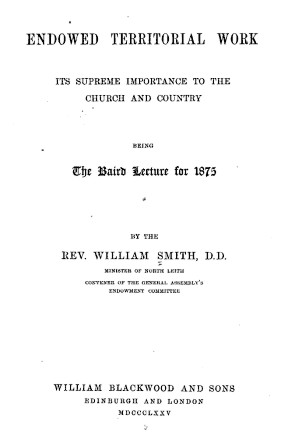 om a disciple of Thomas Chalmers.
The following is a quote in which Smith takes a swipe at 19th century Voluntaryism, which is basically now the status quo most evangelical churches. Every church is functionally on its own, sink or swim, and is fully subject to the laws of the religious marketplace. Or, as Smith succinctly puts it, Voluntaryism is the synthesis of “congregationalism and commercialism.” The net effect is the degradation of the holy ministry.
It also may help orient the reader to mention that Smith has just argued for “necessity of rearranging the whole country into parishes of manageable extent and population, and the likeliest means by which this can be accomplished in present circumstances.” That’s the parish principle a la Chalmers, also called territorialism. In this chapter he contends for a coordinate principle with regards to finance, that is, “the provision for each parish of such an endowment or stipend for the minister as shall make him so far independent of those to whom he preaches, and render his services available for the benefit ot such of his parishioners as are either too poor or indisposed to pay for Gospel ordinances” (182).
So, enjoy! – or be challenged, either one. But at the very least, think.
* * * *
The eminent success of the Free Church of Scotland, not only in the home, but also in the foreign field of evangelistic activity, is frequently quoted as an unanswerable argument in favour of Voluntaryism as against endowment; and on certain platforms it has become customary, for those decrying union with the State, to invite the members of the National Church, to surrender the privileges therein enjoyed, and to imitate the exodus by which their former brethren went forth to enjoy exemption from the burdens connected with permanent endowments. Now, far be it from me, and from every one who has true Scottish blood in his veins, to say one word in disparagement of the sacrifices, exertions, and successes of the Free Church, or to seek to detract from the praise justly due to the skill and statesmanship with which the great founders and leaders of that influential denomination have shaped its policy and guided its career. But their great success is undoubtedly due in no small degree to the institution by Dr Chalmers of what is called the Sustentation Fund, which, though dependent for its supplies on free contributions from year to year, is in its principle and effects diametrically opposed to Voluntaryism, and does, so far as is possible in the circumstances, embody and carry out the principle of endowment. It is not so secure as absolute endowment, and therefore the latter is not to be lightly, or except for very much stronger reasons than have yet been advanced, abandoned for it; but the income it provides for Free Church ministers is not dependent merely on the voluntary donations of those that wait upon their ministry. It is drawn in large measure from a source which is really fixed and permanent in its character, and which, though less secure and exempt from the possibility of variableness than that provided by the piety of remote ancestors and invested in substantial property, is yet sufficiently settled and sure to fulfil many of the purposes of endowment. It affects at least the constitution of tha relation between pastor and people, so far as to mitigate in a very considerable degree the evil inherent in mere Voluntaryism, by which the minister is made the minion and the slave of those whom he is bound as the ambassador of Christ to “exhort and rebuke with all authority.”
This mitigation, to whatever it amounts, is, so far as it goes, an immense gain. The evil it abates is most pernicious in its results. As a system, the evil tends to produce mere vapouring orators and popular demagogues and tinkling cymbals, rather than judicious expositors or valiant defenders of the truth and faithful pastors. It renders the exercise of sound and wholesome ecclesiastical discipline next to impossible, and it fills the advertising columns of Saturday newspapers with announcements of sermons and orations couched in clap-trap [absurd or nonsensical] phraseology, the puffery of which is simply disgusting to serious minds, and cannot but be fearfully deteriorating to the spiritual quality of any man, forced to seek by such unworthy expedients to fill his chapel and increase the coppers cast into his treasury.
That this is more frequently the result of Voluntaryism than some may suspect; that “The pulpit’s laws the pulpit’s patrons give, / And those who live to preach, must preach to live,” is clear from the testimony bome by John Angell James, himself one of the most illustrious of Dissenting ministers. He says: “In many of our churches the pastor is placed far below his level; he may natter like a sycophant, beg like a servant, or woo like a lover; he is not permitted to enjoin like a ruler. His opinion is received with no deference; his person is treated with no respect; and, in presence of some of his lay tyrants, he is only permitted to peep and mutter in the dust.”
The secularization of the ministry
Posted in Experimental Religion & the Cure of Souls, The Sacred Ministry, Thomas Chalmers on July 28, 2010| Leave a Comment »
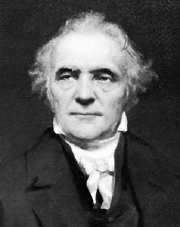 Thomas Chalmers (1780-1847), one of the greatest 19th century preachers, began his ministry in the rural parish of Kilmany in Fife, Scotland. He began that ministry, strangely enough, as an unconverted man. Under the sway of Moderatism, Chalmers approached the ministry as a country gentlemen. To him, it was a cushy job with ample liesure to pursue his real passion – mathematics.
When, however, the Lord converted him, his whole paradigm of ministry shifted. His charge in Kilmany was no longer a sinecure, but a full-time commission from the Most High. At that point, he threw himself into his labors with a weighty sense of pastoral obligation. “Woe unto me if I preach not the Gospel!”
The following quote, in a letter from Chalmers to a correspondent, reflects his high view of the ordained ministry. For context, it comes at a time when a larger field of usefulness was opening up to him at the Tron Church in Glasgow. In this letter, Chalmers explains that he would only consider the post if it was eventually shorn of all those administrative duties that were typically laid on city preachers in those days. He would not go if his spiritual office was thus to be ‘secularised.’
The secular employment laid upon your clergy to the degree mentioned by you, will not restrain me from accepting it. But I will not oblige myself to any portion of such employment, however small. I may find it prudent to take a share; but in its least degree, I count it a corrupt encroachment on the time and occupations of a minister: see Acts, vi., 4. And I shall only add, that I know of instances where a clergyman has been called from the country to town for his talent at preaching; and when he got there, they so belabored him with the drudgery of their institutions, that they smothered and extinguished the very talent for which they had adopted him. The purity and independence of the clerical office are not sufficiently respected in great towns. He comes among them a clergyman, and they make a mere churchwarden of him. I have much to say upon this subject; and I do not despair, if we shall have the felicity of living together, of obtaining your concurrence in this sentiment. It shall be my unceasing endeavor to get all this work shifted upon the laymen; and did I not hope to succeed in some measure, I would be induced to set my face against the whole arrangement at this moment. I shall only say of my own dear parishioners, that they have expressed their value for me on no other ground than pure ministerial services; and it is hard to leave such a people for another, who may not be satisfied unless I add to my own proper work a labor which does not belong to me (Memoirs 1:337).
Two obserations. First, Chalmers was not against ministerial administration. But that administration was largely a service of delegation, so that it could be free to do what it was designed to do – pray and preach! Moreover, most of the supervision had to be delegated as well, or the minister would fill up his time with managing human resources. Little better, really, than “waiting on tables” (Acts 6:2)!
On that score, it does seem that Chalmers’ talk of shifting administrative duties to ‘laymen’ needs a bit of context. If I am not mistaken, Chalmers had first in mind ruling elders, those presbyters devoted not to the regular ministry of the Word but to the government of the Church alongside teaching elders. He probably also meant deacons beneath the elders of the kirk session. So his terminology might mislead some of us. While he did seem to entertain a higher view of the ministry of the unordained believer – what others might more customarily call a ‘lay person’ – yet, ‘shifting’ all the work on the laymen in the first place meant utilizing those in the ruling and diaconal offices to their full capacity. That as an aside.
But the second observation is that in Chalmers’ day, you had a higher view of the ministry across the board within evangelicalism. Evangelical ministers in many cases – especially in the established Church – often resigned to the reality of civil responsbilities that took them away from their study and closet. Chalmers stood out as a minister who would not cave in. What we often have today in American evangelicalism is this same secularization, this distraction of the ministry of the Word and prayer to the administration of temporal matters. But the difference, as I see it, is that most do not even ‘cave in.’ They willingly sign up for the managerial ministry! This is not the seclarization of the office from without, but from within. We are our own worst enemy.
May the Lord raise up a new army of ministers who will not yield to secularization of the ministry, or sell its birthright for a bowl of lentils. May He purge it, purify it, and spread it far and wide for the good of souls, and to the honor of the Lord Christ.
 West Port Experiment