In doubt about a hand-out? Chalmers says that God has made those worthy of our benevolence abundantly clear: “The halt, and the blind, and the maimed, and the impotent, and the dumb, and the lunatic—stand before us, with a special mark impressed upon them by the hand of Providence, and which at once announces both their necessity and their claim, for the unqualified sympathy of all their fellows” (Works, 21:394).
Archive for the ‘The Gospel & the Poor’ Category
God’s clear mark upon the needy
Posted in Benevolence & the Diaconate, The Gospel & the Poor, Thomas Chalmers on January 27, 2025| Leave a Comment »
Take church to them! ‘House-churching’ the heathen
Posted in Gospel Tactics, Missiology, Parish in American Context, Parish Theory & Practice, The Gospel & the Poor, Vignettes from the Old Parish Way, tagged bible, christianity, church, faith, jesus on December 16, 2024| Leave a Comment »
The following extract comes from Thomas Cochrane’s, Home Mission-work; Or, Twenty-five Years in a Mission Field (1873; pp. 51-52). Chalmers earlier advocated these exact same tactics years before. In my parish mission efforts, I’m already seeing the profound wisdom and insight of this policy. If they don’t yet come to church, then (assuming they let you in the door) bring church to them!

“In all Territorial districts there will be found many not only living in entire neglect of the sanctuary, but many of that number who will scarcely be persuaded by prayer and pains to avail themselves of the privilege To meet such cases, the devoted missionary will often be found to try and bridge over the difficulty by taking the church to them; sometimes, perhaps, even taking possession of the home of the neglectful, and making a church in their house. The effect of such little gatherings is often very blessed indeed. By these meetings there is not only opened a way for bringing the Gospel to the very homesteads of the careless and prayerless, but it is also, under GOD, a very fruitful source of augmenting the central gatherings.
“One of the most useful members of the Mission relates, as his own experience, how by this agency especially he was won to the public ordinances of the church. He was ill to gain over. Many months of prayerful effort were spent, but “by keeping at it,” with God’s blessing on the means, he was at last enlisted in the good cause ; and how useful he has been since in gaining others, the future only can reveal. How devoted he has been cannot be told.
“The services at these fireside gatherings should not, as a general rule, be lengthened above an hour, for many reasons. Mothers cannot conveniently give longer time from household duties. Short telling addresses at such meetings will ordinarily be most useful and acceptable. The grand object being to deal chiefly and closely with those who have not been accustomed to much serious thinking about religious subjects, anything fitted to weary and repel should be carefully avoided. How all-important to leave a good impression, and, by this short pithy service, to beget a thirst for the more extended, if not more formal, services of the house of God! It would not be an easy thing to say how many members of the church first found their footing towards the sanctuary through the influence of these district meetings. They will not only prove useful-almost essential-in the forming of a Territorial congregation, but will be of immense benefit after it has been formed, both as a means of dealing with the neglectful members of the congregation, and of reaching those beyond the pale of the church.”
“I am Debtor”
Posted in Audio Resources, Church of Scotland, Free Church of Scotland, Gospel Proclamation, Missiology, The Gospel & the Poor on December 9, 2024| Leave a Comment »
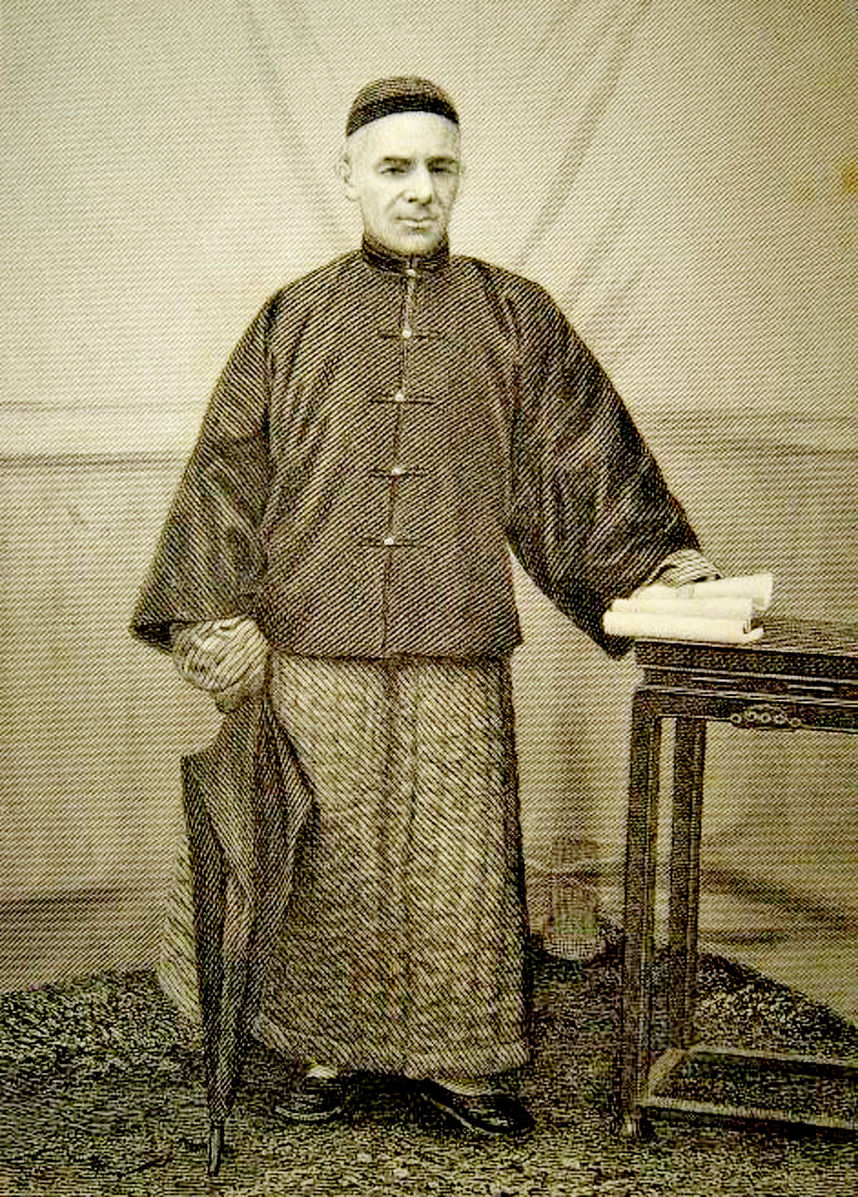
The following is a portion from William Chalmers Burns‘ sermon “I am Debtor,” from Romans 1:14. Burns was a good friend and ministerial colleague to Robert Murray M’Cheyne, and was a heroic Presbyterian missionary to China. Listen to the full audio recording here. And for more audio resources, click on the WPE Audio tab at the top.
* * * *
The apostle says something more than this, — “I am debtor both to the Greeks, and to the Barbarians; both to the wise, and the unwise.” The meaning of this seems to be, — if I were free to make a choice, I might choose the barbarian or I might choose the Greek, I might choose the wise or the unwise; but Paul says, I am debtor, and you know a debtor has no such thing as a choice to make to whom he will pay his debts. The debtor knows this, and the believer feels it just in the same way. “Whatever my calculations may be, or whatever I might myself desire, the question is not, what would I like, but what is my commission, — what are the objects of my embassy? It is not my choice that I have to do with, but God’s commission, — what instructions does it contain?”
We would fain impress this important, solemn truth upon God’s children. Believer, do you feel this? Do you know what it is to feel yourself a debtor to a lost world? Have you ever thought of what object Christ had in view when He brought you to Himself? what design He had in calling you? It was certainly, in the first instance, to save you from perdition, but that was not the only end. It is possible to think too much, or, at least, too exclusively, about your own case. In one sense you cannot do that; woe be to him who seeks to pull the mote out of a brother’s eye, when a beam is in his own. But yet a believer must remember that he is called to know Christ, not only to be safe himself, but also that he may be a witness for Christ in the world. Ah! think of this; don’t be selfish in the matter of salvation, and remember above all, that his is not a thing which you may or may not do, just as you like. Some people do much in this way, just because they have a liking to it, and because the employment suits their taste – and it is a happy thing to feel that; but there is a far more unchangeable foundation for a believer’s labour in the Lord’s vineyard than that. The man is no longer free to like, or not to like; he is a debtor now – a debtor to do it fully, and constantly, and unceasingly, and devotedly, whether he likes it or not. Think of it in this light, and then you will be going and hasting to tell your friends, and all whom you know, of these precious things of God. Oh, if this were fully felt, and felt universally , how many would be preaching whose mouths are dumb through sloth and idleness! There would be fewer preaching as a trade, and more preaching as debtors, forevery believer would then have a voice with which to sound the praises of the most high God.
You shall catch men
Posted in Articles, Gospel Proclamation, Gospel Tactics, Missiology, The Gospel & the Poor, The Kingdom of God, WPE Editor on May 8, 2024| Leave a Comment »
“Fear not; from henceforth thou shalt catch men.” Luke 5:10
In this marvelous account, Jesus catches Peter. Now this may seem strange, given that Simon Peter had already become a follower of the Nazarene. Andrew, Peter’s brother, had been a following of John the Baptist. But the Baptist redirected his disciples to Jesus, for Jesus “must increase,” and he “decrease.” Andrew dutifully went, but soon was himself caught by the Master. From there he went to his brother for another catch. “We have found the Messiah” (Jn. 1:41)! Andrew drew Peter to shore, as it were, and Jesus did the rest! Peter began following Jesus.
But still, he kept one foot on dry land. He held on to his day job—better safe than sorry, after all! Following is one thing; forsaking all quite another. But Jesus would not let this one go. So on this morning, after he finished teaching the crowds, he bade Peter go fishing. “Launch out into the deep, and let down your nets for a draught.” What! Peter was the fisherman, Peter knew these waters like the back of his hand, Peter went when the fish were out, and Peter had done everything right. Yet Peter that night had come up empty. Yet out of respect, he yielded to Jesus. Reluctantly no doubt, but reverently. He believed the Master; at least, generally speaking. But what did the carpenter-preacher really know about this trade?
Read the rest of this article below, published in the Banner of Sovereign Grace Truth
“The Most Joyful Event of My Life” (in-person & livestream)
Posted in Parish Theory & Practice, The Gospel & the Poor, The Romance of Locality, Thomas Chalmers, West Port experiment on February 6, 2024| Leave a Comment »
In Grand Rapids? Join us! Or sign up and/or watch it this Friday, February 9 by Facebook Live.
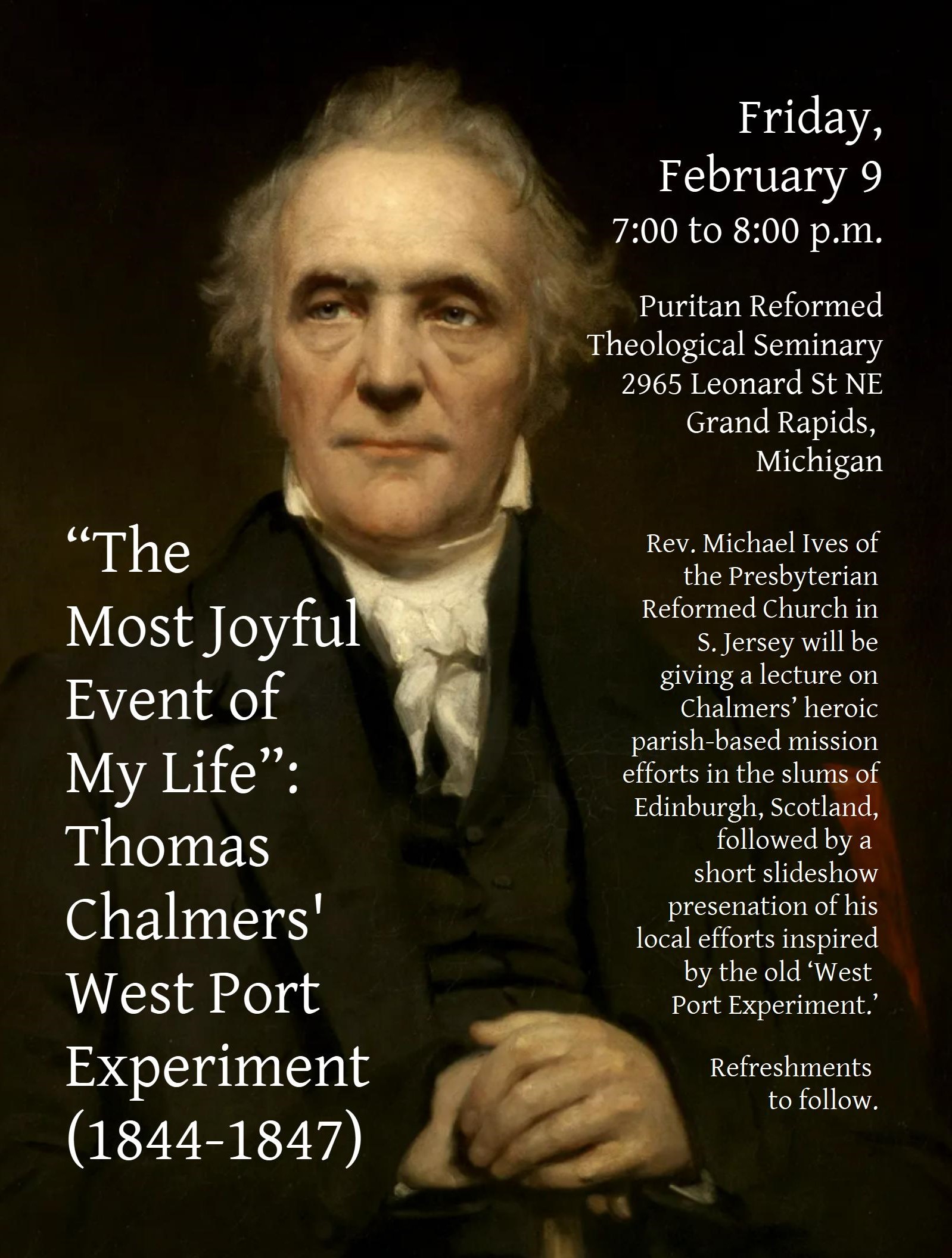
Note: this is a distinct, public event after the earlier PRTS Student Society lecture below. Both, however, are livestreamed (yet not including the short RPM slideshow as these include unedited photos of personal mission contacts).
Another prescription for community renewal
Posted in Free Church of Scotland, Missiology, Moral Suasion, Parish in American Context, Parish Theory & Practice, Parochial Strategy, Social Byproduct, Social Issues, The Gospel & the Poor, Theology of Community, Theology of Place, Thomas Chalmers on August 25, 2023| 1 Comment »
Community is dead. R.I.P. This short article by Dr. Carl Trueman laments the evaporation of community–at least in the West–and of its historically Christian nexus, the Church. He then offers a strategic prescription in the rediscovery of hospitality, no doubt in the spirit of Rosaria Butterfield. I couldn’t agree more. If we are embodied souls living in real places with zip codes and GPS coordinates, we as Christians need to love our neighbors in very tangible ways for their salvation — and as a happy byproduct, recreate community.
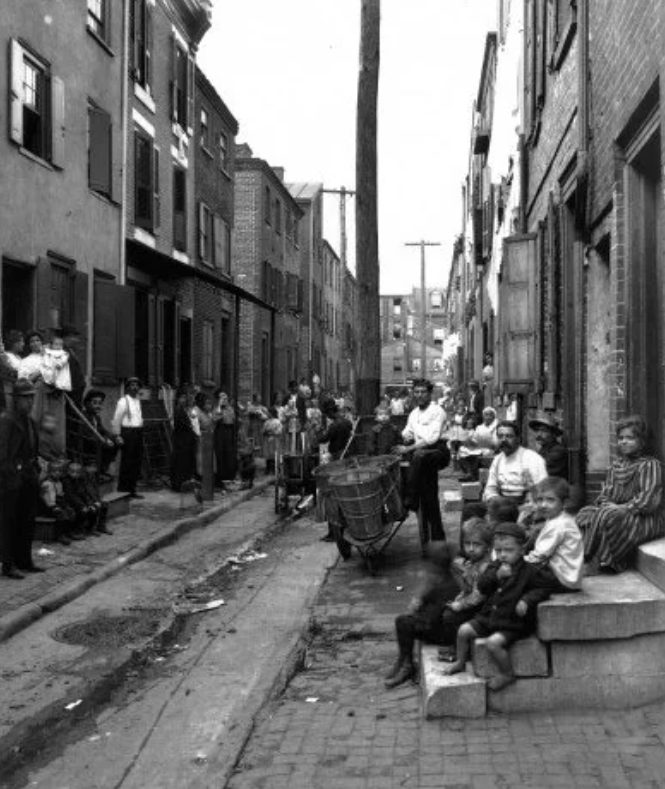
But I think this malady requires more than one prescription. Thomas Chalmers (1780-1847), the pioneer of the Free Church of Scotland in which Trueman spent many years, was even in his day deeply troubled at the disintegration of then-modern community. The Industrial Revolution had forced masses of country folk into the slums of Britain’s factory-choked cities. It grieved him to his core that these people were living in grinding poverty and were completely falling through the cracks of the Church of Scotland’s traditional spiritual care, forming a bloated underclass of unchurched “home heathen.” And the mechanized web of misery only strengthened its grip by the complete and utter absence of community. His assessment is surprisingly contemporary: “As the matter stands, juxtaposition forms no security whatever for acquaintanceship—insomuch that the members of distinct households might live for years under the same roof, unknowing and unknown to each other.”
(more…)“The Most Joyful Event of My Life”: The Story of the West Port Experiment (1844-1847)
Posted in Free Church of Scotland, Locality & the Law of Residence, Parish Theory & Practice, The Gospel & the Poor, Theology of Community, Theology Proper, Thomas Chalmers, Vignettes from the Old Parish Way, Visitation Evangelism, West Port experiment on April 27, 2023| 2 Comments »

Unless otherwise noted here prior to the event, the lecture will be livestreamed here:
Who cares? A plea for reformed parish missions
Posted in Articles, Confessional Subscription, Contemporary Parochialism, Free Church of Scotland, Gospel Proclamation, Missiology, Parish in American Context, Parish Theory & Practice, The Gospel & the Poor, The Romance of Locality, The Sacred Ministry, Thomas Chalmers, West Port experiment, WPE Editor on June 20, 2022| Leave a Comment »
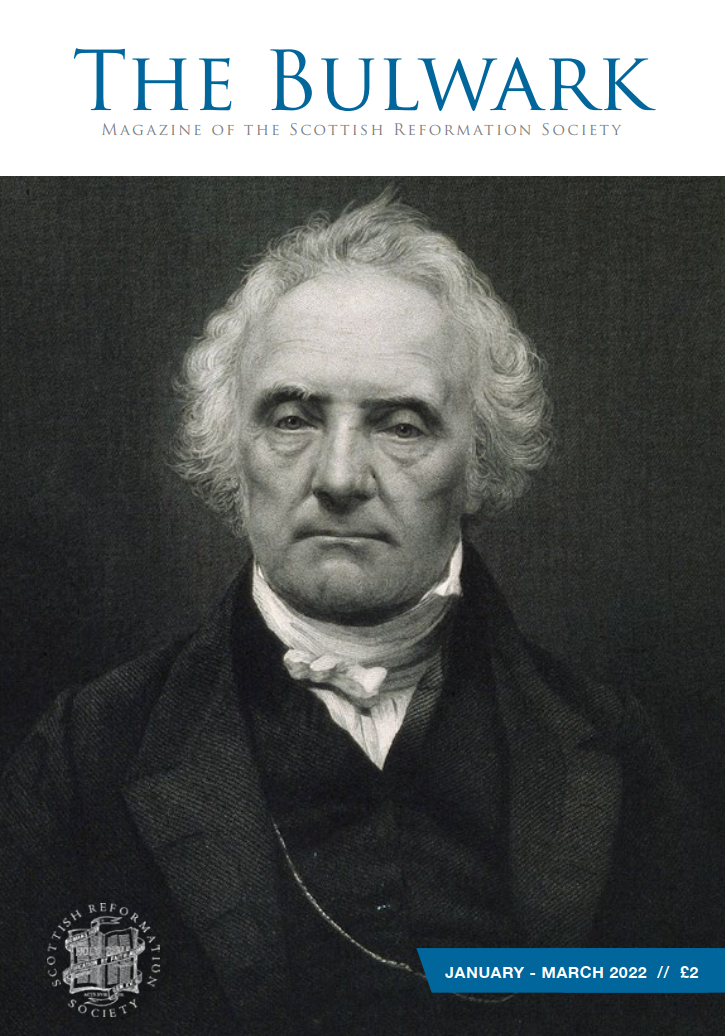
“Chalmers’ method was simple, systematic, spiritual, and unadorned. It was concerned with reaching souls rather than building brands; it sought them out. A gathered team of committed individuals connected with their local community and the lives of individuals through visitation and interaction. Such a method has massive challenges in a society where community has disintegrated but that is not to say it is impossible. No doubt something resembling it is bearing fruit in some communities.”
In this article below, my good friend Matthew Vogan recounts the old national vision of our Scottish Presbyterian forbears like Thomas Chalmers, who maintained confessional fidelity while also aggressively engaged in home missions. Does anyone among the theological heirs of Chalmers have such a national vision? Or even more pointedly, does anyone care?
Well, I for one deeply believe that they do care. And that they have the almighty Spirit of God dwelling in them and resting upon them. Nothing can defeat the sword of the Lord and of Gideon, nothing can stop these ‘sons of oil,’ for it is “not by might, nor by power, but by [His] Spirit, saith the LORD.” They will hear their charge, and they will go, shaking off all inhibitions and possessing the good land that rightly belongs them–and much more, to the Heir of all!
(There. That’s the closest this stodgy Presbyterian will ever get to ‘naming and claiming!’)
* * * *
This article is found in The Bulwark, popular magazine published by the Scottish Reformation Society. To read it more easily, you will likely need to download and rotate view.
Reformed parish missions: “To the Greek and to the barbarian”
Posted in Articles, Contemporary Parochialism, Covenant Theology, Family Religion, Gospel Proclamation, Gospel Tactics, Locality & the Law of Residence, Ministerial Fidelity, Missiology, Ordinary Means Ministry, Parish in American Context, Parochial Strategy, Reformed Parish Mission (RPM) Posts, Social Byproduct, The Church in America, The Gospel & the Poor, The Visible Church, Theology of Community, Thomas Chalmers, Transgenerational Faith, WPE Editor on May 23, 2022| Leave a Comment »
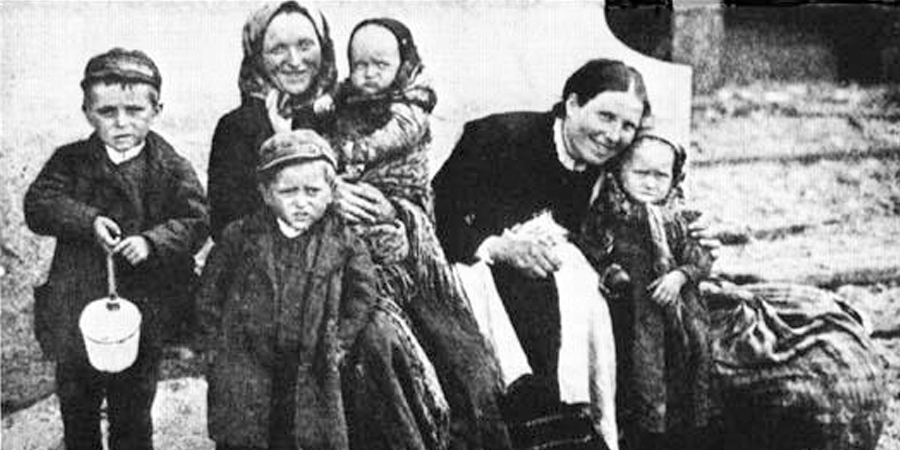
Years back, my heart got large for missions — especially urban missions to those on the ‘other side of the tracks.’ At about the same time, I became Reformed (a high octane, old school Presbyterian no less!), putting me in a a sub-subset of a subset. My life and ministry has ever since lived somewhat in the frontiers the unlikely and the implausible. A straightlaced, tall gringo Presbyterian goes out among immigrants, trying to evangelize in broken Spanish and recruit sinners to the “outward and ordinary means” in a humble, little Reformed church 15 minutes to the south. And to sing Psalms. Without musical accompaniment. In English.
I admit that there are all kinds of problems with this model, from a human perspective. But it is actually more plausible than one might think. Yet before I deal with the plausibles, let me first set forth some principles.
The first principle is principle! Principle precedes the practical. We must first determine whether something should be done before we decide whether or not we think it is practical. We ought to go out and bring the Gospel to all. None excluded. Politics quite aside, we may and must not discriminate based on sex, ethnicity, gender, or for that matter even sexual ‘preference.’ By the mandate of our King, we must go and tell them. Yes, as Calvinists, we know that not every “all” means “all.” But “every creature” does in fact mean “every creature.” Even if they don’t look like us, eat like us, or even use our language. It doesn’t matter whether they ‘have papers’ or not, vote Democrat or not. How they got here and whether they should by law be here, is a separate issue for a different discussion (and full disclosure: I lean quite “red” when it comes to immigration policy!). But that they are here means they are here for us to evangelize. And not just gripe about and avoid them as much as possible.
(more…)Chalmers and the Gospel preached to the poor
Posted in Benevolence & the Diaconate, Ministerial Fidelity, Missiology, The Gospel & the Poor, Thomas Chalmers on October 1, 2021| Leave a Comment »
The following are quotes from Thomas Chalmers (1780-1847) who was passionate about relieving the poor and above all, bringing them the glad tidings of the Gospel.
* * * *

“Such is the peculiar adaptation of the Gospel to the poor, that it may be felt in the full force of its most powerful evidence by the simplest of its hearers” (Chalmers, Works 6:256).
“The proper work of an establishment . . . is to reclaim and christianize the common people” (Chalmers, Works 18:206).
“In respect of immortality, the great and the small ones of the earth stand on an equal eminence” (Chalmers, Works 6:288).
“Yet I must say I liked the Irish part of my parishioners. They received me always with the utmost cordiality, and very often attended my household ministrations, although Catholics” (Chalmers, Works 16:243).
“The main impulse of [the parish minister’s] benevolence, lies in furnishing the poor with the means of enjoying that bread of life which came down from heaven, and in introducing them to the knowledge of those Scriptures which are the power of God unto salvation to every one who believeth” (Chalmers, Works 11:290).
“There is none we think of correct moral taste, and whose heart is in its right place, that will not rejoice in such a spectacle, as far more pleasing in itself, and, if only universal in our churches, far more indicative of a healthful state of the community, than the wretched system of the present day, when the gospel is literally sold to the highest bidders among the rich, and not preached to the poor” (Chalmers, Works 11:381).
* * * *
And some longer quotes:
“Now the great aim of our ministry is to win souls; and the soul of a poor man consists of precisely the same elements with the soul of a rich. They both labour under the same disease, and they both stand in need of the same treatment. The physician who administers to their bodies brings forward the same application to the same malady; and the physician who is singly intent on the cure of their souls will hold up to both the same peace-speaking blood, and the same sanctifying Spirit, and will preach to both in the same name, because the only name given under heaven whereby men can be saved” (Chalmers, Works 11:356).
“It was saying more for the common people of Judea that they heard the Saviour gladly, than for the Scribes and Pharisees who heard him with envy, prejudice, and opposition; and it is saying more for the common people of this country, that they hear the doctrine of Christ gladly, than for those learned who call that doctrine foolishness, for those men of taste who call it fanaticism, for those men of this world who call it a methodistical reverie, for those men of fashion and fine sentiment who shrink from the peculiarities of our faith, with all the disgust of irritated pride and offended delicacy” (Chalmers, Works 11:358).
“If a poor child be capable of being thus transformed, how it should move the heart of a city philanthropist, when he thinks of the amazing extent of raw material, for this moral and spiritual manufacture that is on every side of him—when he thinks, that in going forth on some Christian enterprise among a population, he is in truth, walking among the rudiments of a state that is to be everlasting—that out of their most loathsome and unseemly abodes, a glory can be extracted, which will weather all the storms, and all the vicissitudes of this world’s history—that, in the filth and raggedness of a hovel, that is to be found, on which all the worth of heaven, as well as all the endurance of heaven can be imprinted—that he is, in a word, dealing in embryo with the elements of a great and future empire, which is to rise, indestructible and eternal, on the ruins of all that is earthly, and every member of which shall be a king and a priest for evermore” (Chalmers, Works 6:260).
“It was not thus with the ancients of our Church when spoiled of her endowments by the rapacity of the Crown, and of those nobles who formed the all-powerful aristocracy of that generation. True there was but the population of a million in these days; but whole tracts of country were rifled by the hand of violence of their ecclesiastical patrimony, and no means were left for the Christian education of the people who would have sunk into a state of moral barbarism but for the efforts of so many patriots as courageous and enlightened as the world ever saw,—the fathers and founders of the Kirk of Scotland. The territory had been desolated of its provision both for churches and schools; but they went forth upon it notwithstanding, and chalked out their parishes, and planted their stations for the ministry of the word, and without the visible means of sustenance or support, laboured both with the Church’s plat, and the Church’s polity, till the God in whom they trusted overthrew the counsels of their adversaries, and forced out of their sacrilegious hands a hardwon maintenance for an order of men whom now it is the fashion to stigmatize, but who have ever proved, throughout all the periods of our bygone history, and have now the opportunity of proving still, that they are the best friends of the poor man and of the labourer” (Chalmers, Works 18:289).
“To give money, is not to do all the work and labour of benevolence. You must go to the poor man’s sick bed. You must lend your hand to the work of assistance. You must examine his accounts. You must try to recover those debts which are due to his family. You must try to recover those wages which are detained by the injustice or the rapacity of his master. You must employ your mediation with his superiors. You must represent to them the necessities of his situation. You must solicit their assistance, and awaken their feelings to the tale of his calamity. This is benevolence in its plain, and sober, and substantial reality; though eloquence may have withheld its imagery, and poetry may have denied its graces and its embellishments. This is true and unsophisticated goodness” (Chalmers, Works 11:303-4)
 West Port Experiment