Feeds:
Posts
Comments

Archive for the ‘The Church in America’ Category

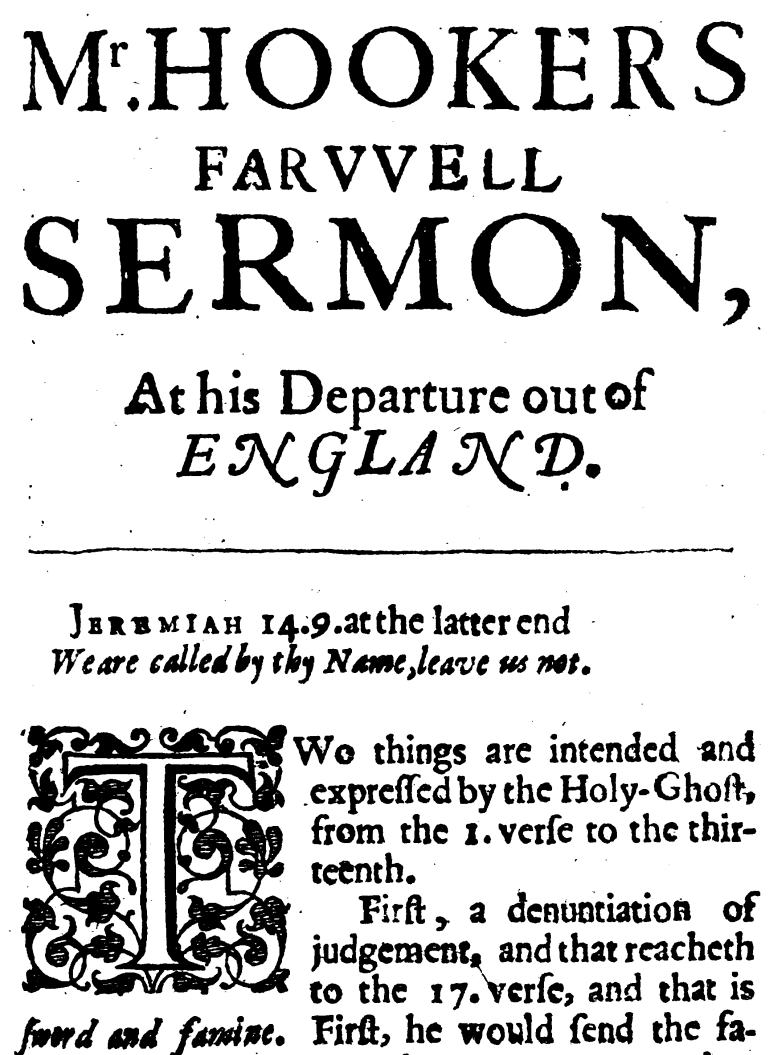
“Englands sinnes have been great, yea and their mercies great. England hath been a mirror of mer­cy, yet God may leave us, and make us a mirrour of his justice. Looke how he spake to the people in Ier. 7. that bragged of the Temple of the Lord, Sacri­fices and offerings: And what may not God which destroyed Shilo, destroy thee O England? Goe to Bohemia, from thence to the Palatinate, and so to Denmarke. Imagine you were there, what shall you see, nothing else but as Travellers say, Chur­ches made heaps of stones, and those Bethels wher­in Gods name was called upon, are made defiled Temples for Satan and superstition to raigne in? You cannot goe two or three steps, but you shall see the heads of dead men, goe a little further, and you shall see their hearts picked out by the fowles of the ayre, whereupon you are ready to conclude that Tilly hath been there: Those Churches are become desolate, and why not England? Goe in­to the Cities and Townes, and there you shall see many compassed about with the chaines of capti­vity, and every man bemoaning himselfe. Doe but cast your eyes abroad, and there you shall see poore fatherlesse children sending forth their breaches, with feare, crying to their poore helplesse mo­thers. Step but a little farther, and you shall see the sad wife bemoaning her husband, and that is her misery, that she cannot dye soone enough; and with­all she makes funerall Sermons of her children within her selfe, for that the Spaniard may get her little ones, and bring them up in Popery and super­stition; and then she weeps and considers with her selfe: If my husband be dead, it is well, happily he is upon the racke, or put to some cruell tortures, and then she makes funerall Sermons, and dyes a hun­dred times before she can dye. Cast your eyes afar off, set your soules in their soules stead, and imagine it were your owne condition, why may not England be thus, who knowes but it may be my wife, when he heares of some in torments? Ah! Brethren, be not high minded, but feare, as we have this bounty on the one side, so may we have this severity on the other; therefore prancke not up your selves with foolish imaginations, as who dare come to En­gland, the Spaniards have enough, the French are too weake: Be not deceived, who thought Ierusa­lem the Lady of Kingdomes, whither the Tribes went to worship, should become a heap of stones, a vagabond people, and why not England? Learne therefore to heare and feare, God can be a God without England, doe not say there are many Chri­stians in it, can God be beholding to you for your Religion? No surely, for rather then he will main­taine such as professe his Name and hate him, he will raise up of these stones children unto Abraham; He will rather goe to the Turks, and say you are my people, and I will be your God. But will you let God goe, England? Why are you so content to let him goe? Oh! lay hold on him, yea hang on him, and say thou shalt not goe. Doe you thinke that Rome will part with her religion, and forsake her gods? nay, an hundred would rather lose their lives. Will you let God goe? Oh England plead with your God! and let him not depart. You should onely part with your rebellions, he will not part with you. Leave us not. We see the Church is very importunate to keep God with them still, they lay hold on God with words of argument.”

From Thomas Hooker’s, “The Danger of Desertion” (1641)
Read Full Post »

Read Full Post »

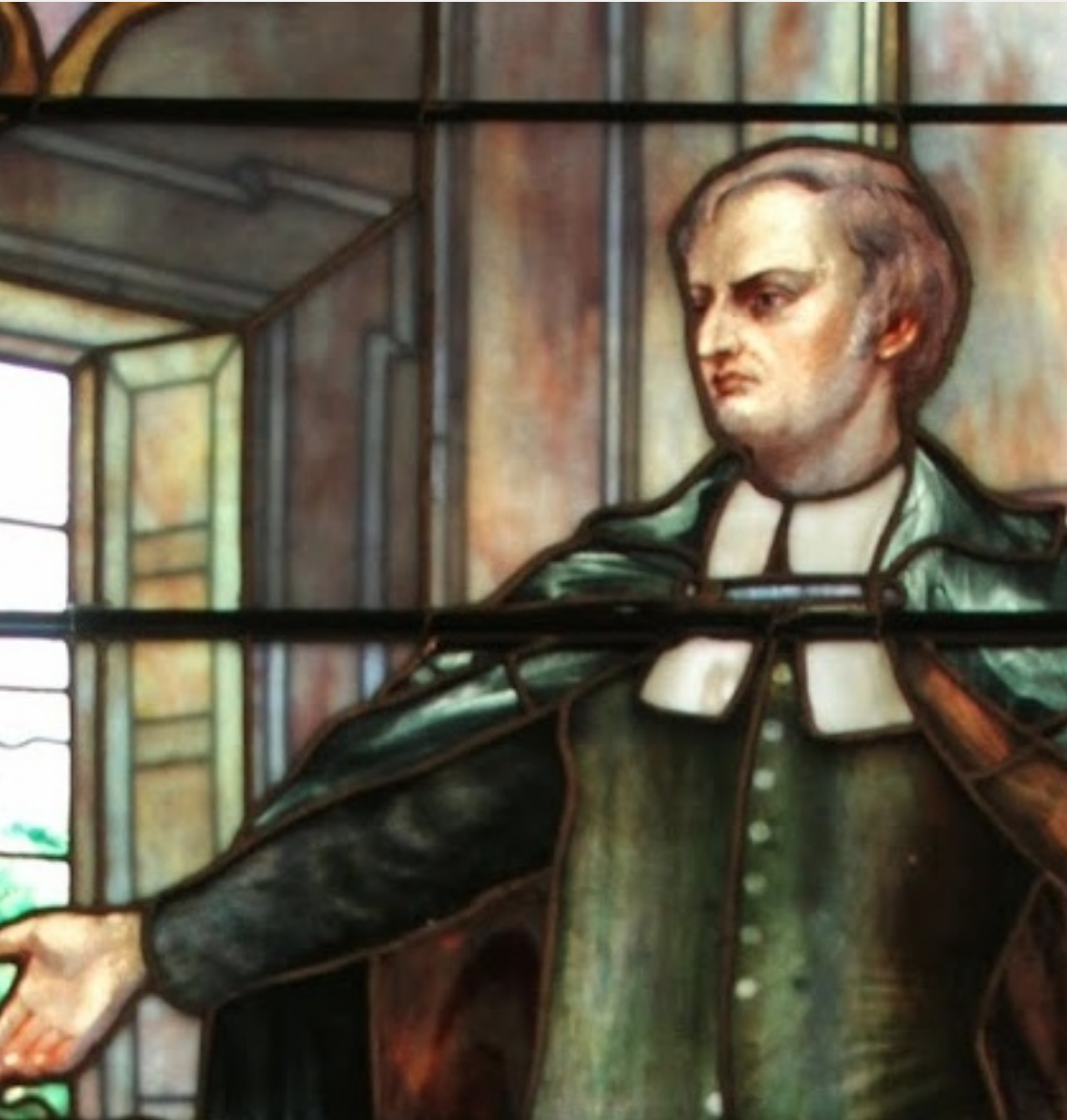
Just finished reading-recording this sermon by the founder of Connecticut, the Puritan Thomas Hooker, entitled, “The Danger of Desertion.” This was Hooker’s farewell sermon to his congregation in England before venturing across the Atlantic. It is one of the most impactful, profound, and weighty sermons I have read in some time. Please, please do yourself a favor and read it. If you are a sincere Christian not in a state of gross backsliding, it will hit you square in the eyes. And if you are, it just may jolt your out of your complacency!

Cling to God. Hard. Until your knuckles are white. And your nailbeds bleed. Do not let Him go! That’s the message. And more, it was a message to England, and so to any Christian nation that has had the privilege of the presence of God.

And here’s the same in PDF:

Read Full Post »

​”The rise of sectarianism that has accompanied the Protestant movement is a dark and negative phenomenon. It manifested itself already at the beginning of the Reformation, but it has never flourished as it has in our age. New church after new church is established. In England there are already more than two hundred sects. In America they are innumerable. The differences have become so many and so insignificant that one cannot keep track of them. There are even voices arguing for a new discipline in theology itself devoted to the comparative history of church confessions. What is even more serious is that this sectarianism leads to the erosion and disappearance of church consciousness. There is no longer an awareness of the difference between the church and a voluntary association. The sense that separation from the church is a sin has all but disappeared. One leaves a church or joins it rather casually. When something or other in a church no longer satisfies us, we look for another without any pangs of conscience. The decisive factor turns out to be our taste. Exercise of discipline thus becomes virtually impossible; it loses its very character. What preacher is left who dares, in good conscience, except perhaps in extremely rare instances, to use the form for excommunication? The worst result of all this is that by breaking the unity of doctrine and the church, Christians do violence to the communion of saints, deprive themselves of the Spirit’s gifts of grace, by which  other believers labor to build up the saints, shut themselves up in their own circle, promote spiritual pride, strengthen Rome, and give the world occasion for scorn and mockery.”

-Herman Bavinck, “The Catholicity of Christianity and the Church”

Read Full Post »

Years back, my heart got large for missions — especially urban missions to those on the ‘other side of the tracks.’ At about the same time, I became Reformed (a high octane, old school Presbyterian no less!), putting me in a a sub-subset of a subset. My life and ministry has ever since lived somewhat in the frontiers the unlikely and the implausible. A straightlaced, tall gringo Presbyterian goes out among immigrants, trying to evangelize in broken Spanish and recruit sinners to the “outward and ordinary means” in a humble, little Reformed church 15 minutes to the south. And to sing Psalms. Without musical accompaniment. In English.

I admit that there are all kinds of problems with this model, from a human perspective. But it is actually more plausible than one might think. Yet before I deal with the plausibles, let me first set forth some principles.

The first principle is principle! Principle precedes the practical. We must first determine whether something should be done before we decide whether or not we think it is practical. We ought to go out and bring the Gospel to all. None excluded. Politics quite aside, we may and must not discriminate based on sex, ethnicity, gender, or for that matter even sexual ‘preference.’ By the mandate of our King, we must go and tell them. Yes, as Calvinists, we know that not every “all” means “all.” But “every creature” does in fact mean “every creature.” Even if they don’t look like us, eat like us, or even use our language. It doesn’t matter whether they ‘have papers’ or not, vote Democrat or not. How they got here and whether they should by law be here, is a separate issue for a different discussion (and full disclosure: I lean quite “red” when it comes to immigration policy!). But that they are here means they are here for us to evangelize. And not just gripe about and avoid them as much as possible.

(more…)

Read Full Post »

Funny, but damningly true. Again, reinforcement that Adam Smith was dead wrong about leaving religion purely to market forces.

Read Full Post »

A revealing (and heartbreaking!) article on the secularizing migration of America into the frontiers of heathenism. “By the rivers of Babylon, there we sat down, yea, we wept, when we remembered Zion. We hanged our harps upon the willows in the midst thereof” (Psa. 137:1-2).

Read Full Post »

Over the years, I’ve heard about different pastors in America, from various evangelical traditions, more or less acting like old parish ministers. That is, they didn’t just look at their faithful congregations as the limits of their pastoral responsibility. Their ‘cure of souls’ reached to the communities where they were placed.

Not long ago, a friend of mine told me about an Assembly of God pastor he knew who fit this description. The following is used with permission from David Shedlock.

And if you know of a similar story, would you kindly forward it to me?  Feel free to drop me a note at mjives dot refparish at gmail dot com.

* * *

Grinnell, IAWhen I first met Pastor Reaves, he had just finished mowing. I didn’t know this, because he came into the house wearing a tie. He shared with me later that he did this so that he would be ready in case he got a call to the hospital. I would also learn soon that a visit to the hospital with him, in this town of about 9,000, could turn into an all-day event. That is not because he overstayed his welcome. On the contrary, he seemed to know just how long to stay, usually less than 15 minutes. No, it was because he visited so many patients.

Back then, a minister could freely visit anybody in the hospital, whether or not they were members of his denomination. Pastor Reaves, of course, did not force his way into people’s rooms, but kindly asked if he might pray for them. Hardly anyone turned him down. You see, he believed the whole town was his church. And many in the town, who never darkened the door of the small, Assembly of God Church he pastored, would think of Sam Reaves as their pastor, and as their friend.

One of the family’s favorite stories was this: If one of the members in the congregation was being rushed to the hospital in Des Moines, he would often beat the ambulance there. A time or two, he got pulled over by the police. But, he would nicely tell them, not ask, that he was headed to the hospital, and they would be better off tagging along, and use their lights to help him get there, not to slow him down. You would have to have known him to know that his look was serious and no policeman ever held him up after his little speech.

Here are thoughts about that, from his daughter, Debi:

“Yes, this is correct. If he could, he would try to get behind the Ambulance rolling out of town and the police knew dad’s car. Then they would radio ahead. Many times he would have family members with him because they were too upset to drive. He was basically the chaplain for the community back in the day. Today I think every pastor should try to be a police chaplain to have the same effect that dad did in Grinnell. I never realized the impact he had till the day of his funeral. They had been away from Grinnell for over 12 years at the time of his death and the place was packed!”

Read Full Post »

I am a whole-hearted supporter of free market capitalism. But like Thomas Chalmers, I demur when it comes to Adam Smith’s opposition to church establishments. He thought that the free market, when applied to the sphere of religion, would yield the best results both for religion and society:

But if politics had never called in the aid of religion, had the conquering party never adopted the tenets of one sect more than those of another when it had gained the victory, it would probably have dealt equally and impartially with all the different sects, and have allowed every man to choose his own priest and his own religion as he thought proper. There would in this case, no doubt’ have been a great multitude of religious sects. Almost every different congregation might probably have made a little sect by itself, or have entertained some peculiar tenets of its own. Each teacher would no doubt have felt himself under the necessity of making the utmost exertion and of using every art both to preserve and to increase the number of his disciples. But as every other teacher would have felt himself under the same necessity, the success of no one teacher, or sect of teachers, could have been very great (Wealth of Nations, 792).

Free market religious competition, further, could possibly result in an ideal “pure and rational religion, free form every mixture of absurdity, imposture, or fanaticism, such as wise men have in all ages of the world wished to see established” (793).

Well, having been born and raised in the land of religious free enterprise, I can think of at least a couple of reasons to disagree ….


kenneth-copeland-jesse-duplantis

Read Full Post »

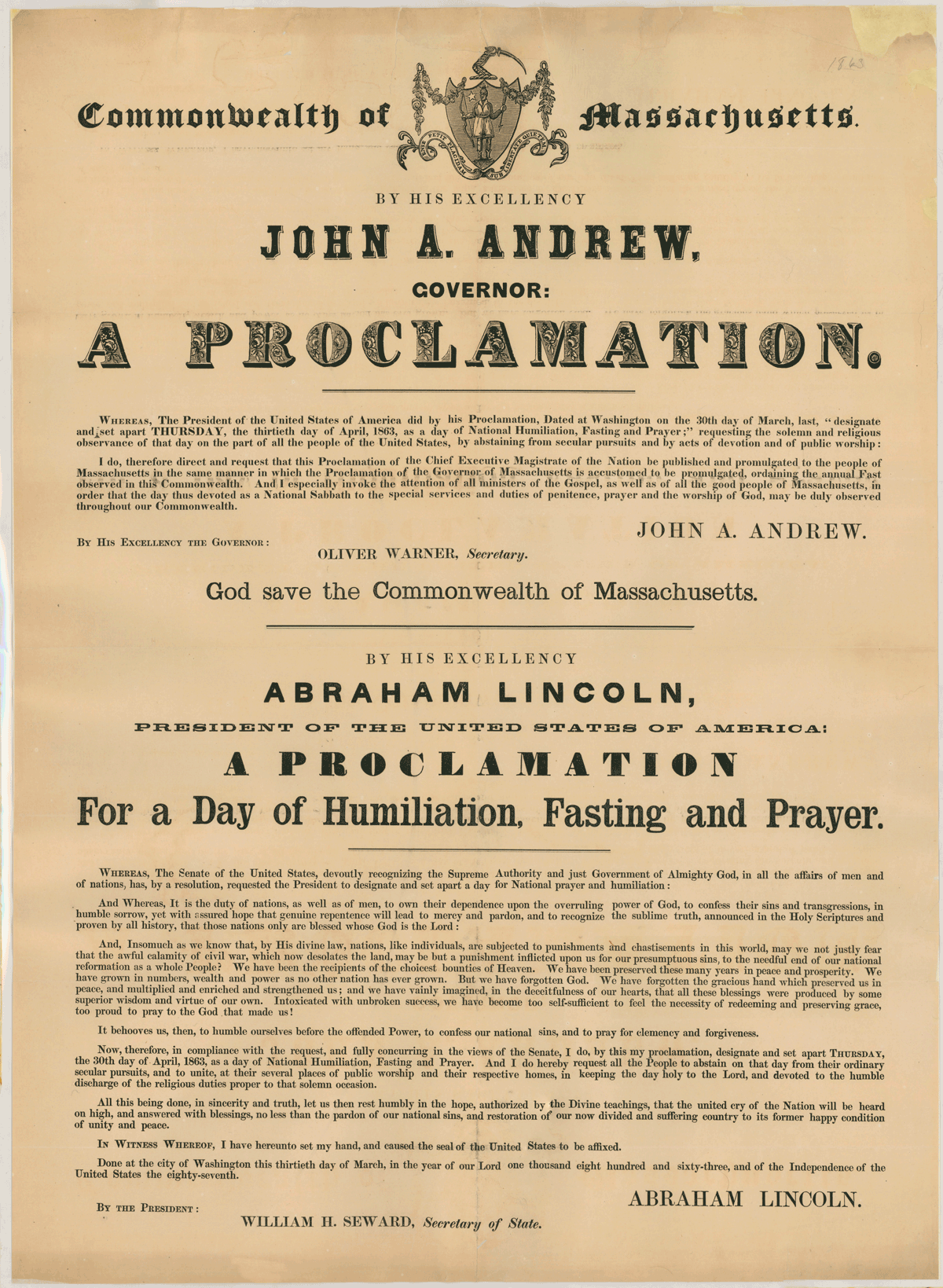
Lincoln_Proclamation_1863While listening to an excellent sermon by Rev. Bill Shishko of the OPC on days of prayer and fasting, I was struck by his final quote of the presidential proclamation of Abraham Lincoln for a national day of humiliation and fasting.  One can read it here.

I am hardly endorsing Abraham Lincoln’s personal theology and practice, much less making commentary on the merits and demerits of each side during the Civil War (or War Between the States, if you prefer).  But I cannot help but ask the modern (contra Melvillian) Two Kingdom advocates (1) whether this was, in the main, a good thing and not inherently a violation of Reformed principles and (2) whether it is ever commendable for a state or its elected officials to call for national days of fasting and humiliation.

I think that any simple Christian will read this and be impressed with how appropriate such a call was and earnestly sigh and cry that God might give us such magistrates again.  And more, for even better and more consistently Christian ones – who explicitly avow Jesus as King of kings and Lord of lords.

At the same time, I would hope that it would give pause to the more thoughtful modern 2K advocates to ask whether their outlook may at least be somewhat misguided.   Are such national fasts, following Westminster and Dort, inherently flawed?  Is this not a fast that the Lord “has chosen” (Isa. 58)?  But sadly, I fear it will make no dent with the more trenchant ones.

Read Full Post »

« Newer Posts - Older Posts »