Continuing to follow with interest Timon Cline et al over at American Reformer. Still parsing the field of contemporary “Christian nationalism” and trying to discern the good and the not-so-good; so I share this with some tentativeness, yet general appreciation thus far. Classical Protestant ethics and socio-political ethics fascinates me, so anyone participating in a retrieval has my attention.
Have enjoyed reading this article about John Witherspoon and the colonial Presbyterian iteration of establishmentarianism, contra Kevin DeYoung’s pluralistic take of the American revision of the WCF 23. Looks like others there have also written on the same. I still wonder to what degree Witherspoon may have been influenced by Enlightenment liberalism and what bearing that may have had on how he approached Christian magistracy. But that there is more continuity with the original WCF 23 than not just seems to sync with what I’ve understood about public religion in colonial America. Absolute separation just seems laughable on so many counts. I am also reminded how Dr. William Young opined that the American revision of WCF 23 did not technically contradict the original 1646 statement. While my denomination is the only NAPARC body committed to the original edition, I am at least coming to appreciate that we may have more of a genetic connection with colonial Presbyterian than I had first thought.
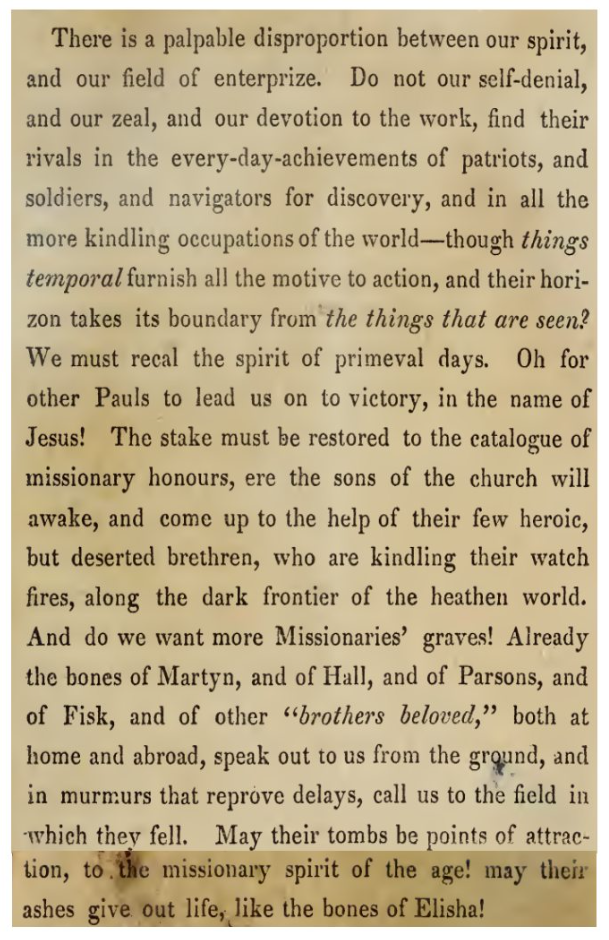
O, that God would stir up the missionary spirit again! Let us humble and abase ourselves, and plead with the Lord for a fresh anointing of the Spirit of God! John Breckinridge (1797-1841):
I’ve recorded several chapters of Cotton Mather’s great Magnalia Christi Americana: Or, The Ecclesiastical History of New-England: from Its First Planting, in the Year 1620, Unto the Year of Our Lord 1698. Here are the opening words of the first chapter, “Discoveries of America.”
* * * * *
“It is the opinion of some, though ’tis but an opinion, and but of some learned men, that when the sacred oracles “of Heaven assure us, the things under the earth are some of those, whose knees are to bow in the name of Jesus, by those things are meant the inhabitants of America, who are Antipodes to those of the other hemisphere. I would not quote any words of Lactantius, though there are some to countenance this interpretation, because of their being so ungeographical: nor would I go to strengthen the interpretation by reciting the words of the Indians to the first white invaders of their territories, we hear you are come from under the world to take our world from us. But granting the uncertainty of such an exposition, I shall yet give the Church of God a certain account of those things, which in America have been believing and adoring the glorious name of Jesus; and of that country in America, where those things have been attended with circumstances most remarkable. I can contentedly allow that America (which, as the learned Nicholas Fuller observes, might more justly be called Columbina) was altogether unknown to the penmen of the Holy Scriptures, and in the ages when the Scriptures were penned. I can allow, that those parts of the earth, which do not include America, are, in the inspired writings of Luke and of Paul, stiled all the world. I can allow, that the opinion of Torniellus and of Pagius, about the apostles preaching the gospel in America, has been sufficiently refuted by Basnagius. But I am out of the reach of Pope Zachary’s excommunication. I can assert the existence of the American Antipodes: and I can report unto the European churches great occurrences among these Americans. Yet I will report every one of them with such a Christian and exact veracity, that no man shall have cause to use about any one of them the words which the great Austin (as great as he was) used about the existence of Antipodes; it is a fable, and nulla ratione credendum.
You read it right. There is actually a Christian religious establishment within the U.S. of A., and I imagine that it is completely free of whites. So for you R2K-types, assorted Anabaptists, and secular liberals, “put that in your pipe and smoke it!”
In this public lecture of the Scottish Reformation Society, I will be discussing Thomas Chalmers’ (1780-1847) defense of church establishments over against Adam Smith’s critique. Chalmers championed such an establishment as a “Great Home Mission.”‘ Yet is this a merely an academic question? Does Chalmers have something to offer is in modern, pluralistic America? You might be surprised. Join us Friday, October 18 at 2:30 p.m. Eastern-U.S. / 7:30 p.m. U.K. Watch throughFacebook Live. More information below:
My daughter, Geneva, and I were discussing this recent chatter (bilge) of kinism among confessional Presbyterian types. She rather perceptively observed that there is a total confusion of race and culture here.
It is claimed that as the swarms of immigrants who pour through our porous border, “our people” are threatened. So does “our people” include Gavin Newsom and Joe Biden? I’m the first to bewail the dreadful non-enforcement of the U.S. border. But I share much more culture with many blacks and Latinos and find them more my people than many a white liberal. What is this supposed pristine white culture that is in jeopardy? And let’s not forget that the Vandals and Visigoths who toppled the Roman Empire became the genesis of Medieval Christendom. The “City of God” is my people.
Here’s a delightful old volume on Sabbath laws in the United States. As I skim through these, a few short observations. 1. We have collectively forgotten what was once a cultural norm. Hence the fitness of the imperative, “Remember the Sabbath day, to keep it holy.” 2. Freedom of thought, speech, and religion obviously had a big asterisk (at least from our 2024 context). Tolerance was clearly not a free-for-all for every pagan and libertine. 3. This gives the lie to the radical secular-sanitizing narratives of liberals who decry ‘Christian nationalism,’ as well as the hardcore R2K types like Daryl Hart who make strange bedfellows with the same.
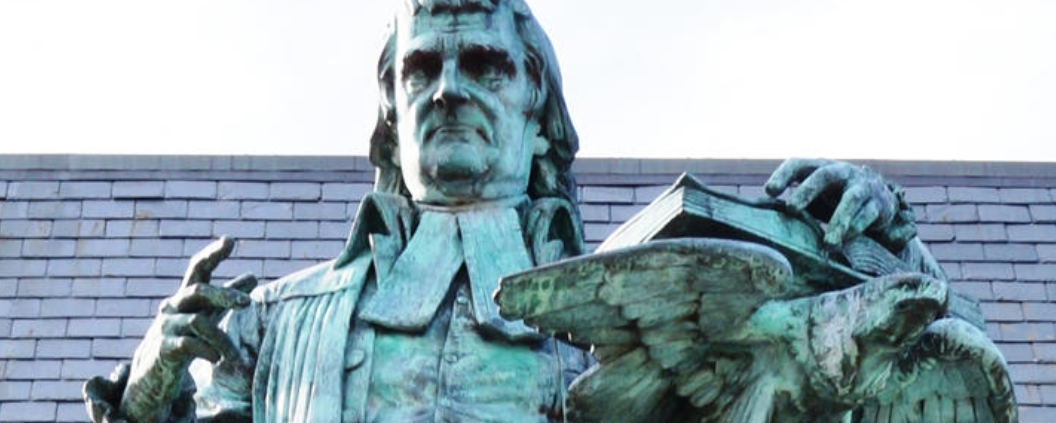
Just added a recording in two parts of John Witherspoon’s farewell sermon to his congregation in Paisley, Scotland before sailing over to the American colonies to take up the presidency of the College of New Jersey in 1768. It is a profoundly moving and historic sermon, and especially one that ministers of the Gospel would do well to read. I began recording it soon before my transition to a pastorate in New Jersey, which added to its personal significance for me. Here are the opening words of the sermon. And to access more titles from my growing audio library, go here.
“My brethren, these words [Acts 20:26-27] are a part of the apostle Paul’s discourse to the elders of Ephesus, when taking leave of them, under a firm persuasion, or rather a certain knowledge, that he would never again see them in the body. My present situation, of which none of you is ignorant, has determined me to the choice of this passage, as a very proper subject from which I may conclude the exercise of my ministry among you. I had once occasion, on leaving another charge, to have taken a formal farewell of a very affectionate people, but had not courage to attempt it. The circumstances attending the removal, which, if Providence prevent not, seems now to be at hand, are such as do not lessen, but greatly increase the difficulty of speaking from such a subject. And yet, in another view, they seemed to urge it so strongly, and to present such an opportunity of being useful, as I durst not wholly decline. Every Christian ought to be an observer of providence. Nothing will more effectually promote his holiness and comfort. And both a minister and his people ought to improve the aspect of providence, when it hath any thing peculiar in it, to their mutual benefit.
“Let me therefore intreat you to attend to the following discourse, with patience and composure. This request I the rather hope you will comply with, as there is nothing intended that is personal, further than must necessarily arise from the subject itself, or be unavoidably suggested by your own thoughts. I bless God that I have no complaint to make of want of duty or affection upon your side; neither is it any part of my purpose to justify my own conduct, during the time that I have had the honour and happiness of being entrusted with the ministry of the gospel in this place. I shall therefore only fay, that whether I have been able to deliver my own foul by fidelity in duty, and by purity of principle, I am certain, that very much has been laid to the charge of many of yours. Least of all do I intend to endeavour to satisfy you of the motives which have induced me to accept of a call to a distant part of the world, and, in some degree, a different employment in the Church of Christ. For this, I know that an account must be given, in due time, to a much greater Judge, with whose approbation either the applause or censure of men are not worthy to be laid in the balance. The single purpose, therefore, of the following discourse, shall be to give you such a comprehensive view of the truths of the everlasting gospel, of the importance and difficulty of a minister’s work; as may direct you in the choice of another pastor, increase your esteem of such as are faithful, and excite you to guard against every thing that may either discourage them in their work, or prevent their success.”
If you would truly profit by ordinances, after you have a fixed pastor, I think it is of moment to forget, as much as possible, the persons of men, and consider them as no more than instruments in the hand of God, for your daily instruction and comfort. The more you remember the appointment of God, and wait upon his ordinances, in the faith of his presence, and the expectation of his blessing, the more you are likely to receive both sensible and lasting benefit. I must therefore take the liberty to observe, that we have amongst us a set of wandering unsettled hearers, who run about from one congregation to another, and even from one profession to another, and are scarcely ever to be seen a whole day in one place. If they be but deliberating where to fix, we may fay of them, that they are ever learning, and never come to the knowledge of the truth. But the probability is, that they have itching and curious ears, and go about not to serve God but to hear men. If I am able at all to judge, either by reflection or observation, those are most likely to profit, who having deliberately made their choice, sit habitually and regularly under one minister. By this means they enter into his views; and as he will naturally endeavour, if any thing was wanting at one time, to complete his scheme by supplying it at another, they will thereby have a more comprehensive view of the whole counsel of God. At the fame time, not having the charm of novelty to enchant them, they will have nothing to do but to reap instruction. On the other hand, by hearing separate, detached, and independent discourses, men may please their fancy more, but they will improve their understanding less. It is also plain, that as every minister will endeavour, not only to follow an order in his discourses on one subject, but to have a respect to the connection, and relation of the subjects themselves, the more accurate and exact he is, in suiting one part to the, illustration of another, the less he will be understood by these desultory hearers, who take only a single branch, without being able to perceive its subserviency to the general design. I have many times known exceptions taken at ministers, for some parts of a discourse by such persons, when, if they had heard the whole upon the same or corresponding subjects, they would have perceived there was no place for their objections. The great purpose, my brethren, of a serious and judicious people, in attending on ordinances, should neither be to please themselves, nor to criticise their teachers; but to hear the word of God, that they may do it. On this account it is, that humble and regular Christians are getting real advantage to their souls, while some are only watching the opinions, or others only passing judgment on the ability, perhaps no more than the style and outward manner of the speaker.
Establishments got some good press last week, at least on a respectable Reformed podcast. Kudos to Christ the Center for welcoming on Timon Cline to a panel discussion last Friday. While I’ve never heard of Timon before, I am sure going to read and listen to more of him. And I’m sure I’m not alone!
The panel discussion focused on Dr. Alan Strange’s newly published book, Empowered Witness: A Panel Discussion on Politics, Culture, and the Spiritual Mission of the Church. Giving feedback and critiques were D. G. Hart, Nick Wilborn, and Timon Cline. I’ve not read Strange’s book, so I’m only commenting on the video. The discussion up to Timon and related rejoinders was interesting enough. But Timon sure rocked the boat pretty hard when he brought up the obvious (at least from a historical Reformed perspective and not an American echo-chamber), that is, what about the spiritual nature in the church in light of the classic, confessionally Reformed and Presbyterian endorsements of religious establishments?
It’s clear that Dr. Strange was a bit flustered, though keeping a gracious demeanor. Sadly, though a respectable and accomplished Reformed scholar whom I otherwise appreciate, Strange’s response to Timon was more or less a rigmarole of informal fallacies and non-answers. Hart, however, just became flummoxed and unhinged. In contrast to Cline’s calm, measured demeanor, and even more importantly, to his much more careful, close, and logical reasoning (they guy’s a practicing lawyer, and it shines), Hart just full-on melted down, notwithstanding a clever little jab about Timon’s alleged tap-dancing like James Cagney. But even that was more amusing than apropos, as it only thinly veiled his chagrin. The young no-namer clearly bested his betters.






 West Port Experiment