Feeds:
Posts
Comments

Archive for the ‘Separatism & Schism’ Category

The following is taken from J. C. Ryle’s exposition of John 3:22-36.

“On one account, this passage deserves the special attention of all devout readers of the Bible. It contains the last testimony of John the Baptist concerning our Lord Jesus Christ. That faithful man of God was the same at the end of his ministry that he was at the beginning. the same in his views of self–the same in his views of Christ. Happy is that church whose ministers are as steady, bold, and constant to one thing, as John the Baptist!

“We have, firstly, in these verses, a humbling example of the petty jealousies and party-spirit which may exist among professors of religion. We are told, that the disciples of John the Baptist were offended, because the ministry of Jesus began to attract more attention than that of their master. ‘They came unto John, and said unto him, Rabbi, he that was with you beyond Jordan, to whom you barest witness, behold the same baptizes, and all men come to him.’

“The spirit exhibited in this complaint, is unhappily too common in the Churches of Christ. The succession of these complainers has never failed. There are never lacking religions professors who care far more for the increase of their own party, than for the increase of true Christianity; and who cannot rejoice in the spread of religion, if it spreads anywhere except within their own denomination. There is a generation which can see no good being done, except in the ranks of its own congregations; and which seems ready to shut men out of heaven, if they will not enter therein under their banner.

“The true Christian must watch and pray against the spirit here manifested by John’s disciples. It is very insidious, very contagious, and very injurious to the cause of religion. Nothing so defiles Christianity and gives the enemies of truth such occasion to blaspheme, as jealousy and party-spirit among Christians. Wherever there is real grace, we should be ready and willing to acknowledge it, even though it may be outside our own pale. We should strive to say with the apostle, ‘If Christ be preached, I rejoice, yes! and will rejoice’ (Phil. 1:18.). If good is done, we ought to be thankful, though it even may not be done in what we think the best way. If souls are saved, we ought to be glad, whatever be the means that God may think fit to employ.”
Read Full Post »

A tremendous, two-part treatment that anyone identifying with historic Presbyterian should read by my friend, Matthew Vogan.

* * * *

Whole doctrine catholicity | “Who is she that looketh forth as the morning, fair as the moon, clear as the sun, and terrible as an army with banners” (Song 6:10)?

Read Full Post »

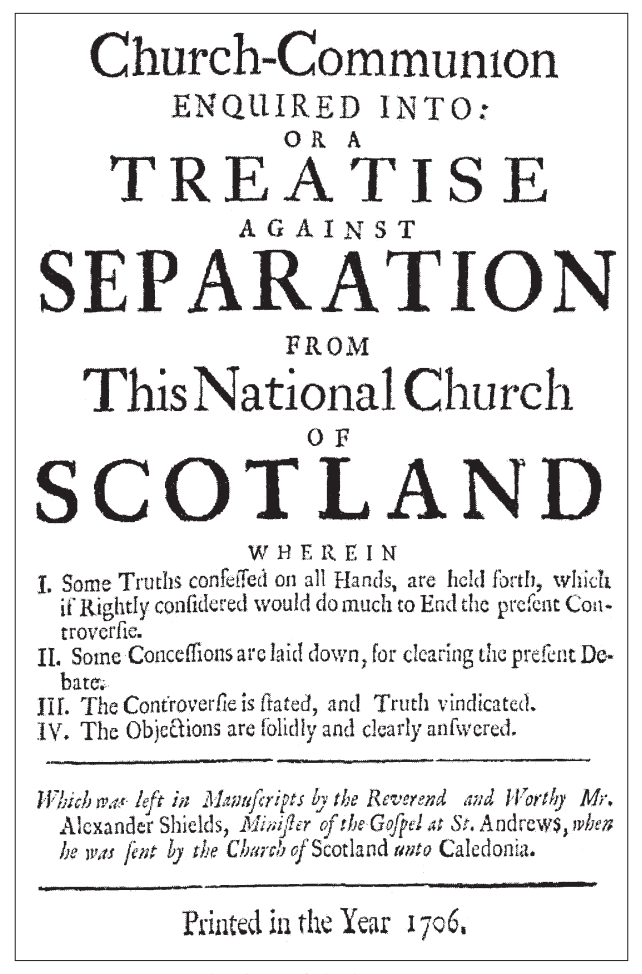
Just finished reading and recording Alexander Shield’s Church Communion Inquired Into (1706). Listen to it here, or read it below. This treatise is such a highwater-mark of classic Presbyterianism, with particular focus on the visible unity of the Church of Christ. It was his heartfelt, pastoral appeal to his brethren who refused to enter the Revolution Church of 1690 on account of its putative corruptions, urging them to reconsider their separation. It is not the easiest of reads, for sure, as it was written in the midst of controversy, among other things. But it is a definitive work on Presbyterian catholicity, right after James Durham’s On Scandal. Here is a very moving appeal from his conclusion:

“Keep your Zeal lively against all sin, but let it have two edges, to resent the Dishonour done to God, by Schism as well as defection; let it be Ballanced with Charity, and managed with Discretion. And we request you, that you study Uniformity in your Zeal, that you be not like Cake unturned, hot for some lesser Points in Religion, and cold for other Duties, but with a regular Proportion to their Concern in the Vitals of Religion. Let Religion be more in your Heart than Head, in Practice than in Controversie. Neglect not the Duties of your General Calling of Piety towards God, Sobriety in your selves, Righteousness and Mercy to Men, Brotherly Love, and Holy Christian Fellowship; And forget not the relative Duties of your particular Callings. Have a care of the Idleness of busy Bodies. 1 Thess. 4.11. But study to be quiet, and do your own business, and to work with your own hands. Beware of them that cause Divisions and Offenses, and avoid them. And look on them that blow the Bellows of Contention as no Friends to your or the Church’s Interest. Finally, study to be United one with another, and with your Pastors make Acquaintance, and entertain frequent and Friendly Converse with them, receive the Law at their Mouth, for they are the Messengers of the Lord of Hosts: Grieve them not by your Contempt, or continued Withdrawing, lest they be put to Complain of you to God, and it become Sin unto you.”

Here is a summary of the author by Matthew Vogan: “Alexander Shields (1660?–1700) is less well known than other field preachers such as Donald Cargill, Richard Cameron, and James Renwick. One of the last of the field preachers and a close associate of James Renwick, he was also a prisoner on the Bass Rock. He was a prolific writer and ably defended the Covenanter principles in the classic book A Hind Let Loose. After the Revolution of 1689, he was chaplain to the Cameronian regiment fighting against France in defence of Holland and the Protestant cause. In 1699, he was also among the first foreign missionaries of the Church of Scotland in the infamous Darien venture to what is now known as Panama. He died and was buried in Jamaica in 1700 at the age of forty. John Macleod well describes him as ‘one of the most striking figures of his epoch’. The life of this zealous young man is uniquely interesting and instructive.” Learn more about Shields and this treatise in Vogan’s two-part article, “Alexander Shields, the Revolution Settlement and the Unity of the Visible Church” (2013).

Whole doctrine catholicity | “Who is she that looketh forth as the morning, fair as the moon, clear as the sun, and terrible as an army with banners” (Song 6:10)?

Listen to other titles at WPE Audio

* * * *

Whole doctrine catholicity | “Who is she that looketh forth as the morning, fair as the moon, clear as the sun, and terrible as an army with banners” (Song 6:10)?

Read Full Post »

A pure and true unity within the Visible Church seems a pipe dream to many.  And yet, as Thomas M’Crie (1772-1835) reminds us below, such a work is nothing with God.  If Omnipotence can devise and execute a plan of higher reconciliation, what obstacle can he face for a lower?

Call to your minds the amazing plan, conceived by “wisdom dwelling with prudence,” for reconciling the world to himself, and for repairing and closing up the wide and tremendous breach opened by the apostasy of man from his Maker.  Survey this ” wisdom of God in a mystery,” as it is now unfolded by the Gospel. Consider the disposition of its parts, the perfect adaptation of the means to the end, and the nice adjustment of each of these means to the rest. See how it tends to vindicate the authority of the divine law, to assert the honour of the supreme lawgiver, and to stamp heaven’s broadest, blackest brand of infamy on sin, at the same time that it provides a way of escape and salvation to the rebellious sinner. See those attributes of Deity, whose claims were apparently conflicting and irreconcilable, harmonising and conspiring together to promote the gracious design, reflecting lustre upon one another, mingling their rays and concentrating their lights, until at last they burst forth in one united blaze of glories more effulgent and overwhelming than is to be seen in all the other works of God. See “mercy and truth meeting together; righteousness and peace kissing each other; truth springing out of the earth, and righteousness looking down from heaven.”  Surely the God of Peace, who has displayed such “manifold wisdom” in restoring us to His favour by Christ Jesus, can be at no loss to reconcile His followers, and to terminate their minor differences, in such a way as shall be fully consistent with the claims of truth and holiness.

* * *

Whole doctrine catholicity | “Who is she that looketh forth as the morning, fair as the moon, clear as the sun, and terrible as an army with banners” (Song 6:10)?

Read Full Post »

“Let there be no strife between us and you, for we are brethren (Gen. 13:7, 8): and is not the Canaanite and the Perizzite yet in the land?  O let it not be told in Gath, nor published in the streets of Ashkelon. Let it not be said, that there can be no unity in the Church without Prelacy.  Brethren I charge you by the roes and by the hinds of the field, that ye awake not nor stir up Jesus Christ till he please (Song. 2:7); for his rest is sweet and glorious with his well-beloved.  It shall be no grief of heart to you afterward, that you have pleased others as well as yourselves, and have stretched your principles for accommodation in church government, as well as in worship, and that for the Church’s peace and edification; and that the ears of our common enemies may tingle, when it shall be said, “The Churches of Christ in England have rest, and are edified, and walking in the fear of the Lord, and in the joy of the Holy Ghost are multiplied (Act 9:31).”  Alas how shall our divisions and contentions hinder the preaching and learning of Christ, and the edifying one another in love!  Is Christ divided? says the apostle.  There is but one Christ, yea the head and the body make one Christ, so that you cannot divide the body without dividing Christ.  Is there so much as a seam in all Christ’s garment?  Is it not woven throughout from the top to the bottom? Will you have one half of Israel to follow Tibni, and another half to follow Omri?  O brethren, we shall be one in heaven, let us pack up differences in this place of our pilgrimage, the best way we can. Nay, we will not despair of unity in this world. Hath not God promised to give us one heart and one way (Jer. 32:39, Ezek. 11:19)? and that Ephraim shall not envy Judah, and Judah shall not vex Ephraim, but they shall flee upon the shoulders of the Philistines toward the East, they shall spoil them of the East together (Isa. 11:13, 14)?  Has not the Mediator (whom the Father hears always) prayed that all his may be one?  Brethren, it is not impossible, pray for it, endeavor it, press hard toward the mark of accommodation. How much better is it that you be one with the other Reformed Churches, though somewhat straitened and bound up, than to be divided though at full liberty and elbow room? Better is a dry morsel and quietness therewith, than a house full of sacrifices with strife (Prov. 17:1).”

George Gillespie (1613-1648)

* * * *

Whole doctrine catholicity | “Who is she that looketh forth as the morning, fair as the moon, clear as the sun, and terrible as an army with banners” (Song 6:10)?


Read Full Post »

« Newer Posts