Feeds:
Posts
Comments

Archive for the ‘Secularization’ Category

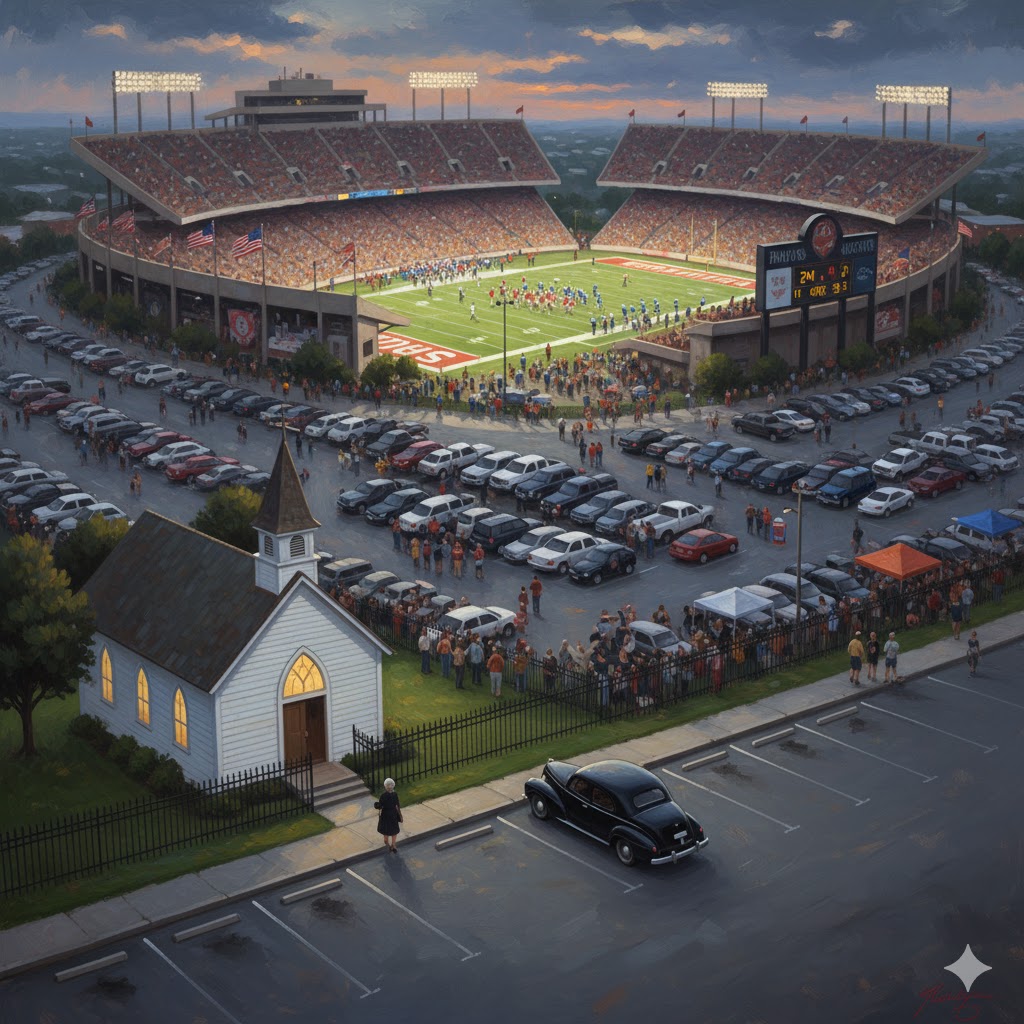
Alas, how far have we fallen from a right honoring of the Lord’s day in a land that was once “a city on a hill!” And how short is our collective memory of far better and holier days. But a simple search will bear witness. Our center of pleasure has shifted from the sacred to the secular, from God to games. The following is the Wikipedia entry for “Sunday sporting events.” Telling.

Sunday sporting events were not usually played until the early 20th century. In North America, they were prohibited due to blue laws at first, but then cities like ChicagoSt. Louis, and Cincinnati later decided to legalize them. Other cities such as New York City and Philadelphia had intense political and court battles to legalize the games. Nowadays, professional sports leagues schedule games on Sundays in the United States, though this practice continues to be opposed by some Christian denominations upholding first-day Sabbatarian doctrine.”

Read the rest here.

[Image courtesy of Google Gemini.]

Read Full Post »

An intriguing thought. I’ve frequently thought of how establishments, while nearly a thing of the past in the secular West, might yet be on the horizon in the East. Stranger things have happened. And, of course, there is that ‘little thing’ (!) of prophecy: “Yea, all kings shall fall down before him: all nations shall serve him” (Psalm 72:11). O, brethren, let us pray for this nation, and for any godly magistrates that He might raise up “for such a time as this!” Mark Noll in his New Shape of World Humanity: How American Experience (2010):

“But third, it is a different story where Christianity spreads in regions of economic strength, as especially in Chᴉna. In this rapidly strengthening Asian power, the systems of belief that once guided society are passing away. Before Maoism imploded, it badly damaged ancestral reliance on Confucian precepts. Christianity seems to be taking off in Chᴉna because more and more Chᴉnese seem to be seeking a new moral compass as Chᴉna itself makes a commanding entrance onto the world stage. David Jeffrey, the provost of Baylor University who for fifteen years has been regularly invited to lecture on Christian subjects at premier universities in Chᴉna, has asked a speculative question that should give foreign analysts pause. Once before, Jeffrey remarks, a great world power passed through tumultuous times as Christian ranks expanded on the margins of society. It was the late 3rd and early 4th centuries. In that turmoil the Emperor Constantine was converted and become, from the top of the imperial system, a supporter of Christianity as a new glue for empire. Is it impossible to imagine that a new Constantine might exist somewhere in the junior ranks of the Chᴉnese communist party?”

Read Full Post »

The following is a six-part series of articles by my father-in-law, Brian Myers, who is a long-standing elder in our Des Moines, Iowa congregation of the Presbyterian Reformed Church on the subject of the Scottish Covenanters, the Reformed Presbyterians, and political dissent. It really is an extremely helpful overview of the subject from the perspective of confessional Presbyterians today who accept the basic legitimacy of the Revolution Church of 1690, who oppose separation and schism, and who allow a legitimate place for voting in the modern democratic political order without the compromise of original Presbyterian principles. Well worth your time.

1. Political Dissent Part One: A Practice Searches For A Doctrine

2. Political Dissent Part Two: The Doctrine Articulated

3. Political Dissent Part Three: A Shift To A New Cause

4. Political Dissent Part Four: Change And Division

5. Political Dissent Part Five: The U.S. Constitution

6. Political Dissent Part Six: Conclusion

Read Full Post »

Birth rates are plummeting in the United States and globally, forecasting a political and financial crisis. The most recent estimate predicts the average American woman will have 1.6 children in her lifetime, far below the rate of 2.1 required to maintain a steady population and even further below the 2.5 rate observed in the United States as recently as 1970.

Many cultural and technological factors have contributed to this dramatic decline, and public policies play a role in shaping people’s decisions about whether to have children and how many. Finding the right policy levers for influencing fertility rates, however, has proven very difficult.

Read the rest of this article at The Federalist here.

Read Full Post »

Found this quite insightful. Disturbing, to be sure; but also enriching to see the manifold grace of God’s Son who came “to destroy the works of the Devil.”

Read Full Post »

Moses atop the U.S. Supreme Court (source)

Here’s a delightful old volume on Sabbath laws in the United States. As I skim through these, a few short observations. 1. We have collectively forgotten what was once a cultural norm. Hence the fitness of the imperative, “Remember the Sabbath day, to keep it holy.” 2. Freedom of thought, speech, and religion obviously had a big asterisk (at least from our 2024 context). Tolerance was clearly not a free-for-all for every pagan and libertine. 3. This gives the lie to the radical secular-sanitizing narratives of liberals who decry ‘Christian nationalism,’ as well as the hardcore R2K types like Daryl Hart who make strange bedfellows with the same.

A few samples from states in which I’ve lived:

(more…)

Read Full Post »

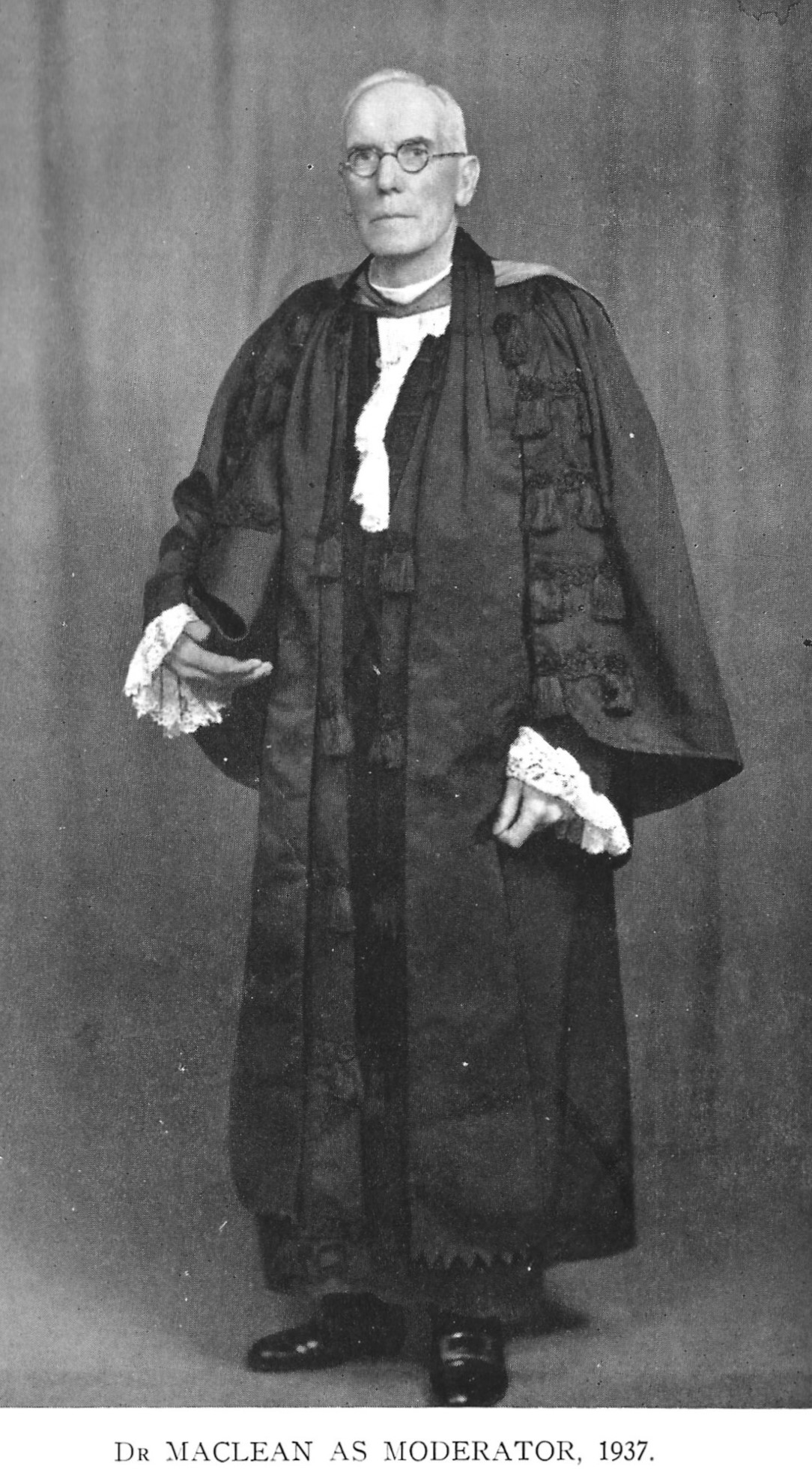
Just recently audio-recorded two articles by Free Church of Scotland Principal Donald Maclean (1869-1943). I have found several of the men of that generation not only profoundly rich theologically and spiritually, but that their English prose is also quite compelling. We are generally below the mark these days, I fear.

The following quote is a sample, from Maclean’s “An Evangelical Ministry.” Here, he answers the question as to the effect of Anglo-American Christianity’s emphasis on the social application of Christian around the turn of the 20th century: “The answer is sadly easy. The flood-tide to the Churches has, alas, not set in. The prejudices and hostility of sinful man have not been softened by the undoubted social amelioration effected. The heedless multitude still pass by. But even more serious is the reaction which the social application of Christianity has had upon the faith itself. Revealed truth itself cannot be affected by human reactions, for the Word of the Lord endures for ever. Nevertheless, the attempts to apply Christianity socially have profoundly affected the meaning which the Christian faith has for the average man and ordinary churchgoer. The emphasis on the social has largely stifled the spiritual nature of the faith. It has obscured the revealed fact that the Christian message was primarily to and for individuals. That the Son of God became man, and that man must be born again, are sufficiently strong reminders to us of the divine estimate of the immortal soul of man. The great doctrines of grace which the Bible so unmistakably connects with the redemption of the human personality, have been so rarely emphasised during more than a generation that, not only have these doctrines become unknown, but the spiritual faculties of hearers have been so weakened by disuse that spiritual discernment has faded away. The Church of to-day is consequently faced with the difficult but necessary task, arising from her former neglect, of re-educating her people in the fundamental elements of the faith which give it the character and distinction of being the Christian faith of revelation. For the business of the Church in its God-given mission is to the individual and through the individual to society. Moreover, the Christian revelation holds out no hope for society except in so far as the men and women who form it are Christian, which for the secular State is a futile and unattainable ideal. It is therefore all the more essential that the truth should be understood that a Christian society can only be fashioned out of and by Christian men and women.”

Special thanks to the Rev. John Keddie for assistance with photo above. More historic audio resources from the heritage of the Free Church of Scotland available here. All Thomas Chalmers titles are separate, here. And visit our entire audio library here.

Read Full Post »

A fallible, yet sturdy monument to far better times, when men feared God and kept His day. Lord, let your Wind blow once again!

Read Full Post »

Cancelled services this ‘Christmas’ should be more than enough proof. Proof that Christmas observance and faithfulness to the pure worship of the one true and living God are mutually exclusive. That Christmas will, at least in part, be the death of us. And that, barring an outpouring of the Holy Spirit and a massive reformational purge of all the inventions of men in the worship of God, the West will soon be a paganized, secular wasteland.

Christmas and Christianity have admittedly coexisted for the better part of Christendom, except of course for the great Puritanic ‘pause’ from the 16th to the 18th centuries in much of English-speaking Protestantism. But how can what is fundamentally “not of heaven, but of men” (Luke 20:4), of unarguably ancient heathen and syncretistic Roman Catholic origin, ever live in peace with the Gospel of God? “And what concord [alliance] hath Christ with Belial? . . . And what agreement hath the temple of God with idols” (2 Cor. 6:15-16)?

(more…)

Read Full Post »

​”The rise of sectarianism that has accompanied the Protestant movement is a dark and negative phenomenon. It manifested itself already at the beginning of the Reformation, but it has never flourished as it has in our age. New church after new church is established. In England there are already more than two hundred sects. In America they are innumerable. The differences have become so many and so insignificant that one cannot keep track of them. There are even voices arguing for a new discipline in theology itself devoted to the comparative history of church confessions. What is even more serious is that this sectarianism leads to the erosion and disappearance of church consciousness. There is no longer an awareness of the difference between the church and a voluntary association. The sense that separation from the church is a sin has all but disappeared. One leaves a church or joins it rather casually. When something or other in a church no longer satisfies us, we look for another without any pangs of conscience. The decisive factor turns out to be our taste. Exercise of discipline thus becomes virtually impossible; it loses its very character. What preacher is left who dares, in good conscience, except perhaps in extremely rare instances, to use the form for excommunication? The worst result of all this is that by breaking the unity of doctrine and the church, Christians do violence to the communion of saints, deprive themselves of the Spirit’s gifts of grace, by which  other believers labor to build up the saints, shut themselves up in their own circle, promote spiritual pride, strengthen Rome, and give the world occasion for scorn and mockery.”

-Herman Bavinck, “The Catholicity of Christianity and the Church”

Read Full Post »

Older Posts »