“He has dressed the whole Supper Himself, covered the table, and there is no more for us to do, but sit down and eat. If we look to this dressed Supper, Christ dressed it all Himself, in the furnace of God’s wrath, and the bread that we here eat is His flesh, which He gave for the life of the world. The wine, which is mingled and drawn is His blood. And, O, sirs, was not our Lord a hot man in making ready this Supper? Not one dish is mis-cooked, all is set before us in the gospel, and Jesus craves no more for all His pains, but only that His friends come to the banquet and eat and be merry; and if ye will come, Christ will pay all the reckoning. When the Israelites were fed with manna, they behoved to go out of the camp, and gather it themselves; but we furnish nothing of this Supper. God be thanked, Christ bears all the expense. Alas! alas! that the unhappy world will not eat heartily, since Christ pays for all. The poor sons of Adam were all sick and at the point of death, and their stomachs were so spoiled with a sour apple that Adam did eat, that they were famished and not able to eat. In comes Jesus and makes a medicinal dinner of His own flesh and blood; lays down Himself and is slain to make physic of His crucified body for us, in order to affect our cure. It is just they die for hunger, and lose their stomach for evermore, who loathe this meat. In the sacrament all things are ready; whatever the soul wants, it shall find at the Table. All the hungry shall find Christ meat and drink.”
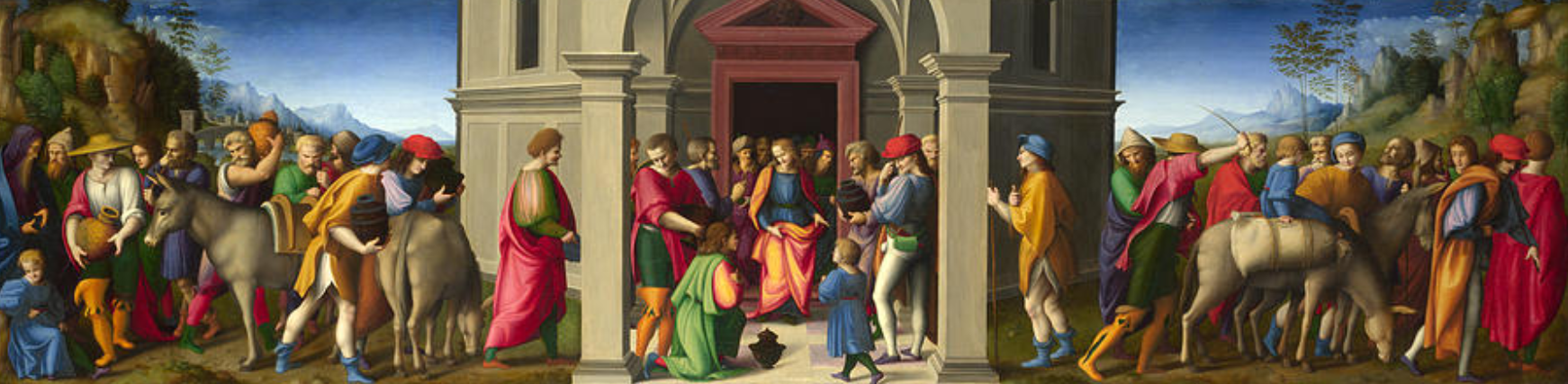
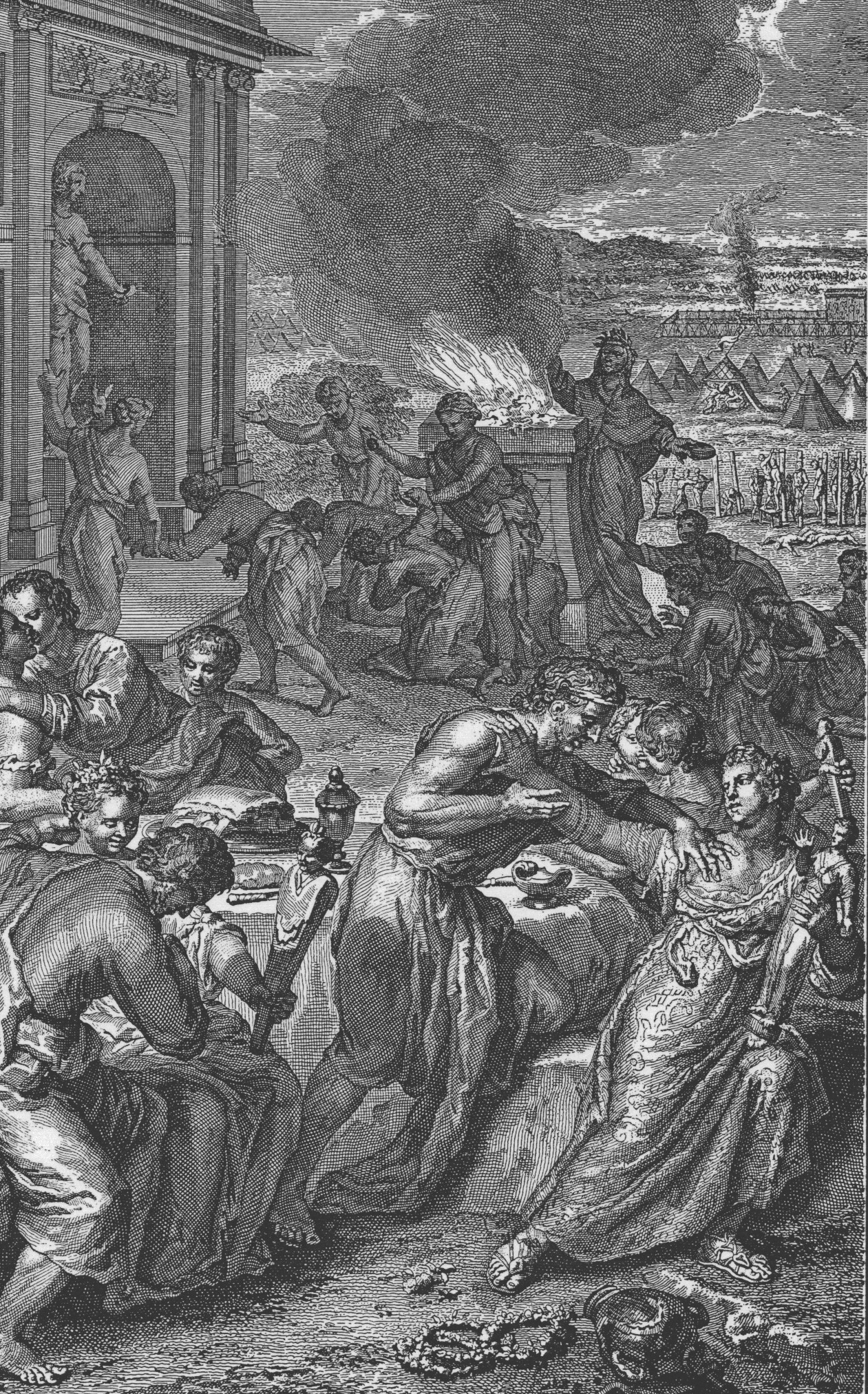
Joseph Receives His Brothers on their Second Visit to Egypt, a painting by Bacchiacca, ca. 1515.
The following are some passages from Scottish Presbyterian fathers on the Christological theme of our Lord’s mediatorial “stewardship.” Sublime:
“And if there be varieties of temperature of saints, some rough and stiff, some mild, some old men, and some babes, 1 John 2:13. And as there be some lambs, some fainting, weak and swooning tender things, that Christ feeds like kings’ sons, with wine of heaven: so there be others that are under the care of the steward Christ, who are heifers and young bullocks, like Ephraim not well broken yet, Jer.31:18, 19 and there be hoping and waiting saints, that must bear the yoke in their youth, Lam. 3:26, 27 and sundry kinds and sizes of children; every one must have their own portion and diet, 2 Tim.2:15; Mat. 24:45. One man’s meat is another’s poison, and yet they are both the sons of one Father.”
-Samuel Rutherford, Christ’s Dying and Drawing Sinners to Himself
“You have cause to hold up your heart in remembrance and hope of that fair long summer day, for in this night of your life, wherein you are in the body absent from the Lord, Christ’s fair moon-light in his word and sacraments, in prayer, feeling, and holy conference, hath shined upon you to let you see the way to the city. I confess our diet here is but sparing; we get but tastings of our Lord’s comforts; but the cause of that is not because our steward Jesus is a niggard, and narrow-hearted, but because our stomachs are weak, and we are narrow-hearted. But the great feast is coming, and the chambers of them made fair and wide to take in the great Lord Jesus . Come in, then, Lord Jesus to hungry souls gaping for thee!”
12. Adam brake the whole frame of heaven and earth: and to the Second ADAM the whole broken and marred lump of the Creation is promised, that he may be the repairer of the waste places. Isa. 49:8. I will preserve thee, and give thee for a Covenant of the people, to establish the earth, to cause to inherit the desolate heritages. Ps. 72:16. Under the reign of the Messiah, There shall be an handfull of corn upon the top of the mountains, the fruit thereof shall shake like Lebanon. Jer. 31:12. Therefore shall they come and sing in the height of Zion, and shall flow together for the goodness of the Lord (Christ) for wheat, and for wine, and for oil, and for the young of the flock, and of the herd.
1. The Lord made all things at the beginning very good, Gen. 1:31. Heaven, Earth, Sun, Moon, Beasts, Birds, &c. being all made servants to man, were in a manner fellow-Covenanters in their kind with man in the Covenant of Works: As a King covenants with a great Family, his servants and dependers have the benefit of the Kings Covenant peace, all obeyed Adam without jarring: but when Adam sinned, war between the Lord, and between the Master and the servants is denounced, the earth is cursed for his sake, Genes. 3:17, 18. and Lions and wild Beasts rise against him like loose boarders. But in the Covenant of Grace, Hos. 2:18, 19, 20. the beasts of the field, the fowls of the heaven, the Sun which shall not smite by day, nor the Moon by night, Ps. 121:6. are by the Surety of the Covenant brought in a new league: yea the stones of the field, Job 5:23. are compartners of the peace, and Christ the King takes off the forefaultry [forfeit, failure] upon all, and looses the arrestment of vanity that by sin was laid upon the Creation, which was made sick like a woman travelling in birth, Rom. 8:20, 21, 22. Hence are they blessed in Christ to the Saints, Deut. 28:4, 5; Levit. 26:4, 5, 6. and the Angels come in under their Head Christ, Col. 2:10. and serve the new restored heirs, Heb. 1:13. for their Heads sake.
2. God hath appointed Christ the Heir of all things, and, Heb. 1:2. hath given a Charter to Christ and put in bread, garments, houses and all to the Believer in Christ the first Heir: his great evidence is, 1 Cor. 3:21. All things are yours. 3. He makes all things new, Rev. 21:5. This Christ mends the broken gold ring which was broken by the first unattentive and rash Heir Adam; So that now Heavens, Earth, Mountains, Isai. 49:13. Sea, trees, fields, Psal. 96:11, 12, 13. are commanded to sing a Gospel Psalm of joy, because Christ the new King and Restorer of all is come to the Throne: yea let the stoods [stands of trees] clap their hands, Psal. 98:9. and he purposes to purge with fire the great Pest-house infected with sin and under bondage of corruption, Rom. 8:21; 2 Pet. 3:10, 11. that he may set up the new world in Gospel-beauty, the new heavens and the new earth, 2 Pet. 3:13; Isai. 65:17; Isai. 66:22; Rev. 21:1. Oh what a life to have a cottage and a little yard of herbs in that new World, and how base to be but Citizens of this World!
“Christ is a drawing and an uniting Spirit; then all that are in Christ should be united. Certainly the divisions now in Britain cannot be of God. The wolf and the good Shepherd are contrary in this; the good Shepherd loves to have the flock gathered in one, and to save them, that they may find pasture, and the flock may be saved: the wolf scatters the flock; or if the wolf would have the flock gathered together, it is that they may be destroyed. Then it would be considered, if a bloody intention of war between two protestant kingdoms, for carnal ends, and upon forced and groundless jealousies, be from an uniting Spirit, and not rather from him, who was a murderer from the beginning.”
For a good, one-chapter introduction to the historic Scottish Presbyterian views of visible Church union or ‘catholicity,’ have a listen to “Church Unity & the Sin of Schism,” by John Macpherson, in his Doctrine of the Church in Scottish Theology.
* * * *
Whole doctrine catholicity | “Who is she that looketh forth as the morning, fair as the moon, clear as the sun, and terrible as an army with banners” (Song 6:10)?
The following passage comes from Rutherford’s Trial and Triumph of Faith (1645), treating the story of Christ and the Syro-Phoenician woman. In it, he deals with a dimension of sin and repentance that often gets very short shrift in our individualistic age, and sadly even in the Church. Does this square with the contemporary Two Kingdoms approach?
* * *
THE dispute between Christ and the woman goeth on: Christ bringeth a strong reason, (verse 26,) why he should not heal her daughter; because she, and all her nation, not being in covenant with God, as are the Jews, the church of God, are but dogs, and profane, and unworthy of Christ, which is the bread ordained for the children.
When Christ humbleth, he may put us in remembrance of our nation, and national sins: “Look to the rock whence ye were hewn, and to the hole of the pit whence ye were digged,” (Isa. 51:1). “I alone called Abraham, he was an idolater,” (Hos. 9:10). I found Israel like grapes in the wilderness; they should have been wild grapes rotting in the wilderness, had I not put them in my basket. “Son of man, cause Jerusalem to know her abomination,” (Ezek. 16:2). How? Make them know the stock they came of, ‘And say, Thus saith the Lord unto Jerusalem, thy birth and thy nativity is of the land of Canaan; thy father was an Amorite, and thy mother an Hittite,’ (verse 3). When the Jew was to offer the first fruits to the Lord; “And thou shalt speak and say before the Lord thy God, A Syrian ready to perish was my father, and went down to Egypt to sojourn there,” (Deut. 26:5). Thus, the forgetting what we are by nature, addeth to our guiltiness: “And in all thine abominations, and thy whoredoms, thou hast not remembered the days of thy youth, when thou wast naked and bare, and wast polluted in thy blood,” (Ezek. 16:22). So the Ephesians must be told how unfit they were by nature for Christ, being the very workhouse and shop of the devil, in which he wrought, (Eph. 2:1-3).
National sins have influence in their guilt and contagion on believers: (1.) When they mourn not for them: God’s displeasure should be our sorrow. (2.) When they stand not in the gap to turn away wrath, (Ezek. 22:30). There were godly men that departed from ill, (Isa. 59), but God’s quarrel was, that there was no intercessor, (verse 15). In fasting, believers, though pardoned, may have on them a burden of the sins of three nations, and be involved in that same wrath with them. National repentance is required of every one, no less than personal repentance. Who sorrows for the blood of malignants and rebels?—for their oaths, mocking, scoffing, massing? The sins of the land, idolatry, superstitious days, vain ceremonies, etc., have influence on a believer’s conscience in his approach to God.
“It is our fault, that we look upon God’s ways and works by halves and pieces; and so, we see often nothing but the black side, and the dark part of the moon. We mistake all, when we look upon men’s works by parts; a house in the building, lying in an hundred pieces; here timber, here a rafter, there a spar, there a stone; in another place, half a window, in another place, the side of a door: there is no beauty, no face of a house here. Have patience a little, and see them all by art compacted together in order, and you will see a fair building. When a painter draweth the half of a man; the one side of his head, one eye, the left arm, shoulder, and leg, and hath not drawn the other side, nor filled up with colours all the members, parts, limbs, in its full proportion, it is not like a man. So do we look on God’s works by halves or parts . . . yet do we not see, that in this dispensation, the other half of God’s work makes it a fair piece.”
-Samuel Rutherford, The Trial and Triumph of Faith (1645)